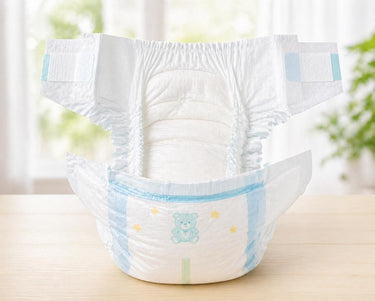
A pack of disposable diapers in the bathroom feels as natural today as wet wipes, bodysuits, and the changing table.
Diaper open, baby in, diaper closed. And after use, it goes into the trash.
Precisely because this has become so normal, its history is surprising: the modern disposable diaper hasn't been accompanying families for very long. Our grandparents or great-grandparents knew a completely different diapering routine – with cloth, safety pins, laundry, and significantly more direct contact with their babies' excretions.
The short answer: Precursors to the disposable diaper emerged in the 1940s. Marion Donovan and Valerie Hunter Gordon developed different solutions to make parents' lives easier. The big breakthrough ultimately came with Pampers, the product developed by Victor Mills and his team at Procter & Gamble, which hit stores in the USA in 1961. In Germany, Pampers were sold from 1973.
The history of the disposable diaper is therefore not just the history of a product. It also tells us how family life, care, and our approach to resources have changed.
How were babies cared for before disposable diapers?
Before disposable diapers became the standard, families primarily used reusable cloths and cloth diapers. These varied greatly depending on the time, region, and available materials.
In Western everyday life, they were often folded cloths made of cotton or linen. They were fastened with pins or later with clips, soaked after each use, washed, dried, and reused.
This was resource-efficient but not automatically easy. Without a modern washing machine, it meant:
- a lot of manual labor
- regular boiling and washing
- long drying times
- and constantly wet clothes or bedding
At the same time, the diaper was never the only way to manage a baby's excretions everywhere in the world. In many families and cultures, babies were also held over suitable places, or adults reacted immediately to their signals.
What we today call Elimination Communication or Diaper-Free is therefore not just a new trend. What's new is that we are bringing this ancient knowledge back into modern family life and combining it with modern backups.
Why were parents looking for a new solution?
Anyone who has washed several cloth diapers in a day can well understand why the idea of a more convenient solution was so appealing.
Parents didn't want to be less caring. They wanted less laundry, less leaking, and a little more time in an already busy daily routine.
The first inventions were therefore not a departure from closeness or need-orientation. They were answers to very practical questions:
- How can clothes stay dry longer?
- How can a diaper be fastened more easily?
- How can some of the laborious laundry be eliminated?
From these questions, several ideas emerged in the 1940s – not just in one place and not just by one person.
Who invented the disposable diaper?
There is no simple answer to this question. The modern disposable diaper was the result of several developmental steps.
Marion Donovan, Valerie Hunter Gordon, and Victor Mills shaped crucial stages. They did not work together but developed solutions to the same problem: making diapering easier and more reliable.
Marion Donovan and the waterproof diaper cover
The American Marion Donovan was a mother and knew the endless changes of cloth diapers, clothes, and bedding from her own daily life.
In the 1940s, she sewed a waterproof diaper cover from a shower curtain. Later, she used parachute nylon and further developed her idea: The cover should not only protect against wetness but also fit more comfortably than the rubber pants common at the time. Snap fasteners also replaced the sharp safety pins.
Donovan called her invention "The Boater". From 1949, it was sold at Saks Fifth Avenue, and in 1951, Donovan received her patent for the waterproof diaper cover.
The distinction is important: "The Boater" was not yet a complete disposable diaper. The outer cover was reused and held an absorbent insert inside.
But Donovan was already thinking further. She also worked on a fully disposable diaper made of absorbent paper. Manufacturers initially rejected her idea. It was only years later that this very principle became a mass-produced item.
Valerie Hunter Gordon and the disposable insert
At the same time, British mother Valerie Hunter Gordon developed another important precursor to the disposable diaper.
Her system, later known as "Paddi", combined a reusable waterproof cover with an absorbent insert that was disposed of after use.
Again, the goal was not to create a product with a short lifespan. The idea arose from the desire to simplify daily life with several small children.
Donovan and Hunter Gordon demonstrate something that is easily lost in brief accounts of inventions: the disposable diaper did not have a single origin. Several women developed new solutions from their own care work – long before major brands recognized the economic potential.
Victor Mills and the breakthrough of Pampers
The decisive step towards an industrial mass product was made in the 1950s by a team at Procter & Gamble led by chemical engineer Victor Mills.
Mills also knew cloth diapers from his family's daily life. As a grandfather, he sought a more convenient solution and began developing a fully disposable product in 1956.
In 1961, the first Pampers hit stores in the USA.
The new promise was as simple as it was effective:
After use, the diaper did not have to be washed.
What sounds self-evident today fundamentally changed the daily lives of many families.
When did the disposable diaper come to Germany?
In Germany, Pampers were launched in 1973. Two years later, Procter & Gamble opened a factory in Euskirchen.
However, the transition did not happen overnight in all families. Disposable diapers were initially more expensive than reusable cloth diapers, and many parents combined both systems.
Only gradually did the disposable diaper evolve from a special convenience product to a normal component of almost every baby's equipment.
Why did the disposable diaper become so popular so quickly?
Its advantages were immediately noticeable in family life:
- less diaper laundry
- easier diaper changes on the go
- less leakage
- faster changes
- a straightforward solution for childcare, travel, and nighttime
For many families, this was and still is a real relief. We should acknowledge this side of the story.
Parents don't use disposable diapers because they are indifferent to sustainability. They use them because life with a baby is intense, and a reliable solution simply feels good on some days.
How did the thick paper diaper become today's disposable diaper?
The first disposable diapers were significantly thicker and simpler in construction than today's models. Over the decades, fit, fasteners, absorbency, and leak protection have been continuously modified.
- In the 1970s, adhesive tapes increasingly replaced safety pins.
- Elastic leg cuffs improved fit and leak protection.
- New non-woven fabrics wicked liquid into the interior faster.
- Since the 1980s, superabsorbents have made diapers significantly thinner and more absorbent.
- Later additions included wetness indicators, pull-up diapers, and different fits.
Today, a disposable diaper is a complex composite product made of several precisely coordinated layers. We explain in detail what's inside in "What's in disposable diapers?".
You can read how the small polymer particles in the absorbent core can bind so much liquid in our article "Superabsorbents in diapers".
An invention also changes our perception of excretions
The disposable diaper not only changed washing. It also changed how close we are to a baby's excretions in everyday life.
A modern diaper absorbs a lot of liquid, binds it inside, and can feel dry on the outside for a long time. This is pleasant and practical. At the same time, it makes it easier to experience excretion as something that simply happens in the diaper and then disappears.
But babies don't excrete completely unnoticed or without body awareness. Many become restless beforehand, pause briefly, push, seek closeness, or wake up. Not every signal is clear – and parents don't have to recognize every one. But those who start to look sometimes discover small recurring moments.
That's where Elimination Communication begins: not with pressure and not with the demand to avoid every diaper, but with an offer.
From relief to environmental issue
The disposable diaper solved a major everyday problem. At the same time, a new one arose: Each diaper is used only once.
Over the entire diapering period, several thousand products accumulate. We show approximately how many there are in the article "How many diapers does a baby really use?".
With urine and feces, this can amount to several hundred kilograms of residual waste. You can find a comprehensible model calculation in "How much diaper waste does a baby really produce?".
In Germany, used disposable diapers are usually disposed of as residual waste and thermally treated. So they do not lie in a landfill for centuries as complete diapers. We explain why the frequently cited decomposition time of 300 to 500 years must nevertheless be considered in a differentiated way in "How long does a diaper take to decompose?".
Knowing these consequences should not cause a bad conscience. Rather, knowledge gives us the opportunity to make conscious decisions.
Do we therefore have to go back to the cloth diaper of yesteryear?
No. We don't have to reject the convenience of the present or romanticize our great-grandparents' diapering routine.
Today, families have more options than ever before:
- disposable diapers
- modern cloth diapers
- washable inserts
- reusable backups
- Elimination Communication
- and any practical combination thereof
Some families use cloth diapers at home and disposable diapers on the go. Others do EC with their baby after waking up and otherwise continue to use a backup. Still others don't change anything at first – except their perspective.
That, too, is a start.
What the history of the disposable diaper can show us today
The disposable diaper made many things easier for families. It relieved parents of laundry, created security on the go, and became something we hardly think about within a few decades.
Its history also shows: there was never only one way to care for a baby. Cloth, disposable inserts, disposable diapers, and EC existed side by side at different times and in different places.
Even today, we don't have to choose between convenience, closeness, and sustainability, as if only one of them could ever matter.
We are allowed to observe, try things out, and find our own way – with as much relief as necessary and as much change as feels good for our family.
If you want to learn about EC without all-or-nothing pressure, read our article "Part-time Diaper-Free: Why individual moments matter".
Our free EC starter guide will also practically accompany you to your first relaxed attempt.
And if you want a quick-opening, reusable backup for this, you'll find our wool EC diapers here.
Frequently asked questions about the history of the disposable diaper
Who invented the disposable diaper?
The modern disposable diaper cannot be attributed to a single person. In the 1940s, Marion Donovan developed a waterproof diaper cover and later worked on a disposable diaper made of absorbent paper. Valerie Hunter Gordon developed a system in the UK consisting of a reusable cover and a disposable insert. Victor Mills and his team at Procter & Gamble finally developed Pampers, which was sold as a complete disposable diaper from 1961.
When was the first disposable diaper invented?
Important precursors emerged in the 1940s. A single year for "the first disposable diaper" is difficult because early systems sometimes combined reusable covers with disposable inserts. The breakthrough of the complete disposable diaper as a mass product began with Pampers in 1961.
When did Pampers come to Germany?
Pampers entered the German market in 1973. In 1975, Procter & Gamble opened a Pampers factory in Euskirchen.
What was used before the disposable diaper?
Many families used folded and washable cloths made of cotton or linen, often together with a protective diaper cover. The materials and practices used varied depending on the time and region. Babies were and are also deliberately held over a suitable place in some families for elimination.
Since when have diapers contained superabsorbents?
Superabsorbent polymers became an important component of modern disposable diapers in the 1980s. They allowed for thinner diapers because they can bind large amounts of liquid and less pulp is needed.
Why did disposable diapers become so popular?
They saved families a large part of diaper laundry, were easy to use on the go, and offered reliable leak protection. With better fit, increasing absorbency, and growing availability, they gradually became the standard.
Is Elimination Communication a new trend?
No. Guiding babies without a constantly absorbent diaper or holding them over a suitable place for elimination has been known in many parts of the world for a long time. What is new is primarily the modern term and the possibility of flexibly combining EC with modern diapers or reusable backups.
Do I have to choose between disposable diapers and Diaper-Free?
No. Elimination Communication is not an all-or-nothing concept. You can do EC with your baby in individual suitable situations and otherwise use any form of backup that makes you feel secure.
Conclusion: The disposable diaper is young – and our path can be new
The disposable diaper has made many things easier for families. It relieved parents of laundry, created security on the go, and within a few decades became something we hardly think about.
Its history also shows: there was never only one way to care for a baby. Cloth, disposable inserts, disposable diapers, and EC coexisted at different times and in different places.
Even today, we don't have to choose between convenience, closeness, and sustainability, as if only one of them could ever matter.
We are allowed to observe, try things out, and find our own way – with as much relief as necessary and as much change as feels good for our family.
Sources and further information
- National Inventors Hall of Fame: Marion Donovan and the waterproof diaper cover
- National Museums Scotland: Objects and documents on Valerie Hunter Gordon's Paddi system
- Science Museum Group: Valerie Hunter Gordon as a pioneer of the disposable diaper
- Pampers: Company history from 1956 to today
- Pampers Germany: Market Launch in Germany