
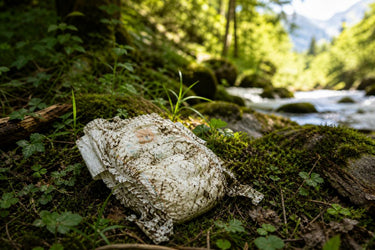
A used diaper is changed in a few seconds. Then it ends up in the diaper pail and disappears from our sight.
But what happens to it next? And is the often-repeated statement that a disposable diaper takes 300 to 500 years to decompose true?
The short answer: An exact decomposition time for disposable diapers cannot be reliably stated. Several hundred years is a frequently cited estimate for diapers stored in a landfill. A period of 300 or 500 years has not been directly measured. In Germany, the question is also different: Used disposable diapers belong in residual waste and are usually treated in a waste incineration plant.
This does not make disposable diapers environmentally neutral. However, it means that the well-known 500-year figure does not accurately describe the actual disposal method in Germany.
How long does it take for a diaper to decompose?
Those looking for the decomposition time of a disposable diaper usually find figures between 300 and 500 years. Scientific reviews also state periods of almost 500 years for complete decomposition under landfill conditions.
Nevertheless, this figure should not be understood like a measured countdown. Modern disposable diapers have only been widely used since the second half of the 20th century. Therefore, no common disposable diaper has yet been observed for several centuries.
The following classification is more reliable:
The natural components of a diaper can degrade under suitable conditions. However, the conventional plastics and superabsorbents they contain are not easily biodegradable and can persist for a very long time under landfill conditions.
Why there is no exact figure
How quickly a product decomposes does not depend solely on the material. The environment is also crucial.
- How much oxygen is present?
- How humid or dry is it?
- What are the temperatures?
- What microorganisms are present?
- Is the material exposed to light and weathering?
- How is the diaper constructed and what plastics does it contain?
Conditions in a densely packed landfill are different from those on a compost heap, in an industrial composting plant, or in nature. Low oxygen and light can also slow down decomposition.
Therefore, there is no single decomposition time that applies to every disposable diaper and every disposal location.
Decompose, disintegrate, and biodegrade: What's the difference?
The term "decompose" primarily applies to organic materials that are broken down by microorganisms. However, a disposable diaper is a composite product made of natural and synthetic components.
Three processes must be distinguished:
- Disintegrate: A material is broken down into ever smaller pieces.
- Biodegrade: Microorganisms convert a material under specific conditions.
- Completely decompose: The original material is not only reduced in size but largely converted into simpler substances.
Especially with plastics, this distinction is important. If a plastic becomes brittle and disintegrates into small particles, it is not automatically fully biodegraded.
Why disposable diapers can last so long
A modern disposable diaper must quickly absorb liquid, retain moisture inside, seal to the outside, and remain soft and flexible. Various materials are firmly bonded together for this purpose.
- Cellulose absorbs liquid and distributes it in the absorbent core.
- Superabsorbents bind large amounts of liquid in a gel-like structure.
- Polyethylene and polypropylene are used for films and nonwovens, among other things.
- Elastic materials, adhesives, and closures ensure fit and leak protection.
Some of these components are of organic origin, others consist of durable polymers. The firm bonding of the materials also complicates their separation and recycling.
You can find more about the construction in "What's in disposable diapers?" We also explain how the absorbent core binds liquid in the article "Superabsorbents in diapers".
What happens to used diapers in Germany?
In Germany, used disposable diapers belong in the residual waste bin. They must not be placed in the organic waste bin, waste paper, recycling collection, or toilet.
The German Environment Agency describes the disposal of disposable diapers as predominantly organized via residual waste. Diapers are often thermally recovered along with this residual waste, i.e., treated by incineration.
For Germany, an important difference to many international representations must be noted: Since 2005, untreated municipal waste may no longer simply be deposited in landfills. The German Environment Agency therefore assumes that disposable diapers in this country are disposed of in waste incineration plants. This can generate electricity and heat.
A diaper that is incinerated does not lie in a landfill for 300 or 500 years. Therefore, it is incorrect to directly transfer the theoretical decomposition time of a landfilled diaper to every diaper disposed of in Germany.
Does a diaper completely disappear during incineration?
The diaper does not remain as a complete product after thermal treatment. However, this does not mean that it "disappears" without environmental impact.
For every disposable diaper, raw materials must first be extracted, processed, manufactured into individual components, and transported. After only one use, these materials are removed from the product cycle.
During incineration, part of the contained energy is used. At the same time, emissions and solid residues are generated, which must be further treated or deposited. Thermal recovery therefore does not replace the circular economy of the original materials.
Life cycle assessments also show: Not only disposal matters. The production of the components also contributes significantly to the environmental impacts of a disposable diaper.
Are disposable diapers recycled?
In the normal German disposal system, used disposable diapers are currently not materially recycled. There are several reasons for this:
- The diaper consists of tightly bound different materials.
- It contains urine and sometimes feces.
- The components would have to be hygienized, separated, and cleaned.
- Economic recovery requires separate collection of large quantities.
Technical processes for the recovery of cellulose, plastics, and superabsorbents are being researched and some are being tested in pilot projects. However, they are not yet a regular disposal method for diapers from German private households.
Are eco or organic diapers more rapidly degradable?
Terms like "eco," "organic," "plant-based," or "with renewable raw materials" do not automatically mean that a complete diaper is compostable.
Even disposable diapers with bio-based components can contain conventional plastics, superabsorbents, adhesives, or elastic components. Furthermore, "bio-based" is not the same as "biodegradable": a material can be made from renewable raw materials and still not be degradable under normal environmental conditions.
Conversely, many materials described as compostable require precisely defined conditions, which can only be achieved in industrial facilities. Used diapers also contain human excretions and are normally not accepted as organic waste by municipal composting plants.
Therefore, eco-disposable diapers also generally belong in residual waste, unless the local waste disposal company explicitly specifies another method.
Why decomposition time is still an important question
Even if the 500-year figure does not describe the actual disposal method for Germany, the question makes something essential visible:
A disposable diaper is manufactured for a few hours and then disposed of. However, its materials, production, and treatment have impacts that extend far beyond this short period of use.
Added to this is the quantity. Throughout the entire diaper period, not just individual, but several thousand disposable diapers are used. According to the German Environment Agency's model assumptions, this can result in approximately 410 to 550 kilograms of used diapers per child in 2.5 years.
You can find the exact calculation in the article "How much diaper waste does a baby really cause?".
How to reduce diaper waste?
Less disposable waste doesn't have to be a radical all-or-nothing decision. Families can use and combine different solutions.
Use cloth diapers or washable inserts
Reusable products are washed after use and used again. This significantly reduces the number of individual products that need to be disposed of. Their environmental footprint depends, among other things, on how they are washed and dried, how long they are used, and whether they are later passed on to siblings or other families.
Combine disposable and reusable solutions
Some families use washable solutions at home and disposable diapers on the go or at night. A mixed system can also reduce the number of disposable products without changing the entire daily routine at once.
Practice elimination communication (EC)
With elimination communication (EC), the baby is given the opportunity to eliminate outside the diaper, for example over a potty or toilet.
If a disposable diaper remains clean and dry and can be reused, a waste product is avoided. Not every EC moment automatically saves an entire diaper. But individual saved diapers can add up over weeks and months.
EC does not mean completely avoiding diapers. Many families use a backup and only practice EC in situations that suit them well. You can find out more about this in "Part-time EC: Why even individual moments count".
Why wool can be useful in a reusable system
At Mata Origin, we use wool for reusable EC diapers and clothing that can be opened quickly. Wool is breathable, temperature-regulating, and can be used repeatedly with proper care.
An EC diaper made of wool does not automatically make your everyday life waste-free. However, it can be part of a system in which washable inserts, a reusable backup, and EC are combined.
We explain why wool is particularly suitable for this on our page "Why wool is ideal for EC".
Would you like to try out EC without obligation first?
Our free EC starter guide will accompany you to a first attempt. You don't have to completely give up diapers or recognize every signal from your baby.
If you would like a reusable and quick-to-open backup, you will find our wool EC diapers here.
Frequently asked questions about the decomposition time of diapers
Does a disposable diaper really take 500 years to decompose?
Approximately 500 years is a frequently cited estimate for complete decomposition under landfill conditions. It is not a directly measured value applicable to every diaper. Material composition and environmental conditions significantly influence degradation.
Why can decomposition take so long?
Disposable diapers contain not only cellulose but also plastics, superabsorbents, elastic materials, and adhesives. Especially the synthetic polymers are not easily biodegradable. In landfills, low light, low oxygen, and other conditions can further slow down decomposition.
Does a diaper even decompose in Germany?
Not for centuries in a landfill under the usual German disposal method. Used diapers go into residual waste and are usually thermally treated. The question of decomposition time therefore primarily concerns a hypothetical or internationally landfilled diaper.
What waste bin do used diapers belong in?
In Germany, used disposable diapers belong in residual waste. They must not be disposed of in the organic waste bin, waste paper, recycling collection, or via the toilet.
Can disposable diapers be composted?
Conventional disposable diapers do not belong on the garden compost and usually not in the organic waste bin either. Even products with bio-based or advertised as degradable components are not automatically compostable as a complete used diaper.
Are organic diapers completely biodegradable?
Not automatically. A diaper can contain renewable or certified raw materials and still have synthetic, non-compostable components. The complete material composition, suitable certification, and the disposal method specified by the local waste disposal company are decisive.
Is waste incineration a sustainable solution?
Incineration means the diaper does not remain as a complete product for centuries, and part of the energy can be used. However, the raw materials used are lost after a single use. In addition, emissions and residues are generated. Waste prevention and genuine reuse therefore start earlier in the life cycle.
Do I have to completely give up disposable diapers?
No. Cloth diapers, washable inserts, EC, and disposable diapers can be combined. A solution is only sensible in the long term if it suits your baby and your family's everyday life.
Conclusion: 500 years is an estimate, not a measured countdown
The statement that a disposable diaper takes 300 to 500 years to decompose is highly simplified. Several hundred years is a plausible and frequently cited order of magnitude for durable diaper components under landfill conditions. However, there is no exact measured value that applies to all diapers.
For families in Germany, it is particularly important: Used disposable diapers belong in residual waste and are usually incinerated. Therefore, they do not lie for centuries as a complete diaper in a German landfill.
This does not eliminate the ecological question. Thousands of disposable products require raw materials, are transported, and are disposed of after short use. Those who want to change something about this do not have to start perfectly or radically.
Every permanently avoided disposable diaper saves a product. Whether through reusables, EC, or a combination: The decisive factor is a method that works in real family life.
Sources and further information
- German Environment Agency: Blue Angel Ecolabel for Disposable Diapers – Background Report
- German Environment Agency: Evaluation of the collection and recovery of selected waste streams – Diapers chapter
- Khoo et al.: Recent technologies for treatment and recycling of used disposable baby diapers


