
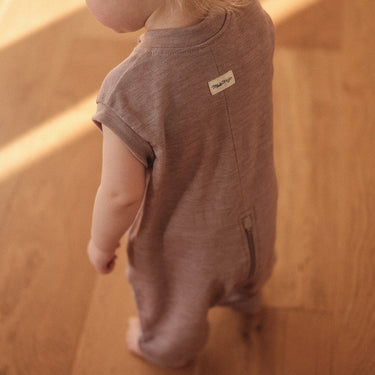
The underestimated solution for warm days
Wool in summer sounds wrong at first. When it gets warm, most parents automatically think of light cotton or as little clothing as possible.
Many associate wool with winter, thick sweaters, and cold. But this is precisely where a misunderstanding lies.
High-quality merino wool is one of the best materials your baby can wear in summer.
Wool in summer - the advantages
- temperature-regulating
- breathable
- absorbs moisture
- stays dry on the skin
Why babies need special support in summer
Babies cannot yet reliably regulate their body temperature themselves.
This means:
- They overheat faster
- They cool down faster
- They react sensitively to temperature changes
Especially in summer, when it's warm during the day and cooler in the evening, the body needs support.
What good summer clothing for babies must do
For your baby to feel comfortable, clothing should be able to do more than just be light.
Important properties are:
- Temperature regulation
- Breathability
- Moisture regulation
- Skin-friendliness
This is exactly where wool plays to its strengths.
How wool regulates temperature
Merino wool has a special ability.
It adapts to the environment.
When it's warm, it has a cooling effect.
When it gets cooler, it retains warmth.
This works because the fiber:
- stores air
- can absorb moisture
- remains breathable at the same time
Your baby's temperature therefore remains much more stable.
No clammy feeling on the skin
A major advantage of wool is how it handles moisture.
Unlike cotton, wool can absorb moisture without feeling wet.
This means:
- less sweating on the skin
- no chilling due to moisture
- overall more well-being
Especially on warm days, this makes a noticeable difference.
Why cotton is often not the best choice
Cotton is often seen as the standard for baby clothing.
However, it has disadvantages in summer:
- It stores moisture
- It quickly feels clammy
- It cools the body when wet
If you want to understand the differences in detail, it's worth taking a look at our comparison of baby clothing in summer.
If you want to understand the differences in more detail, you can find a direct comparison between wool and cotton for babies in summer here.
Wool is also suitable for sensitive skin
Many parents are concerned that wool might scratch.
However, modern merino wool is:
- very soft
- skin-friendly
- also suitable for sensitive baby skin
In combination with high-quality fibers, a material is created that is particularly comfortable to wear.
Wool and movement in everyday life
Babies move a lot and often unpredictably.
That's why it's important for clothing to react flexibly.
Wool supports exactly that:
- it adapts to movements
- it remains dimensionally stable
- it works in various situations
This makes everyday life much more relaxed.
Especially practical for elimination communication families
If you're dealing with elimination communication, clothing plays an even bigger role.
It should be:
- easy to open
- flexible
- not additionally stress your baby
Wool supports this approach because it balances temperature and moisture, keeping your baby calmer.
If you want to delve deeper, you can find more on the topic of elimination communication in summer here.
Less changing, more calm
An often underestimated advantage is its suitability for everyday use.
With the right clothing, you have to change your baby less often.
This means:
- fewer interruptions
- more calm
- less stress for you and your baby
Especially in summer, when many things are more restless anyway, this makes a big difference.
Wool is a summer material
Wool is not just for winter.
It is one of the few materials that actively supports your baby.
In summer, it ensures that your baby:
- does not overheat
- does not get cold
- feels generally more comfortable
If you want to try it right away
If you want to see how light wool feels in everyday life:
Our summer collection combines fine merino wool and modern materials like Tencel with well-designed cuts for babies.
This makes it easier to dress your baby appropriately for the temperature.


