
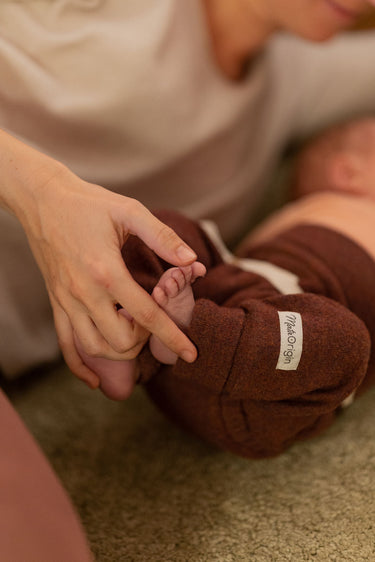
Nighttime Elimination Communication – how to make nightly EC relaxed and practical
For many parents, nighttime Elimination Communication (EC) is initially a big question mark.
Perhaps you're wondering:
- Do I have to wake my baby for this at night?
- How do I even recognize signals during sleep?
- Am I not too tired for this?
The good news:
Nighttime EC doesn't have to be perfect.
It's not about "catching" every elimination.
It's about:
- Sensitivity
- Connection
- Comfort
- As peaceful nights as possible
And often it works surprisingly gently.
Does nighttime EC really work?
Yes.
Many babies also show signals at night when they need to eliminate.
With a calm routine and as few stimuli as possible, you can often do EC with your baby at night without significantly disturbing their sleep.
How does nighttime EC work?
During nighttime EC, you react to your baby's signals – often while they are half-asleep.
You briefly hold your baby over a potty and then put them straight back down.
Important points:
- little light
- calm movements
- no unnecessary stimuli
Many families develop a very natural routine over time.
Why do EC at night?
Many babies also need to eliminate at night.
If they lie in a full diaper or feel pressure, they often become:
- restless
- wake up more frequently
- find it harder to fall back asleep
Many parents therefore report:
After EC, everyone sleeps more peacefully.
Particularly sensitive babies often react strongly to:
- wetness
- pressure
- temperature changes
There isn't just one right way
Nighttime EC can look very different.
For example:
- only doing EC during nighttime breastfeeding
- only during certain phases
- a mix of diapering and EC
- completely diaper-free at night
The important thing is:
Find your own way.
You can always make new decisions.
How babies signal at night
Babies also send subtle signals when half-asleep.
Often much gentler than during the day.
Typical signs are:
- Restlessness
- Tossing and turning
- Pulling legs up
- Brief waking
- Small sounds
- Sucking without hunger
Many parents eventually feel intuitively:
"Something is different right now."
And it is precisely from this that a calm nighttime routine often develops.
A signal sound like "psss" also helps many babies with orientation.
The right setup makes a huge difference
The simpler everything runs at night, the more relaxed sleep remains.
Helpful things include:
- a small potty directly by the bed
- a gentle nightlight
- easy-to-grab clothing
- a simple routine
Particularly practical are:
The more uncomplicated your setup, the easier nighttime EC often becomes.
How often to do EC at night?
That is individual.
Some babies need to go:
- one to two times
- several times
- sometimes not at all
Many families start very gently:
- only once per night
- only during breastfeeding
- only in the morning after waking up
And "sometimes yes, sometimes no" is perfectly okay.
Many parents also like to use a nighttime EC diaper at night, which can be opened quickly and still keeps them warm.
What to do if it doesn't work at night?
Then that's perfectly okay.
There are nights:
- with a lot of tiredness
- with wet beds
- with little energy
EC is not a performance program.
You are allowed to:
- take breaks
- use diapers
- use backups
- find your own rhythm
Many families use at night:
- washable inserts
- hybrid solutions
- part-time EC
And that is perfectly legitimate.
What helps many families emotionally
Many parents report:
It's not just about staying dry at night.
But about:
- Closeness
- Connection
- Trust
- Mutual awareness
Even if not every night runs "perfectly."
The 5 most important tips for nighttime EC
- react to signals instead of actively waking
- keep everything calm and dark
- develop a simple routine
- use clothing that can be easily opened
- take the pressure off and stay flexible
Clothing makes a big difference at night
Especially at night, it's important that your baby:
- doesn't overheat
- doesn't get cold
- can move freely
Clothing that:
- can be easily opened
- regulates temperature
- stays soft
- is breathable
often makes nighttime EC significantly easier.
Products from Mata Origin were developed precisely for this.
Conclusion
Nighttime EC doesn't have to be complicated or strenuous.
With:
- calm processes
- simple clothing
- less pressure
- a suitable setup
nighttime EC can become surprisingly gentle and practical.
Not perfect.
But often much more relaxed than expected.
And sometimes something very beautiful emerges there:
a quiet moment of connection – in the middle of the night.


