
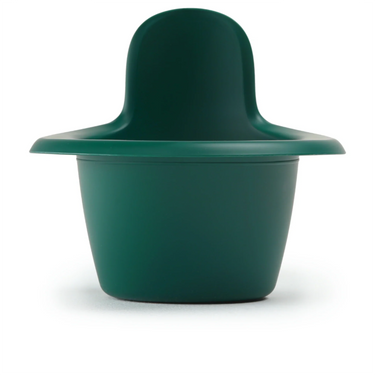
The transition from elimination communication (EC) to independent potty use is not a sudden switch, but a gradual handover: Initially, you perceive your baby's excretions and physically support them. Later, your child increasingly takes over individual steps themselves.
Perhaps your child is getting heavier, no longer wants to be held over the sink or toilet, or curiously sits on a potty. Maybe they say "pee," pull at their pants, or only go to the toilet after excreting. Then the question quickly arises: How does familiar EC transition into independent toilet use?
The most important answer is: You don't have to end EC one day and replace it with traditional potty training. You can gradually change your support. Carried EC becomes supported sitting. Your offering increasingly becomes their own decision. A signal you interpret becomes a communication from your child – sometimes with words, sometimes through a gesture or action.
There's no fixed timetable or guarantee that an early EC-ed child will become fully potty trained particularly early. Body awareness, bladder and bowel control, motor skills, language, and independence do not develop at the same pace. This article shows you how to guide the transition practically and without pressure.
From EC to Potty: The Short Answer
Don't change everything at once. Observe which part of the toilet process your child currently wants to take over themselves, and only help with the steps they are not yet confident with.
A possible transition looks like this:
- Your child is held over a suitable place.
- They sit on a stable potty with your support.
- They sit down themselves while you open their clothes.
- They participate in pulling down and pulling up their pants.
- They communicate their need or go to the potty themselves with a reminder.
- They begin to take over individual hygiene steps.
- They increasingly manage toilet use independently and ask for help when needed.
This sequence is not a checklist. Some children can climb onto the potty early but only report peeing while doing so. Others clearly vocalize their need but require long-term help with clothes or hygiene. Independence grows in partial skills.
Why Elimination Communication and Independent Toilet Use Are Not the Same Thing
With EC, the caregiver takes on a large part of the process. They anticipate an appropriate time, open the clothes, bring the child to a suitable place, hold or support them, and then clean them up.
Independent toilet use involves significantly more:
- noticing a sensation from the bladder or bowel,
- interpreting it as a need to eliminate,
- interrupting an ongoing activity,
- reaching the potty or toilet in time,
- opening and pulling down clothes,
- sitting securely and relaxing,
- cleaning oneself afterwards,
- pulling clothes back up,
- flushing and washing hands.
A child may master some of these steps and still be completely dependent on you for others. Therefore, pee in the potty alone is not proof that they can manage without support. Conversely, a wet pair of pants is not a sign that the previous path was fruitless.
The German Federal Institute for Public Health describes personal bowel and bladder control primarily as a maturation process with large individual differences. Early, constant placement on the potty does not automatically accelerate this process. EC and elimination communication should therefore not be understood as a method by which continence is established at a fixed time.
Diaper-Free and Potty Training: What Children Can Bring from EC
A child familiar with EC may already be familiar with some elements:
- Eliminations are allowed to take place outside of a diaper.
- Pee and bowel movements are accompanied by words, sounds, or gestures.
- There are specific places and body postures for elimination.
- Caregivers react to body signals and transition moments.
- A wet or soiled backup is changed promptly.
This familiarity can practically facilitate the next step. However, it does not prove that the child can reliably consciously control their bladder, hold an urge for a long time, or announce every toilet trip in time. The growing self-control of the bladder and bowel is also referred to as elimination autonomy.
Previous research on early assisted toileting is too limited to make reliable statements about long-term benefits or an ideal process. A recent research review found various possible associations with bladder and bowel health, but generally assessed the available studies as heterogeneous and prone to bias. For your family, this means: observe your child instead of trying to derive a result from EC.
How You Know Your Child Wants to Take on More Themselves
There isn't one single sign that tells you it's time to switch from EC to the potty. Often, several small changes indicate that a new form of support might be more appropriate.
Your child:
- no longer wants to be carried or held in the previous position,
- can sit stably and relaxed on a potty,
- is interested in the toilet, potty, or others' toilet use,
- gets the potty or walks towards the bathroom,
- shows a recurring word or sign before, during, or after elimination,
- wants to open or pull down clothes themselves,
- points to a wet or soiled backup,
- interrupts their play or withdraws for a bowel movement,
- wants to be without a backup or in underwear temporarily,
- clearly says "No" to an EC moment you suggest.
Not all signs need to be present. Even a "No" to the previous EC position can be a developmental signal: Perhaps your child wants more floor contact, a different position, or to decide for themselves when to sit.
If signals change in toddlerhood, you'll find more examples in the article "Recognizing Elimination Signals from 16 Months: When Children More Consciously Show They Need to Go". The observations there are possibilities, not prerequisites for the next step.
The Ladder to Independence: Eight Skills Instead of One Big Goal
"Going to the toilet independently" is a very big undertaking for a toddler. It becomes more manageable if you break it down into individual skills. Then you can provide support exactly where it's needed, without taking over the entire process.
1. Getting to Know a Familiar Place
Place the potty in an easily accessible, fixed location. Your child can look at it, touch it, and initially sit on it fully clothed. Explain in simple words what it's for. You don't have to wait for an elimination after every trial sit.
If your child prefers to use the toilet directly, a tip-proof child seat and a stable stool are important. The environment should be designed so that your child doesn't feel like they're falling into a large opening.
2. Sitting Securely and Relaxed
A child can only become more independent when the position is physically secure. On the potty, their feet should have firm contact with the floor. On the toilet, they generally need a stool on which both feet can stand stably, as well as a suitable toilet seat reducer.
A stable position helps the child to relax instead of having to hold on with their legs. For bowel movements, a posture with well-supported feet is particularly helpful. If your child remains tense, wants to stand up immediately, or the seat seems insecure, first change the equipment – not the expectation.
3. Connecting Body Sensations with Words
With EC, you may have primarily read the child's signals. Now you can help them interpret their own sensations:
- "You paused for a moment. Do you feel something in your tummy?"
- "Your pee is coming. This is what it feels like."
- "The pants got wet. Your body made pee."
- "You're pushing. Maybe your poop wants to come out."
Speak descriptively, not interrogatively. You cannot know for sure what your child is feeling in their body. Sentences like "You have to go!" or "I know for sure you have to go" override their perception and can easily turn the situation into a power struggle.
4. Developing Your Own Signal
A signal doesn't have to be a complete sentence. A word, a sound, a hand gesture, getting the potty, or walking to the bathroom door can be enough.
React even if the communication comes during or after elimination. "Pee" after wet pants is not a too-late signal without value. Your child has noticed a physical experience and associated it with a meaning. The time lag can change later.
5. Handling Clothes Independently
Timely opening of clothes is often more difficult than sitting on the potty. Practice this step outside of urgent situations. Your child can initially take over the last part when getting dressed: You pull the pants down to the knees, they push them further down themselves. Later, you reduce your help.
Suitable clothing is:
- has a soft, easy-to-grasp waistband,
- manages without complicated buttons, belts, or dungaree straps,
- is not too tight over the hips and thighs,
- consists of few layers,
- can be quickly opened even by small hands.
Our EC pants are designed for quick access during elimination communication. However, in the transition to full independence, it is crucial whether your child can already operate the specific fastener themselves. What is quick for adults is not automatically independently usable for a toddler.
6. Getting to the Potty Independently
The potty should be reachable without your child first having to open a door, find an adult, or navigate stairs. Observe especially during engrossed play: Some children notice the urge but cannot yet make it to the toilet in time.
Reminders can help at first. Frame them as guidance rather than constant control:
"We're going outside soon. Would you like to check if pee wants to come out beforehand?"
Less helpful is the repeated question every minute: "Do you have to? Are you sure? Just try." Frequent questioning can lead the child away from their own perception and create pressure.
7. Gradually Taking Over Cleaning
Independent wiping often develops later than going to the potty. Show the individual steps, remain available, and check or help as long as it is hygienically necessary. Many children still need support, especially after a bowel movement.
Use an understandable sequence: wipe, dispose of paper, put on clothes, flush, wash hands with soap and dry them. A small picture chart can help if language alone is not yet sufficient.
8. Asking for Help Independently
Complete independence does not mean never needing help. An important developmental step is also the phrase or sign: "Help me." Your child may go to the potty themselves and then call you to wipe. They may open their pants, but need assistance pulling them up.
Help as much as necessary and as little as possible – without turning an everyday situation into a test.
How to Change Your Role During the Transition
With EC, you are often the person who initiates the process. On the path to independence, your role shifts in several small steps.
From Interpreting to Joint Observation
Instead of "You have to pee," you can say: "You just became very quiet. Shall we see together what your body is saying?" This way, you share an observation without dictating the outcome.
From Carrying to Securing
You no longer automatically lift your child into the EC position, but instead provide the potty, perhaps initially offering a hand for stabilization, and letting them get up themselves.
From Complete Undressing to Partial Assistance
You open the first tricky fastener, your child pulls their pants down further. Or you only verbalize the sequence while they act.
From Reminding to Waiting
Initially, you use familiar anchor moments, such as after waking up or before going out. With increasing confidence, you more often wait to see if your child starts independently. It's still okay for accidents to happen.
From Praising the Outcome to Acknowledging the Step
Instead of just celebrating pee in the potty, you can name the action itself:
- "You noticed that you had to pee."
- "You pulled your pants down yourself."
- "You told me you needed help."
- "You didn't want to sit and got up again."
In this way, a "no" remains a valid communication and not the opposite of a success.
Potty or Toilet: Which is Better for the Transition?
Both are possible. The Federal Institute for Public Health recommends considering the child's preference and ensuring safety and comfort with both options.
The Potty
A potty is low, easy to reach, and usually allows for firm foot contact. Many children can sit on it and get up again early on. It can be placed where a long trip to the bathroom would still be difficult.
The disadvantage: The contents must then be disposed of and the potty cleaned. Furthermore, another transition to the toilet may follow later.
The Toilet with Seat and Stool
The toilet is already part of later daily routines. However, a suitable attachment and a stable stool are not minor considerations. The child must be able to get up themselves, sit securely, and support both feet.
Some children don't like the flushing sound or the large opening. In such cases, a potty can temporarily provide more security. There is no pedagogical advantage in forcing the toilet against the child's resistance.
The best solution is the one on which your child can sit safely, relaxed, and voluntarily.
What to Do if Your Child Suddenly Doesn't Want to Be Held for EC Anymore?
Especially mobile toddlers sometimes resist a position that previously worked well. This could mean they don't need to go. But it could also mean: I want to stand, go myself, sit differently, or not interrupt my play.
End the offering if there is clear resistance. Afterwards, you can calmly try:
- the potty instead of the carried EC position,
- more time for independent sitting,
- an invitation instead of physical guidance,
- easier clothing access,
- fewer offerings and more observation,
- a temporary break with a reliable backup.
An EC strike does not have to be "overcome." Often, it shows that the previous routine no longer fits the current development. You can find more about this in "EC Strike: Why Babies Suddenly Stop Cooperating".
How Often Should You Remind Your Child to Use the Potty?
There is no single number that suits every child. Familiar transition moments can still be helpful, for example:
- after waking up,
- before leaving the house,
- after coming home,
- before sleeping,
- if you observe a recurring signal.
A reminder becomes problematic if it turns into nagging or your child has little opportunity to perceive and decide for themselves. If they reliably say no and a short time later their pants are wet, that's not proof of defiance. Perhaps they haven't recognized the body's urge in time, didn't want to interrupt their play, or couldn't yet estimate the time it would take to get to the toilet.
Describe the process neutrally: "The pee went into your pants. We'll put on something dry." Later, you can discuss together: "Where should the potty be so you can reach it faster?"
Backup, Underwear, or Nothing at All: Choosing the Right Protection
The transition to independent toileting doesn't mean that every backup disappears overnight. At the same time, a child may be less immediately aware of certain bodily sensations in a highly absorbent diaper than in a thin liner or underwear.
The right solution depends on the situation and the child:
- A reliable backup provides relief when traveling, during illness, in long care situations, or when there's little capacity available.
- A thin absorbent liner can catch minor accidents and, depending on the model, is easier to handle like underwear.
- Underwear allows for more independence but hardly absorbs any liquid.
- Short periods without underwear at home can facilitate access, but are not a necessary method.
Don't switch to a solution that overwhelms you out of fear of a "setback." A backup doesn't erase an ability and doesn't end elimination communication. We explain this in more detail in "Elimination Communication with Backup".
It's important that your child isn't blamed for the protective solution. Phrases like "You're a big kid now, why do you still need a diaper?" associate support with shame. Better to say: "Today we're taking a long train ride. We'll bring a backup, and you can still let us know."
Why Pee, Poop, Day, and Night Are Separate Developments
A child might reliably poop in the potty but often miss peeing. They might go by themselves at home but need help at daycare. They might stay dry for long periods during the day but still need a backup at night.
These differences are normal. Nocturnal bladder control often develops later than daytime control. While regularly taking a sleeping child to the toilet at night might keep the bed dry, according to the Federal Institute for Public Health, it doesn't generally accelerate nocturnal dryness.
Therefore, don't label the journey with a single tag like "dry" or "not dry." It's more precise to say:
- "She usually signals when she needs to poop."
- "At home, he goes to the potty with a reminder."
- "When she's playing, she often notices she needs to pee late."
- "At night, we still use a backup."
This way, you can see where independence is already growing and where your child still needs support.
Accidents, Breaks, and Apparent Setbacks
The transition rarely proceeds linearly. Illness, travel, a developmental leap, a new sibling, starting daycare, unfamiliar toilets, or particularly engrossing play can lead to a child wetting themselves more frequently again or requiring more help.
React practically first:
- Help your child get dry and clean.
- Avoid accusations, ridicule, and comparisons.
- Check if the toilet or potty is accessible and comfortable.
- Observe if bowel movements are painful or being withheld.
- Temporarily offer more support or a backup again.
- Discuss changes with other caregivers.
A child may be able to demonstrate a skill under calm conditions but not yet be able to access it in a demanding situation. This is not an intentional setback.
For collaboration with childcare facilities, the article "Elimination Communication in Daycare: Communication Without Pressure" is helpful.
Withholding Stool and Constipation: Please React Early
Painful, hard stool can lead a child to want to avoid the next bowel movement. Further withholding can make the stool even harder – a cycle that cannot be resolved by more motivation or more frequent attempts to sit on the toilet.
Pay attention to, among other things:
- hard, dry, or very large stool,
- pain or significant straining during bowel movements,
- noticeable holding maneuvers or hiding,
- abdominal pain or a bloated stomach,
- blood in the stool or on toilet paper,
- unusually infrequent bowel movements,
- repeated stool marks in underwear,
- fear of the potty or toilet.
If you suspect constipation, pain, bleeding, or recurring problems, you should seek pediatric advice early. The German S2k guideline emphasizes that acute constipation in toddlers, in particular, should be treated quickly. Medical complaints are not a toilet learning problem and no reason to exert more pressure.
Seven Phrases That Support Independence
“You can sit down by yourself. I’ll stay here if you need help.”
“Feel your tummy. Does pee or poop want to come out?”
“You say no. Then we’ll get back up.”
“I’ll unbutton, and you pull your pants further down.”
“The pee went in your pants. We’ll get you dry again.”
“Today we’re taking a backup. You can still go to the potty.”
“Tell me which step you’d like help with.”
What Research Says About the Transition from EC to Potty Training
There is currently no scientifically proven step-by-step method for this specific transition. Research on elimination communication (EC) or assisted early toileting is generally limited. Therefore, it cannot be reliably promised that EC automatically leads to earlier, problem-free, or complete continence.
However, some general guidelines for guidance are well-founded:
- Bladder and bowel control develop individually and cannot be forced.
- A child can gradually learn the practical steps of toileting.
- Constant questioning, shaming, and pressure are not helpful.
- Potties or toilet seats must be stable and comfortable.
- A stool and well-supported feet promote a stable toilet position.
- Constipation and painful bowel movements should be recognized and treated early.
- Day, night, bladder, and bowel do not necessarily follow the same timetable.
The approach described in this article is therefore not a training program. It is a practical framework to gradually reduce your assistance in line with your child's growing motor skills, communication, and initiative.
Frequent Questions About the Transition from Elimination Communication to Potty Training
When should I switch from elimination communication to the potty?
There is no fixed age. A switch may be useful if your child can sit securely, is interested in the potty, wants to do more themselves, or resists the supported holding position. You can use both forms side-by-side for a while.
Will a baby who uses elimination communication automatically become dry earlier?
No. Elimination communication can create familiarity with elimination places, terms, and routines. However, reliable bladder and bowel control, as well as full toileting, depend on several physical, motor, communicative, and emotional developmental steps. Research does not allow for a guarantee.
Does my child need to be able to speak before going to the potty independently?
No. They can communicate their need through sounds, gestures, pointing, fetching the potty, or going to the bathroom door. Language is just one form of communication.
What's better: a potty or a toilet seat reducer?
That depends on your child's preference and physical security. A low potty usually allows for early independent sitting and firm foot contact. For the toilet, a secure child's seat and a stable stool for the feet are needed.
Should I put my child on the potty regularly?
Familiar anchor moments and occasional reminders can help. However, your child should not be forced to sit against their will or constantly asked. A brief voluntary offer is sufficient; if rejected, it ends.
What do I do if my child only tells me after they've peed?
Respond with appreciation. Your child has noticed and named the elimination. For example, say, "You noticed your pee came out." Then help them change, without making the timing a mistake.
Can my child continue to wear a backup during the transition?
Yes. A backup can provide relief when out and about, at night, in childcare, or during restless phases. It doesn't prevent your child from communicating, going to the potty, or taking individual steps themselves. Choose the protection that suits your situation.
Why does toilet training work at home, but not at daycare?
Different rooms, routines, people, noises, and play stimuli can alter perception and reaction. Discuss a few specific aids with the daycare: the known signal, easy-to-open clothing, a secure seat, and a non-judgmental reaction to accidents.
Is nocturnal enuresis after a period of daytime dryness a regression?
No. Nighttime bladder control often develops later than daytime control. A nighttime backup can continue to be useful. If you have concerns, pain, or unusual changes, you should seek pediatric advice.
When should I seek medical advice for toilet problems?
Please seek professional advice if your child experiences pain, has hard stools or bleeding, significantly holds back stool or urine, has recurrent urinary tract issues, or if you are concerned about a persistent change. Sudden renewed wetting after a longer dry period can also be medically evaluated.
Conclusion: Independence Grows Step by Step
Transitioning from elimination communication to using the potty doesn't mean replacing a trusting relationship with training. You remain attentive, but gradually hand over individual parts of the process to your child.
Perhaps they first sit down by themselves. Then, at some point, they pull down their pants. Later, they recognize a bodily sensation earlier, interrupt their play, and communicate their need. Wiping, dressing, or using the toilet in an unfamiliar environment may still require support for a long time.
Therefore, don't just focus on whether something ends up in the potty. Pay attention to the many small steps: Your child notices something. They decide. They try. They say no. They ask for help. They take on one more task than yesterday.
Independent toileting doesn't begin only on the day when no more accidents happen. It grows every time your child understands their own body better and is allowed to take over a part of the process themselves.
Sources and Further Information
- Federal Institute for Public Health: Becoming Dry and Clean
- Institute for Quality and Efficiency in Health Care: Support for Becoming Dry and Clean
- Hindmarsh et al. (2025): Assisted Infant Toilet Training and Bladder and Bowel Health – A Scoping Review
- AWMF: S2k Guideline Functional Constipation and Fecal Incontinence in Childhood and Adolescence
- ERIC – The Children’s Bowel & Bladder Charity: Potty training
- ERIC – The Children’s Bowel & Bladder Charity: Interoception and toileting