
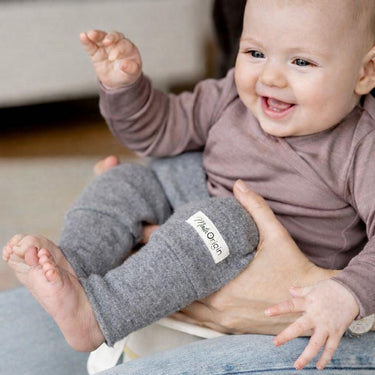
You want to try elimination communication with your baby and are wondering how it works? Then you've come to the right place.
With elimination communication – also called "Windelfrei" in German or EC in English – you support your baby in eliminating waste and give them the opportunity to pee or poop outside of a diaper. You pay attention to your baby's signals and help them communicate their needs.
Many parents start elimination communication with their baby right from birth. Others only start after a few weeks or months. Both are perfectly fine. EC is not a competition and not a dogma. It's more about strengthening the communication between you and your baby and finding a way that fits your family's daily life.
In this article, you'll learn what elimination communication means, how you can do it with your baby, when good times arise, what benefits many families experience, and what tools can make getting started easier.
Elimination Communication for Babies: The Most Important Things at a Glance
Elimination communication with a baby means giving your baby the opportunity to eliminate outside the diaper – for example, over a potty, sink, or toilet. Many families also know this approach as Windelfrei or Elimination Communication.
It's not about completely doing without diapers. Much more important is to better understand your baby's signals and develop relaxed routines – without pressure, without perfection, and suitable for your everyday life.
- With elimination communication, you give your baby the opportunity to pee or poop outside the diaper.
- You can start elimination communication from birth, but a later start is also possible.
- Elimination communication works through signals, typical times, and small routines in everyday life.
- You don't need much to start: a sink, a potty, or a bowl are often enough.
- Elimination communication doesn't have to be perfect. Even individual EC moments can bring connection, body awareness, and ease to everyday life.
- Many families combine elimination communication with diapers, cloth diapers, elimination communication diapers, or diaper liners as a backup.
Elimination Communication and Windelfrei Explained Simply in a Video
Sometimes it's easier to see elimination communication in action than just read about it. In this video, we show you the easy way to get started with elimination communication and Windelfrei according to Mata Origin – lovingly, suitable for everyday life, and without pressure.
You'll learn why elimination communication has nothing to do with perfection, how you can better understand your baby's signals, and how you can gradually find your own path.
What Does Elimination Communication Mean for Babies?
Elimination communication for babies means that you mindfully accompany your baby during elimination. When you notice that your baby wants to pee or poop, you hold them over a potty, sink, bowl, or toilet.
It's not about your baby becoming "potty-trained" as early as possible. It's also not about avoiding every diaper. Rather, it's about communication, connection, and recognizing your baby's natural needs.
Elimination communication is often also referred to as Windelfrei. However, Windelfrei does not mean that babies never wear a diaper. Many families use diapers, cloth diapers, or elimination communication diapers as a backup and also practice EC with their baby at appropriate times.
When Should I Start Elimination Communication?
You can start elimination communication with your baby from birth. Many parents start in the first few weeks, others only after a few months. The decisive factor is not the perfect time, but that it feels right for you.
Especially in the first few months of life, many babies show their needs very clearly. But elimination communication can also work wonderfully later on. So you don't have to feel like you've missed something if you don't start immediately after birth.
A good start can be to briefly practice EC with your baby in normal everyday situations – for example, after waking up, during diaper changes, or when you notice your baby becoming restless.
How Does Elimination Communication Work in Everyday Life?
In everyday life, you observe your baby and react to their signals. If you have the impression that your baby needs to go, you hold them over a suitable receptacle and give them the opportunity to eliminate.
Some families primarily use typical times when many babies often eliminate: after sleeping, during diaper changes, after being carried, or around feeding. Other parents learn over time to read their baby's body language and rhythm better and better.
Many families experience the following as a result:
- more understanding between parents and baby
- more ease in everyday life
- a more natural elimination communication
- more trust in their own parental instincts
- sometimes also more relaxation around the abdomen, feeling of pressure, and elimination
In most cases, families also use a backup diaper or an elimination communication diaper. These can be opened and closed quickly, significantly simplifying elimination communication in everyday life.
What Are the Benefits of Elimination Communication for Babies?
For many families, elimination communication is much more than an alternative to diapers. It is a loving way to better understand the baby's signals and to shape everyday life more consciously.
Many parents report that their baby seems more relaxed after elimination communication – especially when abdominal pressure or restlessness around elimination plays a role. Elimination communication does not replace medical advice but can be a helpful everyday experience for some families.
The Most Important Benefits of Elimination Communication
- More Connection: You get to know your baby's signals better and react more consciously to their needs.
- Less Skin Contact with Moisture: Urine and stool remain on the baby's skin for a shorter time.
- Support with Abdominal Pressure: Some babies can eliminate more easily in the EC position. Many parents report that their baby seems more relaxed afterward – especially if pressure before elimination plays a role.
- Less Diaper Waste: Every successful elimination outside the diaper saves a diaper or reduces laundry.
- More Body Awareness: Your baby can experience elimination as a natural need.
- Flexible Everyday Life: Elimination communication can be combined with diapers, elimination communication diapers, cloth diapers, or diaper liners.
- More Serenity: Many parents lose their uncertainty in dealing with pee, poop, and diapering situations.
Important: Elimination communication doesn't have to work perfectly. Even individual EC moments during the day can make your everyday life easier and show your baby: I see you, I understand you, I'm here for you.
If you are particularly concerned about stomach aches, you will find a detailed article here: Baby Stomach Ache & Elimination Communication.
The 5 Most Important Principles of Elimination Communication
Elimination communication doesn't have to be complicated. Especially at the beginning, a few simple principles will help you stay relaxed and lovingly accompany your baby.
- Pay Attention to Signals: Observe your baby lovingly and without pressure. Some babies show very clear elimination signals, others only subtle hints. Over time, you will get to know your own pattern better and better.
- Utilize Typical Times: Many babies need to go after waking up, during diaper changes, after being carried, or around feeding. These moments are particularly good for simply trying elimination communication with your baby. Stay Calm: Elimination communication works best without stress or pressure to perform. If nothing comes, that's perfectly fine. It was still a valuable moment of attention.
- Don't Force Your Baby: Your baby is allowed to eliminate, but doesn't have to. If they feel uncomfortable, cry, or push away, simply end the attempt lovingly and try again later.
- Develop Small Routines: Start with a few fixed moments a day – for example, after sleeping or during diaper changes. This way, elimination communication gradually becomes a natural part of your everyday life.
The most important thought here: You don't have to catch every pee. Elimination communication is not a performance test, but an invitation to your baby. Even individual EC moments can strengthen your bond and bring more understanding into your everyday life.
What Do I Need for Elimination Communication?
The good news first: You don't need much to start with elimination communication. Many families simply start with a sink, a bowl, or a small potty.
Over time, however, most parents find that some aids can make everyday life much more relaxed. Elimination communication diapers have proven particularly useful, as they can be opened and closed quickly without your baby having to be completely undressed.
Many families also use diaper liners as a backup for small mishaps and a changing mat for on the go to remain flexible even outside their own four walls.
If you are unsure which equipment is really useful for the beginning, our lovingly compiled guide will help you: Windelfrei Starter Set – what do I really need? There we show you various starting options – from cautious trying out to comprehensive initial equipment.
However, it is important: You don't have to be perfectly equipped to start elimination communication. The best prerequisites are attentiveness, serenity, and the willingness to get to know your baby.
How Exactly Does Elimination Communication Work for Babies?
The easiest way to start is by using normal diapering situations and briefly holding your baby over a potty, sink, or toilet before putting on a fresh diaper.
Two positions are particularly suitable for this: the cradle hold and the squat-spread position.
The Two Best Positions to Start With
Especially at the beginning, it helps a lot to see the elimination communication positions. In this short video, we show you two simple positions that many parents can use to get started.
You don't have to perfectly imitate the positions. Just see what feels safe, comfortable, and right for you and your baby.
Cradle Hold
In the cradle hold, you hold your baby in a cradle position and place a potty under their bottom or use a sink.
This position is particularly suitable for newborns and small babies because it provides a lot of support and feels very familiar to many parents.
Many parents use a quiet sound like "Psssss" as a key signal. Over time, your baby often associates this sound with elimination.

Squat-Spread Position
As soon as your baby develops a little core tension, you can also use the squat-spread position. In this position, you hold your baby securely under their thighs, so they are slightly squatted.
This position also works well over a sink, potty, or toilet. Many babies can eliminate particularly well in this posture.

When to Practice Elimination Communication with Your Baby?
There are typical moments when many babies eliminate particularly often. These times can make it easier for you to get started without having to constantly look for signals.
Particularly suitable situations are:
- after waking up
- after being carried
- before leaving the house
- when you come home
- during or after feeding
- during diaper changes
- when your baby becomes restless
- when you feel it's a good moment
Important: These moments are only a guide. Your baby doesn't always have to eliminate exactly then. Over time, you will find your own rhythm.
How Do You Recognize That Your Baby Needs to Go?
One of the most common questions when practicing elimination communication is: "How do I actually know that my baby needs to go?"
Babies often show very subtle signs when they need to eliminate. These signals can vary from baby to baby and often change with age.
If you start to observe your baby attentively, you will recognize more and more patterns over time. This is precisely why many parents describe elimination communication as a special form of communication between parents and child.
Typical elimination signals can be:
- restlessness
- babbling or certain sounds
- arching their back
- grimacing
- flatulence
- crying without an apparent reason
- sudden unlatching during feeding
- intense eye contact
- certain movements with legs or pelvis
It's important to remember: You don't have to perfectly recognize the signals. Elimination communication is not a competition. It's about getting to know your baby and gaining experience together.
If you want to delve deeper into the topic, you will find a detailed article on the different elimination signals by age here:
Recognizing Elimination Signals in Babies – Explained by Age
Our Community on Elimination Signals
Every baby is different. The following signals come from the experiences of many families in our Mata Origin Community and can serve as a guide for you.
Please do not understand these signals as a checklist that your baby must fulfill. Some babies show very clear signs, others barely discernible ones. Both are normal. The examples are meant to help you look more closely – not to put pressure on you.
Elimination Signals from Birth
- latching and unlatching during feeding
- high-pitched squealing or whimpering
- a specific grumbling sound
- "Heh" sounds
Elimination Signals from 3 Months
- kicking
- stretching the body
- restlessness in the carrier
- unlatching from the breast
- intense eye contact
Elimination Signals from 6 Months
- crawling away
- crossing legs
- wanting to get out of the high chair
- rolling away from the breast
Elimination Signals from 9 Months
- looking at the potty
- wanting to get out of the high chair
- getting restless when it's not a good time
Elimination Signals from 12 Months
- retreating
- making pushing sounds
- insisting on getting down
- suddenly becoming quiet
- little movement
Elimination Signals from 18 Months
- reaching into their crotch
- verbally announcing that something is coming
- rocking their legs
- going to the potty or bathroom
Away from Dogma – Towards Connection and Ease
Elimination communication doesn't have to be strict or perfect. You don't have to catch every pee, become a diaper-free model family, or change your entire daily routine overnight.
Many families combine:
- Elimination Communication
- disposable diapers
- cloth diapers
- elimination communication diapers
- diaper liners as backup
Precisely this flexible middle ground makes Windelfrei feasible for many families in everyday life. You are allowed to find your own rhythm – one that suits you, your baby, and your daily life.
Does Elimination Communication Really Work?
Yes, elimination communication can work. But not because parents become perfect.
But because understanding develops over time. You observe your baby, recognize patterns, and develop a feel for appropriate moments.
Many parents suddenly notice at some point:
- They recognize certain signals again.
- They understand their baby better.
- They become more confident in everyday life.
This doesn't require superpowers. Just time, peace, and observation.
Frequently Asked Questions about Elimination Communication
Is Elimination Communication the same as Diaper-Free?
Elimination Communication and Diaper-Free are often used synonymously. In both cases, it means that you accompany your baby during elimination and enable them to pee or poop outside of a diaper. Diaper-free doesn't mean your baby never wears a diaper.
Do I have to practice Elimination Communication with my baby all day long?
No. Many families only practice Elimination Communication at certain times, for example, after waking up, during diaper changes, or when they recognize clear signals. Part-time diaper-free can also be very valuable.
What if I don't recognize my baby's signals?
That's completely normal. Many parents start with standard situations like after sleeping or during diaper changes. Over time, you'll get to know your baby better and may recognize more subtle signs.
Can I combine Elimination Communication with diapers?
Yes. Most families combine Elimination Communication with diapers, cloth diapers, or EC diapers. A backup diaper can even be very relieving because it takes pressure off the issue.
What tools are useful for getting started?
For starters, a sink, a bowl, or a potty are often enough. In everyday life, EC diapers, diaper inserts, and a changing mat for on the go can be very helpful. If you're looking for a specific recommendation to get started, you can find our Diaper-Free Starter Kit from Birth here.
Can Elimination Communication help with stomach aches?
Some parents report that their baby can relieve themselves more easily in the EC position and appears more relaxed afterward. This can be especially helpful around feelings of pressure, bloating, or elimination. However, if your baby has severe or persistent discomfort, you should have it medically checked.
More on Elimination Communication and Diaper-Free
If you are just starting with Elimination Communication, we recommend these further articles and products:
- Diaper-Free Starter Kit: What do I really need?
- Recognizing Elimination Signals by Age
- Can Elimination Communication help with stomach aches?
- How Elimination Signals Change with Age
- Discover Our EC Diapers
- Suitable Diaper Inserts for Everyday Use
- View Changing Mat for On the Go
Our most important advice at the end: Start relaxed. You don't have to catch every pee and don't have to become a perfect diaper-free family. Many parents find that even individual EC moments a day make a difference. Over time, trust, understanding, and often a very special connection between you and your baby develop.
5