
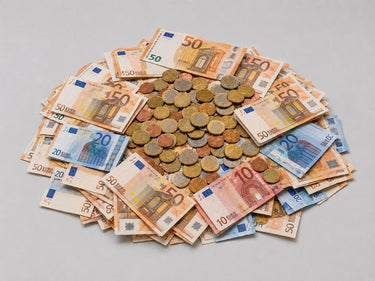
"Save 2,500 Euros in diaper costs quickly."
That sounds good.
Maybe even a bit too good.
Because 2,500 Euros is a lot of money.
A family vacation.
A stroller.
Many weekly grocery shops.
Or simply:
a lot, a lot of diapers.
But can a family actually save 2,500 Euros by practicing Elimination Communication (EC) and holding their baby for elimination?
The honest answer is:
Yes, it can be possible – but not for every family.
How much you can actually save depends on:
- how many disposable diapers your child would have otherwise used
- how expensive these diapers are
- how long your child wears diapers
- how many diapers are actually not needed due to EC
- and what additional equipment you buy for EC
Therefore, we want to break down this large number calmly.
Can a child's diapers actually cost 2,500 Euros?
Yes.
Under certain conditions.
But 2,500 Euros is not automatically the normal diaper cost for every child.
For our previous model calculations, we often use approximately:
3,800 disposable diapers over a diapering period of about two and a half years.
With different unit prices, this results in, for example:
| Example price per diaper | Cost for 3,800 diapers |
|---|---|
| 0.15 € | 570 € |
| 0.20 € | 760 € |
| 0.30 € | 1,140 € |
| 0.40 € | 1,520 € |
Under these assumptions, the pure diaper costs are significantly below 2,500 Euros.
The 2,500 Euros only arise with a different combination of diaper quantity, diapering duration, and unit price.
When can diapers cost around 2,500 Euros?
A simple example:
A child needs a total of approximately over a longer diapering period:
6,250 diapers.
A diaper costs on average:
40 cents.
Then the calculation is:
6,250 × 0.40 € = 2,500 Euros.
Or:
5,000 diapers at an average of 50 cents.
This also results in:
2,500 Euros.
Such magnitudes can arise, for example, if:
- a child wears diapers longer
- diapers are changed frequently
- more expensive premium diapers are used
- more pull-ups are bought later
Therefore, the statement:
"A child costs 2,500 Euros in diapers."
is too generalized.
More accurate is:
Depending on the diaper price, consumption, and diapering duration, the costs over the entire diapering period can total several hundred to over 2,000 Euros.
Can you then save 2,500 Euros with EC?
Here comes the crucial limitation.
You can only save money on diapers that you would have actually bought otherwise.
If your total disposable diaper costs without EC would have been, for example, 900 Euros, you obviously cannot save 2,500 Euros in diaper costs.
And even if your disposable diapers would have cost a total of 2,500 Euros, the full amount would only be eliminated if you practically don't need any of these disposable diapers.
This is usually not a realistic assumption for part-time EC.
2,500 Euros is therefore a possible maximum magnitude in certain scenarios – not a savings promise for every family.
What is more realistic for part-time EC?
We find a smaller calculation much more interesting.
One less diaper per day.
That hardly seems worth mentioning.
Over the entire diapering period, this can simply become:
around 1,000 unneeded disposable diapers
This corresponds to approximately with different example prices:
| Price per diaper | Savings for approx. 1,000 diapers |
|---|---|
| 0.15 € | approx. 150 € |
| 0.20 € | approx. 200 € |
| 0.30 € | approx. 300 € |
| 0.40 € | approx. 400 € |
A few hundred Euros.
Without having to completely forgo diapers.
Without perfection.
Perhaps simply through a familiar EC moment in the morning.
One less diaper per day: How much money does that really save?
With two fewer diapers a day, it becomes significant
If EC works well for you more frequently and an average of two disposable diapers per day are actually not needed, we are simply talking about:
around 2,000 fewer diapers.
At 30 cents per diaper, that's approximately:
600 Euros.
At 40 cents:
around 800 Euros.
This is already a noticeable sum.
But even here, we don't want to create any pressure to perform.
You don't have to save two diapers a day.
Sometimes EC works well.
Sometimes not at all.
Both are part of family life.
What would have to happen to actually save 2,500 Euros in diaper costs?
For a diaper costing 30 cents, a family would have to approximately:
not buy 8,333 disposable diapers
At 40 cents per diaper, it would be:
6,250 diapers.
At 50 cents:
5,000 diapers.
This shows quite clearly:
Saving 2,500 Euros requires either very high initial diaper costs or a very strong reduction in disposable diaper use.
For a family that only practices EC once a day and otherwise uses disposable diapers, this amount would usually not be realistic.
But EC can save more than just the price of the diaper
Classic diapering routines often include other consumables.
For example:
- wet wipes
- diaper bags
- disposable changing pads
- disposable liners
If a family uses fewer disposables, these expenses can also change.
Especially with held-out pees, little cleaning is often needed.
And with held-out bowel movements, less elaborate cleaning may be necessary.
However, the extent of these savings cannot be meaningfully calculated across the board for all families.
Therefore, we would not simply add them to the diaper savings.
One less diaper should never mean: wearing it longer
Even in an article about saving money, this applies:
A wet or soiled diaper is changed.
Diaper costs should never be reduced by letting a baby stay in a full diaper longer.
The better question is:
Can this elimination perhaps land outside the diaper from the start?
For example, in the morning.
Your baby wakes up.
The backup is still clean.
You briefly hold them over the sink or potty.
They pee.
The backup stays dry.
And can continue to be worn.
That is a truly avoided diaper.
Why EC is financially interesting
When it comes to classic diaper saving, there's an obvious way:
buy cheaper diapers.
That can be very effective.
EC addresses a different point.
You don't lower the price of the diaper – but possibly the number of diapers needed.
And, of course, both can be combined.
An affordable backup.
And EC in situations where it fits well.
What is part-time EC?
Part-time EC means:
You don't have to try to recognize every elimination of your baby.
Perhaps you only use:
- the moment after waking up
- a clearly recognizable bowel movement
- the moment before bathing
- or individual quiet situations at home
The baby otherwise wears a backup as usual.
EC does not mean diaper-free.
And especially financially, part-time EC is interesting because even small changes can accumulate over months.
Not every successful EC eliminates a diaper
For an honest savings calculation, this distinction is important.
If the diaper is already used and needs to be changed anyway, an additional EC doesn't save another diaper.
Financially, what matters most is the moment when:
- the backup is clean
- the baby eliminates outside of it
- the backup stays clean
- and can continue to be worn
Only this actually unneeded disposable diaper also saves its full purchase price.
Can EC itself cost money?
Of course.
Perhaps you buy:
- an EC potty
- washable liners
- an EC diaper
- EC clothing
That belongs in an honest calculation.
But:
You don't have to buy any of that to try out EC initially.
A sink and your current backup are enough for a start.
Only when you notice that EC suits you well can you consider what things truly make your everyday life easier.
What does EC cost – and is EC financially worthwhile?
Why an EC diaper can still be financially interesting
An EC diaper from Mata Origin certainly costs money.
But it's not disposed of after a single use.
It can serve as a backup again and again.
And it's designed to be quickly opened for EC.
This allows it to combine two things:
Security.
And the ability to quickly utilize a suitable EC moment.
If the backup remains clean, it simply continues to be worn.
Why EC pants can help save money
Actually, pants don'nl--> t save diapers.
But they can remove an obstacle.
You notice:
My baby needs to go.
And now it depends on how quickly you can react.
With normal clothing, that might mean:
Pants down.
Onesie open.
Tights off.
Backup open.
And the pee was faster.
An EC pant from Mata Origin is designed so you can get to the diaper area quicker.
The easier EC becomes in daily life, the greater the chance that a recognized moment will actually be used.
And your baby needs clothes anyway
This is also important for the cost calculation.
An EC pant is not exclusively an additional EC expense.
Your baby needs pants anyway.
An EC romper replaces a normal romper.
Therefore, it would be unfair to consider the full purchase price of such clothing as pure "EC costs."
You buy clothes.
Only clothes that also make your EC daily life easier.
What happens with multiple children?
Here, the calculation becomes particularly exciting.
Disposable diapers must be bought new for each child.
Reusable equipment, on the other hand, can potentially be passed down.
For example:
- EC potties
- washable liners
- EC diapers
- high-quality EC clothing
And the possible diaper savings also multiply.
Let's simply assume one actually unneeded diaper per day.
Then this results in approximately:
- 1 child: around 1,000 fewer diapers
- 2 children: around 2,000 fewer diapers
- 3 children: around 3,000 fewer diapers
For a model diaper costing 30 cents, that would be:
- 1 child: around 300 €
- 2 children: around 600 €
- 3 children: around 900 €
With more frequent EC, it can be correspondingly more.
Can families with multiple children eventually save 2,500 Euros?
This is significantly more realistic than with a single child practicing part-time EC.
Imagine, for example:
Three children.
Over several years.
Many thousands of disposable diapers.
And a family that regularly practices EC with all children and uses reusable backups.
Then the avoided disposable costs can accumulate significantly over many years.
Whether this actually amounts to 2,500 Euros still depends on individual diaper prices and consumption.
But especially with multiple children, a small daily change eventually turns into a large family bill.
Saving 2,500 Euros: That should not be an EC goal
This is important to us.
Please don't start converting your baby's pee into cents in the morning.
EC should not become a bonus program.
No:
Today we've already achieved 1.20 Euros.
Your baby is not a savings project.
Perhaps EC works because you notice:
My baby needs to go after waking up anyway.
Then you hold them for elimination.
The backup stays clean.
And incidentally, a diaper was not needed.
The fact that money is left over over the years can be a nice side effect.
How much can you personally save?
You can calculate that very easily yourself.
You only need:
1. the unit price of your diapers
and:
2. the number of diapers actually not needed.
Then the calculation is:
avoided diapers × unit price = fewer diaper costs.
Example:
You save approximately 1,500 disposable diapers over the diapering period.
Your diaper costs an average of 30 cents.
Then that is:
1,500 × 0.30 € = 450 Euros.
That may be less spectacular than 2,500 Euros.
But it's your real calculation.
What magnitude is realistic for part-time EC?
This cannot be answered the same for every family.
But as a simple guide, we can say:
For one less diaper a day:
around 1,000 fewer diapers.
For two diapers:
around 2,000 fewer diapers.
For three:
around 3,000 fewer diapers.
Multiply this number by your average unit price.
This results in a realistic personal savings range.
Frequently asked questions about €2,500 in diaper costs
Can a child really cost €2,500 in diapers?
This is possible if many relatively expensive disposable diapers or pull-ups are used over a long diaper-wearing period. With a shorter diaper-wearing period and inexpensive diapers, the total costs can be significantly lower.
Can you save €2,500 with elimination communication?
This is possible under certain conditions, but it's not a realistic blanket promise for every family. The savings can never be higher than the diaper costs that would have actually been incurred without EC.
How much does one less diaper save per day?
Over a diaper-wearing period of about two and a half years, this can simply amount to around 1,000 unnecessary diapers. At an example price of 30 cents, this corresponds to approximately 300 Euros, and at 40 cents, about 400 Euros.
How much do you save with two fewer diapers per day?
Simply put, that's about 2,000 diapers over the diapering period. At 30 cents per diaper, that's about 600 euros, and at 40 cents, about 800 euros.
How many diapers would you have to avoid to save €2,500?
At 30 cents per diaper, it would be approximately 8,333 diapers, at 40 cents around 6,250, and at 50 cents about 5,000 diapers.
Does every EC attempt save money?
No. A disposable diaper is only actually saved if it is not needed due to the EC attempt. If an already used diaper is changed, additional EC does not automatically save another diaper.
Can I save money without expensive elimination communication equipment?
Yes. To try it out, you can continue to use your existing backup and hold your baby over a sink or toilet, for example. Additional equipment is not a prerequisite.
Is elimination communication financially worthwhile with multiple children?
It can be particularly interesting because avoided diaper costs accumulate over several children and reusable equipment can sometimes be passed on.
Is €2,500 a realistic average value for diaper costs?
No. The actual total costs vary greatly. €2,500 is a possible magnitude for high consumption, a long diapering period, and more expensive products, but not a meaningful general average value.
Conclusion: €2,500 is possible. But the smaller calculation is often the nicer one.
Yes.
A family can spend a lot of money on diapers over the years.
And yes.
With correspondingly high original diaper costs and very few disposable diapers needed, the savings can also approach €2,500.
But perhaps that's not the number you should start with.
Perhaps it's:
one diaper.
Your baby wakes up.
You open its EC pants.
Hold it briefly over the potty.
It pees.
The backup stays clean.
One diaper wasn't needed today.
Maybe 30 cents.
Maybe 40.
Maybe again tomorrow.
And eventually it's:
100 diapers.
500.
1,000.
Maybe more.
You don't have to save €2,500 for a small change to be worthwhile.
Perhaps the nice feeling of buying less, throwing away less, and being able to keep a small part of your family budget for something else is enough.
Read more
- How much do diapers really cost until potty training?
- One less diaper per day: How much money does that really save?
- What does elimination communication cost – and is EC financially worthwhile?
- Cloth diapers or disposable diapers: Which is really cheaper?
You don't want to start with €2,500, but with a small moment?
Then just try out EC at your leisure.
Our free starter guide shows you how to begin without pressure.
And if EC suits you well, EC pants, EC diapers, and washable diaper inserts can make these small everyday moments easier.