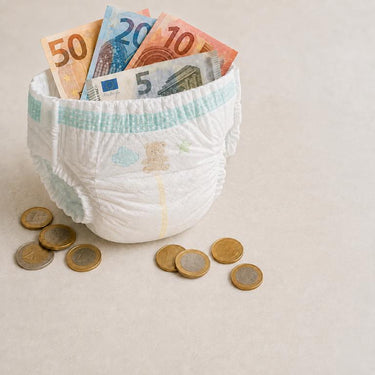
One less diaper.
That sounds like very little at first.
Maybe 20 cents. Maybe 30. Maybe 40.
Not an amount you'd usually start calculating with.
But your baby wears diapers not just for a day, but for months and often years.
If, on average, one disposable diaper per day is actually not needed, that can simplified amount to around 1,000 fewer diapers over the entire diapering period.
Depending on what your diapers cost, this can mean approximately 150 to 400 Euros less in diaper costs.
And for that, your baby doesn't have to be completely diaper-free.
Perhaps a single familiar moment a day is enough.
How much money does one less diaper per day save?
Let's calculate it simply.
Assuming a diapering period of approximately two and a half years, if one disposable diaper per day is actually not needed, we're simplifying talking about:
around 1,000 fewer diapers.
How much money that amounts to depends on the unit price of your diapers.
| Example price per diaper | Savings for approx. 1,000 diapers |
|---|---|
| €0.15 | approx. €150 |
| €0.20 | approx. €200 |
| €0.30 | approx. €300 |
| €0.40 | approx. €400 |
Thus, a seemingly tiny change over the entire diapering period can lead to savings of several hundred Euros.
But of course, no family is a model calculation.
Maybe your baby needs six diapers a day. Maybe only four. Maybe your diaper costs 19 cents or 34.
That's why your personal calculation is much more interesting than any average value.
With our diaper cost calculator you can enter your actual diaper consumption, your unit price, and your diapering period.
And you can try out what changes if individual disposable diapers are no longer needed through elimination communication.
→ Calculate your personal diaper costs
Very important:
Saving on diapers never means leaving your baby in a wet or dirty diaper for longer.
One less diaper never means: changing later
This is particularly important to us.
If your baby needs a fresh diaper, they get one.
The savings happen in a completely different place.
For example, in the morning.
Your baby wakes up.
The backup is still clean.
Perhaps you already know this moment and realize:
After waking up, a pee often comes.
You hold your baby over the sink or a potty for a moment.
They pee.
The backup remains clean and can continue to be worn.
That's exactly when a new disposable diaper was actually not needed.
Why one diaper a day matters financially at all
Disposable diapers are consumable products.
A single diaper doesn't cost much. But it's only used once.
After that, the calculation starts over with the next diaper.
Therefore, the financial impact becomes apparent primarily over time.
For a diaper costing 30 cents, that's approximately:
- 30 cents in one day
- about 9 Euros in a month
- around 110 Euros in a year
- simplified, around 300 Euros over the entire diapering period
On a Tuesday morning, that doesn't feel like much.
Over months and years, the calculation suddenly looks different.
Does my baby have to be completely diaper-free for this?
No.
Diaper-free does not mean without diapers.
Your baby is, of course, allowed to wear a backup.
This can be a disposable diaper, a cloth diaper, an elimination communication diaper, or another solution that you feel comfortable with.
Elimination communication initially just means:
You sometimes give your baby the opportunity to eliminate outside the diaper.
Perhaps once a day.
Perhaps more often.
Perhaps not at all today.
All of that is allowed.
What is elimination communication? Diaper-free explained simply
Which elimination communication moments are particularly suitable?
If you're looking for an uncomplicated start, you don't have to try to anticipate every pee.
Often, the easiest moments are those that are already part of your day anyway.
After waking up
For many families, this is a particularly easy time.
Your baby wakes up. You take them out of bed anyway – and maybe you've already noticed that a pee often comes shortly after.
Then you can use exactly this moment.
Elimination communication after waking up: A particularly easy start
During bowel movements
Some babies show quite clearly when they are having a bowel movement.
Perhaps they become quiet, push, make a certain sound, or you simply know their rhythm by now.
If you recognize this moment, you can hold your baby for elimination.
Before bathing
The clothes are off anyway and the backup is opened.
Then a short elimination communication moment over a potty or sink can be a natural part of it.
During the already planned diaper change
Again, there's no need to create an additional agenda item.
Perhaps you hold your baby for a moment before closing the clean backup again.
The easier an elimination communication moment fits into your normal daily routine, the more naturally it can become a part of it.
What does part-time diaper-free save?
Perhaps one diaper a day isn't realistic for you.
It doesn't have to be.
If approximately three disposable diapers per week are actually not needed, over the diapering period that's roughly:
around 400 fewer diapers.
With five diapers a week, it's approximately:
around 650 fewer diapers.
At an exemplary unit price of 30 cents, this corresponds to approximately:
- 3 diapers per week: approx. €120
- 5 diapers per week: approx. €195
- 1 diaper per day: approx. €300
There is no minimum amount at which elimination communication suddenly "counts".
A single disposable diaper that is not needed remains a single disposable diaper that is not needed.
No targets. No pressure to be perfect.
And what about two fewer diapers a day?
Perhaps elimination communication will work more often for you eventually.
If, on average, two disposable diapers are actually not needed per day, this can simplify to:
around 2,000 fewer diapers over the entire diapering period.
At 30 cents per diaper, that would be approximately:
600 Euros.
At 40 cents per diaper:
around 800 Euros.
But again:
This is a model calculation – not a task.
Diaper-free should not become a savings challenge.
Not every successful elimination communication saves a diaper
For an honest calculation, we need to differentiate precisely.
Imagine:
Your baby has already peed in their backup.
You open it and then hold your baby for elimination.
After that, they need a fresh backup anyway.
The elimination communication could still have been a beautiful and meaningful moment.
But it didn't automatically save an additional disposable diaper financially.
A disposable diaper is usually not needed if:
- the backup is still clean
- your baby eliminates outside of it
- the backup remains clean
- and can then be worn again
That's why at Mata Origin, we prefer to calculate cautiously rather than make big promises of savings.
What makes a bigger difference: cheaper diapers or fewer diapers?
Both can make a difference.
Those who use cheaper diapers reduce the price of each individual diaper.
Those who don't need some disposable diapers by using elimination communication reduce the quantity.
And of course, you can combine both.
It doesn't have to be an either-or.
Why clothing suddenly plays a role in elimination communication
Perhaps this connection initially sounds a bit surprising.
But imagine a typical morning.
You realize:
My baby probably needs to pee soon.
Then pants, bodysuit, and maybe even tights need to be opened first.
And in the meantime, your baby was faster.
Not necessarily because elimination communication doesn't work.
But because the process was too cumbersome at the crucial moment.
That's precisely why at Mata Origin, we've developed clothing that can make elimination communication easier in everyday family life.
Elimination Communication Pants: when a few simple steps make a difference
A Mata Origin elimination communication pant provides quick access to the diaper area.
Your baby doesn't have to be completely undressed every time.
Open. Communicate. Close again.
That sounds like a small detail.
In real family life, this small detail can decide whether a spontaneous elimination communication moment can be used at all.
Elimination communication diapers: combining backup and elimination communication
Many parents don't want to go without a backup.
They don't have to.
A Mata Origin elimination communication diaper is designed precisely for this combination.
It can be worn as a backup in everyday life and quickly opened for an elimination communication moment.
If it stays clean, it can then be worn again.
Diaper-free doesn't have to be all or nothing.
But elimination communication diapers and clothing also cost money, right?
Of course.
That's part of an honest calculation.
An elimination communication diaper costs money.
Elimination communication pants cost money.
Washable inserts too.
That's why it would be wrong to claim:
300 Euros less in disposable diapers automatically means 300 Euros extra in your account.
Many things related to elimination communication can be used repeatedly.
A washable diaper insert is washed and reused.
An elimination communication diaper can be worn repeatedly.
A potty can accompany you for a long time.
And high-quality clothing can perhaps later be used by a sibling or another family.
However, washable products also incur ongoing costs for water, detergent, and energy.
Therefore, the actual savings are always your very personal calculation.
Can you start without special equipment?
Yes.
You don't need a complete elimination communication set-up for your first attempt.
You can continue to use your existing backup and hold your baby over a sink or toilet, for example.
Special clothing, a potty, or an elimination communication diaper can make your daily life easier later on.
But you don't have to go shopping first to find out if elimination communication suits you.
The equipment can grow with you.
One less diaper for two or three children
With siblings, the small daily change can continue to add up.
If we simplify with roughly 1,000 disposable diapers not actually needed per child, this means:
- 1 child: roughly 1,000 fewer diapers
- 2 children: roughly 2,000 fewer diapers
- 3 children: roughly 3,000 fewer diapers
At an example price of 30 cents per diaper, that would be approximately:
- 1 child: approx. €300
- 2 children: approx. €600
- 3 children: approx. €900
Especially with siblings, many items related to elimination communication can be reused.
For example, a potty, washable inserts, elimination communication diapers, or high-quality clothing.
And what about diaper waste?
This article consciously focuses on money.
But every disposable diaper that is actually not needed also has a second effect, of course:
It also doesn't end up in the diaper pail.
With approximately one disposable diaper not actually needed per day, over the entire diapering period, we are simplifying talking about roughly 1,000 fewer disposable diapers.
What this can mean for diaper waste, we have discussed in detail here:
What one less diaper per day means for diaper waste
How much could we personally save?
This is where averages eventually become boring.
Because what matters is not what some model family saves.
But:
What does your diaper cost? How many do you need? And how many of them are actually not needed through elimination communication?
That's exactly what we built our diaper cost calculator for.
There you can enter your own values and see:
- what your diapers cost approximately per month
- what can add up over the entire diapering period
- how many disposable diapers may not be needed through your elimination communication moments
- what potential savings result from this
- and how additional expenses for elimination communication equipment affect the calculation
Maybe it's less than you thought in the end.
Maybe more.
But it's your number.
→ Calculate your personal diaper costs now
Frequently asked questions about saving on diapers
How much money does one less diaper per day save?
Over a diapering period of approximately two and a half years, this can simplify to around 1,000 fewer needed disposable diapers. At example prices between 15 and 40 cents, this corresponds to approximately 150 to 400 Euros.
How much does one less diaper per day save annually?
With approximately 365 diapers not actually needed, at 30 cents per diaper, it's about 110 Euros per year. At 40 cents, it's about 146 Euros.
How many diapers does one less diaper per day amount to over the entire diapering period?
Assuming a diapering period of approximately two and a half years, for simple orientation, we are talking about roughly 1,000 diapers.
How much does part-time elimination communication save?
That depends on the number of disposable diapers not actually needed and their unit price. Even a few fewer diapers per week can add up to several hundred diapers over months and years.
Does every successful elimination communication save a diaper?
No. If an already-used backup needs changing anyway, holding off additionally does not automatically save another diaper. Financial relevance primarily arises when a clean backup stays clean and can be worn again afterwards.
Does my baby have to be completely diaper-free for us to save money?
No. Individual, regular elimination communication moments can already lead to fewer disposable diapers being needed.
What is an easy elimination communication moment to start with?
For many families, the moment after waking up is particularly uncomplicated. However, you don't have to choose a specific time. What matters is what can be easily integrated into your daily routine.
Do I need special elimination communication diapers for this?
No. You can initially try elimination communication with your current backup. Elimination communication diapers and suitable clothing can make it easier later to quickly seize a spontaneous moment.
Can I calculate our personal savings?
Yes. With our diaper cost calculator, you can enter your actual unit price, daily diaper consumption, diapering period, and potential unneeded disposable diapers.
Conclusion: 30 cents is small. 1,000 diapers are not.
Perhaps your diaper costs 20 cents.
Perhaps 30.
Perhaps 40.
A single diaper feels hardly financially relevant.
But from one genuinely unneeded disposable diaper per day, over the entire diapering period, this can simplify to:
around 1,000 fewer diapers.
And 30 cents then roughly becomes:
300 euros.
Perhaps your baby wakes up tomorrow morning.
You now know this moment.
You open the backup.
Briefly hold your baby over the sink or potty.
They pee.
The backup stays clean.
And today one less diaper was needed.
Not because you have to save money.
Not because you want to be as perfectly diaper-free as possible.
But because it just fit well.
One diaper is little. Around 1,000 is not.
Read more
- Diaper Cost Calculator: Calculate Your Personal Diaper Costs
- How Many Diapers Does a Baby Really Use?
- What One Less Diaper Per Day Means for Diaper Waste
- Part-Time Elimination Communication: How Much Diaper Waste You Can Save
- What is Elimination Communication? Diaper-Free Explained Simply
Would you like to simply try it out?
Then don't start by trying to save as many diapers as possible.
Start with one moment.
Perhaps tomorrow morning after waking up.
Our free starter guide lovingly and pressure-free shows you how to begin elimination communication.
And if you eventually realize that elimination communication suits you well, elimination communication pants, elimination communication diapers, and washable diaper liners can make these small moments in everyday life easier.