
Assisted Pottying for Tummy Aches, Gas, and Colic – Can It Really Help?
When babies suffer from tummy aches, gas, or colic, many parents feel helpless.
The baby pulls their legs up, strains, writhes, cries, and simply can't seem to find peace.
Then the question often arises:
What really helps my baby?
Many families have surprisingly good experiences with assisted pottying.
Why Assisted Pottying Often Provides Relief for Babies
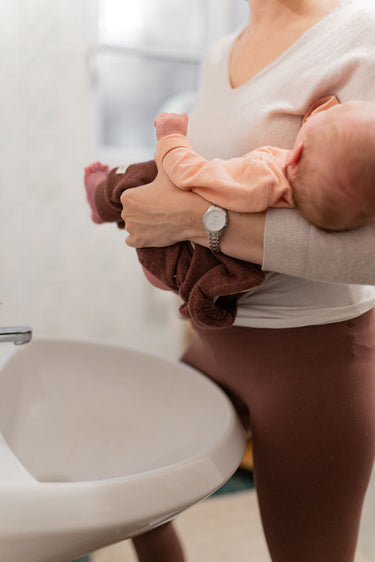
When you assist pottying, you hold your baby over a sink, a potty, a bowl, or the toilet, supporting them in a natural posture for elimination.
Your body provides:
- Support
- Closeness
- Warmth
- Security
Many babies visibly relax as a result.
Especially with:
- Gas
- Pressure in the belly
- Restlessness
- Colic
- Nighttime straining
this can be a great relief.
Why the Assisted Pottying Position Can Help
The bent-knee position naturally supports the abdominal area.
Many babies can:
- fart more easily
- release stool better
- relieve pressure
- use their abdominal muscles more effectively
Without the resistance of a tight diaper, elimination is significantly easier for some babies.
Many parents then experience:
- visible relaxation
- calmer sleep
- less crying
- easier release
Closeness Also Plays an Important Role
Assisted pottying is not just a position.
It's also connection.
Physical contact, your breathing, and your calm guidance help many babies feel secure enough to let go.
Overstimulated or tense babies often benefit particularly from this.
Can Assisted Pottying Help with 3-Month Colic?
Many parents report that assisted pottying can noticeably alleviate the symptoms of so-called 3-month colic.
Why?
Often, factors such as:
- Air in the belly
- Digestive pressure
- Tension
- Difficulty letting go
play a larger role than expected.
Assisted pottying can help to gently release this pressure.
Of course, every baby is different.
But many families experience significantly more relaxed days and nights as a result.
Important: It's Not About Perfection
Especially at the beginning, assisted pottying takes some time.
Everything new has to be learned – by you and your baby.
It's not about "catching" every single bowel movement.
Much more important is:
- to offer your baby a chance
- to observe without pressure
- to gain experience together
Many parents notice over time:
It gets easier.
When You Can Try Assisted Pottying
For example:
- when your baby pulls their legs up
- with visible straining
- after breastfeeding
- after waking up
- in the evening when restless
- when your baby needs to fart
What Makes Everyday Life Easier for Many Families
Especially with tummy aches or frequent assisted pottying, simple solutions in everyday life help many families.
Practical assisted pottying diapers or easy-to-open clothing often make assisted pottying significantly more relaxed – especially at night or when out and about.
Conclusion
Assisted pottying can gently support babies with tummy aches, gas, and pressure.
Not as a miracle cure.
But often as a simple way to:
- more relaxation
- less pressure
- better release
- more connection
Many parents are surprised how much calm it can bring to everyday life.
Further Reading
👉 Baby isn't farting – what to do?
👉 Baby has a tummy ache and is straining – what really helps?
Is Assisted Pottying New to You?
Here you'll find our easy introduction: