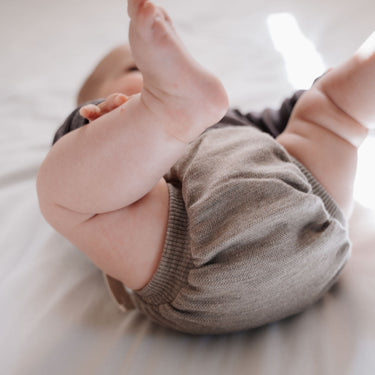
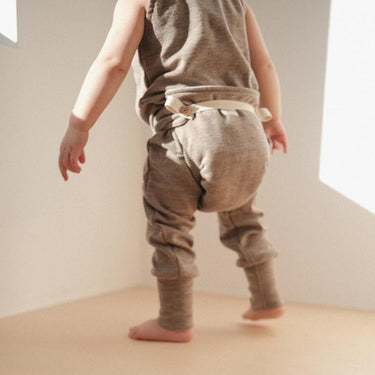
The diaper area is one of the most sensitive areas in a baby's daily life.
Here, moisture, warmth, friction, and excretions directly meet delicate skin.
And that's precisely why the question is important:
What materials are actually on my baby's skin every day?
Many parents first think of absorbency when changing diapers. Or whether a diaper stays leak-proof.
This is understandable. But just as important is the climate created in the diaper area. Because baby skin doesn't just need protection.
It also needs air, dryness, and materials that put as little strain on it as possible. The question also arises as to what materials and substances the delicate baby skin is exposed to.
Baby skin is particularly sensitive
Baby skin is thinner and more sensitive than adult skin. It reacts more quickly to external influences.
Especially in the diaper area, several factors come together:
- Moisture
- Warmth
- Friction
- Urine
- Stool
- Little air
The longer the skin remains moist or in contact with excretions, the more it can be stressed.
Therefore, it makes sense not only to think about diapers.
But about the whole system.
- Which materials absorb?
- Which materials protect?
- Which materials allow air to reach the skin?
- And how quickly can your baby be dry and relaxed again?
Why synthetic materials are not always ideal
Synthetic materials appear practical if you only look at them superficially. They are often light, dense, and easy to clean. But they work differently from natural fibers.
Many synthetic moisture protection materials form a barrier.
This can help keep clothes dry. At the same time, however, heat and moisture can build up underneath.
For some babies, this is not a problem. Others react more quickly with redness or discomfort.
That's why many parents are looking for more breathable alternatives. And this is where wool comes in as a natural material.
What natural materials do differently
Natural materials often have properties that can be very valuable in the diaper area.
Wool, cotton, and other natural fibers not only feel different.
They also work differently. Wool can absorb moisture without immediately feeling wet. It remains breathable. It can regulate temperature. And with lanolin, it can become water-repellent. Cotton can absorb moisture as an absorbent layer. The cool thing about wool is that it is the only plastic-free alternative for moisture protection!
Together, a simple, natural principle emerges:
- Cotton absorbs
- Wool protects
- Lanolin supports the moisture protection function
- Elimination communication additionally relieves the system
Why wool is so special in the diaper area
The use of wool in the diaper area is no coincidence. It is extremely sensible.
It combines several properties that are particularly helpful there.
- Wool is breathable.
- It regulates moisture.
- It regulates temperature.
- And with lanolin, it is water-repellent.
Wool is practically the only plastic-free alternative for moisture protection!
The decisive difference to plastic:
- Wool does not form a completely impermeable plastic barrier.
- It remains alive, open, and functional.
- This massively helps to support a more pleasant skin climate.
You can find more about this here: Why wool is ideal for elimination communication
What role does lanolin play?
Lanolin is the natural wool grease of sheep's wool. It helps wool to remain water-repellent.
This is particularly important for wool diapers, wool covers, and elimination communication diapers.
Because these products should regulate moisture and at the same time help to retain wetness. Over time, wool loses some lanolin through use, friction, and washing.
It can then be re-greased with a lanolin bath. If you want to know how organic lanolin is extracted, you can find a detailed explanation here: How is organic lanolin obtained?
Suitable organic lanolin can be found here: Organic Lanolin Wool Wax
Why elimination communication usefully complements natural materials
Natural materials can relieve the sensitive baby bottom in the diaper area. Elimination communication goes a step further. Because with elimination communication, some of the excretions don't even end up in the diaper.
This means:
- Less moisture in the diaper area
- Less contact with urine and stool
- Less stress for the skin
- Less stress for inserts and wool
You don't have to live completely diaper-free for this. Many families use individual moments.
For example, after waking up, after breastfeeding, or before sleeping.
Even small routines can help to make the diaper area more natural and relaxed. If you are not yet familiar with elimination communication: What does elimination communication mean?
Natural materials and diaper rash
Diaper rash often arises from a combination of moisture, warmth, friction, and prolonged contact with excretions.
Natural materials cannot completely prevent these factors. But they can help to support a better skin climate.
- Wool can regulate moisture.
- Cotton can absorb.
- Elimination communication can ensure that less ends up in the diaper.
- And air breaks can also do the skin good.
If your baby frequently has diaper rash, it is therefore worthwhile not only to look for the one cream.
But also to ask:
- How much moisture remains on the skin?
- How breathable is the system?
- How quickly can the skin calm down again?
You can find more about this here: Diaper rash in babies: causes and prevention
Sustainability begins with material selection
Natural materials are not automatically perfect.
Here, too, origin, processing, quality, and durability count.
But high-quality natural materials can be an important building block for a more sustainable baby's daily life. At Mata Origin, depending on the product, we therefore pay attention to GOTS-certified materials, mulesing-free wool, and materials that are as natural and plastic-free as possible.
Our claim is clear:
Baby skin, daily life, sustainability, and responsible manufacturing belong together for us.
Which products are suitable for a more natural diaper area?
If you want to make the diaper area more natural, you don't need a complicated system.
Often a few good components are enough:
- An elimination communication diaper or wool diaper
- Absorbent inserts
- Organic lanolin for re-greasing
- A suitable wool detergent
- Clothing that does not constrict
Suitable products can be found here:
Discover elimination communication wool diapers
Natural materials make the diaper area more conscious
The diaper area of a child is sensitive. That's why it's worth taking a close look at the materials.
Natural fibers like wool and cotton can help to make moisture, warmth, and skin contact more conscious.
Lanolin supports the natural function of wool.
Elimination communication can additionally relieve the system.
And plastic-reduced solutions can make everyday life more sustainable without having to be perfect. In the end, it's not about doing everything right.
But about bringing baby skin, everyday life, and the environment together a little better.