
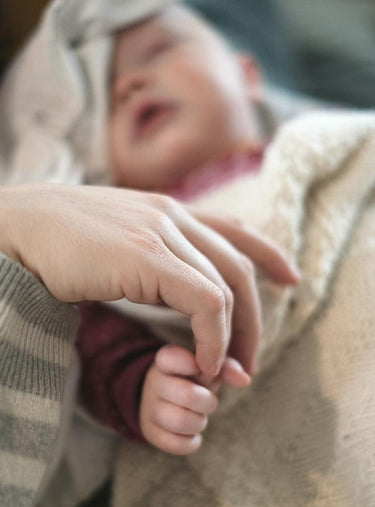
Oh dear - many parents are familiar with this situation:
The baby is breastfeeding, drinking well – yet seems restless. They pull up their legs, strain, wriggle, cry after feeding, or have trouble falling asleep.
Then the question quickly arises:
Why does my breastfed baby have a tummy ache?
The honest answer:
There can be many reasons. It's not always due to breast milk or something you "ate incorrectly."
Often, development, digestion, air in the stomach, or the urge to eliminate play a larger role.
Common causes of tummy aches in breastfed babies
1. Swallowing air while feeding
Many babies swallow air while breastfeeding.
This is common – especially if they drink hastily, are very hungry, or frequently unlatch.
2. Immature digestion
The intestines continue to develop significantly in the first few months.
Therefore, gas, pressure, or restless digestive phases are not unusual.
3. Strong milk flow
If the milk flows very quickly, some babies drink more frantically, swallow more air, or seem restless after feeding.
4. Overtiredness or overstimulation
Not all fussiness after breastfeeding is a tummy ache.
Sometimes the baby is simply exhausted and shows it physically.
5. Urge to eliminate
Many babies need to pass gas, pee, or have a bowel movement after breastfeeding. If this moment is experienced as unpleasant, it quickly seems like a tummy ache.
Typical signs of a breastfed baby with a tummy ache
- Pulling legs up
- Straining
- Releasing the breast
- Frequent latching and unlatching
- Wriggling
- Crying after breastfeeding
- Tense belly
- Restlessness in the evening
- Poor sleep
What can help
1. Breastfeed calmly
A relaxed environment often helps enormously.
2. Allow breaks
Burping, short interruptions, or changing positions can help.
3. Upright position after feeding
Many babies benefit from being held or carried upright for a short time.
4. Warmth and closeness
Warm hands and skin-to-skin contact often have a calming effect.
5. Elimination communication after feeding can help
Many parents find that their baby is significantly more relaxed after being held over a potty after breastfeeding.
Why:
- Pressure can be released more easily
- Air escapes
- Bowel movements are easier
- The baby calms down faster
Especially if your baby regularly becomes restless after feeding, this can be a valuable attempt.
Do I need to change my diet?
Not automatically.
Just because your baby is restless doesn't immediately mean you've eaten something wrong.
If you have a genuine suspicion of intolerances, please discuss this with your midwife or pediatrician.
When to consult a doctor?
Please seek medical clarification for:
- Very severe crying
- Feeding problems
- Poor weight gain
- Blood in stool
- Vomiting
- Fever
- A general uneasy feeling
Practical support in everyday life
Many families use practical elimination communication diapers or easy-to-open clothing when the baby suddenly shows signs of pressure after breastfeeding.
Conclusion
When a breastfed baby has a tummy ache, it's often due to air, digestion, or the urge to eliminate – not automatically your diet.
With calmness, an upright position, closeness, and sometimes elimination communication, it becomes noticeably easier for many babies.
Is elimination communication new to you?
Here's our simple introduction:
What is elimination communication – simply explained
Read more
👉 Baby Tummy Ache & 3-Month Colic: Can Elimination Communication Help?
👉 Baby has a tummy ache and is straining – what really helps?