
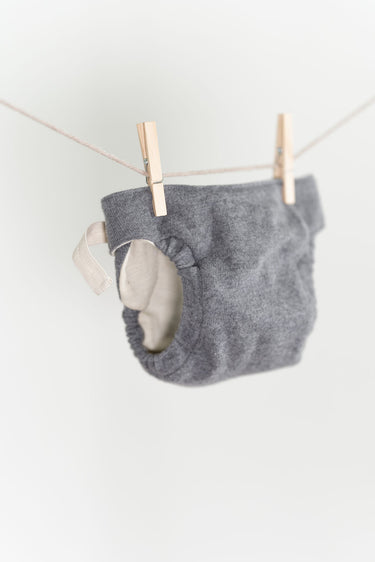
7 Changes When Disposable Diapers Become Less Common in Your Daily Life
What happens when you start diapering differently?
Perhaps you’ve had this thought:
"Does my baby really have to wear so many disposable diapers every day – or is there another way?"
Maybe you want to produce less waste. Maybe you wish for more natural materials against your baby's skin. Or perhaps you've heard about elimination communication and are wondering if it could fit into your daily routine.
Giving up disposable diapers doesn't automatically mean your baby has to be diaper-free all the time.
Cloth diapers, elimination communication diapers, reusable inserts, and part-time elimination communication with a backup can be combined in many different ways.
It's not about perfection. It's about finding a way that suits your baby, you, and your family's daily life.
1. You Become More Aware of Your Baby's Eliminations
When not every elimination automatically ends up in a disposable diaper, your perception of your baby often changes.
You might start to notice more precisely:
- When does my baby get restless?
- Are there specific sounds or movements?
- Does he often need to go after sleeping or nursing?
- At what times is elimination communication particularly easy?
You don't have to recognize every signal. Many families also orient themselves to typical situations, such as after waking up, after a meal, or before bedtime.
Elimination communication is not about getting your baby potty-trained as quickly as possible. You simply regularly give them the opportunity to relieve themselves outside of the diaper.
2. Your Diaper Waste Can Be Significantly Reduced
Over the entire diapering period, a child will have several thousand diaper changes. Each disposable diaper is used only once and then ends up in the residual waste.
If you partially or completely replace disposable diapers with reusable solutions, your waste volume can therefore be noticeably reduced.
How big the difference is depends on your personal approach:
- Do you only practice elimination communication once or twice a day?
- Do you use cloth diapers?
- Do you only use disposable diapers when out and about or at night?
- Do you live predominantly or completely without disposable diapers?
Even small changes count. Every disposable diaper you don't use is one less diaper in the trash.
You can find detailed guidance in our comparison: Disposable Diapers, Cloth Diapers, or Elimination Communication – What Are the Options?
3. New Routines Can Emerge From Automatic Diapering
Without disposable diapers, everyday life doesn't automatically become easier. Initially, it primarily becomes different.
Reusable inserts need to be washed. Cloth diapers require a suitable care routine. With elimination communication, there are moments when it works wonderfully – and others when the pee ends up in the backup or on the mat.
Over time, however, small routines often develop that seamlessly integrate into your day:
- Elimination communication after waking up
- A fresh insert after nursing
- A potty within reach
- Easy-to-open clothing
- A reliable backup for on the go and at night
You don't have to constantly pay attention to your baby. It's enough to start with individual situations that feel good for you.
4. The Diaper Can Go From Standard to Backup
Elimination communication doesn't necessarily mean no diapers.
Many families continue to use a diaper – but with a different attitude. It no longer serves exclusively as a place for every elimination, but as a security in the background.
Such a backup can be particularly helpful:
- when out and about
- in the car or stroller
- during sleep
- on particularly turbulent days
- when signals are difficult to recognize
- when other caregivers are with your baby
This way, elimination communication can remain flexible. You can practice elimination communication when it fits, and still feel secure if a moment doesn't go as planned.
5. Reusable Materials Get a Permanent Place
When disposable diapers become less common, other items often move into family life:
- washable diaper inserts
- cloth diapers or elimination communication diapers
- wool covers
- a small potty or an elimination communication bowl
- washable mats
- clothing that can be opened quickly
However, reusable doesn't mean effort-free. Textiles need to be washed, dried, and occasionally cared for.
But you can use many of these products for a long time, pass them on, or save them for siblings. Instead of regularly buying new disposable products, you gradually build up a system that fits your daily life.
6. There Will Still Be Wet Inserts and Small Accidents
Even without disposable diapers, everyday life with a baby remains true family life.
There will be days when you recognize multiple signals. And there will be days when you don't notice a single one.
Perhaps some pee ends up on the changing pad. Perhaps the backup is wet more often than expected. Perhaps you want to use more diapers again during a challenging phase.
All of this is perfectly fine.
Elimination communication is not a performance system. There is no quota you have to reach. A diaper is not a step backward, and a missed elimination is not a mistake.
What matters is that your approach supports you – and doesn't put additional pressure on you.
7. You Discover How Many Options You Actually Have
Those who only know disposable diapers often experience diapering as an either-or: diaper on or diaper off.
But there are many possibilities in between.
You can:
- only practice elimination communication after waking up
- use cloth diapers at home and disposable diapers when out and about
- try elimination communication during the day and use an absorbent backup at night
- start with a single reusable insert
- switch between different solutions depending on your life stage
This freedom can be relieving. You don't have to decide today for the entire diapering period. You are allowed to try things out, observe, and adapt your approach again and again.
Do You Have to Completely Give Up Disposable Diapers?
No.
Even a few eliminated outputs or individual reusable diapers can reduce your consumption of disposable diapers.
You can start small:
- with one elimination communication moment in the morning
- with washable inserts at home
- with a backup that opens quickly
- with elimination communication-friendly clothing
Perhaps more will develop from it over time. Perhaps it will remain a small ritual. Both are valuable, as long as it feels good for you.
Which Alternative Suits You?
There isn't one solution that works for every family.
Cloth diapers can be a good choice if you want to completely avoid disposable diapers and can integrate a reliable washing routine into your daily life.
Elimination communication can be for you if you want to be more consciously involved in your baby's eliminations.
Part-time elimination communication combines individual elimination communication moments with a backup and is a relaxed introduction for many families.
A combination of disposable diapers, cloth diapers, and elimination communication can be sensible if you want to remain flexible.
Your Next Step
You don't have to get rid of all disposable diapers overnight.
Start with a moment that feels easy. Many parents start after waking up, as the likelihood of an elimination is often particularly high then.
- Observe your baby without pressure or expectations.
- Offer them the potty or sink.
- Use a backup if you feel more secure with it.
- Be happy about every successful moment.
- Let difficult days simply be difficult days.
Our wool elimination communication diapers, reusable diaper inserts, and our elimination communication-friendly clothing are designed to make this journey easier for you in real family life.
Not every pee has to go into a diaper. And not every diaper has to be a disposable diaper.


