
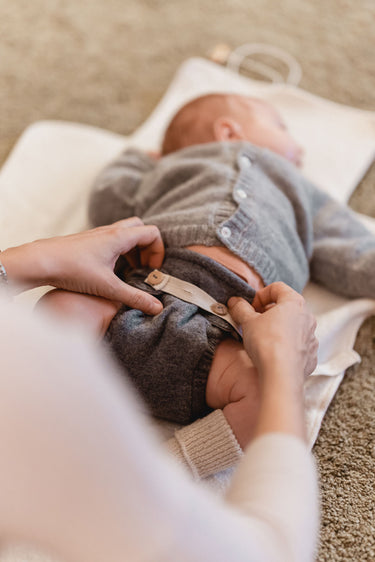
Cloth Diapers: Benefits for Babies, Parents, and the Environment
More and more parents are asking themselves:
Is there a more natural and reusable alternative to disposable diapers?
One option is cloth diapers.
Modern cloth diaper systems often have little in common with the complicated ideas many people still have. They can be practical, reliable, and highly customizable to suit family life.
Key benefits of cloth diapers include:
- significantly less diaper waste
- reusable materials
- long-term use
- more material choices
- the option to combine cloth diapers with elimination communication
However, cloth diapers are not entirely effortless. They need to be washed, dried, and assembled to fit the child.
Whether cloth diapers are right for you therefore depends not only on their benefits but also on your needs, your washing facilities, and your family's daily routine.
1. Cloth diapers create less residual waste
A child needs several thousand diapers throughout the entire diapering period. With disposable diapers, each individual diaper is used only once and then discarded.
Cloth diapers, on the other hand, can be washed and reused repeatedly.
Depending on their quality and condition, they can also be:
- reused for siblings
- passed on within the family
- sold second-hand
- supplemented with new inserts or covers
This can significantly reduce the amount of residual waste in daily family life.
You can find out how many diapers and how much waste can accumulate during the diapering period in our article:
How much diaper waste does a baby really generate?
2. The environmental balance depends on usage
Cloth diapers are reusable. However, this does not automatically mean that every cloth diaper in every usage situation has a better environmental balance.
Washing and drying also require water and energy. How sustainable a cloth diaper system truly is therefore depends, among other things, on:
- how long the diapers are used
- whether they are used for multiple children
- at what temperature they are washed
- whether the washing machine is full
- whether the diapers air dry or are tumble-dried
- how durable the inserts, covers, and fasteners are
A cloth diaper system usually becomes particularly sensible when the diapers are used for a long time, washed as energy-efficiently as possible, and not replaced after a short period.
Sustainability therefore does not arise solely from the product. It also arises from how it is used.
3. Cloth diapers can be cheaper in the long run
The initial cost of a complete cloth diaper system often seems expensive.
Depending on the system, several diapers, covers, absorbent inserts, and possibly additional accessories are needed. There are also costs for water, electricity, and detergent.
Nevertheless, cloth diapers can be financially appealing over the entire diapering period.
This is especially true if:
- the diapers are used for several years
- they are also used for siblings
- second-hand cloth diapers are purchased
- well-preserved products are later resold
- only individual components need to be replaced
Whether you actually save money depends on your chosen system, the number of diapers, and your washing costs.
Instead of a blanket promise, an honest calculation for your own daily life is worthwhile.
4. You can consciously choose materials
Many parents want to know exactly what materials come into contact with their baby's skin for many hours.
With cloth diapers, you can usually choose and combine the individual layers yourself.
Depending on the system, the following materials may be used:
- organic cotton
- hemp
- wool
- viscose fibers
- synthetic functional materials
Each material fulfills a different purpose.
Cotton absorbs liquid quickly. Hemp can provide additional absorbency. Wool is often used as a breathable and temperature-regulating cover or as a natural backup.
This allows you to put together a system that suits your baby and your personal priorities.
You can find more about the properties of the different materials in our Fabric Science for Baby Skin, Elimination Communication, and Diapering.
5. Are cloth diapers better for baby's skin?
Cloth diapers are often generally described as being gentler on the skin. However, it's not that simple.
Heat and moisture can also build up in a cloth diaper. If a wet diaper stays on the body for too long, it can irritate delicate baby skin.
For the most comfortable diaper area possible, the following points are therefore particularly important:
- check the diaper regularly
- change wet or soiled diapers promptly
- ensure a good fit
- rinse detergent residues thoroughly
- avoid irritating fragrances and unsuitable care products
- allow the baby regular time without a closed diaper
Some babies get along very well with cloth diapers. Others need a different material combination or feel more comfortable with a highly absorbent system.
Therefore, there is no single diaper that is best for every baby's skin.
A more detailed classification can be found here:
Disposable diapers, cloth diapers, or elimination communication: what is gentler on baby's skin?
6. Your baby can perceive wetness more consciously
Many disposable diapers quickly trap liquid inside. This often makes the surface feel relatively dry, even though the baby has already soiled it.
With many cloth diaper systems, wetness is more noticeable.
This can help parents notice excretions more quickly. Some children also react more strongly to the insert getting wet.
However, this should not lead to a performance expectation.
Cloth diapers do not automatically lead to a child becoming potty-trained earlier. When a child is ready for the potty or toilet depends on many individual developmental steps.
However, more conscious perception can help to accompany excretions as a normal part of family life.
7. Modern cloth diapers can be very suitable for everyday use
When it comes to cloth diapers, many people still think of large muslin squares, complicated folding techniques, and safety pins.
These options still exist. However, there are now numerous modern systems available.
These include, for example:
- all-in-one diapers
- pocket diapers
- covers with changeable inserts
- fitted diapers
- prefolds and muslin diapers
- wool covers
Some systems are put on almost like a disposable diaper. Others consist of several parts and can therefore be adapted particularly flexibly.
Which system is easiest depends on your needs. Some parents want as few individual parts as possible. Others only want to change the wet insert and reuse the cover multiple times.
8. Cloth diapers require a reliable washing routine
An honest assessment also includes this: cloth diapers create laundry.
Used diapers must first be collected and then hygienically washed. Storage and preparation differ slightly depending on the child's age and the type of excretion.
For a relaxed daily routine, the following help:
- a sufficient number of diapers and inserts
- a suitable container or wet bag
- a fixed washing routine
- a suitable detergent
- enough space to dry
Fabric softener is not suitable for absorbent inserts, as it can coat the fibers and reduce absorbency.
Those with little space, no washing machine of their own, or few drying options may find cloth diapers more cumbersome. This should also be taken into account when making a decision.
9. Cloth diapers can be easily combined with elimination communication
Cloth diapers and elimination communication are not mutually exclusive. On the contrary: many families combine both options.
With elimination communication, you give your baby the opportunity to urinate or defecate outside the diaper – for example, over a potty, a bowl, the toilet, or the sink.
The cloth diaper or elimination communication diaper remains on the body as a backup.
This can mean:
- fewer wet or soiled diapers
- less laundry
- a more conscious perception of excretions
- more flexibility in family life
You don't have to live completely diaper-free for this. Even individual elimination communication moments can complement your cloth diaper routine.
We explain exactly what elimination communication means here:
Easily understand elimination communication and diaper-free living
10. An elimination communication diaper can simplify everyday life
Classic cloth diapers often have to be fully opened or removed for elimination communication.
An elimination communication diaper, on the other hand, is specifically designed to be quickly opened and closed again. Your baby still wears an absorbent backup, but can be more easily held over a suitable place for elimination.
This is particularly practical:
- after waking up
- before or after breastfeeding
- before bedtime
- on the go
- at night
- with clear signals from the baby
Our wool elimination communication diapers combine a quick-opening system with natural materials and a soft backup for everyday use.
Our washable diaper inserts made from natural materials match these.
What are the disadvantages of cloth diapers?
Cloth diapers offer many advantages. Nevertheless, they do not automatically suit every family and every life stage.
Possible challenges include:
- higher initial purchase costs
- regular additional laundry
- space requirements for storage and drying
- finding the right system
- a bulkier diaper on the baby
- arrangements with daycare or caregivers
- more organization on the go
Many of these points can be simplified with experience and a good routine. Nevertheless, cloth diapers do not have to be the sole solution for every family.
Mixed forms are also possible.
Cloth diapers, disposable diapers, or elimination communication?
You don't have to choose a rigid either-or.
Many families use:
- cloth diapers at home and disposable diapers on the go
- cloth diapers during the day and a different backup at night
- elimination communication diapers in predictable situations
- disposable diapers during travel or particularly challenging phases
- a combination of cloth diapers and part-time elimination communication
Which solution suits you may change with your daily life.
You can find a detailed comparison in our article:
Disposable diapers, cloth diapers, or elimination communication: What are the options?
Conclusion: Cloth diapers are an option, not a must
Cloth diapers can help families reduce diaper waste, make more conscious material choices, and integrate reusable products firmly into their daily lives.
They can be financially beneficial in the long term and can be easily combined with elimination communication or part-time diaper-free living.
At the same time, they require water, energy, time, and a suitable washing routine.
Therefore, there isn't one right diaper solution for all families.
The best solution is the one that fits your baby, your values, and your actual daily life.
Is elimination communication new to you?
You don't have to change your entire diapering system immediately.
You can start with a single moment – for example, after waking up – and calmly observe how it feels for you.
Discover the free starter guide to elimination communication


