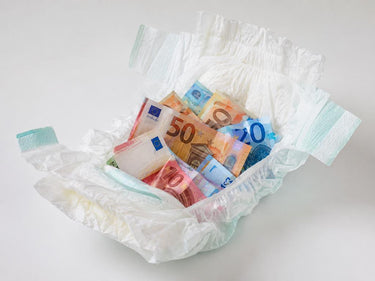
A baby doesn't need much at the beginning.
Closeness.
Milk.
Sleep.
Lots of love.
And an astonishing number of diapers.
Especially before the birth, many parents ask themselves:
How much money do we actually need to budget each month just for diapering?
The answer depends heavily on which diapers you use and how often your baby is changed.
For disposable diapers alone, a realistic model calculation can be roughly between:
20 and 70 Euros per month
This is a realistic figure.
With wet wipes, disposable changing mats, and other consumables, it can be even more.
But precisely here, there are also some ways to reduce monthly diapering costs easily.
What do diapers cost per month?
The simplest calculation is:
Diapers per day × 30 days × price per diaper.
Let's take five disposable diapers per day as an example.
That's roughly:
150 diapers per month.
Depending on the unit price, this results in:
| Example price per diaper | Cost for 150 diapers per month |
|---|---|
| €0.15 | €22.50 |
| €0.20 | €30.00 |
| €0.30 | €45.00 |
| €0.40 | €60.00 |
This quickly shows:
Not only the number of diapers determines the monthly costs. The unit price makes a big difference.
Newborns often need more diapers
Especially in the first few weeks, changes are usually more frequent.
For example, if a baby needs six diapers per day, that's roughly:
180 diapers per month.
At an example unit price of 30 cents, that would be:
54 Euros per month.
At 40 cents:
72 Euros.
This does not mean that every newborn needs exactly six diapers daily.
Some need more.
Others less.
And of course, a diaper should always be changed when it's full or soiled.
For older babies, consumption may decrease
As children get older, the diaper-changing rhythm often changes.
Let's take four disposable diapers per day as an example.
That's roughly:
120 diapers per month.
At 30 cents per diaper:
36 Euros per month.
At 40 cents:
48 Euros.
Therefore, diapering costs are not the same every month of life.
How much should I budget for diapers per month?
If you're planning a family budget just before the birth, you can work with a simple range.
For disposable diapers alone, a rough model calculation would look something like this:
- inexpensive diapers: approximately 20 to 30 Euros per month
- mid-range price: approximately 30 to 50 Euros per month
- more expensive diapers or pull-ups: approximately 50 to 70 Euros or more per month
These are not fixed market prices.
They only show the magnitude at different unit prices and diaper quantities.
For your personal calculation, it's best to:
Look at the unit price of your diaper – not just the price of the pack.
Why the pack price can be deceiving
A pack for 12 Euros can be cheaper than a pack for 9 Euros.
Sounds strange.
But it's very simple:
What matters is how many diapers are inside.
That's why it's always worth looking at:
Price per diaper.
If a pack contains 40 diapers for 12 Euros:
€12 ÷ 40 = 30 cents per diaper.
A pack with 25 diapers for 9 Euros, on the other hand, costs:
€9 ÷ 25 = 36 cents per diaper.
The seemingly cheaper pack is therefore more expensive per diaper.
In addition to diapers, there are often other diapering costs
The diaper is usually the largest regular consumption item.
But depending on how you diaper, other things are added.
For example:
- wet wipes
- diaper sacks
- disposable changing pads
- diaper rash cream
- disposable inserts
Not every family uses all of these products.
Some use water and washcloths.
Others wet wipes.
Some have a washable changing mat.
Others like to use disposable ones when out and about.
Therefore, it would make little sense to simply add a flat amount for all families.
What are the total monthly diapering costs?
If you add up disposable diapers and other consumables, the monthly diapering budget can quickly be higher than the pure diaper bill.
A family with inexpensive diapers and many reusable aids can be significantly below a family that:
- uses more expensive diapers or pull-ups
- needs many wet wipes
- uses disposable changing mats
- uses additional disposable products
Therefore, for personal family planning, I would not ask:
What are the average diapering costs?
But:
What things do we actually want to use regularly?
Disposable products are small – but they repeat every month
This is precisely the special characteristic of diapering costs.
A diaper may cost 30 cents.
A wet wipe only a few cents.
A diaper bag likewise.
It all feels like little.
But:
today.
Tomorrow.
The day after tomorrow.
Every month.
For years.
For consumables, the big bill doesn't come from a high individual price, but from constant repetition.
What do 45 Euros in monthly diaper costs mean over time?
Let's take our example again:
150 diapers per month.
30 cents per diaper.
That's:
45 Euros per month.
In one year:
540 Euros.
Of course, consumption does not remain exactly the same for two and a half years.
However, the calculation clearly shows why small unit prices add up over the diapering period.
For the entire diapering period, we have therefore created our own detailed cost comparison:
How much do diapers really cost until potty training?
How can you reduce monthly diaper costs?
The most obvious option is:
buy cheaper.
For example:
- compare unit prices
- check larger packs
- use offers
- compare different brands
But there's a second lever.
And that's particularly exciting for us:
Not only buy cheaper diapers – but sometimes not even need a diaper.
What does one less diaper a day save per month?
Here the calculation becomes particularly simple.
One diaper that is actually not needed per day is approximately:
30 fewer diapers per month.
For an example diaper costing 30 cents, that saves:
around 9 Euros per month.
At 40 cents:
around 12 Euros.
That doesn't sound huge at first.
But over the entire diapering period, that one small daily moment can simply add up to around:
1,000 fewer diapers
This can result in significant savings.
One less diaper a day: How much money does that really save?
One less diaper never means: changing later
Please don't.
If a diaper is wet or soiled, it is changed.
The saving does not come from your baby staying in it longer.
But, for example, like this:
Your baby wakes up in the morning.
The backup is still clean.
You know:
Now usually comes a pee.
So you hold your baby briefly over a sink or potty.
It pees.
The backup remains dry.
And is worn further.
Exactly then, a new diaper was actually not needed.
What is "elimination communication" anyway?
With elimination communication, you give your baby the opportunity to eliminate outside their diaper.
For example, over:
- a sink
- a small potty
- the toilet
This is often also called diaper-free or elimination communication.
And most importantly:
Diaper-free does not mean your baby is not allowed to wear a diaper.
A backup can always remain.
Maybe elimination communication is only practiced once in the morning.
Perhaps during a bowel movement.
Maybe more often.
Perhaps not at all today.
What is elimination communication? Diaper-free explained simply
Can you save money monthly with part-time elimination communication?
Yes, if disposable diapers are actually not needed as a result.
Let's take three avoided diapers per week.
That's roughly:
12 to 13 diapers per month.
For a 30-cent diaper, that's just under:
4 Euros per month.
Five diapers a week correspond to approximately 20 to 22 diapers a month.
At 30 cents each:
approximately 6 Euros monthly.
One diaper a day:
around 9 Euros monthly.
Perhaps that's not an amount that will turn your family budget upside down.
But it adds up over months and years.
Not every elimination communication automatically saves money
For an honest calculation, we must always distinguish this.
If the diaper is already full and needs to be changed anyway, an additional pee over the potty does not automatically save another diaper.
Financially, it becomes particularly relevant if:
- the backup is clean
- your baby eliminates outside of it
- the backup remains clean
- and can continue to be worn
Only these actually unneeded disposable diapers belong in the savings calculation.
Can you also save on wet wipes?
Yes.
And it doesn't necessarily require elimination communication.
At home, for example:
- water
- small washcloths
- reusable wipes
can be an alternative to disposable wet wipes.
Especially with elimination communication for pee, little cleaning is often needed anyway.
For bowel movements, elimination communication can also lead to less skin surface needing to be cleaned, because the excretion is not first distributed in the diaper.
This doesn't mean you can never use wet wipes on the go again.
Perhaps you use washcloths at home and wet wipes when out and about.
Even a hybrid solution can reduce costs and waste.
What about disposable changing pads?
Here too, the same principle repeats itself.
A single pad doesn't cost much.
Many of them over months cost more.
A reusable changing pad costs money once and can then be used again and again.
Especially when on the go, this can be practical.
Here too, you don't have to completely abolish every disposable solution.
Perhaps you have a washable pad for everyday use and a few disposable pads for situations where they make your life easier.
What do cloth diapers cost per month?
With cloth diapers, the monthly bill cannot be as easily read from a pack.
A large part of the costs arises during acquisition.
After that, there are ongoing costs for:
- water
- detergent
- electricity
- and possibly the dryer
How high these are monthly depends very much on washing habits.
Therefore, there is no meaningful uniform monthly amount for all families.
Anyone who wants to know whether cloth or disposable financially better suits their daily life can find our detailed comparison here:
Cloth diapers or disposable diapers: What is really cheaper?
Can elimination communication also reduce costs with cloth diapers?
Yes, but differently than with disposable diapers.
With a disposable diaper, a truly unneeded diaper immediately saves its purchase price.
A cloth diaper is reused anyway.
If it stays clean through elimination communication, however, it is possible that:
- an insert can be used longer
- less change of clothes is needed
- less laundry accrues
How big the financial effect is depends very much on the respective system.
Therefore, we would not name a general savings sum for this.
Why the right clothing can even influence monthly diapering costs
Elimination communication itself sometimes takes only a few moments.
The complicated part comes before that.
Bodysuit.
Pants.
Maybe tights.
Then the backup.
You notice:
My baby needs to go now.
And by the time everything is opened, the pee was faster.
That's exactly why Mata Origin's clothing was developed for elimination communication.
The easier you can access the diaper area, the easier you can actually take advantage of a suitable moment.
Elimination Communication Pants: fewer hurdles between baby and potty
An elimination communication pant from Mata Origin can be quickly opened at the diaper area.
Your baby doesn't have to be completely undressed every time.
That sounds like a small detail.
But especially if elimination communication is to become part of normal daily life, these few steps are important.
The simpler the moment becomes, the more likely it is to be used.
And only if a backup actually stays dry can it also become a saved disposable diaper.
Elimination Communication Diapers: Backup yet quickly opened
An elimination communication diaper from Mata Origin is also designed for exactly this combination.
Your baby remains protected.
If something goes into the backup, that's perfectly fine.
If a good elimination communication moment arises, it can be opened quickly.
If it stays clean, it's simply closed again and worn on.
So, saving money doesn't have to mean sacrificing safety.
But Elimination Communication (EC) gear costs money too, doesn't it?
Of course.
And that's why it needs to be included in an honest calculation.
A potty costs money.
An EC diaper.
Washable inserts.
EC-friendly clothing.
But:
You don't need all of it to start with EC.
And many of these items can be reused repeatedly.
Perhaps even for a sibling.
That's why we've thoroughly examined this calculation separately:
How much does EC cost – and is EC financially worthwhile?
How much does diapering two children cost per month?
If two children wear diapers at the same time, the monthly budget can almost double.
Let's take an example:
150 disposable diapers per child per month.
For two children:
300 diapers.
At a unit price of 30 cents:
90 euros in pure diaper costs per month.
At 40 cents:
120 euros.
Additional consumables may also apply.
Especially when siblings are diapered simultaneously, small savings therefore become visible more quickly.
A very simple personal monthly calculation
If you want to know what you actually spend monthly on diapering, you don't need a complicated calculator at all.
For one month, write down:
- how many packs of diapers you buy
- how many wet wipes
- what other disposable products
- and what reusable products are newly purchased
Then you'll know much more than with any average value from the internet.
And perhaps you'll notice:
We don't need disposables everywhere.
Or:
These three EC moments per week work surprisingly well.
Then you can continue right there.
What can a frugal diapering routine look like?
Perhaps like this:
After waking up, the baby is held for EC.
During the day, the baby wears a backup.
At home, you use small washable cloths.
When out and about, wet wipes stay in the bag.
The changing mat is reusable.
And if a day is chaotic, diapering is done normally.
Saving doesn't have to mean optimizing every diaper change.
Often, a few simple habits are enough.
Frequently asked questions about monthly diaper costs
How much do diapers cost per month?
That depends on the unit price and consumption. For example, with 150 diapers per month, the costs are around 22.50 euros at 15 cents per diaper, 45 euros at 30 cents, and 60 euros at 40 cents.
How many diapers does a baby need per month?
That depends on the age and individual diapering needs. At five diapers a day, it would be approximately 150 diapers per month, at six daily about 180.
How much money should one budget for diapers per month?
As a guideline, pure diaper costs can range approximately between 20 and 70 euros or more per month, depending on the unit price and consumption. Additional diapering products may be added.
How much does a newborn cost in diapers per month?
With, for example, six diapers daily, about 180 diapers are needed per month. At 30 cents per diaper, that would be around 54 euros, at 40 cents approximately 72 euros.
What additional diapering costs are there?
Depending on the family, these can include wet wipes, diaper bags, disposable changing pads, inserts, and care products.
How can I reduce monthly diaper costs?
You can compare unit prices, take advantage of offers, replace certain disposable products with reusable alternatives, and practice EC with your baby in suitable situations. This can reduce the number of disposable diapers actually needed.
How much does one less diaper per day save in a month?
One less diaper per day corresponds to approximately 30 diapers per month. At 30 cents per diaper, that would be about 9 euros, at 40 cents about 12 euros.
Does my baby need to be completely diaper-free to reduce diaper costs?
No. Even individual regular EC moments can lead to fewer disposable diapers being needed.
Are cloth diapers cheaper monthly?
That depends on acquisition, washing costs, drying, and duration of use. Cloth diapers can become particularly attractive if they are used for a long time and later passed on to siblings.
Conclusion: It's not the 30 cents – it's every day
A diaper doesn't cost much.
Neither does a wet wipe.
And a diaper bag doesn't either.
And yet, this adds up to a bill every month.
20 euros.
40 euros.
60 euros.
Perhaps more.
You don't have to start looking at every diaper change in terms of cents.
Your baby needs a fresh diaper when it needs one.
But maybe there's a little moment in the morning.
Your baby wakes up.
You open their EC pants.
Hold them briefly over the sink.
They pee.
The backup stays dry.
And today, one less diaper is needed.
Maybe that's only 30 cents.
But 30 cents every day eventually adds up to around 300 euros.
And perhaps that's a beautiful way to save:
not on your baby – but where a disposable product is sometimes simply not necessary.
Read more
- How much do diapers really cost until potty training?
- One less diaper per day: How much money does that save?
- How much does EC cost – and is EC financially worthwhile?
- Cloth diapers or disposable diapers: Which is cheaper?
Perhaps your savings start with a single moment
You don't have to completely change your daily diapering routine.
Perhaps you simply try EC after waking up.
Our free starter guide shows you how to begin stress-free.
And if EC becomes a more frequent part of your daily life, EC pants, EC diapers, and washable diaper inserts make these small moments easier.