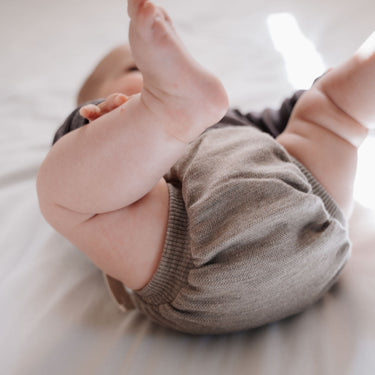
Sometimes it's not the big changes that make the most difference.
But the little things that quietly creep into our everyday lives.
A brief moment after waking up.
Opening the diaper.
Picking up the baby.
Holding them over the sink, a potty, or the toilet.
And perhaps, at that very moment, what would otherwise have ended up in a freshly changed diaper a few seconds later happens.
A pee.
A diaper that stays dry.
One less diaper.
At first, that sounds like almost nothing.
But if it becomes a small daily ritual, amazing things can add up over the diapering period.
One less diaper per day amounts to approximately 913 diapers over two and a half years.
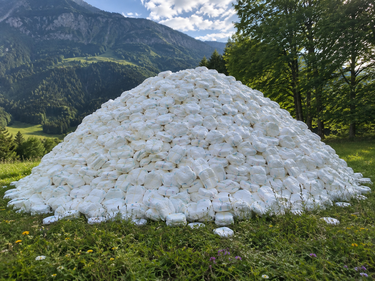
Almost 1,000 disposable diapers.
Not through perfection.
Not by having to watch your baby all day long.
And not by suddenly having to live completely without diapers.
But perhaps simply by one single elimination communication moment a day.
Almost 1,000 fewer diapers – how can that be?
A single diaper seems small.
But days turn into weeks. Weeks turn into months. And months eventually turn into years.
The calculation is quite simple:
- 1 fewer diaper per day
- 7 fewer diapers per week
- about 30 fewer diapers per month
- 365 fewer diapers per year
- approximately 913 fewer diapers in two and a half years
For an assumed diapering period of about two and a half years, based on typical consumption values, approximately 3,800 disposable diapers per child can be estimated.
913 fewer diapers would be almost a quarter of that.
Simply by one small moment a day.
Of course, this is a model calculation.
Some babies are in diapers longer. Some shorter. On some days, elimination communication works wonderfully. On others, not at all.
And you know what?
That's exactly how it should be.
The number is not meant to be a new goal you have to achieve.
It's meant to show something else:
Small changes are not insignificant.
One less diaper does not mean: staying in a diaper longer
This is particularly important to us.
Saving diapers does not mean leaving a full diaper on the baby for longer.
A wet or soiled diaper should be changed. As soon as possible after a bowel movement.
One less diaper does not happen by waiting longer.
It happens when the excretion doesn't even end up in the fresh diaper in the first place.
For example:
You've just changed your baby's diaper.
Shortly thereafter, they become restless. Or you now know: after feeding, they often need to pee.
You open the diaper again, hold your baby for a moment – and the diaper stays dry.
Exactly there, a diaper can be saved.
Not changing less. But creating fewer full diapers.
And this is where Elimination Communication begins
Many parents hear the word "diaper-free" and immediately think:
I could never do that. I don't want to walk around without a diaper all day.
You don't have to.
Diaper-free can start very small.
With elimination communication, you simply give your baby another option to relieve themselves, in addition to the diaper.
The diaper can stay on.
It can provide security.
It can catch what you don't notice.
It just won't automatically be the only place for every pee and poop anymore.
And sometimes, that's exactly where something beautiful begins:
You suddenly realize that your baby's eliminations are not completely unpredictable.
Perhaps they almost always need to go after waking up.
Perhaps during feeding.
Perhaps they pull their legs up beforehand.
Perhaps they become restless for a moment.
Perhaps there are no visible signals at all – but a rhythm.
You don't have to know all of this right away.
You can discover it together with your baby.
What does Elimination Communication mean? Find a simple introduction here.
The easiest moment: after waking up
If we parents had to recommend a single moment to start, it would often be this one:
directly after waking up.
Why?
Because your baby will wake up anyway.
Because you'll pick them up anyway.
Because the diaper is often opened anyway.
And because many babies eliminate after sleeping.
So you can simply try:
- Your baby wakes up.
- You open the diaper.
- You hold them for a short moment over the sink, potty, or toilet.
- You wait completely relaxed.
- Then you get dressed again.
Maybe something will come out.
Maybe not.
Both are perfectly fine.
Diaper-free is not a test your baby has to pass.
And you don't have to "do anything right" either.
You are just offering an option.
Elimination Communication after waking up: The easiest start
What if it only works three times a week?
Then it's still three fewer diapers.
We live in a world where sustainability often sounds very grand.
Plastic-free.
Zero Waste.
Completely sustainable.
100 percent.
Especially with a baby, this can quickly sound like another chore.
That's why we want to look at the calculation the other way around.
If you don't save a diaper every day, but only three times a week, that's approximately over two and a half years:
390 fewer diapers.
Five times a week?
About 650 fewer diapers.
Only on weekends?
That also adds up.
It doesn't have to work daily to have an effect.
Perhaps that is one of the most important messages of part-time diaper-free:
You don't have to change everything for something to change.
Part-time Diaper-Free: Why even individual moments count
What do almost 1,000 diapers mean for waste?
When we throw away a diaper, it surprisingly quickly disappears from our sight.
Lid open.
Diaper in.
Lid closed.
But of course, it hasn't disappeared.
It is collected, transported, and finally disposed of with the rest of the waste.
An unused disposable diaper weighs differently depending on its size and product. If we assume approximately 36 grams, 913 diapers correspond to:
33 kilograms of diaper material.
33 kilograms of material that must first be produced.
This includes – depending on the diaper – among other things:
- Cellulose pulp
- Superabsorbent polymer
- Plastic non-wovens
- Films
- Adhesives
- Elastic
- Fasteners
And then the entire product is disposed of again after only a few hours of use.
For a used diaper, of course, the weight of urine and stool is added.
As a result, 913 avoided diapers can theoretically mean approximately 99 to 131 kilograms less residual waste.
Important to note:
A large part of this weight is, of course, the excretions themselves.
Your baby doesn't produce less pee just because you practice elimination communication.
The difference lies in where it lands.
With elimination communication, it lands in the potty, sink, or toilet – instead of ending up in the residual waste along with plastic, cellulose, and superabsorbent.
You can find more about the quantities here:
How much diaper waste does a baby really generate?
One less diaper saves more than just waste
Before a disposable diaper even reaches your changing table, a lot has already happened.
Raw materials were extracted.
Cellulose was produced.
Plastics and superabsorbents were manufactured.
The diaper was assembled.
It was packaged.
Transported.
Brought to the warehouse.
Sent to retail.
And finally purchased by you.
After a few hours, it's thrown away.
Therefore, less diaper consumption also means in the long term:
- less raw material demand
- less production
- less packaging
- less transport
- less residual waste
A single family doesn't change a factory because of this.
But many families change demand.
And every big change ultimately consists of many small decisions.
What does one less diaper mean for your wallet?
Even financially, a small daily change adds up.
Diaper prices vary greatly.
A cheap drugstore diaper costs less than a high-quality eco-diaper. Larger sizes are often more expensive than small ones.
Therefore, you can easily calculate your potential savings yourself:
Price of one diaper × 913.
At an average price of 30 cents, that would be over two and a half years:
around 274 Euros.
At 40 cents per diaper:
around 365 Euros.
And of course, it's not about turning every elimination communication moment into a cost-saving measure.
But it's nice to know:
Something that can fit more naturally into your everyday life can simultaneously save resources and money.
What one less diaper can mean for baby's skin
Perhaps this is even the part we find most important.
Because one less diaper is not just one less piece of trash.
When your baby eliminates outside the diaper, it also means:
This excretion is not on their skin.
Especially with bowel movements, this can make a difference.
Instead of the stool:
- being spread in the diaper
- getting on the bottom and in skin folds
- staying there until changed
- then having to be thoroughly removed
it lands directly outside the diaper.
This doesn't mean that elimination communication automatically prevents every diaper rash.
Baby skin can be irritated for many reasons.
But less contact with urine and especially with stool is a very understandable advantage.
How Elimination Communication can relieve baby's skin
And what changes between you and your baby?
Maybe nothing at all.
But maybe something very small.
You begin to observe your baby differently.
Not constantly.
Not anxiously.
But curiously.
You might notice at some point:
Ah, that's why they always get so restless after waking up.
Or:
Interesting. After feeding, there's almost always a pee.
Or:
Now I know why they suddenly push during diaper changes.
This doesn't mean that parents who don't practice elimination communication know their baby less well.
It just means:
Elimination can become another small part of your communication.
Like hunger.
Tiredness.
Closeness.
Cold.
Or the desire to be carried.
Elimination is just as much a part of your baby's body.
And it's allowed to be visible.
What if we need a diaper?
Then use it.
It's that simple.
There are days with little sleep.
There are car rides.
Doctor's appointments.
Siblings.
Visitors.
Travel.
Illness.
And days when you simply don't feel like thinking about pee.
A diaper is there to give you security.
It is not a failure.
And if your baby goes in the diaper despite elimination communication, "diaper-free" hasn't "failed."
The backup simply did exactly what it was designed to do.
Diaper-free with a backup: Why a diaper is not a step backward
Perhaps sustainability needs less perfection
Parents, in particular, are constantly being told what they could be doing better.
Better nutrition.
Better sleep.
More sustainable shopping.
More enrichment.
Less plastic use.
And now maybe even fewer diapers?
No.
This article is not meant to feel that way.
One less diaper is not a new to-do on your list.
It's an opportunity.
Something you can try if it feels right.
Maybe it works.
Maybe it only works sometimes.
Perhaps through it, you discover diaper-free for yourselves.
Perhaps it just remains that one small morning moment.
That's enough too.
What happens if many families need one less diaper?
For one child, almost 1,000 diapers is already an astonishing number.
But let's take the thought further.
If 100 families use one less diaper daily, that's over two and a half years:
approximately 91,300 fewer disposable diapers.
For 1,000 families:
approximately 913,000 fewer diapers.
Almost a million diapers.
Not through radical abstinence.
But through many parents who perhaps try something new for two minutes in the morning.
That's where so much hope lies for us.
We don't have to wait for everyone to completely change their lives.
Sometimes it's enough for many of us to start a little differently.
What backup do you need for this?
For a start, no special one at all.
You can begin with the diaper you already use.
You can practice elimination communication with your baby and then close the same clean diaper again.
If elimination communication later becomes a more frequent part of your everyday life, a quick-opening backup can make things much easier.
That's exactly what elimination communication diapers are for.
They protect your baby when nothing is announced.
And when you notice a suitable moment, they can be opened quickly.
Our wool elimination communication diapers combine this easy access with a natural, reusable material.
You can also use washable diaper inserts.
But here too, the rule applies:
You don't need a new product to practice elimination communication with your baby for the first time.
Frequently Asked Questions
Can I really save almost 1,000 diapers?
Absolutely! One less diaper per day adds up to approximately 913 diapers over two and a half years. Whether this number is actually achieved in your daily life depends on how long your child wears diapers and how often a fresh diaper is truly saved through elimination communication.
Do I have to do elimination communication every day?
No. Even individual elimination communication moments count. Three times a week results in approximately 390 fewer diapers over two and a half years, five times a week approximately 650.
Does my baby have to be completely diaper-free?
No. Your baby can continue to wear a disposable diaper, cloth diaper, or elimination communication diaper as a backup. Diaper-free can be part-time diaper-free.
When is the easiest time for elimination communication?
Many families start after waking up. Your baby is picked up and often changed anyway, and many babies eliminate at this moment.
Do I automatically save a diaper every time I do elimination communication?
No. A disposable diaper is only truly saved when no fresh diaper is needed as a result. But an elimination communication moment that doesn't save a diaper can still help you learn rhythms and signals.
Should I leave a wet diaper on longer to save diapers?
No. Saving diapers does not mean delaying changes. The idea is to offer elimination outside the diaper so that the backup stays as clean as possible.
What if it doesn't work?
Then the diaper takes over. That's what it's there for. Elimination communication is not a test, and your baby doesn't have to learn or perform anything.
Conclusion: Perhaps change begins with a single pee
Almost 1,000 diapers.
The number sounds big.
The beginning doesn't have to be.
Perhaps it starts tomorrow morning.
Your baby wakes up.
You pick them up.
Open the diaper.
Hold it over the sink for a moment.
And maybe something will come.
Maybe not.
You don't have to make a project out of it.
You don't have to keep a list.
You don't have to count.
You can simply be curious.
Because a small moment can, over time, lead to something great:
fewer diapers.
less waste.
fewer resources.
less time with excretions on the skin.
And perhaps a little more awareness for what your baby shows you every day anyway.
Not perfectly diaper-free.
Not all or nothing.
Perhaps just one less diaper.
Read more
- How much diaper waste does a baby really generate?
- Part-time Diaper-free: Why even individual moments count
- Elimination Communication after waking up: The easiest way to start
- How Elimination Communication can relieve baby's skin
Would you like to try Elimination Communication?
Then don't start with the whole day.
Start with a moment.
Our free starter guide accompanies you step by step and shows you how Elimination Communication can work even if you don't know any signals yet.
Discover the free starter guide to Elimination Communication