Lanolin initially sounds like a specialized product.
Almost a bit technical.
But in reality, lanolin is something very natural.
It is the wool grease from sheep's wool.
It's exactly the substance that naturally protects wool, keeps it supple, and makes it more resistant to moisture.
For families who use wool diapers, wool covers, or elimination communication diapers, lanolin is therefore particularly important.
Because it helps maintain the natural function of the wool.
But how is lanolin actually obtained?
And what is the difference between lanolin and organic lanolin?
What exactly is lanolin?
Lanolin is the natural wool grease from sheep's wool.
Sheep don't produce this fat by chance.
It protects their fleece from moisture, wind, dirt, and external influences.
You can therefore think of lanolin as a natural protective layer for wool.
This very property also makes lanolin interesting for wool diapers and wool covers.
Because wool in the diaper area shouldn't function like plastic.
It should remain breathable.
It should regulate moisture.
And it should still help to retain wetness.
Lanolin supports precisely this function.
Is lanolin extracted from the sheep?
This question is important.
Because many parents want to know exactly where materials come from.
Lanolin is not "extracted from the sheep".
It is naturally present in sheep's wool.
When sheep are shorn, the raw wool contains not only the wool fiber but also wool grease, suint salts, dust, and other natural residues.
During the cleaning of the raw wool, this wool grease is recovered from the wash water.
This means:
Lanolin is produced in connection with virgin wool and wool washing.
The sheep is not killed for the lanolin.
Nevertheless, lanolin is not a vegan product because it comes from an animal.
This transparency is important to us.
How is lanolin obtained?
After shearing, the raw wool is cleaned.
This cleaning process is also called wool washing.
During this process, dirt, dust, suint salts, and wool grease are removed from the wool.
The wool grease is then in the wash water.
The raw wool grease is separated from this wash water.
In industrial processing, separation and purification processes are used, among others.
The wool grease initially obtained is still dark, strong-smelling, and contains natural residues.
To become lanolin for care products, it must be further cleaned and refined.
The result is the yellowish, waxy wool grease that many parents know as lanolin or wool wax.
Why does lanolin need to be purified?
Raw wool grease is not a finished care product.
It contains residues from the raw wool and from the washing process.
Therefore, it is cleaned, filtered, and processed.
Undesirable components are reduced in the process.
Odor, color, and purity change.
The dark raw material becomes a much lighter, finer, and more usable wool wax.
Especially when lanolin is used for wool diapers, elimination communication diapers, or baby clothing, this quality is crucial.
What is the difference between lanolin and organic lanolin?
Lanolin fundamentally describes the wool grease from sheep's wool.
Organic lanolin goes a step further.
Here it's not just about the wool grease being cleaned.
It's also about the origin of the raw material and the standards according to which it is produced and processed.
Therefore, questions like these play a role in organic lanolin:
- Where does the raw wool come from?
- Under what conditions are the animals kept?
- What standards apply to the raw material?
- What is the quality of the finished wool wax?
- Are there independent certifications?
This is particularly important when lanolin is used in everyday baby care.
Because then it's not just about function.
It's also about trust.
Organic Lanolin at Mata Origin
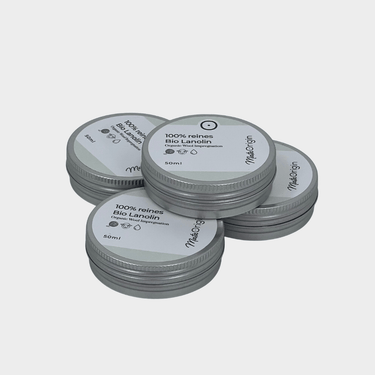
At Mata Origin, you'll find organic lanolin wool wax for the care of wool diapers, wool covers, and elimination communication diapers.
- Our organic lanolin consists of 100% pure organic lanolin.
- It contains no additives and no fragrances.
- It is produced in Germany for Mata Origin.
- The raw material comes from controlled organic animal husbandry according to EU Regulation (EU) 2018/848.
- It is also NATRUE certified.
This is important to us because lanolin is not just any care product.
It is part of our wool system.
And this system should suit delicate baby skin, natural care, and a conscious family life.
You can find the product here: Organic Lanolin Wool Wax
And here you can learn what makes organic lanolin so special.
What does NATRUE certified mean?
NATRUE is an international standard for natural and organic cosmetics.
For parents, the most important thing is:
The certification provides orientation.
It shows that a product meets certain requirements for natural ingredients, processing, and quality.
Especially with a product like lanolin, this is helpful.
Because many parents want to know whether they are using a pure, high-quality, and as natural as possible wool wax.
Our organic lanolin is NATRUE certified and contains no fragrances or unnecessary additives.
An external explanation of NATRUE can be found here: NATRUE: Requirements for natural and organic cosmetics
Is lanolin sustainable?
Lanolin is a natural raw material.
It is produced in connection with the processing of sheep's wool.
The wool grease is recovered during the cleaning of the raw wool and further processed.
This utilizes a component of the wool that would otherwise be lost in the washing process.
This makes lanolin interesting from a sustainability perspective.
At the same time, it is important:
Lanolin is not vegan.
It comes from sheep.
Therefore, it is particularly important under what conditions the raw material is produced and what standards are adhered to.
That's exactly why we at Mata Origin rely on organic lanolin with controlled raw materials and certified quality.
Why does wool need lanolin?
Wool naturally possesses special properties.
It is breathable.
- It can absorb moisture.
- It can regulate temperature.
- And it often feels pleasantly dry for a long time.
In the diaper area, there is an additional task:
Wool should help retain moisture.
For this, it needs wool grease.
Over time, wool loses some of its lanolin through use, friction, and washing.
Then the moisture protection function can diminish.
Through a lanolin bath, the wool is re-greased.
This allows it to fulfill its natural function better.
You can find more about this here: Greasing wool: How the lanolin bath works so easily
Why organic lanolin is so important for wool diapers and elimination communication diapers
Wool diapers and elimination communication diapers are close to the baby.
Therefore, not only the function is important.
But also the quality of the materials and care products.
Organic lanolin helps to make wool more water-repellent without forming a plastic layer.
The wool remains breathable.
It can continue to regulate moisture.
And it fits into a natural diaper system.
That's exactly why lanolin is not an additional product for many families.
But an important component of wool care.
An example of an elimination communication diaper made of wool can be found here:
Elimination Communication Diaper Babysize extra dry
Is lanolin skin-friendly?
Lanolin has been used in care products for a long time.
In connection with wool diapers and elimination communication diapers, however, it is primarily about the care of the wool.
The lanolin is intended to re-grease the wool fibers and support their function.
This can create a more pleasant climate in the diaper area because the wool remains breathable and can regulate moisture.
As with all natural materials:
Every baby is different.
If your baby is sensitive to lanolin or wool products, you should observe their skin and, if in doubt, discontinue use of the product.
How often should you re-grease with lanolin?
That depends on how intensely the wool is used.
For wool diapers, wool covers, and elimination communication diapers, re-greasing can be regularly useful.
Typical signs are:
- the wool feels damp more quickly
- clothing over it becomes clammy more quickly
- the moisture protection function diminishes
- the wool appears less protected
Then a lanolin bath is useful.
At Mata Origin, depending on use, we recommend re-greasing merino wool approximately every two to four weeks.
Detailed instructions can be found here: Greasing wool: How the lanolin bath works so easily
Further sources
If you want to delve deeper, here are two external sources on the extraction and certification of lanolin:
Conclusion: Organic lanolin is natural wool care with a traceable origin
Lanolin is the natural wool grease from sheep's wool.
It is obtained during the cleaning of shorn raw wool, then purified and processed into wool wax.
For wool diapers, wool covers, and elimination communication diapers, it is particularly valuable because it supports the natural moisture protection function of the wool.
Organic lanolin goes beyond pure function.
It also stands for origin, quality, and consciously selected raw materials.
At Mata Origin, we rely on 100% pure organic lanolin without additives and without fragrances.
So that wool can remain what makes it so special in everyday baby life:
- natural
- breathable
- functional
and comfortable on the skin.