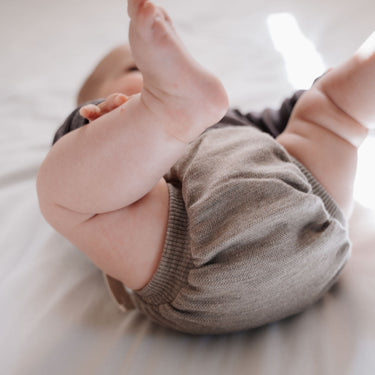
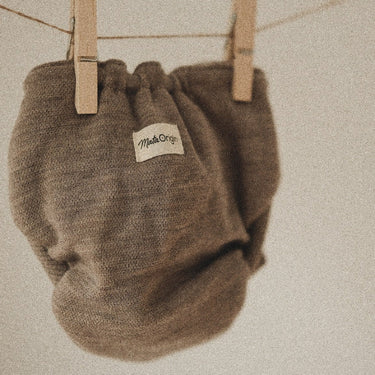
At first, elimination communication works wonderfully.
The wool diaper stays leak-proof. The clothes stay dry.
And you think: that's exactly why we use wool.
But eventually it happens:
The wool diaper feels damp more quickly.
The bodysuit gets clammy. Or the clothes over it are suddenly wet.
Then the question quickly arises:
Why is my wool diaper no longer leak-proof?
The good news:
In most cases, the wool diaper is not broken.
It just needs a little attention.
Wool works differently than plastic
First, it's important to understand: a wool diaper does not work like a plastic barrier.
It is not completely waterproof.
And that's not its goal.
- Wool needs to breathe.
- It can absorb moisture.
- It can regulate temperature.
- And it can become more water-repellent with lanolin.
This creates a natural system that behaves significantly differently from synthetic moisture protection materials.
So if a wool diaper no longer reliably protects, it is usually due to one of the following points.
1. The wool diaper needs lanolin again
The most common reason:
The wool is no longer sufficiently lanolized.
Lanolin is the natural wool grease from sheep's wool.
It helps the wool repel moisture better.
Over time, a wool diaper loses some of this wool grease through use, friction, and washing.
Then the moisture protection function can diminish.
Typical signs of this are:
- the wool diaper feels damp more quickly
- the clothes over it get clammy
- the diaper lasts for a shorter time than before
- the wool appears less protected
Then it's time for a lanolin bath.
You can find detailed instructions here:
Lanolizing wool: How easy the lanolin bath works
You can find suitable organic lanolin here: Organic Lanolin Wool Wax
2. The absorbent insert is full
Sometimes the problem is not with the wool.
But with the insert.
Wool can regulate moisture and serve as a natural moisture barrier.
But it does not replace sufficient absorbency.
If the insert is full, the moisture has to go somewhere.
Then even the best wool diaper will eventually become clammy.
Typical signs:
- the wool diaper only feels damp after a long wearing time
- the insert is completely wet
- the problem occurs particularly at night or when out and about
- your baby is peeing more than usual
In this case, a stronger or additional insert often helps.
You can find suitable inserts here: Discover diaper inserts
3. The wool diaper does not fit correctly
The fit also plays a major role.
If the wool diaper slips, fits too loosely, or does not lie well in certain places, moisture can escape more easily.
This happens particularly often:
- at the leg cuffs
- at the back
- with very active babies
- if the insert slips
- if clothes over it are too tight
It is important:
The wool diaper should fit comfortably.
But it should not be so loose that the insert no longer has good contact.
At the same time, clothes over it should not be too tight.
Because if a bodysuit or pants press heavily on the wet insert, moisture can be drawn outwards.
4. The clothes over it are too tight
This is often overlooked.
A wool diaper can work well. The insert can absorb sufficiently.
And yet the clothes get clammy. Why?
Because tight clothing creates pressure. This pressure can draw moisture out of the insert or the wool diaper.
Particularly critical are:
- tight bodysuits
- tight leggings
- pants with strong pressure in the diaper area
- clothing that compresses the wool diaper
Especially with cloth diapers, wool diapers, and elimination communication diapers, babies often need a little more freedom of movement in the diaper area.
You can find suitable clothing here: Discover wool clothing for elimination communication
5. The wool diaper was washed incorrectly
Wool is robust, but not infinitely resilient.
Water that is too hot, strong rubbing, wrong detergent, or the dryer can change the wool structure.
Even normal detergents are usually unsuitable for wool.
They can stress the fiber and remove lanolin more strongly.
This can lead to the wool diaper not functioning as well.
Typical care mistakes are:
- washing too hot
- strong rubbing or wringing
- unsuitable detergent
- fabric softener
- dryer
- direct heat during drying
If you are unsure how to care for wool correctly, you can find detailed instructions here: The right care for wool clothing
You can find a suitable wool detergent here: Wool detergent concentrate with lanolin
6. The wool diaper was worn for too long
Wool also has its limits. If a wool diaper is worn for a very long time, it can eventually release moisture to the outside.
This is particularly relevant at night or during longer outings.
Then it's not necessarily something wrong. The diaper may have simply been in use for too long or the insert was overloaded.
Here often helps:
- checking more frequently
- using a stronger insert
- doing elimination communication after certain situations
- re-lanolizing the wool diaper regularly
7. Your baby is peeing more than usual
Sometimes the diaper doesn't change. But your baby does.
Babies have phases when they suddenly excrete more.
For example, due to growth, altered drinking habits, developmental leaps, or other rhythms in everyday life.
What worked well before is suddenly no longer sufficient.
This is not a failure. It just means: the system needs to be readjusted.
Wool diaper and elimination communication: a good combination
If you practice elimination communication with your baby, some of the excretions don't even end up in the diaper.
- This can relieve the wool diaper.
- The insert is less stressed.
- The wool stays comfortable for longer.
- And the skin has less contact with moisture.
That's why wool and elimination communication fit so well together for many families.
If you are not yet familiar with elimination communication:
What does elimination communication mean?
Quick checklist: Why is the wool diaper leaking?
If your wool diaper is no longer leak-proof, first check these points:
- Is the wool sufficiently lanolized?
- Is the insert perhaps full?
- Does the wool diaper fit correctly?
- Are the clothes over it too tight?
- Was the wool washed correctly?
- Was the diaper worn for too long?
- Does your baby currently need more absorbency?
In most cases, the problem can be solved quickly.
Often, a lanolin bath, a better insert, or a little more space in the clothes is enough.
Conclusion: A leaky wool diaper is usually not a drama
If your wool diaper is no longer leak-proof, it doesn't automatically mean it's broken.
Most of the time, it just needs lanolin again. Or the entire system needs to be slightly adjusted. Wool works differently than plastic: it is breathable, natural, and moisture-regulating.
For it to function reliably in the diaper area, it needs appropriate care, sufficient absorbency, and a good fit.
Then it can do exactly what many families love it for:
- Naturally protect baby's skin.
- Regulate moisture.
- And make diapering more plastic-free, softer, and more conscious.