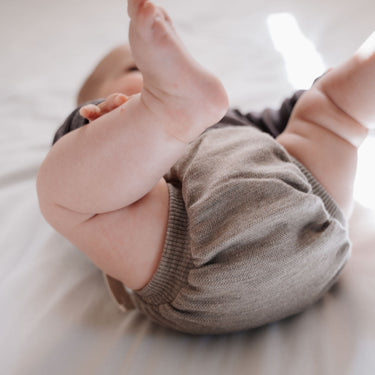
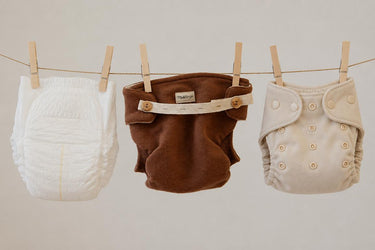
When a baby is born, many small things move into everyday life with them.
Bodysuits.
Burp cloths.
Tiny socks.
And quite a lot of diapers.
One diaper after another.
Day after day.
For months and often for years.
So the question arises:
Which way of diapering is actually best for our environment?
Disposable diapers cause a lot of waste.
Cloth diapers can be reused over and over again, but they need to be washed and dried.
And elimination communication introduces a third possibility:
What if some of the excretions didn't have to end up in any diaper at all?
The honest answer to the question of the best ecological footprint is less clear than many headlines suggest.
But that's precisely why it's exciting.
What does "ecological footprint of diapers" even mean?
When we talk about sustainability, we often first look at what we can see.
For disposable diapers, that's the full diaper pail.
For cloth diapers, it might be the washing machine.
But a true ecological footprint begins much earlier and ends much later.
It considers the entire life cycle of a product as much as possible:
- Extraction of raw materials
- Production of materials
- Manufacture of the diaper
- Packaging
- Transport
- Use
- Washing and drying for reusable products
- Disposal
And even then, there isn't just one single environmental value.
For example, the following are examined:
- Greenhouse gas emissions
- Energy consumption
- Water consumption
- Raw material demand
- Waste
- Water pollution
- Acidification
- Land use
This explains why the answer cannot simply be:
Cloth is always better.
Or:
Modern disposable diapers are now just as sustainable.
It depends on which environmental aspect we consider – and, most importantly, on how the diapers are actually used.
The short answer: Which diaper has the best ecological footprint?
If you just want a quick overview, the current state of research can be summarized approximately as follows:
- Disposable diapers cause a particularly high consumption of materials and residual waste. A large part of their environmental impact already arises during the production of the many individual diapers.
- Cloth diapers avoid this daily disposable waste. Their environmental impact, however, strongly depends on how often, how hot, and how full they are washed, and how the diapers are dried.
- Elimination communication and part-time EC pursue a different principle: If an excretion lands outside the diaper and thereby actually avoids a diaper or a wash cycle, this part of the diapering system does not have to be used at all.
For elimination communication, there is currently no large ecological balance study that directly compares it with disposable and cloth diapers over the entire baby period.
Therefore, it would be disreputable to promise a specific number like "EC saves X percent CO₂".
However, the basic principle is simple:
A product that is not needed at all does not have to be manufactured, washed, or disposed of.
Disposable Diapers: Comfort Comes at a Visible Price
Disposable diapers are incredibly practical.
They are ready to use immediately.
They absorb large amounts of liquid.
And then they simply disappear into the diaper pail.
At least from our sight.
From an ecological perspective, however, the diaper begins long before the changing table.
For each individual diaper, materials are needed – depending on the product, these include:
- Cellulose pulp
- Superabsorbent polymers
- Plastic nonwovens
- Moisture barrier films
- Adhesives
- Elastic
- Fasteners
The materials are produced, transported to the diaper factory, processed, packaged, and then transported to retail.
Then the diaper is worn for a few hours.
And thrown away.
After that, the same journey begins again with the next diaper.
For disposable diapers, manufacturing is particularly important
A European life cycle analysis by the Joint Research Centre already showed that for disposable diapers, the materials used primarily shape the environmental footprint.
This may be surprising at first.
Because what becomes visible to us is mainly the waste.
But before a diaper even ends up in the trash, its raw materials have already been extracted and processed.
Modern disposable diapers have become lighter over time. This has allowed their environmental impact per diaper to be reduced.
But a fundamental problem remains:
Each individual diaper is only used once.
And over the entire diapering period, this amounts to several thousand individual products.
What's in disposable diapers? Materials and layers explained simply
How much waste do disposable diapers cause?
Precisely here, the difference to reusable systems is particularly clear.
While a cloth diaper can be worn repeatedly, every disposable diaper ends up in residual waste after a single use.
Over an entire diapering period, this creates an impressive mountain.
Based on the assumptions we use at Mata Origin for a diapering period of about two and a half years, around 3,800 disposable diapers accumulate.
And these do not only contain the baby's excretions.
Each diaper additionally brings its own material:
- Plastics
- Cellulose pulp
- Absorbent materials
- Adhesive
- Elastic
All of this is disposed of along with urine and stool.
More about the magnitude can be found here:
How much diaper waste does a baby really cause?
Cloth diapers: less waste, but not without environmental impact
At first glance, the calculation for cloth diapers seems quite simple:
A diaper is not thrown away.
It is washed and reused.
And again.
And again.
That is precisely their great strength.
Instead of consuming thousands of disposable products over the diapering period, a comparatively small number of reusable diapers are used repeatedly.
This significantly reduces the raw material demand and, above all, the amount of diaper waste.
But reusability also comes at a price.
Cloth diapers must be:
- washed
- rinsed
- dried
- occasionally replaced
And that's why their ecological footprint strongly depends on our behavior.
What does the current life cycle assessment say about cloth and disposable diapers?
An extensive life cycle assessment, commissioned by the British Department for Environment, Food & Rural Affairs (Defra) in 2023, compared disposable and reusable diapers over the first two and a half years of a child's life.
For climate change, cloth diapers performed better in this study:
- Disposable diapers: around 457 kilograms of CO₂ equivalents
- Reusable diapers: around 345 kilograms of CO₂ equivalents
This corresponds to approximately 25 percent less greenhouse effect for the reusable system examined.
But the story doesn't end there.
The study considered 18 different environmental categories.
In several of them, cloth diapers scored higher – partly due to washing, energy consumption, and the detergents used.
Therefore, the British government explicitly summarized the study as follows:
Across all environmental impacts considered, there is no clear winner.
This is an important statement.
Because sustainability is more than just CO₂.
Why the washing routine is so crucial for cloth diapers
For disposable diapers, it is primarily the manufacturing process that determines the extent of their environmental impact.
For cloth diapers, however, a large part of the environmental impact occurs at home.
In your washing machine.
And perhaps in your dryer.
Even the older large Environment Agency study very clearly showed how strongly usage can affect the outcome.
Particularly unfavorable were:
- very hot wash cycles
- half-empty washing machines
- frequent dryer use
The balance improved through:
- well-filled washing machines
- appropriate washing temperatures
- as little dryer use as possible
- air drying
- energy-efficient appliances
- using the diapers for multiple children
The last point is particularly important.
A cloth diaper that is passed on after one child or used for a sibling distributes its manufacturing costs over a significantly longer period of use.
Durability is one of the biggest sustainability levers there is.
Secondhand can further change the cloth diaper balance
Perhaps you don't even have to buy a cloth diaper new.
Many high-quality diapers can be passed on through several children.
Anyone who takes over used diapers continues to use a product that has already been manufactured.
This applies not only to diapers, by the way.
Clothing also becomes more sustainable the longer it is worn.
The more children a high-quality piece of clothing can use, the fewer new products need to be created for the same period of use.
That's precisely why high-quality materials, repairable pieces, and durable cuts are so important to us at Mata Origin.
So what is more sustainable: disposable or cloth?
If we only look at diaper waste, the answer is pretty clear:
Cloth diapers produce significantly less disposable waste.
If we only look at the greenhouse gas effect from the current Defra study, reusable diapers also come out ahead.
If we consider the entire ecological balance with water consumption, energy, detergent, and other environmental impacts, it becomes more complicated.
Then a lot depends on:
- which cloth diaper system you use
- how many diapers you own
- how long they are used
- how often you wash
- how full the washing machine is
- how you dry
- which electricity you use
- whether the diapers are passed on
That's why we almost prefer a different question:
How can we collectively use fewer resources for bodily excretions?
And this is where elimination communication comes in
Disposable diapers and cloth diapers initially pose the same fundamental question:
What do we use to catch the excretion?
Elimination communication asks a different one:
Does this excretion even need to land in a diaper?
With elimination communication, you give your baby the opportunity to excrete pee or stool directly outside the diaper.
For example:
- over a sink
- over an EC potty
- over the toilet
- over a suitable bowl
Your baby can still wear a backup in between.
This can be a disposable diaper.
A cloth diaper.
Or a reusable elimination communication diaper.
Diaper-free doesn't mean that suddenly no diaper is allowed at all.
It just means:
The diaper is no longer automatically the only place for every excretion.
What does the ecological footprint of elimination communication look like?
Here we have to be honest.
There is currently no comprehensive life cycle analysis that directly compares a typical elimination communication or part-time EC system with disposable and cloth diapers over several years.
Therefore, we cannot make a reliable statement such as:
"EC causes exactly 48 percent less CO₂."
But what we can consider are the things that are actually avoided by EC.
If a disposable diaper is not needed due to an EC moment, the following are avoided for that diaper:
- Raw materials
- Manufacturing
- Packaging
- Transport
- Residual waste
If a cloth insert stays dry through EC, the following can be reduced:
- the number of wet inserts
- the necessary amount of laundry
- detergent
- water
- energy for washing and drying
Of course, elimination communication also has some environmental impact.
A potty needs to be manufactured.
It requires water for cleaning.
Anyone who flushes a full toilet for every single pee also uses water.
But elimination communication requires surprisingly little.
To start, you don't even need a special product.
Often, all you need is:
- your baby
- your arms
- a suitable place
- and a brief moment
Avoiding is different from replacing
This difference is particularly important for sustainability.
If we replace a disposable diaper with a cloth diaper, we continue to use a product.
Just a different one.
If an excretion lands directly in the potty during elimination communication and the backup remains clean, part of the product consumption can be entirely avoided.
In the waste hierarchy, this very principle is at the top:
Avoid waste before we have to think about how to dispose of it better.
This does not mean that elimination communication is automatically always more ecological.
But it opens up a lever that the pure comparison between two types of diapers overlooks.
Even part-time EC can make a difference
You don't have to catch every excretion.
That would be neither realistic nor the idea of Mata Origin.
Imagine you actually save just three disposable diapers a week.
Over two and a half years, that would be approximately:
390 fewer diapers.
At five diapers per week:
about 650 fewer diapers.
And if one diaper is eliminated on average per day:
around 913 diapers – almost 1,000 fewer disposable diapers.
Perhaps that is precisely the most beautiful form of sustainability.
Not changing everything.
Not doing everything perfectly.
But finding something that feels so light that it can stay.
Part-Time EC: How much diaper waste you can really save
Elimination communication can also make cloth diapers more ecological
Elimination communication and cloth diapers are not opposites.
On the contrary.
They can go wonderfully together.
If your baby excretes during elimination communication, the cloth diaper may stay dry.
Or only the small insert needs to be changed.
This can mean:
- less heavily soiled diapers
- less laundry
- less detergent
- less energy
- less wear and tear
And best of all:
The diaper doesn't have to absorb as much as possible for as long as possible.
It simply provides security.
The backup is there.
But it doesn't have to be used every time.
Wool: sustainability primarily means long-term use
At Mata Origin, we particularly like to use wool.
Not because wool has no environmental impact whatsoever.
Wool also requires sheep, land, processing, energy, and transport.
A natural material is not automatically resource-free.
What we love about wool is something else.
It can be used for a very long time.
It often doesn't need to be washed after every wear.
Often, airing it out is enough.
It can absorb and release moisture.
And when cared for with lanolin, it can serve as reusable wetness protection.
Especially when it comes to elimination communication, this works wonderfully:
- a washable insert absorbs
- the wool protects
- the backup is reused again and again
- and every caught excretion can relieve the system
Sustainability here is primarily created by:
less single-use, long-term use, and conscious washing.
Why wool is so practical for elimination communication
Perhaps the most underestimated factor: clothing
What does clothing have to do with the ecological balance of diapering?
More than one might initially think.
Because elimination communication only works permanently in real everyday life if it's not complicated every time.
Imagine:
You suddenly notice that your baby needs to go.
But first, you have to:
- unbutton the bodysuit
- take off a pair of pants
- pull down tights
- open the diaper
By the time everything is open, the moment is often over.
And next time, you might think:
Oh, the diaper will hold it.
That's why EC-friendly clothing is not just a nice accessory.
It makes it more likely that elimination communication will actually happen in everyday life.
EC pants turn an intention into a quick moment
An EC pant from Mata Origin is designed so that you don't have to completely undress your baby every time.
You can open it quickly.
Eliminate.
Close it again.
Done.
Especially in the morning, at night, on the go, or in winter, this can make a huge difference.
Not theoretically.
But in that one moment when you think:
I think my baby needs to go.
EC diapers make backup easier
Our wool EC diapers are also made for exactly this middle ground.
Your baby remains protected.
If you miss an elimination, the diaper takes over.
If you notice an opportune moment, it can be opened quickly.
And if the backup stays clean, it can continue to be worn.
This is an important part of sustainable design for us:
Not just using a more sustainable material – but designing a product in such a way that a more resource-efficient everyday life becomes easier in the first place.
Even EC rompers can make a difference
The same applies to rompers.
A classic romper can mean a surprising number of steps during elimination communication.
Our EC rompers were therefore developed so that your baby can stay warm and cozy, and you can still quickly access the diaper area.
That sounds like a small detail.
But small details often determine whether something works regularly in family life.
Discover EC clothing from Mata Origin
Which combination likely has the best ecological balance?
It would be nice if we could simply declare a winner now.
But the honest answer is:
The best solution is usually the one that requires little disposable material, uses durable products, and gets by with as little additional energy as possible.
This can be, for example:
- Elimination communication with a reusable backup
- Cloth diapers, efficiently washed and air-dried
- Secondhand cloth diapers used for several children
- EC diapers with washable inserts
- Part-time EC with a disposable diaper as backup
- a mixture of these possibilities
Maybe you use wool and washable inserts during the day.
A disposable diaper on the go.
You practice EC after waking up.
At night, you do whatever helps everyone sleep best.
That's not a bad compromise.
That's family life.
The most sustainable diaper is sometimes the one that isn't needed at all
This sentence sounds almost too simple.
But it pretty well sums up the idea behind elimination communication.
Of course, your baby needs ways to eliminate.
Of course, you need security.
And of course, a diaper can provide exactly this security.
But maybe it doesn't have to be used every time.
Maybe the morning pee ends up in the sink.
The bowel movement after breakfast in the potty.
And in the afternoon, the diaper simply takes over.
No competition.
No quota.
No perfect elimination communication.
Just a small shift in perspective:
Before we ask ourselves which diaper is the most sustainable, we can ask ourselves if we even need one at that moment.
Seven simple ways to a better diaper ecological balance
- Try individual elimination moments. Especially after waking up, this can often be easily integrated.
- Use cloth diapers for as long as possible. Passing them on or using them for siblings improves their balance.
- Wash full loads. A half-empty machine requires almost the same infrastructure for fewer diapers.
- Avoid using the dryer as often as possible. Drying, in particular, can strongly influence the carbon footprint of cloth diapers.
- Buy durable instead of many. High-quality products need to be replaced less often.
- Use clothing that makes elimination communication easy. The less effort the moment requires, the more often it becomes part of everyday life.
- Stay pragmatic. A solution that you use relaxed for years is often more sustainable than a perfect system that is abandoned after two weeks.
Frequently Asked Questions about the ecological balance of diapers
What is more sustainable: disposable diapers or cloth diapers?
In terms of climate change, reusable diapers performed better in the large British Defra life cycle assessment of 2023. The greenhouse effect there was approximately 25 percent lower than that of the disposable diapers studied. However, in several other environmental categories, cloth diapers had higher impacts. The overall balance depends heavily on washing and drying behavior.
Why are cloth diapers not automatically more environmentally friendly?
Because they need to be washed and dried regularly. Water, electricity, detergent, washing temperature, and dryer use significantly influence their environmental balance. If they are used for a long time, washed efficiently, and air-dried as much as possible, their balance improves significantly.
What is the biggest environmental problem with disposable diapers?
Disposable diapers require new raw materials for each single use and are then disposed of. Their production and the large amount of single-use material are central environmental factors. In addition, a significant amount of residual waste is generated during the diapering period.
Is elimination communication more ecological?
A complete comparative ecological balance specifically for elimination communication or EC is not yet available. However, if elimination communication actually avoids disposable diapers or reduces cloth diaper laundry, corresponding materials, waste, and partly washing effort are saved.
Does successful elimination communication always save a diaper?
No. If a diaper was already full and had to be changed anyway, subsequent elimination communication does not automatically mean a saved diaper. It becomes particularly relevant when a clean backup remains clean and can be reused.
What is more sustainable: cloth diaper or elimination communication?
These are not opposites. The combination can be particularly useful: a reusable diaper as backup and elimination communication in suitable situations. This way, both disposable waste and the amount of soiled diapers can be reduced.
Is wool automatically more sustainable than plastic?
No material is without environmental impact. Wool also requires resources in animal husbandry and processing. Its strength lies, among other things, in the fact that high-quality wool products can be used for a long time, passed on, and often aired out instead of being washed after every use.
How can I use cloth diapers in the most environmentally friendly way possible?
Use a well-filled washing machine, avoid unnecessarily high temperatures and the dryer as often as possible, use the diapers for a long time, and, if possible, pass them on to other children.
Do I have to completely forego disposable diapers for sustainable diapering?
No. Even a combination can make a big difference. For example, you can use cloth or wool at home, integrate individual elimination moments, and continue to use a disposable diaper on the go.
Conclusion: Perhaps there isn't one single most sustainable diaper
Disposable diapers have a great advantage:
They are simple.
But their simplicity creates thousands of disposable products over the years.
Cloth diapers replace this mountain of waste through reuse.
However, they require water, detergent, and energy.
And elimination communication goes one small step further.
To the question:
Do we even need a diaper for this elimination right now?
Perhaps that's exactly where the most beautiful answer lies.
Not in a perfect system.
But in a combination that suits you.
A durable cloth diaper.
Wool as backup.
Pants that open quickly.
A morning pee over the sink.
And sometimes just a disposable diaper on the go.
Sustainability with a baby doesn't have to look perfect.
It can feel easy. And it can begin with a single small moment.
Independent sources for further reading
- UK Parliament / Defra: Assessment of the life cycle of disposable and reusable diapers 2023
- Environment Agency: Life cycle assessment of disposable and reusable diapers
- Joint Research Centre: Life Cycle Assessment of European disposable diapers
- European Commission: Environmental criteria for absorbent hygiene products
Read more
- How much diaper waste does a baby actually produce?
- Part-time EC: How much diaper waste you can really save
- Almost 1,000 fewer diapers: What one elimination moment per day can achieve
- Disposable diapers, cloth diapers, or EC: What are the options?
Would you like to try elimination communication?
You don't have to change your entire diapering routine for it.
Start with one moment.
Perhaps tomorrow after waking up.
Our free starter guide shows you step-by-step how to get to know elimination communication in a relaxed way – even if your baby continues to wear a diaper as backup.
Discover the free starter guide for elimination communication
And if you notice that elimination communication suits you, you'll find clothing specifically designed to make this small moment easier in everyday life at Mata Origin.