A full diaper.
Roll it up.
Close it.
Open the diaper pail.
And gone.
In family life, this moment might take ten seconds.
After that, the diaper is out of sight for a while.
But of course, it's not gone.
It's just beginning the next part of its journey.
And when you consider that several thousand disposable diapers can accumulate during a baby's diapering phase, this small everyday action suddenly becomes a rather big question:
What actually happens to all those used diapers?
And:
How are diapers properly disposed of in Germany, Austria, and Switzerland?
The short answer is surprisingly similar:
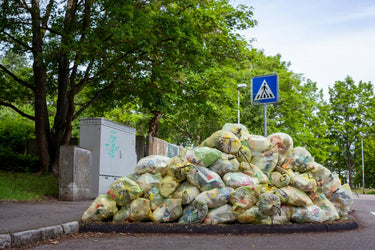
- Germany: used diapers belong in the residual waste.
- Austria: used diapers belong in the residual waste.
- Switzerland: used diapers belong in the general waste or household waste.
They do not belong in the waste paper.
Not in the organic waste bin.
Not in the plastic collection.
And certainly not in the toilet.
We will take a closer look at why this is the case and what happens to the diapers afterward.
Diaper disposal: The quick overview for Germany, Austria, and Switzerland
| Country | Correct Disposal | What happens next? |
|---|---|---|
| Germany | Residual waste | mostly thermal recovery or mechanical-biological treatment |
| Austria | Residual waste | thermal or mechanical-biological treatment |
| Switzerland | General waste / Household waste | usually thermal recovery in a waste incineration plant |
The exact collection method may differ depending on the municipality.
Some places offer larger residual waste bins, special diaper bags, or so-called diaper bins. In Switzerland, depending on the municipality, there are fee-based bags or other local collection systems.
However, the basic principle remains the same:
A used disposable diaper is usually residual waste and not a recyclable material for the usual separate collection.
How are diapers disposed of in Germany?
In Germany, used baby diapers belong in the residual waste bin.
The German Federal Environmental Agency explicitly lists diapers as waste for which there is no separate recycling path in a normal household.
This means:
- not in the yellow bag
- not in the yellow bin
- not in the waste paper
- not in the organic waste bin
- not on the compost heap
Even if a disposable diaper contains cellulose and plastics, these components cannot simply be recovered after use through the usual recycling collections.
The diaper is then a heavily soiled composite product made of various materials.
What happens to the diaper in residual waste in Germany?
When the garbage truck has emptied the residual waste bin, the contents are not simply dumped somewhere in a landfill.
Untreated municipal waste has generally not been allowed to be simply landfilled in Germany since 2005.
Residual waste is treated beforehand.
A large part goes to waste incineration plants.
There, it is thermally recovered.
The energy generated during incineration can be used for:
- electricity
- district heating
- process heat
Another part of the residual waste is first mechanically-biologically treated.
For example, metals or components with a particularly high calorific value are separated. A part is then also energetically recovered.
For the used diaper, this generally means:
It does not become a new diaper again. Its materials are largely lost as material.
How are diapers disposed of in Austria?
In Austria, too, the clear answer is:
Baby diapers belong in the residual waste.
The city of Vienna, for example, explicitly lists baby diapers under residual waste in its waste ABC.
Here too, diapers do not belong:
- in the organic waste bin
- in the plastic and packaging collection
- in the waste paper
- in the toilet
The size of the residual waste bin, how often it is emptied, and whether there are additional services for families with babies in diapers differ depending on the municipality.
Some Austrian municipalities, for example, offer an additional diaper bin.
This initially sounds like a separate recycling solution.
In many cases, however, it is simply an additional residual waste container for families who generate a particularly large amount of waste due to diapers.
The diapers then continue to end up in the appropriate waste treatment facility along with the residual waste.
What happens to residual waste in Austria?
Austrian residual waste is treated thermally or first mechanically-biologically processed.
In thermal treatment, the waste is incinerated.
Here too, the energy generated can be used.
In mechanical-biological treatment, the waste is first processed and separated into different fractions.
However, this changes little for a single disposable diaper:
In a normal Austrian household, there is currently no nationwide cycle in which used baby diapers are broken down into their raw materials and new diapers are made from them.
How are diapers disposed of in Switzerland?
In Switzerland, residual waste is usually called Kehricht or Hauskehricht.
And here too, used diapers belong in it.
The city of Bern explicitly names diapers as combustible waste for the general waste bag.
Depending on the municipality, household waste is collected, for example, via:
- official fee-based bags
- general waste containers
- underground containers
- municipal collection systems
The exact organization and fees differ regionally.
However, the disposal method is very similar:
Used diapers belong in non-recyclable household waste.
What happens to used diapers in Switzerland?
In Switzerland, combustible waste that cannot be meaningfully recycled is thermally recovered in waste incineration plants.
This generates heat.
This can be used, for example, for:
- district heating
- electricity generation
Switzerland has a well-developed infrastructure for this energetic recovery.
The diaper is thus treated more meaningfully than if it were to end up untreated in a landfill.
But here too:
Incineration is not a material circular economy.
The energy can be partially used.
However, the raw materials originally used for the diaper are largely lost.
Why can't used diapers simply be recycled?
At first glance, a diaper seems to consist of valuable raw materials.
- Cellulose.
- Plastics.
- Superabsorbent polymers.
Why don't we just separate these things again?
The problem is the structure.
A modern disposable diaper consists of many closely interconnected components:
- cellulose
- superabsorbent polymers
- plastic fleeces
- foils
- elastic materials
- adhesives
- fasteners
After use, there are also:
- urine
- possibly stool
- cream residues
- possibly wet wipe residues
For a used diaper to yield reusable raw materials again, it would have to be:
- separately collected
- hygienically treated
- disassembled into its components
- cleaned
- technically processed
This is technically possible.
But it is complex.
Is diaper recycling already available?
Yes – and that's exciting.
In Europe, various processes are being developed that could allow used diapers to be better recycled in the future.
Research projects are also underway in Austria.
For example, the following are being investigated:
- enzymatic processes
- mechanical separation
- gasification
- chemical recycling of plastic components
Some projects now show that parts of used diapers can fundamentally be recovered.
This is a good development.
But for families in Germany, Austria, and Switzerland, little is currently changing.
Used diapers still belong in the residual waste or general waste.
There is currently no nationwide separate diaper recycling.
Why doesn't a diaper belong in the yellow bag?
Because the yellow bag, or the corresponding packaging collection, is intended for packaging waste.
A used diaper is not packaging waste.
Although it consists of various plastics, these are:
- bound with cellulose
- mixed with superabsorbent polymers
- contaminated
- not suitable for usual packaging sorting
Therefore, a diaper does not belong in the plastic collection.
Are diapers allowed in the organic waste bin?
No.
Not even if the packaging contains terms such as:
- Eco
- Bio
- plant-based
- bio-based
- with natural materials
A disposable diaper usually does not consist exclusively of biodegradable materials.
And even if individual components were biodegradable, the entire used diaper remains a soiled composite product.
Therefore, it does not belong on the home compost or in the regular organic waste bin.
Eco-diapers and organic diapers: What does "natural" really mean for disposable diapers?
Can you dispose of diapers in the toilet?
No.
A diaper can absorb enormous amounts of liquid and swells up in the process.
In the sewage system, it can block pipes and pumps.
The toilet is fundamentally for human waste and toilet paper – not diapers.
This also applies to:
- wet wipes
- diaper liners
- cotton pads
- hygiene articles
If your baby excretes while being held over a potty or using a potty, the excretions can of course be disposed of in the toilet.
The diaper itself, however, cannot.
What actually happens to the pee in a discarded diaper?
This question is interesting because it shows how differently elimination communication and a disposable diaper deal with the same excretion.
When your baby pees in a disposable diaper, the urine is absorbed by the superabsorbent polymer.
The diaper is then disposed of along with its contents.
This means:
The urine ends up along with:
- cellulose
- plastic
- superabsorbent polymer
- adhesives
- other diaper components
in the residual waste.
With elimination communication, something else happens.
The pee lands directly:
- in the potty
- in the sink
- or in the toilet
and enters the sewage system to the wastewater treatment plant.
It does not require a disposable diaper that then needs to be disposed of.
The most important step actually happens before the trash can
We can technically improve our waste incineration more and more.
We can recover energy from residual waste.
We can research diaper recycling.
All of this is important.
But in waste management, there is an even simpler idea:
Waste that is not generated in the first place does not have to be disposed of later.
And that's precisely why we find the topic of elimination communication so exciting in connection with diaper waste.
Elimination communication is not about replacing one disposable diaper with another disposable diaper.
It's about ensuring that some excretions don't even end up in a diaper.
Even a few EC moments can reduce the diaper mountain
You don't have to live completely diaper-free for this.
Perhaps you only do EC in the mornings.
Or after the nap.
Or for bowel movements, because by now you recognize exactly when your baby needs to go.
If this actually means one disposable diaper is not needed, it adds up.
Three diapers saved per week over two and a half years amount to approximately:
390 fewer diapers.
Five per week:
about 650 fewer diapers.
One per day:
around 913 diapers – almost 1,000 fewer diapers.
That's almost 1,000 diapers that don't have to end up in German residual waste, Austrian residual waste, or Swiss general waste.
Part-time elimination communication: How much diaper waste you can really save
And you don't have to sacrifice safety for it
Perhaps you are now thinking:
That's nice – but I don't want to leave my baby without a diaper all day.
You don't have to at all.
A diaper can still be there.
It can provide security.
It can catch things when EC is not possible.
With part-time elimination communication, the diaper becomes a backup.
And that's exactly what our wool EC diapers were developed for.
They protect your baby in everyday life, but can be quickly opened when a suitable EC moment arises.
So you don't have to choose between:
Diaper or Diaper-free.
You can combine both.
Why clothing is much more important than you initially think
Perhaps you know this moment:
You suddenly realize:
I think my baby needs to go.
And then the undressing begins.
Body open.
Pants down.
Tights down.
Diaper open.
And before everything is done:
too late.
That's precisely why Mata Origin's clothing was developed with elimination communication in mind.
An EC pant can be opened quickly without your baby having to be completely undressed every time.
That may sound like a small difference.
In everyday life, it's often quite a big one.
Because the easier the EC moment becomes, the more likely you are to actually use it.
And it is precisely from these small moments that diapers can eventually emerge that don't even end up in the trash.
Clothing cannot directly prevent waste – but it can make EC easier
Of course, an EC pant doesn't automatically save diapers.
And an EC diaper doesn't automatically make your baby use the potty.
But good design can reduce a hurdle.
If you don't have to every time:
- take off several layers of clothing
- look for buttons
- pull legs out of tight pants
- completely unwrap your baby
a possible EC moment can much more easily become an actual one.
That's what Mata Origin is all about.
Clothing should not make EC more complicated. It should make it easier.
Waste prevention is more than proper waste separation
Waste separation is important.
But with diapers, there's hardly anything to separate.
The used disposable diaper is ultimately a material mix that ends up in residual waste in Germany and Austria and in general waste in Switzerland.
Therefore, sustainability begins one step earlier here.
Not just:
Which bin does the diaper belong in?
But sometimes also:
Do we even need a new diaper for this excretion?
Perhaps the answer is often enough:
Yes.
Then the diaper is exactly right.
And sometimes it is:
No.
Then the pee might end up in the sink.
The stool in the potty.
And the diaper stays dry.
Frequently Asked Questions about Diaper Disposal
Which bin do diapers go in in Germany?
Used baby diapers in Germany belong in the residual waste bin. They do not belong in the yellow recycling bin (Gelber Sack), the paper recycling bin, or the organic waste bin.
Which bin do diapers go in in Austria?
In Austria, too, baby diapers are disposed of with residual waste. The exact organization and any additional diaper bins or diaper bags depend on the respective municipality.
How are diapers disposed of in Switzerland?
Used diapers in Switzerland belong in household waste (Hauskehricht or Kehricht). Depending on the municipality, collection may occur, for example, via official fee-based bags or containers.
Are used diapers incinerated?
Very often, yes. In Germany and Austria, residual waste is thermally treated or, in some cases, initially mechanically-biologically treated. In Switzerland, non-recyclable combustible household waste is predominantly energetically recovered in waste incineration plants.
Is energy recovered from the incineration of diapers?
Yes. Modern waste and incineration plants often use the resulting heat for electricity, district heating, or process energy. However, the material raw materials of the diaper are not fully returned to the material cycle.
Can used diapers be recycled?
Technically, there are now various research and pilot processes. However, comprehensive separate collection and material recycling of used baby diapers is currently not the normal disposal method in Germany, Austria, and Switzerland.
Can eco-diapers go into the organic waste bin?
No. Even disposable diapers advertised as eco, organic, or plant-based fundamentally belong in the residual waste after use. Individual bio-based components do not make the entire used diaper organic waste.
Can diapers be flushed down the toilet?
No. Diapers, wet wipes, and other hygiene products can clog wastewater pipes and technical systems. Human waste and toilet paper belong in the toilet – not the diaper itself.
What is a diaper bin?
Some municipalities provide families with babies in diapers with an additional diaper bin or special diaper bags. This usually involves additional residual waste volume and not a separate diaper recycling system.
How can I dispose of fewer diapers?
You can partially replace disposable diapers with cloth diapers or reusable elimination communication diapers and practice elimination communication with your baby at appropriate moments. Even a few disposable diapers saved per week add up over the diapering period.
Conclusion: The Diaper Disappears into the Bin – but Not from the World
Germany.
Austria.
Switzerland.
The terms differ a little.
Residual waste.
Residual waste.
Household waste.
But the path of the used disposable diaper is very similar.
It is collected together with other non-recyclable household waste and then predominantly thermally or, after appropriate pre-treatment, recovered.
This is technically more sensible than leaving untreated diapers in a landfill.
But the diaper still remains a product that is produced for a few hours and then disposed of.
Perhaps that is why, in addition to the question:
How do we dispose of diapers correctly?
a second one is still important:
How can we ensure that we don't have to dispose of some of them at all?
Not all of them.
Not immediately.
Not perfectly.
Maybe just one less.
And eventually another.
With a small elimination communication moment.
With a backup that provides security.
And with clothing that can be opened quickly enough when your baby says:
Now.
Read more
- How much diaper waste does a baby really cause?
- Part-time elimination communication: How much diaper waste you can really save
- Almost 1,000 fewer diapers: What one elimination communication moment per day can achieve
- Ecological balance of diapers: disposable, cloth, and elimination communication compared
Would you like to try elimination communication easily?
You don't have to give up diapers for that.
Start with one moment – maybe tomorrow after waking up.
Our free starter guide shows you how elimination communication can work relaxed and without pressure for perfection.
Discover the free starter guide to elimination communication
And if that one moment eventually turns into more, at Mata Origin you'll find elimination communication pants and elimination communication diapers that were developed precisely for this purpose: so you can quickly practice elimination communication with your baby without having to completely undress them every time.