
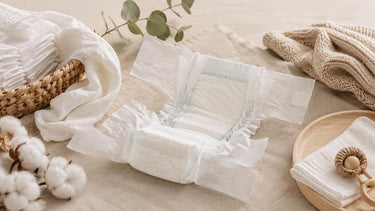
What's in disposable diapers? Materials, layers, and additives explained simply
For many families, disposable diapers are a natural part of everyday life with a baby.
They are highly absorbent, quick to change, and reliably keep clothes, beds, and strollers dry.
However, at some point, a legitimate question arises for many parents:
What materials actually touch my baby's delicate skin every day?
Because a disposable diaper is not simply made of soft paper or cellulose. It is a technically constructed hygiene product with several layers, each fulfilling a specific task.
Depending on the manufacturer and model, these may include:
- Cellulose
- Synthetic nonwovens and films
- Superabsorbents
- Adhesives
- Elastic materials
- Dyes and wetness indicators
- Sometimes lotions or fragrances
This does not mean that every disposable diaper is automatically problematic.
But it does mean: You should take a closer look. Not out of fear, but because a diaper is directly against your baby's body for a large part of the day for many months or years.
How is a disposable diaper constructed?
A modern disposable diaper consists of several functional layers. The exact construction differs depending on the brand, product line, and diaper size.
Typical layers include:
- A soft inner layer directly against the skin
- An acquisition and distribution layer
- A wrapper for the absorbent core
- An absorbent core made of cellulose and/or superabsorbents
- An outer layer for moisture protection
- Leak-proof cuffs and elastic elements
- Adhesives, side panels, and fasteners
Some products also include prints, wetness indicators, lotions, or fragrances.
Not every diaper contains all these components. The materials used and their quantities can also differ significantly.
1. The inner layer: What lies directly against the baby's skin?
The inner layer is often referred to as the topsheet. It is the part of the diaper that faces your baby's body directly.
Its task is to feel soft and to transfer liquid as quickly as possible to the underlying layers.
For this purpose, depending on the product, materials such as the following are used:
- Polypropylene
- Polyethylene
- Polyester
- Viscose
- Cellulose-based fibers
- Material blends
The surface can feel textile-like, although it consists entirely or partially of synthetic fibers.
This does not automatically equate to a health hazard. Nevertheless, this layer is particularly interesting for parents because it has direct contact with the bottom, groin, abdomen, and delicate skin folds for extended periods.
When buying, you can therefore pay attention to:
- Which materials does the manufacturer specify?
- Is the diaper fragrance-free?
- Has a lotion been applied to the inner layer?
- How does your baby's skin react to the product?
- Do the cuffs or side panels cause visible chafing?
2. The distribution layer: So that liquid does not remain in one spot
Beneath the inner layer of many disposable diapers lies an acquisition and distribution layer.
Its purpose is to quickly absorb urine from the surface and distribute it as evenly as possible to the absorbent core. This prevents the liquid from accumulating in just one spot, and the surface can feel dry again more quickly.
This layer can also consist of synthetic or cellulose-based fibers.
It is important for the function of a modern disposable diaper: it helps keep the diaper thin, distributes liquid quickly, and prevents immediate leaks.
3. The absorbent core: Cellulose and superabsorbents
At the center of the diaper is the absorbent core. It absorbs urine and is designed to securely hold it inside.
Depending on the diaper, the core consists of:
- Cellulose fibers
- Superabsorbents
- A combination of both
- Other synthetic or cellulose-based fibers
What is the purpose of cellulose?
Cellulose is derived from plant-based raw materials. In the diaper, it helps absorb, distribute, and transfer liquid to the superabsorbent.
However, the fact that a diaper contains cellulose does not automatically mean that it consists entirely of natural materials. Cellulose is only one of several components.
Therefore, even with terms like "plant-based," "with natural materials," or "organic diaper," it's worth taking a closer look at the entire product.
What are superabsorbents?
Superabsorbents are highly swelling polymers. They can absorb and bind liquid, forming a gel-like structure.
This allows a comparatively thin diaper to absorb large amounts of urine without immediately feeling wet or heavy.
The superabsorbent normally does not lie openly on the baby's skin. It is located in the absorbent core and is enclosed by other layers.
Sometimes, small gel particles may be visible in a damaged or very full diaper. In this case, the diaper should be changed and the skin gently cleaned.
You can find out more about its function and classification here:
Superabsorbents in diapers: Why disposable diapers absorb so much liquid
4. The wrapper of the absorbent core
The absorbent core is surrounded by a thin layer of material. It keeps cellulose and superabsorbents where they are needed and contributes to the diaper's stability.
This wrapper can consist of cellulose-based fibers, synthetic fibers, or a nonwoven fabric made from various materials.
From the outside, this layer is hardly noticeable. Nevertheless, it is another example of how many individual components interact in a seemingly simple diaper.
5. The outer layer: Protection against leaks
The outer layer is designed to prevent moisture from getting onto clothes, bedding, carriers, or strollers.
It is often referred to as the backsheet and usually consists entirely or partially of plastic-based films or nonwovens.
Commonly used materials include:
- Polyethylene
- Polypropylene
- Material blends
- Partially cellulose-based components
Many diapers feel soft, matte, or paper-like on the outside. However, this does not necessarily mean that their outer layer consists of paper or a pure natural material.
Even outer layers advertised as "breathable" are generally still designed for reliable moisture protection. Therefore, breathable does not mean that the diaper area is completely openly ventilated.
6. Leak cuffs and elastic materials
For the diaper to fit snugly and follow the baby's movements, it needs elastic elements.
These are often found:
- on the legs
- on the back
- on the tummy
- in the side leak barriers
- in the flexible fastening tabs
Depending on the product, elastane, polyurethane, or other synthetic elastic materials may be used for this purpose.
A good fit is important: If the diaper is too loose, it can leak. If it is too tight, the cuffs and fasteners can cause pressure marks or chafing.
Obvious red marks, chafing, or recurring irritations are an indication to check the size and fit again.
7. Adhesives and fasteners
A disposable diaper is assembled from several layers. Adhesives are used during manufacturing to hold these layers together.
The side fasteners often also consist of several components:
- Plastic nonwovens
- Elastic side panels
- Adhesive or hook-and-loop systems
- Thermoplastic materials
- Adhesives
These components fulfill important tasks. They ensure stability, freedom of movement, and a secure fit.
They also show that disposable diapers are not simple cellulose products, but rather consist of numerous technically processed components.
You can find an even more detailed look at the layer structure here:
Cellulose, nonwoven, and plastics: The material layers of a disposable diaper
8. Fragrances: Not necessary for function
Some disposable diapers are perfumed. The scent is intended to give the product a fresh or clean smell.
However, fragrances are not necessary for the actual function of the diaper. They do not improve absorbency or leak protection.
Fragrances are also not automatically harmful to health. However, additional fragrance components can be relevant for sensitive or already irritated skin.
Many parents therefore consciously choose a fragrance-free diaper – especially if their baby is prone to skin irritations.
Important: "Free of declarable fragrance allergens" is not necessarily the same as "completely fragrance-free." If in doubt, it is worth reading the manufacturer's information carefully or asking directly.
9. Lotions on the inner layer
Some disposable diapers contain a lotion on the skin-facing surface.
It is intended to reduce friction, protect the skin surface, or help prevent irritation. The exact composition varies by manufacturer.
A lotion is therefore not automatically problematic. However, it is also not necessary for every baby.
For very sensitive skin, it may be useful to try a product without additional lotion and observe whether the skin condition changes.
Furthermore, a lotion does not replace:
- regular changing
- an appropriate diaper size
- gentle cleaning
- as little friction as possible
- time without a closed diaper
You can find more about optional additives here:
Fragrances, lotions, and dyes in baby diapers: Does baby skin really need that?
10. Dyes, prints, and wetness indicators
Many disposable diapers are printed with motifs, size information, or colored markings.
The prints are usually on the outside and have no direct skin contact. Decorative motifs are not necessary for the function of the diaper.
The wetness indicator is different: it is supposed to show parents whether the diaper has absorbed liquid. A narrow strip changes color when it comes into contact with moisture.
Again, the exact technical implementation varies depending on the product. Those who want as few additional components as possible can look for a diaper without fragrances, lotion, decorative prints, or a wetness indicator.
Materials are not automatically pollutants
In discussions about disposable diapers, materials, chemicals, and pollutants are quickly conflated.
But these terms do not mean the same thing.
A material like polypropylene, cellulose, or a superabsorbent first fulfills a technical function.
An additive like a lotion, a fragrance, or a dye is used for an additional product property.
A residue or contamination can inadvertently originate from a raw material or manufacturing process.
A pollutant is a substance that, due to its properties and potential exposure, can be problematic for health or the environment.
Therefore, a diaper is not "toxic" simply because it contains plastics, adhesives, or superabsorbents.
At the same time, testing standards, limit values, and transparent manufacturer information are important because babies wear disposable diapers very frequently and for long periods.
You can find an objective classification in our article:
Harmful substances in disposable diapers: What parents should know factually
Why isn't every ingredient listed on the packaging?
A diaper is not a food product or a cosmetic product with a completely uniform ingredient list.
Many manufacturers list the most important material groups but do not necessarily publish every single component or the exact formulation of their adhesives, dyes, and functional materials.
If a cosmetic lotion has been applied, additional information may be provided on the packaging. Any perfuming should also be evident from the product information.
Nevertheless, it can be difficult for parents to meaningfully compare two diapers solely based on their packaging.
Therefore, the following are helpful:
- Specific material specifications
- An understandable product description
- Traceable test seals
- Information on fragrances and lotions
- Manufacturer's responses to specific inquiries
What does "dermatologically tested" mean?
The statement "dermatologically tested" sounds reassuring at first. It means that the product has been tested in a skin-related test under dermatological supervision.
However, the term alone does not explain:
- how the test was conducted exactly
- how many people participated
- whether babies or adults were tested
- which skin types were included
- what results were achieved
- whether fragrances or lotions are included
Furthermore, no test can guarantee that every baby will tolerate a product equally well.
"Dermatologically tested" can therefore be an additional hint, but it does not replace transparent material specifications or the observation of the individual baby's skin.
You can find out more about this here:
"Dermatologically tested" for diapers: What does it really mean?
What stresses the skin in the diaper area?
It's not just the diaper material that determines the condition of your baby's skin.
Several factors interact in the diaper area:
- Moisture
- Warmth
- Friction
- Urine and stool
- The wearing time of a wet or soiled diaper
- Care and cleaning products
- The individual sensitivity of the skin
- The fit of the diaper
A highly absorbent diaper may feel dry on the surface. Nevertheless, it should be checked and changed regularly.
After bowel movements, prompt changing is especially important, as prolonged contact with excretions can irritate the skin.
When cleaning, the rule is often: gentle rather than thorough rubbing. Lukewarm water, a soft cloth, and gentle patting dry are sufficient in many everyday situations.
For persistent, weeping, open, or severely painful skin changes, the cause should be clarified by a doctor or midwife.
You can find a more detailed comparison here:
Disposable diapers, cloth diapers, or diaper-free: What is gentler on baby's skin?
What should you look for when buying disposable diapers?
If disposable diapers work well for your family, you don't have to use them with a bad conscience.
You can still choose consciously.
For example, pay attention to:
- a good fit
- fragrance-free products
- diapers without lotion if your baby reacts sensitively
- as specific material information as possible
- traceable test seals
- manufacturer transparency
- a package size that you actually use up
- regular checks and timely changes
It's not just what's on the packaging that matters.
Also observe:
- Are rashes regularly appearing?
- Are the cuffs chafing?
- Are significant pressure marks remaining?
- Does the diaper smell strongly even when unused?
- Does the skin worsen after changing brands?
The best diaper on paper is not automatically the best diaper for your baby.
What about eco-friendly and organic diapers?
Terms like "eco-diaper," "organic diaper," "natural," or "plant-based" are not always clear.
For example, a diaper might contain pulp from certified forestry or individual plant-based plastic components, yet still rely on superabsorbents, adhesives, elastic, and synthetic moisture protection layers.
Therefore, it's worth asking:
Which specific component is natural or plant-based – and how is the rest of the diaper constructed?
Even an eco-diaper is usually a single-use product. After use, it usually ends up in the residual waste.
However, it can still fit your priorities, for example, if the manufacturer works more transparently, avoids certain additives, or uses more responsible raw materials.
What alternatives are there to disposable diapers?
You don't have to choose between "only disposable diapers" and "fully diaper-free starting tomorrow."
Many options lie in between:
- Cloth diapers at home
- Wool covers with washable inserts
- Elimination communication diapers as a quick-opening backup
- Elimination communication after waking up or during a diaper change
- Part-time elimination communication
- Disposable diapers only at night or on the go
- A flexible combination of multiple systems
Every family can find their own way.
Perhaps you want to reduce your diaper waste. Perhaps you desire more natural materials. Perhaps you simply no longer want your baby to automatically soil a diaper with every elimination.
Even a single elimination communication moment per day can be a start.
Why Mata Origin focuses on wool and elimination communication
At Mata Origin, we don't want to demonize disposable diapers or make parents feel guilty.
We want to show that there is more than one option.
Wool can be used as a natural, reusable moisture barrier. It is breathable, temperature-regulating, and can absorb moisture. Treated with lanolin, it becomes more water-repellent.
With elimination communication, your baby regularly gets the opportunity to relieve themselves outside the diaper.
The diaper can remain on the body as a backup. It's security in the background – not a sign that elimination communication isn't working.
This way, families can:
- catch individual eliminations outside the diaper
- allow less time in a soiled diaper
- reduce the consumption of disposable diapers
- use natural and reusable materials
- become more aware of their baby's signals and routines
Elimination communication is not training. There is no success rate you need to achieve.
Here's an easy start:
What does "diaper-free" or "elimination communication" mean?
Discover wool elimination communication diapers
Frequently asked questions about disposable diapers
Are disposable diapers made of plastic?
Disposable diapers consist of a material mix. In addition to pulp, they often contain plastic-based nonwovens, films, elastic, adhesives, and superabsorbents. Therefore, they consist neither exclusively of plastic nor exclusively of natural materials.
Which part of the diaper touches the skin?
Direct skin contact is primarily with the soft inner layer. It can consist of synthetic, cellulose-based, or mixed fibers. Some diapers also have a lotion applied to this surface.
Is the gel in a soiled diaper dangerous?
The gel forms when the superabsorbent binds liquid. Normally, it remains enclosed in the absorbent core. If gel particles become visible in a damaged diaper, the diaper should be changed and the skin carefully cleaned.
Are superabsorbents harmful substances?
Superabsorbents are primarily functional materials that absorb and bind liquid. The term "harmful substance" should be considered separately. For evaluating a product, material quality, possible residues, testing standards, and actual exposure are relevant, among other things.
Does a baby diaper need fragrances?
No. Fragrances are not necessary for absorbency, fit, or leak protection. Some parents prefer fragrance-free products because they want to avoid additional fragrance components in the sensitive diaper area.
Are diapers with lotion better for the skin?
Not automatically. A lotion can be used for certain product properties but is not needed by every baby. Changing frequency, fit, friction, and contact with excretions remain important regardless.
Are eco-diapers plastic-free?
Generally not completely. Even diapers with certified pulp or plant-based components can contain superabsorbents, plastic films, elastic, and adhesives. The manufacturer's specific material specifications are crucial.
How often should a disposable diaper be changed?
That depends on age, amount of excretion, and situation. The diaper should be checked regularly and changed as soon as possible after a bowel movement. Even a very absorbent diaper should not be left on the baby unnecessarily long just because it still feels dry.
Do I have to completely forgo disposable diapers?
No. You can continue to use disposable diapers and at the same time integrate individual elimination communication moments, cloth diapers, or wool into your daily life. It doesn't have to be all or nothing.
Conclusion: You are allowed to know what your baby wears daily
Disposable diapers are practical and an important support for many families.
At the same time, they consist of a complex system of various materials:
- a skin-touching topsheet
- a distribution layer
- pulp and superabsorbents
- a water-repellent outer layer
- elastic, adhesives, and fasteners
- partially dyes, lotions, or fragrances
None of these terms needs to scare you.
But you are allowed to ask questions. You are allowed to compare manufacturer specifications. You are allowed to observe what your baby's skin feels comfortable with. And you are allowed to look for alternatives if you want to make your diapering routine more natural.
Awareness does not mean having to change everything immediately.
Perhaps your journey begins with a fragrance-free diaper. Perhaps with more frequent changes. Perhaps with wool, a washable insert, or a first elimination communication moment after waking up.
Every small step should fit your family's daily life – without pressure and without the demand for perfection.
Read more
- Pulp, nonwovens, and plastics: The material layers of a disposable diaper
- Superabsorbents in diapers: Why disposable diapers absorb so much liquid
- Fragrances, lotions, and dyes in baby diapers
- "Dermatologically tested" for diapers: What does it really mean?
- Harmful substances in disposable diapers: What parents should know objectively
Elimination communication is new to you?
You don't have to change your entire diapering system immediately.
Start with a moment that feels easy – for example, after waking up or during the next diaper change.
Discover the free starter guide to elimination communication


