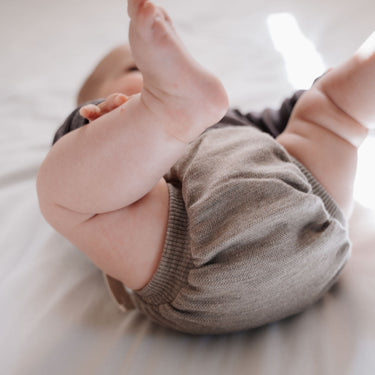
A used diaper is an astonishingly complex piece of waste.
It consists of cellulose.
Of plastics.
Of superabsorbents.
Of non-woven fabric.
Of films.
Of adhesives and elastic materials.
And after a few hours, urine and sometimes stool are added.
To turn these back into usable raw materials, researchers and companies are now developing impressive technologies.
Diapers are treated under high pressure and high temperature.
They are sterilized.
Shredded.
Dried.
Mechanically separated.
Treated with enzymes.
Or gasified at over 600 degrees.
All of this is technically exciting.
And certainly useful for diapers that have already been used.
But while we are busy figuring out how to elaborately separate a diaper after use, we must not forget a much simpler question:
Does every bodily excretion even need to end up in a diaper?
Because a diaper that is not used at all doesn't need to be:
- collected
- transported
- sterilized
- disassembled
- chemically treated
- incinerated
- or recycled
This is precisely where the really interesting part of the story begins for us.
Can used diapers be recycled?
Yes.
That should be stated clearly now.
Used disposable diapers are not inherently unrecyclable.
Various European projects have already shown that components such as cellulose and plastics can be recovered.
In the Netherlands, this is already happening on an industrial scale.
Other projects are working with chemical recycling, gasification, or even enzymes.
The technical question today is therefore no longer:
Can a diaper be recycled at all?
But:
How do we separately collect millions of soiled diapers, hygienically process them, and economically separate them again?
And suddenly, a seemingly simple diaper becomes a fairly large system.
Why diaper recycling is so complicated
If you want to recycle a glass bottle, it consists mainly of one material:
Glass.
A diaper is constructed completely differently.
It should be soft and at the same time leak-proof.
It should quickly wick away liquid from the skin.
It should absorb large quantities of it.
It should be snug around the legs and still allow movement.
For all this to work, many different materials are firmly bonded together.
Typically, these include:
- Cellulose fibers
- Superabsorbents
- Plastic non-wovens
- Plastic films
- Elastic
- Adhesives
- Fasteners
After use, these materials are additionally contaminated with excretions and moisture.
This is one of the reasons why a used diaper cannot simply be put into a sorting plant and then processed back into a new diaper.
Why disposable diapers are so difficult to recycle
For diaper recycling to work, an entire infrastructure is needed
A recycling machine alone is not enough.
First, the diapers must arrive there at all.
This means:
- separate collection bins
- separate collection
- transport
- suitable recycling plants
- hygienic treatment
- separation of materials
- further processing
- buyers for the recovered raw materials
And that's why the biggest challenge in diaper recycling today is not just the technology.
It's the entire system surrounding it.
Which diaper recycling projects already exist?
Nevertheless, it would be wrong to downplay all these developments.
A lot is happening in Europe right now.
And some projects clearly show that the previous disposable product could one day become at least partially a circular product.
Netherlands: Diaper recycling already works industrially
Probably the most tangible example is in Weurt near Nijmegen.
ARN has been processing used diapers and incontinence products there since 2021.
The plant has a capacity of around:
15,000 tons per year.
The diapers are collected separately and then hygienically treated and digested under high temperatures and pressure.
After that, various components can be separated and reused.
This is important.
Because it shows:
Diaper recycling can work on an industrial scale.
At the same time, the example also shows how much infrastructure is necessary before even a single diaper can be recycled.
Italy: Diapers to be turned back into raw materials
The European research project EMBRACED has also shown that used absorbent hygiene products can be reused.
Among other things, cellulose and plastics were recovered and investigated as starting materials for new applications.
In 2025, a new demonstration plant based on the results of this project was opened in Treviso.
The goal:
To create secondary raw materials from what was previously a predominantly incinerated waste stream.
An important step.
But not yet a comprehensive system for millions of families.
Belgium: Chemically recycling diaper plastics
In 2026, Woosh, Borouge International, and BlueAlp demonstrated another possible path.
Plastics from used baby diapers were recovered and then chemically recycled.
This created pyrolysis oil.
This, in turn, can be used as a raw material for new polymers.
This is particularly interesting because the plastics are returned to their original building blocks much further than with simple mechanical recycling.
But here too, the same applies:
The diapers must first be collected, transported, processed, and treated.
BASF, Essity, and TU Wien: The diaper becomes gas
BASF, Essity, and the Technical University of Vienna are investigating another approach.
They gasify used diapers at high temperatures.
This produces a gas mixture including carbon monoxide and hydrogen.
These substances can then serve as raw materials for the chemical industry.
The advantage:
The diaper does not have to be completely disassembled into all its individual components beforehand.
This is also exciting.
But it also shows very well what technical effort we have to make to deal with a product that was perhaps only used for a few hours.
Austria: Enzymes to break down diapers
The Austrian Centre of Industrial Biotechnology is taking a different approach.
In the "Diapers Recycler" project, enzymes are used to process diaper materials.
The idea of smaller, decentralized facilities is particularly interesting.
They could be used, for example, where large quantities of hygiene products accumulate:
- Hospitals
- Care facilities
- Childcare facilities
This could reduce transport distances.
However, in 2026, this process is still at the laboratory stage.
All these projects are useful – but they start very late
And this is exactly where we want to change our perspective again.
Diaper recycling only begins after a lot has already happened.
For every single diaper, the following occurred beforehand:
- Raw materials were extracted
- Cellulose was produced
- Plastics were manufactured
- Superabsorbents were made
- The individual layers were joined
- The diaper was packaged
- It was transported
- Sold
- And finally, used for a few hours
After that, we have to build a second technical cycle to recover as much as possible.
That can be useful.
But perhaps it shouldn't always be the first thought we start with.
The simplest form of diaper recycling is: not needing a diaper at all
Of course, your baby has to pee.
And of course, it has to excrete stool.
We cannot and do not want to change that.
But we can change where that excretion ends up.
For example, if a baby excretes over a sink or potty after waking up in the morning, it may not need a new disposable diaper for that pee at all.
Then for that one moment, there is:
no diaper material.
No diaper waste.
No transport to incineration.
And no subsequent recycling problem.
This is actually astonishingly simple.
Elimination communication does not mean: no more diapers
A misunderstanding quickly arises at this point.
When we say that fewer diapers are the simplest form of waste prevention, we don't mean:
All parents should completely forgo diapers from tomorrow on.
That would neither be realistic nor our understanding of diaper-free.
Your baby is, of course, allowed to wear a backup.
Perhaps a disposable diaper.
Perhaps a cloth diaper.
Perhaps an EC-friendly diaper with a washable insert.
Diaper-free can mean:
Some excretions end up in the diaper. And some just don't.
It doesn't have to be more than that.
Maybe it starts with the morning pee
Many parents eventually realize:
Babies don't excrete completely randomly.
There are moments when it is particularly likely.
For example:
- after waking up
- around breastfeeding or feeding
- during diaper changes
- after longer periods of being carried
- with certain signals
- with recognizable bowel movements
You don't have to observe all day for this.
Perhaps there is simply a moment you would like to try.
The baby wakes up in the morning.
You pick it up.
Open the backup.
Hold it briefly over the sink.
Perhaps a pee comes.
Perhaps not.
If not, nothing happens.
If it does and the backup stays clean, then exactly one less diaper can result from that.
One less diaper sounds small – until you add them up
A single diaper doesn't change the world.
But family life consists of repetitions.
One less diaper a day, over an assumed diapering period of two and a half years, results in approximately:
913 diapers.
Almost 1,000 disposable diapers.
Even with only five diapers actually saved per week, it's still around:
650 diapers.
With three per week:
around 390 diapers.
This does not mean that you have to reach these numbers.
They only show:
Even part-time EC is not insignificant.
Part-time elimination communication: How much diaper waste you can really save
Almost 1,000 fewer diapers mean almost 1,000 fewer recycling problems
A diaper that is not needed due to elimination communication does not have to be broken down into its components after use.
It also doesn't have to be produced in the first place, provided that lower consumption leads to correspondingly lower demand in the long term.
That's why waste prevention fundamentally precedes recycling.
Recycling asks:
What do we do with this product after we've used it?
Prevention asks:
Did we need this product at all for this moment?
Both questions are important.
But the second one comes first.
Why we still need diaper recycling
Even though we love elimination communication:
It would be unrealistic to believe that disposable diapers will eventually no longer be needed at all.
Diapers will continue to be useful.
For some nights.
For travel.
For childcare.
For illness.
For families who do not wish to use elimination communication.
And for all those moments when no one notices a signal.
For these diapers, we need better solutions.
That's why projects in the Netherlands, Italy, Belgium, Germany, and Austria are important.
Once a product has been used, we should keep as many of its raw materials in circulation as possible.
But we should not confuse recycling with prevention.
A circular economy is good. A avoided disposable product can be even simpler.
Imagine two paths.
Path 1: Disposable diaper and recycling
Extract raw materials.
Produce materials.
Manufacture diaper.
Package.
Transport.
Purchase.
Use.
Collect.
Transport.
Sanitize.
Shred.
Separate or chemically convert.
Recover new raw materials.
Path 2: Elimination communication
Pick up baby.
Open backup.
Hold for elimination.
Close backup again.
Of course, this is consciously simplified.
A potty was also manufactured. Water for cleaning is needed. Clothes are washed.
And so far, there is no comprehensive life cycle analysis that precisely compares diaper-free with other diaper systems over the entire baby period.
Therefore, we do not want to promise artificially exact CO₂ figures.
But for the individual disposable product, the difference is obvious:
A diaper that is not used does not generate used diaper waste.
And this is precisely where family life decides
The idea is simple.
The implementation can still fail due to something completely trivial:
the clothing.
Perhaps you notice:
Now my baby has to go.
Then comes:
Unbutton onesie.
Pull up sweater.
Pull down pants.
Pull down tights.
Open diaper.
And while you're still struggling with the clothes, the pee has long been in the diaper.
This is one of the reasons why Mata Origin came into being at all.
Elimination communication becomes much easier when clothing is made for it.
Split-crotch pants: so the moment isn't over before the pants are open
A split-crotch pant from Mata Origin is cut so that your baby doesn't have to be completely undressed every time for elimination communication.
Open.
Hold over a toilet/potty.
Close again.
This is especially helpful when the urge to eliminate comes spontaneously.
And particularly:
- in winter
- at night
- after waking up
- on the go
- with very young babies
Because if something is easy, we are more likely to do it again in everyday life.
Elimination Communication Diapers: Security Without Missing the Moment
Our wool elimination communication diapers are therefore not an alternative to EC.
They are a backup for it.
If your baby has an accident:
no problem.
If you notice they need to go:
you can quickly open them.
This takes the pressure off.
You don't have to choose between two worlds:
Diaper or EC.
You can combine both.
EC Rompers Can Also Make a Difference
A beautiful romper can be quite impractical for EC if you have to unbutton numerous snaps and partially undress the baby every time.
That's why our EC clothing is designed so that the diaper area is quickly accessible.
Your baby can stay warm.
And you can still react.
For us, this is sustainable design:
not just using a different material, but designing clothes so that a resource-saving everyday life becomes easier.
The Better Solution Is Probably Not Either Recycling or EC
We need both.
And more.
We need:
- better disposable diapers
- less problematic materials
- better recycling processes
- functioning collection systems
- durable reusable backups
- cloth diapers where they fit well
- and more knowledge about EC
Sustainability doesn't have to mean finding a single solution for all families.
Perhaps the better future consists of many small changes.
Part will be recycled.
Part will be reused.
And part will not be needed at all.
Our Vision for the Future
Imagine parents learning during pregnancy:
Babies don't necessarily have to eliminate every bodily waste into a diaper.
You can practice EC with your baby.
Completely relaxed.
With a diaper as a backup.
Maybe just once a day.
At the same time, the disposable diapers that are actually needed would be collected separately after use and recycled in a meaningful way.
And reusable products would be used, passed on, and repaired for as long as possible.
That would be true circular economy for us.
Not:
We can consume endlessly because we will recycle everything later.
But:
We consume less where it is easily possible – and take good care of what still arises.
Frequently Asked Questions About Diaper Recycling
Can used diapers really be recycled?
Yes. Various European processes show that components such as cellulose and plastics can be recovered from used diapers. There is already a plant with industrial capacity in the Netherlands.
Why is diaper recycling so difficult?
Disposable diapers consist of many tightly bonded materials. After use, moisture, urine, and possibly feces are added. Therefore, diapers must be collected separately, treated hygienically, and then technically separated with complex processes or chemically or thermochemically processed.
Where are diapers already being recycled?
An important example is ARN in the Netherlands, where diapers and incontinence products have been processed on an industrial scale since 2021. Further demonstration, pilot, and research projects exist in Italy, Belgium, Germany, and Austria, among others.
Is diaper recycling better than incineration?
Recycling can keep materials or chemical raw materials in a cycle that would be lost in terms of material during pure incineration. Whether a specific process performs better overall ecologically depends, among other things, on energy demand, collection, transport, and the quality of the recovered materials.
What is better: recycling or avoiding diapers?
Both have their place. If a disposable diaper is already used, recycling can enable better use of its raw materials. However, if a diaper is not needed at all through EC, neither the corresponding disposable waste nor the subsequent recycling effort for that diaper is generated. In the waste hierarchy, avoidance therefore generally takes precedence over recycling.
Does my baby have to be completely diaper-free for this?
No. EC can naturally work with a backup. Many families only hold their baby over a toilet/potty in selected situations and otherwise continue to use diapers.
How can I get started most easily?
A particularly easy moment for many families is right after waking up. Open the backup and offer your baby for a short moment to eliminate over a sink, potty, or toilet. If nothing comes, that's perfectly fine too.
How many diapers can part-time EC save?
That depends on the child and your daily routine. Three disposable diapers actually saved per week, over two and a half years, amount to approximately 390 diapers; five per week, about 650; and one per day, around 913 diapers.
Do I need special clothing for EC?
No. You can start with the clothes you already have. If EC becomes a more frequent part of your daily routine, EC pants, quick-opening EC diapers, and EC rompers can make that crucial moment significantly easier.
Conclusion: Before we recycle the diaper, we can ask if we even need it.
Diaper recycling is fascinating.
We can break down used diapers under pressure and heat.
We can chemically recover plastics.
We can gasify diaper waste.
We are even developing enzymes to help separate their components.
All this research is important.
Because for the diapers we use, we need better solutions.
But sometimes it's worth going back to basics before all the technology.
To your baby.
To a sink.
To a small potty.
To that one moment after waking up.
Maybe a pee comes out.
The backup stays dry.
And a disposable diaper isn't needed at all.
No conveyor belt.
No high-pressure system.
No pyrolysis.
No gasification.
No recycling.
Sometimes, the simplest circular economy is one where waste isn't generated in the first place.
Independent Sources for Further Reading
- ARN: Diaper Recycling in the Netherlands
- Circular Bio-based Europe: Recycling Plant in Treviso
- Circular Bio-based Europe: EMBRACED
- Woosh, Borouge International and BlueAlp: Recycling of Diaper Plastics
- BASF, Essity and TU Wien: Gasification of Diaper Waste
- acib: Diaper Recycling with Enzymes
Read More
- Recycling Disposable Diapers: Why Used Diapers Are Hardly Recycled
- How Are Used Diapers Disposed of in Germany, Austria, and Switzerland?
- Part-time EC: How Much Diaper Waste You Can Really Save
- Almost 1,000 Fewer Diapers: What One EC Moment Per Day Can Achieve
Maybe You Just Want to Give it a Try
You don't have to throw anything away for it.
And you don't have to decide to live completely diaper-free from tomorrow.
Just take a moment.
Maybe tomorrow morning.
Your baby wakes up.
You open the backup.
And briefly hold them over the toilet/potty.
The beginning doesn't have to be more than that.
Our free starter guide shows you step-by-step how this can work in a relaxed way.
Discover the Free Starter Guide to EC
And if you realize that you'd like to pursue this path more often, at Mata Origin you'll find EC pants, EC diapers, and EC clothing that were developed for exactly this small moment:
quickly open, hold over, close again – instead of completely undressing the baby every time.