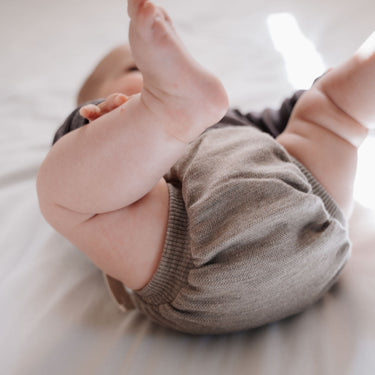
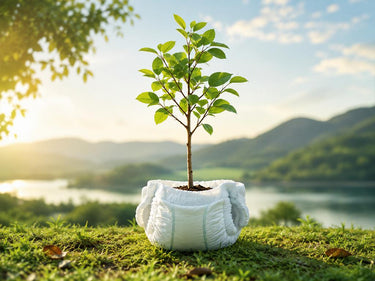
Diaper open.
Change baby's diaper.
Roll up the diaper.
And into the trash.
This small routine is such a given in many families' daily lives that we rarely think about what happens next.
But eventually, that full diaper pail might be sitting in front of you, and you wonder:
Why isn't something new simply made from it again?
We recycle glass.
Paper.
Metal.
Many packages.
So why not diapers too?
After all, a disposable diaper contains materials that are fundamentally valuable:
- Cellulose
- Plastics
- Superabsorbents
- Elastic materials
The short answer is:
A used diaper is not a single material. It is a tightly interconnected, soiled mix of materials.
And that's precisely what makes its recycling so difficult.
Why are disposable diapers so difficult to recycle?
A modern disposable diaper has to do many different things at once.
It should be soft.
Absorb liquid quickly.
Retain moisture inside.
Remain leak-proof on the outside.
Move with the baby.
And still be as thin as possible.
This only works because various materials are combined.
Typically, a disposable diaper contains, among other things:
- Cellulose fibers
- Superabsorbents
- Non-woven plastics
- Plastic films
- Adhesives
- Elastics
- Fasteners and side panels
Depending on the product, additional colors, wetness indicators, lotions, or other components may be present.
Cellulose, non-woven fabric, and plastics: The material layers of a disposable diaper
The real problem starts after use
As long as a diaper is clean and unused, its materials could theoretically be examined and separated relatively easily.
After use, that's a different story.
Now the diaper additionally contains:
- Urine
- Potentially stool
- Moisture
- Possibly creams or care products
The superabsorbent has soaked up liquid.
The cellulose is damp.
Different layers are stuck together and tightly pressed against each other.
And the entire product is hygienically contaminated.
This turns an already complex composite product into particularly challenging waste.
Problem 1: A diaper consists of many different materials
Recycling works particularly well when a material is as pure as possible.
A glass bottle consists predominantly of glass.
An aluminum can consists predominantly of aluminum.
With a diaper, it's different.
Here, plastics are right next to cellulose.
Superabsorbent lies between fibers.
Elastic materials are glued.
Fasteners are connected to other layers.
These materials cannot simply be taken apart like individual building blocks.
For recycling to be possible, the diaper must be technically opened, disassembled, and its components separated.
This costs equipment, energy, and money.
Problem 2: Superabsorbent changes during use
A particularly important component of modern disposable diapers is the superabsorbent.
These are usually highly swellable polymers that can absorb and retain large amounts of liquid.
That's why modern diapers work so well.
The pee seemingly disappears.
The diaper feels relatively dry for a long time.
However, this strength becomes a problem for recycling.
After use, the superabsorbent is swollen and loaded with liquid.
It is also mixed with cellulose fibers in the absorbent core.
Both must be separated and technically processed again.
In modern diapers, superabsorbent represents a significant part of the absorbent core.
Superabsorbents in diapers: Why disposable diapers absorb so much liquid
Problem 3: Used diapers must be hygienically treated
This is probably the most obvious difference from an empty beverage bottle.
A used diaper contains excretions.
Before its materials can be industrially processed again, it must therefore be hygienically treated.
In already proven recycling processes, used diapers are first, for example:
- opened
- hygienized with hot steam
- dried
- mechanically shredded
- subsequently separated into various material fractions
Only then can cellulose, plastics, or other components be further processed.
This shows:
Diaper recycling is technically possible – but it requires significantly more than a normal sorting process.
Problem 4: Diapers would need to be collected separately
Imagine there's a perfect diaper recycling plant somewhere.
Then one crucial question remains:
How do the diapers get there?
Today, used diapers usually end up in the bin with other residual waste or sweepings.
There they lie together with:
- Vacuum cleaner bags
- Hygiene articles
- Soiled packaging
- Ceramics
- Sweepings
- Other unsorted household waste
Sorting out individual used diapers from this mixture would be complex and hygienically problematic.
Therefore, a functioning diaper recycling system ideally requires its own collection.
Meaning:
Separate containers.
Separate transport.
Separate logistics.
Separate processing plants.
And enough diapers in a region to make this effort worthwhile.
Problem 5: Recycling also has to be economically viable
Technically feasible doesn't mean economically viable by a long shot.
This applies to many recycling processes.
Especially with used diapers.
Collected diapers must be:
- transported
- sanitized
- dried
- disassembled
- sorted
- cleaned
- reprocessed
to become secondary raw materials.
These must be of good enough quality for companies to actually use them again.
And they must be able to compete in price with newly produced raw materials.
This very point has long hampered the development of diaper recycling.
But does that mean diaper recycling is impossible?
No.
And that's important.
Sometimes you read that diapers can't be recycled at all.
That's not true.
Various European research and demonstration projects have already shown that used diapers can be technically processed.
For example, the following can be recovered:
- Cellulose fibers
- Plastic fractions
- Partially superabsorbent polymers
A particularly interesting European project was EMBRACED.
It developed a facility where used absorbent hygiene products are first sterilized and dried with steam.
Subsequently, the different components are mechanically and optically separated.
The recovered materials can then be used to create raw materials for other products.
So, things are moving technologically.
But there's a pretty big step between "it works in a demonstration plant" and "every family can throw their diapers into a recycling bin."
Why do we still throw diapers in the residual waste today?
Because the necessary infrastructure is not yet widely available.
In Germany and Austria, used baby diapers therefore usually go into residual waste.
In Switzerland, they go into general waste.
There, they are treated along with other non-recyclable household waste and predominantly thermally recovered.
The diaper thus disappears from our bathroom.
But its materials are not turned into a new diaper.
How are used diapers disposed of in Germany, Austria, and Switzerland?
Why aren't disposable diapers simply made from a single material?
Because a diaper has to fulfill many different tasks simultaneously.
The material against the skin should be soft and quickly wick away liquid.
The absorbent core should absorb enormous amounts of urine.
The outer layer should prevent clothes from getting wet.
The leg cuffs should be tight yet flexible.
The fasteners must hold and be able to be reopened.
No single material can currently fulfill all these tasks as well as the complex layered system of modern diapers.
That's precisely the dilemma:
What makes the disposable diaper particularly effective also makes it difficult to recycle.
Are eco or organic diapers more recyclable?
Not automatically.
For example, a diaper can contain cellulose from certified forestry or individual plant-based plastic components.
Nevertheless, it generally still requires:
- Absorbent materials
- Moisture protection
- Non-woven fabrics
- Adhesives
- Elastic components
The term "plant-based" therefore says nothing about whether the entire used diaper can be recycled.
The same applies to terms such as:
- Organic diaper
- Eco-diaper
- Natural diaper
- Sustainable diaper
The entire material composition is always decisive.
Eco-diapers and organic diapers: What's really behind them?
And what about compostable diapers?
Again, it's worth taking a closer look.
Bio-based does not automatically mean biodegradable.
Biodegradable does not automatically mean home compostable.
And individual compostable components do not yet make a fully compostable used diaper.
The challenge is the same:
A diaper must meet very high demands for absorbency, leak-proofness, safety, and comfort.
Especially the absorbent core and the water-repellent layers are technically challenging.
Therefore, many disposable diapers advertised as "eco" or "plant-based" still belong in residual waste after use.
Recycling is important – but prevention comes first
We find research into diaper recycling exciting.
Very much so.
If we could widely recover materials from used diapers someday, that would be progress.
But the circular economy doesn't start with recycling.
It starts one step earlier.
With a simple question:
Does this product even need to be created and used?
With diapers, this question is particularly interesting.
Because a baby naturally needs to excrete.
But the excretion doesn't necessarily have to end up in a disposable diaper every time.
How does elimination communication change the recycling question?
With elimination communication, we don't try to improve the subsequent recycling of a disposable diaper.
We give the baby another option beforehand.
For example:
- after waking up
- after breastfeeding or feeding
- during a diaper change
- when a clear signal comes
- with a clearly recognizable bowel movement
The baby then excretes over a sink, a potty, or the toilet.
If a clean backup stays clean as a result, a new disposable diaper may not need to be used.
And this diaper then:
- does not need to be manufactured
- not packaged
- not transported
- not collected
- not incinerated
- and also not recycled
The easiest diaper to recycle is sometimes the one that wasn't even needed in the first place.
You don't have to live completely diaper-free for this
This is particularly important to us.
This idea should not create new demands on parents.
You don't have to recognize every excretion.
You don't have to sit next to your baby all day waiting for signals.
And you don't have to ban all diapers from your home either.
Maybe you just start with a single moment.
In the morning after waking up.
Or during a bowel movement.
Or only on weekends.
That's part-time elimination communication.
And that counts too.
Part-time elimination communication: How much diaper waste you can really save
Even a few fewer diapers add up
A single diaper feels like little.
But family life consists of repetitions.
Day after day.
Week after week.
If elimination communication really eliminates only three disposable diapers per week, that's approximately over two and a half years:
390 fewer disposable diapers.
At five per week:
around 650 fewer diapers.
And with an average of one less diaper per day:
around 913 diapers – almost 1,000 fewer disposable diapers.
Almost 1,000 diapers whose recycling problem never even arises.
Almost 1,000 fewer diapers: What one elimination communication moment a day can achieve
Why elimination communication becomes much easier with the right clothing
In theory, elimination communication sounds pretty simple.
Pick up baby.
Open diaper.
Hold over toilet/potty.
Done.
In real family everyday life, there are sometimes an astonishing number of snaps between these four steps.
A bodysuit.
Pants.
Maybe tights.
Then the diaper.
And while you're still opening, the moment might already be over.
That's precisely why elimination communication-friendly clothing is so important to us at Mata Origin.
It shouldn't explain why elimination communication is a good idea. It should ensure that it's easy in the crucial moment.
Elimination communication pants: open instead of completely undressing
Our elimination communication pants are designed so that your baby does not have to be completely undressed every time for elimination communication.
You open the diaper area.
You hold your baby over the toilet/potty.
And close it again.
Especially when time is of the essence, this small difference can change a lot.
And the easier elimination communication becomes, the more easily it can become a normal part of your day.
Elimination Communication Diapers: Protection and still quick to open
The same principle is behind our wool elimination communication diapers.
Your baby continues to wear a backup.
If you don't notice an elimination moment, they are protected.
If you think:
Now they might need to go.
then the diaper can be opened quickly.
So you don't have to decide:
Either diaper or diaper-free.
Both can belong together.
And that's precisely where many families find the relaxed way.
Clothing can also be part of waste reduction
Of course, elimination communication pants do not automatically save waste.
They are not an environmental magic trick.
But they can reduce a hurdle.
If elimination communication is easier, it may happen more often.
If it happens more often, backups stay clean more frequently.
And if backups stay clean, fewer disposable diapers are needed or fewer washable inserts are soiled.
That is the idea behind Mata Origin:
Not just talking about more sustainable materials, but designing products in such a way that a more resource-efficient everyday life becomes easier.
Is cloth a better solution than recycling?
Cloth diapers solve a different problem.
Instead of using a new product after each elimination, they are washed and reused.
This significantly reduces single-use waste.
Of course, cloth diapers require water, detergent, and energy.
Their environmental footprint therefore heavily depends on how they are washed, dried, and how long they are used.
The combination is particularly exciting:
Elimination communication plus reusable backup.
Then the diaper does not have to be disposed of after each elimination.
And if the baby eliminates outside the diaper, the washable insert might even stay dry.
What would need to happen for diaper recycling to become commonplace?
For used disposable diapers to actually be recycled on a large scale, several things would need to come together:
- a separate collection of used diapers
- sufficient quantities in one region
- suitable hygiene and reprocessing facilities
- reliable methods for separating materials
- buyers for the recovered raw materials
- economically viable costs
Technical solutions alone are therefore not enough.
An entire system is needed.
Why recycling should still be further developed
Even if we at Mata Origin talk about prevention, it does not mean that recycling is unimportant.
Disposable diapers will remain a part of family life for a long time.
For nights.
For childcare.
For travel.
For families for whom other solutions are currently not suitable.
Therefore, it makes sense to research how the raw materials contained therein can be better kept in circulation.
We don't have to choose between two ideas.
We can simultaneously:
- design diapers better
- develop recycling technologies
- use reusable alternatives
- and, where it fits well, avoid diapers entirely
Sustainability rarely needs only one solution.
Frequent questions about disposable diaper recycling
Can disposable diapers be recycled?
Technically, components of used disposable diapers can be recovered. European pilot and demonstration plants have already shown this. However, in the normal municipal waste system, used baby diapers are generally not separately recycled.
Why is diaper recycling so difficult?
A diaper consists of various tightly bound materials such as cellulose, plastics, superabsorbents, adhesives, and elastic components. After use, urine, possibly stool, and moisture are added. The diapers must therefore be sanitized, dried, and technically separated into their different material fractions.
Why can't diapers go into the yellow bag?
A diaper is not packaging waste and consists of a complex material composite that is heavily contaminated after use. It is therefore not suitable for the normal sorting of packaging.
Can cellulose from diapers be recycled?
Basically, yes. Special recycling processes can recover cellulose fibers from used absorbent hygiene products. However, the diapers must be collected separately, hygienically treated, and technically processed for this.
Can superabsorbent be recycled?
The recovery of superabsorbents is also being technically investigated and is possible in special processes. However, it is significantly more complicated than recycling a single-sort plastic, because the superabsorbent is swollen and mixed with cellulose and liquid after use.
Are diapers recycled today?
There are specialized facilities, demonstration projects, and advanced processes in Europe. However, widespread separate diaper collection with material recycling is still not the normal disposal method for families.
Are eco-diapers recyclable?
Not automatically. Even a diaper with more sustainable cellulose or plant-based components can still consist of multiple plastics, superabsorbents, adhesives, and other materials. The overall construction is crucial.
Are biodegradable diapers compostable?
Not necessarily. Bio-based, biodegradable, and compostable mean different things. Individual biodegradable materials do not automatically make the entire used diaper suitable for the organic waste bin or home compost.
What is better than recycling diapers?
Recycling is useful when waste has already been generated. However, prevention is even higher in the waste hierarchy. If a disposable diaper is actually not needed through elimination communication, neither the material consumption nor the subsequent disposal and recycling problem of that diaper arises.
Do I have to be completely diaper-free to avoid waste?
No. Even part-time elimination communication can reduce diaper consumption. For example, you can offer your baby to eliminate only after waking up, at clear signals, or for bowel movements, and otherwise continue to use a backup.
Conclusion: The recycling problem begins with the construction of the diaper
A disposable diaper is an amazing product.
It is soft.
Thin.
Leak-proof.
And can absorb a lot of liquid.
Precisely for this, different materials are intricately combined.
And it is precisely this combination that makes it so difficult to take them apart again after a few hours of use.
In addition, there are excretions.
Moisture.
Hygiene requirements.
Collection.
Transport.
Processing.
Diaper recycling is therefore not impossible.
But it is complicated.
Perhaps that's why we shouldn't just ask:
How can we better recycle this diaper after use?
But sometimes also:
Do we even need a diaper for this elimination?
Maybe not tomorrow morning.
Maybe the first pee just goes into the sink.
Maybe the backup stays dry.
And maybe this one diaper is the simplest of all:
The one that never had to be produced, bought, and thrown away.
Independent sources for further reading
- European Commission: Creating sustainable value from used nappies
- Circular Bio-based Europe Joint Undertaking: EMBRACED
- European Commission: LIFE RECALL – Recycling of Complex AHP Waste
- CORDIS: High quality cellulose recovery from used absorbent hygiene products
- German Environment Agency: Absorbent Hygiene Products
Further reading
- Cellulose, Fleece, and Plastics: The Material Layers of a Disposable Diaper
- Superabsorbent in Diapers: Why Disposable Diapers Absorb So Much Liquid
- How Are Used Diapers Disposed of in Germany, Austria, and Switzerland?
- Life Cycle Assessment of Diapers: Disposable Diapers, Cloth Diapers, and Elimination Communication Compared
Would you rather prevent than dispose of?
You don't have to give up diapers overnight for this.
Perhaps you just try a single elimination communication moment.
After waking up.
During a diaper change.
Or when you are pretty sure:
Now my baby needs to go.
Our free starter guide shows you how to get started in a relaxed way.
Discover the free starter guide for elimination communication
And if elimination communication eventually becomes a more frequent part of your daily life, at Mata Origin you will find elimination communication diapers and elimination communication pants that make this small moment easier: quick to open, offer to eliminate, close again – without completely undressing your baby every time.