
At first glance, diaper inserts seem quite simple: lay them in, close the diaper, done.
In everyday life, however, it makes a big difference how you fold the insert. This is because the fold helps determine whether the insert fits well, whether it is comfortable for the baby, and whether the absorbency is where it's needed.
Especially with elimination communication diapers, wool covers, or cloth diapers, correct folding is therefore particularly helpful.
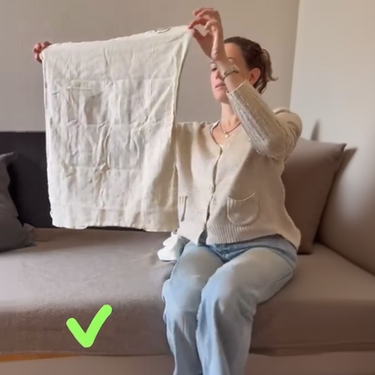
Video: How to fold the absorbent insert correctly
In our short video, we show you step-by-step how to correctly fold our absorbent insert. You'll first see what kind of fold works less well, and then the simple variant that makes the insert compact, even, and highly usable.
Why correct folding is important
An absorbent insert should absorb liquid and lie as comfortably as possible in the diaper. If it is folded incorrectly, it can become too wide, too long, too thick, or uneven.
This can lead to the diaper fitting poorly, the insert slipping, or insufficient absorbency in certain areas.
When folded correctly, however, a compact, multi-layered absorbent surface is created. This is practical in everyday life: the insert lies more stably in the diaper and absorbs where your baby usually wets.
Folding a diaper insert correctly: Step by step
The simplest folding technique works in three steps.
1. Fully open the absorbent insert
First, lay the absorbent insert completely flat. Smooth it briefly to prevent large creases or twists.
This is important because the insert will lie more evenly later and no thick edges will form.
2. Halve the longer side
Now, first fold the longer side of the absorbent insert in half.
This is the most important step.
This creates a good basic shape from which you can then fold the insert compactly.
3. Then fold twice
After halving, fold the insert twice more until a compact, multi-layered insert is formed.
In the end, it should not be too wide or too loose. It should feel stable, but not stiff or uncomfortable.
4. Place in the diaper
Now place the folded absorbent insert in the diaper. Make sure it lies flat and doesn't bunch up too much.
Depending on where your baby usually wets, you can place the insert a little further forward, in the middle, or further back.
Common mistake: Folding too narrow or unevenly
Many parents intuitively fold the insert together somehow. This is understandable, but it doesn't always work well.
If the insert is folded too narrowly, the absorbent surface is often not where it is needed. If it is folded too loosely or unevenly, it can slip in the diaper.
It is better to fold the insert consciously and calmly: first halve the longer side, then fold twice more.
This creates a more even shape.
Where should the absorbent insert be placed?
There isn't one perfect position for every baby.
Some babies tend to wet more in the front. Others more in the middle. For tummy sleepers, it can be useful to have a little more absorbency in the front. For other babies, a central placement is perfectly sufficient.
Therefore, simply observe where the insert is particularly wet after use. This is usually where your baby needs more absorbency.
How many absorbent inserts do I need?
That depends on how you use the diaper.
For short periods, one well-folded absorbent insert is often sufficient. For longer wear times, on the go, at night, or for babies who pee a lot at once, additional absorbency can be useful.
However, it is important to note: more inserts do not automatically mean a better result. If the diaper becomes too bulky or no longer fits well as a result, it can even leak more easily.
Therefore, not only the quantity of inserts is crucial, but also the right combination.
More absorbency without a bulky diaper
If the normal diaper insert is no longer sufficient, you can combine it with our Mata Origin Hemp Booster.
This is particularly practical if you need a little more security:
- at night
- on the go
- for longer car journeys
- for older babies
- if your baby pees a lot at once
The combination of Mata Origin absorbent insert and hemp booster can significantly increase the absorbency volume without the diaper package having to become noticeably bulkier.
The reason is the different material function: The absorbent insert quickly absorbs liquid. The hemp booster underneath stores additional moisture.
The correct order is important here:
The fast-absorbing insert goes on top, the hemp booster underneath.
Hemp can store a lot of moisture, but it absorbs more slowly than cotton. Therefore, you should not use the hemp booster as the sole absorbent material, but always combine it with a fast-absorbing insert on top.
Here you can find our hemp booster: Mata Origin Hemp Booster Diaper-Free 5-Pack
How to layer an absorbent insert and hemp booster
If you need more absorbency, proceed as follows:
- First, fold the absorbent insert as shown in the video.
- Place the hemp booster underneath.
- Make sure both lie flat and don't bunch up too much.
- Place the combination in the diaper so that the absorbency is where your baby usually wets.
The absorbent insert is thus closer to the baby. The hemp booster lies underneath and provides additional storage capacity.
This keeps the diaper package slim, but provides significantly more reserve.
You can find more information here: Cloth diapers leaking: Why it happens and what really helps
Prepare new absorbent inserts before first use
New absorbent inserts usually do not reach their full absorbency immediately.
This is normal. Natural fibers such as cotton and hemp need a few washes to absorb liquid properly.
Therefore, ideally wash new inserts three to five times before their first proper use. This rinses out any production residues and allows the fibers to develop their absorbency better.
If you want to further support the absorbency, you can place new absorbent inserts in clear water overnight before first use, then wash them again in the washing machine and let them dry.
Especially with the hemp booster, a little patience pays off. Hemp usually becomes more absorbent and suitable for everyday use with the first few washes.
What to consider when washing
To ensure your absorbent inserts reliably absorb, you should avoid fabric softener.
Fabric softener can form a film around the fibers. This makes absorbent inserts less able to absorb liquid and reduces their absorbency.
Instead, use a suitable detergent and make sure that no conditioning residues remain on the fibers.
You should not use vinegar permanently or for all diaper parts. For pure cotton or hemp inserts, a small dash of vinegar can occasionally help dissolve residues. However, for wool parts, elastic bands, PUL or elastic materials, vinegar is not ideal.
Therefore, if used at all, use it sparingly and specifically for suitable inserts. Do not simply add it as a standard to every diaper wash.
Drying absorbent inserts: Air or dryer?
When air-dried, absorbent inserts can become a little stiffer. This is normal and says nothing about the absorbency.
If the inserts are to be particularly soft, a dryer can help. Cotton and hemp inserts often become noticeably softer in the dryer.
The absorbency is generally maintained, regardless of whether you hang the inserts or tumble dry them.
Air drying is usually more sustainable. If it is important to you that the inserts are particularly soft from time to time, you can use the dryer consciously and gently.
Why folding is particularly practical for elimination communication diapers
With elimination communication diapers, the goal is not to avoid changing for as long as possible. It is about making everyday life with a baby more conscious and flexible.
A well-folded absorbent insert can help catch small amounts of pee without having to change the entire diaper immediately.
If you need more security, simply add the hemp booster underneath. This gives you more absorbent reserve in everyday life without making the elimination communication diaper unnecessarily bulky.
This is especially practical if you also practice elimination communication with your baby. The insert then serves as a backup for those moments when something does end up in the diaper. The hemp booster is the additional reserve for longer periods.
Here you can find our diaper inserts: Discover diaper inserts
When should you change the insert?
Change the absorbent insert as soon as it is noticeably wet or could feel uncomfortable for your baby.
Even if wool and good materials can compensate for a lot: baby skin prefers it dry, airy, and as little irritated as possible.
If your baby is prone to diaper rash, a conscious changing rhythm is particularly worthwhile.
Relevant to this: Diaper rash in babies: Causes and prevention
Conclusion: Correct folding makes everyday life easier
Folding a diaper insert correctly is not a complicated technique. But it makes a real difference in everyday life.
If you first halve the absorbent insert along the longer side and then fold it twice more, a compact, even shape is created. It sits well in the diaper, slips less, and brings absorbency where it is needed.
If you need additional security, you can combine the folded absorbent insert with the hemp booster. The absorbent insert goes on top, the hemp booster underneath.
Sometimes it's these small adjustments that make everyday life with cloth diapers, wool covers, or elimination communication diapers easier.
Frequently asked questions about folding diaper inserts
How do I fold a diaper insert correctly?
Lay the absorbent insert completely flat, first halve the longer side, and then fold it twice more. This creates a compact, multi-layered insert.
Why should I halve the longer side first?
This creates a good basic shape. The insert becomes more even, sits better in the diaper, and can then be folded compactly.
Can I fold the absorbent insert differently?
Yes, you can generally adapt the fold to your baby and your diaper. However, the variant shown in the video is particularly simple and works very well in everyday life.
Where should the folded insert be placed in the diaper?
Where your baby wets the most. For some babies, this is more in the front, for others in the middle. Observe the wet spot after use, and you will quickly find the right position.
When do I need a hemp booster?
A hemp booster is useful when a normal absorbent insert is no longer sufficient. For example, at night, on the go, for longer car journeys, for older babies, or if your baby pees a lot at once.
Does the hemp booster go over or under the absorbent insert?
The hemp booster goes under the fast-absorbing insert. The absorbent insert is closer to the baby and quickly absorbs liquid. The hemp booster underneath provides additional storage capacity.
Can I use the hemp booster alone?
Better not. Hemp stores a lot of moisture, but it absorbs more slowly than cotton. Therefore, we always recommend combining the hemp booster with a fast-absorbing insert on top.
Do I need to pre-wash new absorbent inserts?
Yes. New absorbent inserts should ideally be washed three to five times before their first proper use. This allows cotton and hemp to develop their absorbency better.
Why don't new inserts absorb properly yet?
New natural fibers can still contain production residues and need a few washes to absorb liquid well. This is quite normal, especially for cotton and hemp.
Can I use fabric softener for absorbent inserts?
No. Fabric softener is not suitable for absorbent inserts because it can coat the fibers and reduce absorbency.
Do absorbent inserts get softer in the dryer?
Yes. Cotton and hemp inserts often become softer in the dryer than when air-dried. Air drying is more sustainable, but for extra soft inserts, the dryer can occasionally be helpful.
Do I need more than one absorbent insert at night?
This can be useful if your baby wears a diaper for a longer period at night. However, make sure that the diaper does not become too bulky and still fits well. Often, a well-folded absorbent insert plus hemp booster is a better solution than several thick inserts on top of each other.