Disposable diapers, cloth diapers, or diaper-free – what is actually gentlest for sensitive baby skin?
Many parents wish for a clear answer to this question.
One product. One material. One system that reliably prevents diaper rash.
But unfortunately, it's not that simple.
A highly absorbent disposable diaper can keep moisture away from the skin. A cloth diaper allows for a more conscious choice of materials. With elimination communication, some of the excretions can land completely outside the diaper.
Each of these methods has advantages. But each also has limitations.
The more honest question is therefore:
What stresses baby skin in the diaper area – and how can we minimize this stress in everyday life?
At Mata Origin, it's not about judging parents for their choice of diaper.
It's about making a frequently overlooked connection visible:
For baby skin, it's not just about which diaper your baby wears. At least as important is how long they lie in it, how often it's changed, and whether excretions always have to end up in the diaper.
Why baby skin in the diaper area can become irritated so quickly
The diaper area is exposed to particular stresses.
Several factors converge there:
- Moisture
- Body heat
- Little direct air circulation
- Friction from movement and elasticated cuffs
- Contact with urine
- Contact with stool
- Cleaning and care products
- Diaper materials
If the skin remains moist for a long time, its protective horny layer softens. It becomes more sensitive to friction and irritating substances.
Prolonged contact with stool can be particularly stressful. Enzymes from the stool become more active in a moist and altered skin environment and can further attack the skin barrier.
A classic diaper rash is therefore usually not caused by a single substance.
It arises from an interplay of:
- too long moisture
- excretions
- friction
- heat
- insufficient ventilation
- individual sensitivity
Fragrances, lotions, wet wipes, detergents, or care products can also play a role in sensitive skin.
You can learn more about the peculiarities of this skin area here:
Baby skin in the diaper area: Why it is particularly sensitive
What really helps baby skin?
Regardless of the diaper system used, some principles are particularly important:
- regularly check wet and soiled diapers
- change as soon as possible after a bowel movement
- clean the skin gently rather than rubbing vigorously
- let the diaper area dry carefully
- ensure a good fit
- avoid fragrances and unnecessary additives as much as possible
- regularly air the skin
Dermatological recommendations name the quick changing of wet and soiled diapers as one of the most important measures for preventing and treating diaper rash.
This already makes something crucial clear:
Even the most skin-friendly diaper can lose its benefits if it stays on the body for too long.
Disposable diapers: dry on the surface
Modern disposable diapers are designed to quickly wick urine away from the skin and hold it in the absorbent core.
Several layers work together for this:
- a skin-adjacent inner layer
- an acquisition and distribution layer
- pulp
- superabsorbent polymers
- an outer waterproof layer
The superabsorbent polymer binds liquid and turns it into a gel-like mass. This can make the surface feel comparatively dry, even though the diaper has already absorbed urine.
This can be an advantage for the skin.
Because less free liquid directly on the skin means less softening of the skin barrier.
You can learn more about how it works here:
Superabsorbers in diapers: effects, risks, and open questions
Are disposable diapers therefore automatically more skin-friendly?
No.
The dry surface is only one part of the skin question.
Even a modern disposable diaper:
- fits snugly against the body
- covers the genital and gluteal area
- creates friction
- already contains excretions
- may contain fragrances or lotions
- creates a different microclimate than freely ventilated skin
A very absorbent diaper can also appear dry and leak-proof for so long that a single pee is barely noticed.
The theory is therefore:
The less visible and palpable the excretion, the easier it is for the diaper to stay on the baby for longer.
A direct cause-and-effect relationship has not been conclusively proven.
However, the mechanism is plausible:
- The diaper still feels dry.
- It doesn't leak.
- The baby may react less clearly to wetness.
- Parents don't notice every excretion.
- The technical capacity is easily confused with a sensible wearing duration.
The possible skin relief provided by superabsorbers should therefore not be understood as an invitation to extend changing intervals as long as possible.
A diaper does not have to be completely full before it is changed.
What does research say about disposable diapers and diaper rash?
Some older studies concluded that superabsorbent disposable diapers can reduce skin moisture and the severity of diaper dermatitis.
These results are still often used today as evidence that disposable diapers are generally more skin-friendly.
However, the overall body of research is less clear-cut.
A Cochrane review concluded that there are not enough high-quality randomized controlled trials to recommend or reject a particular type of disposable diaper for the prevention of diaper dermatitis.
This means:
- The ability to wick moisture away from the skin is fundamentally beneficial.
- Some disposable diapers can be very effective in this.
- A general superiority over all cloth diaper systems is not definitively proven.
- Changing rhythm and actual use remain crucial.
Therefore, even with positive product studies, it is worth asking which diapers were compared.
Testing a modern disposable diaper with superabsorbent polymers against a simple cotton diaper with a plastic cover says little about how it compares to modern cloth diapers, wool, frequent changes, or elimination communication.
What disadvantages can disposable diapers have for the skin?
Possible stresses include:
- long wearing times due to high absorbency
- friction at cuffs and fasteners
- a tightly covered diaper area
- fragrances or lotions
- contact with stool until the next change
- individual reactions to specific materials
Allergic reactions to diaper components are significantly rarer than classic irritant diaper dermatitis.
However, they can occur – for example, at elastic edges, adhesives, dyes, or cosmetic additives.
If redness always appears at the same contact points or starts after a brand change, a closer look is worthwhile.
What you can look out for with disposable diapers
- fragrance-free
- preferably without lotion
- good fit without strong pressure points
- transparent material specifications
- traceable pollutant and environmental standards
- regular checks despite high absorbency
- prompt change after a bowel movement
Your baby's skin is more important than any advertising promise.
A diaper advertised as "sensitive" can work well for one baby and cause irritation for another.
Cloth diapers: natural alternative or moist burden?
Cloth diapers are often presented as particularly natural and skin-friendly.
Here, too, a differentiated perspective is important.
Cloth diapers can consist of easily traceable materials, for example:
- cotton
- hemp
- wool
- viscose fibers
- synthetic functional fibers
Parents can often assemble the absorbent layer, the skin-contacting surface, and the waterproofing themselves.
This transparency is a great advantage.
Cloth diapers are also reusable and avoid daily contact with a constantly new industrial disposable product.
Cloth diaper does not automatically mean natural fiber
The term cloth diaper primarily means that the diaper is washed and reused.
Cloth diaper systems can also contain:
- polyester
- microfiber
- fleece
- polyurethane coatings
- synthetic elastic bands
- plastic snaps
Many modern covers are waterproofed with a PUL or TPU membrane.
This can be very practical and leak-proof. However, it does not mean that the system is plastic-free or completely openly ventilated.
If you want to use the most natural materials possible, you should therefore not just ask for "cloth diaper," but for the specific construction.
What can be skin-friendly about cloth diapers?
Possible advantages are:
- consciously selectable materials
- fewer unnecessary fragrances and lotions
- earlier perception of wetness
- more frequent changing
- reusable instead of constantly new materials
- with wool, a different kind of moisture protection than plastic film
The changing rhythm in particular can make a difference.
Many cloth diapers feel wet more quickly than a highly absorbent disposable diaper. This means that excretion is noticed earlier, and the insert may be changed more quickly.
This is not an automatic advantage of the material.
It is a possible advantage of how it is handled.
When can cloth diapers irritate the skin?
A wet cloth insert can keep liquid directly on the skin if it is not changed in time.
Possible problems are:
- inserts wet for too long
- friction from thick or ill-fitting fabric layers
- detergent residues
- fragrances in detergent
- fabric softener on the fibers
- insufficient rinsing
- unsuitable or very rough materials
- inserts not completely cleaned
Therefore, cloth diapers should not be changed less frequently simply because they are made of natural materials.
A wet cotton insert remains a wet cotton insert.
Even natural fibers do not protect the skin from prolonged contact with urine and stool.
Are cloth diapers demonstrably better for the skin?
A general superiority has not been scientifically proven.
The existing comparisons vary greatly:
- old cotton systems versus modern disposable diapers
- different covers
- different changing intervals
- different cleaning and care routines
- different definitions of diaper dermatitis
Therefore, no reliable skin prognosis can be derived from the product category alone.
A frequently changed cloth diaper made of well-tolerated materials can be very gentle.
A cloth diaper worn wet for a long time can severely irritate the skin.
Wool: natural moisture protection with limits
Wool plays a special role in cloth diapers and elimination communication.
It is not used as the actual absorbent core, but mostly as an outer protective layer.
Wool can:
- absorb and release moisture
- balance temperature differences
- serve as a reusable outer layer
- become more water-repellent with lanolin
The absorbent work is still done by an insert made of cotton, hemp or another material.
The system works, simplified, as follows:
- The insert absorbs.
- The wool protects the clothes.
- Lanolin supports moisture protection.
- Elimination communication can relieve the backup.
Wool is not absolutely waterproof and does not replace a timely change.
It is also not a medical remedy for diaper rash.
Its advantage lies rather in a reusable system that is not designed for maximum, as long as possible concealed liquid storage.
You can find more information here:
Why wool in the diaper area is the better choice
Discover wool elimination communication diapers
Is wool suitable for every baby's skin?
No material automatically suits every baby.
Very fine merino wool is well tolerated by many babies. Coarse or scratchy wool fibers, however, can mechanically irritate sensitive skin.
Detergents, lanolin products, dyes, or inappropriate care can also play an individual role.
Therefore, for wool too:
- start with a small everyday situation
- pay attention to a soft quality
- observe care instructions
- monitor the skin
- if there is a significant reaction, omit the product initially
Diaper-free: less product, fewer full diapers
Diaper-free is often understood as a baby having to live completely without diapers.
That is not necessary.
With elimination communication, you regularly give your baby the opportunity to excrete pee or stool outside the diaper.
This can happen:
- after waking up
- during diaper changes
- around breastfeeding or feeding
- after wearing
- before bedtime
- with recognizable signals
Your baby can still wear a diaper or elimination communication diaper as a backup.
Diaper-free therefore does not necessarily mean less security.
It primarily means:
The diaper doesn't have to be the only place for every excretion.
Why elimination communication can be interesting for baby skin
If an excretion lands outside the diaper, the skin has no or significantly shorter contact with it.
This is particularly relevant for stool.
Stool can irritate the skin more than urine because it contains enzymes that can attack the already softened skin barrier.
If a bowel movement occurs during elimination communication, it does not have to:
- be spread over the skin
- remain in the diaper area until the next diaper change
- interact with urine and warmth
- be laboriously removed from irritated skin
Regular diaper-free moments also give the area air and reduce the time spent in a tightly fitting system.
That makes elimination communication so interesting from a skin perspective.
What does research say about diaper-free and skin rashes?
Research on elimination communication and diaper dermatitis is still limited.
A survey study published in 2023 found a correlation between more diaper-free times and less reported skin rashes, as well as reduced use of wound care products.
The study is an interesting indication, but not definitive proof.
It was based on an online survey of caregivers. Families decided for themselves whether and how they practiced elimination communication. As a result, the groups may have differed in other respects too – for example, in changing frequency, care products, or general health behavior.
Therefore, it can be seriously stated:
- More diaper-free time was associated with fewer rashes in this study.
- A causal protective effect has not yet been definitively proven.
- The practical mechanism is understandable.
- Further independent investigations would be useful.
Elimination communication is therefore not a medical promise of healing.
However, it is a very direct way to reduce the time spent in a full diaper.
Part-time elimination communication: Why even individual moments count
Can elimination communication prevent diaper rash?
Not reliably in every case.
Even a baby who is frequently taken to a potty can develop skin irritations – for example, due to:
- Diarrhea
- Infections
- Care products
- Friction
- A poorly fitting diaper
- Allergies or other skin conditions
However, elimination communication can reduce an important stress factor:
prolonged contact with excretions in a closed diaper.
The more often stool and urine land outside the diaper, the less the backup has to absorb and the shorter the contact with the skin can be.
Disposable diapers, cloth diapers, and elimination communication in an honest comparison
Disposable diapers
Possible benefits for the skin:
- Wick liquid away from the surface quickly
- Retain free wetness in the absorbent core
- Are easy and quick to change
- Can reduce friction with a proper fit
Possible disadvantages:
- Complex material mix
- Possible fragrances and lotions
- High absorbency can make excretions less noticeable
- Closed diaper area
- Stool remains on the skin until changed
Cloth diapers
Possible benefits for the skin:
- Materials can be consciously selected
- Often fewer cosmetic additives
- Wetness is often noticed sooner
- Wool can serve as reusable moisture protection
Possible disadvantages:
- Wet natural fibers can retain moisture on the skin
- Detergent residues can irritate
- Thick layers of fabric can chafe
- Not every cloth diaper system is plastic-free or particularly breathable
Elimination communication
Possible benefits for the skin:
- Fewer excretions end up in the diaper
- Less contact with stool
- More air and diaper-free time
- The backup can often stay dry
- Excretions are perceived more consciously
Possible limitations:
- Not every excretion is recognized
- A backup remains useful for many families
- It requires attention and suitable routines
- A medical protective effect is not guaranteed
What is gentlest on baby's skin?
There is no diaper type that is automatically the gentlest for every baby and every family.
Skin is usually relieved most by a daily routine in which:
- Excretions are noticed as early as possible
- Wet and soiled diapers are changed promptly
- Stool remains on the skin for as short a time as possible
- Friction is avoided
- Few unnecessary additives are used
- The materials are individually tolerated
- The diaper area gets regular air
This can be achieved with a well-fitting disposable diaper.
It can be achieved with a frequently changed cloth diaper.
And it can be particularly well supported if your baby regularly has the opportunity to eliminate outside the diaper.
Why combinations are often useful
You don't have to commit to a single system for the entire diapering period.
Possible combinations include:
- Cloth diapers at home and disposable diapers on the go
- Wool during the day and another solution at night
- Elimination communication after waking up and diapers the rest of the time
- Eco-disposable diapers as backup and part-time elimination communication
- Elimination communication diapers at home and classic diapers in childcare
A pragmatic middle ground can be more skin-friendly than a theoretically perfect system that overwhelms you in everyday life.
The easier the solution fits you, the more likely you are to succeed with regular checking, changing, and elimination communication.
The Mata-Origin way: less full diaper instead of just a better diaper
At Mata Origin, we don't want to reduce the diaper question to a competition between products.
Because even the best diaper remains a diaper.
It can absorb excretions and protect clothing. But it cannot give the baby the opportunity to eliminate outside of it.
This is exactly where elimination communication begins.
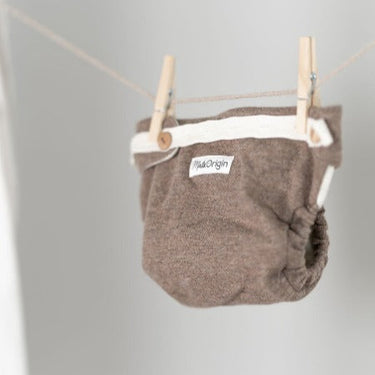
With a quick-opening elimination communication diaper made of wool, your baby remains protected. At the same time, you can easily react to typical moments or signals.
The diaper thus becomes a backup.
Not the only solution.
The goal is not to catch every excretion.
The goal is:
- Less time in a full diaper
- More air in the diaper area
- More awareness
- Natural and reusable materials
- A relaxed approach without pressure to perform
What does elimination communication mean?
Discover wool elimination communication diapers
Seven steps for a more skin-friendly diapering routine
- Change after bowel movements as promptly as possible.
- Regularly check even very absorbent diapers.
- Choose fragrance-free products without unnecessary lotions whenever possible.
- Ensure a good fit without chafing or pressure.
- Clean gently and let the skin dry briefly.
- Incorporate regular air breaks.
- Try a simple elimination communication moment after waking up.
You don't have to implement all seven points at once.
Even a small step can already change how long the skin remains in contact with moisture and excretions.
When should a diaper rash be medically evaluated?
Mild redness can often be soothed by more frequent changing, gentle cleaning, air, and suitable protective care.
Medical or midwifery advice is advisable if:
- the redness does not improve despite care
- it spreads or significantly worsens
- open or weeping sores develop
- blisters, pustules, or pus are visible
- the skin folds are severely affected
- your baby has pain or fever
- the rash recurs repeatedly
Not every rash in the diaper area is a simple irritation.
Fungal infections, bacterial infections, eczema, and other skin conditions can also look similar and may require different treatment.
Frequently asked questions
Are disposable diapers better for diaper rash?
Superabsorbent disposable diapers can reduce free wetness on the skin. However, a general superiority over all cloth diaper systems has not been proven by sufficiently high-quality comparative studies. Frequent changing remains crucial regardless of the system.
Are cloth diapers automatically more natural?
No. Cloth diapers can consist of natural fibers, but also contain polyester, microfiber, plastic coatings, and synthetic fasteners. The specific material composition is crucial.
Is cotton always good for baby skin?
Cotton is a well-understood natural fiber and absorbs liquid quickly. However, if it remains wet on the skin, cotton can also soften and irritate the skin. The insert must therefore be changed in good time.
Can wool heal diaper rash?
No. Wool is not a medical remedy. As a reusable and moisture-regulating outer layer, it can fit into a more conscious diapering system. In case of severe or persistent inflammation, medical advice should be sought.
Is elimination communication demonstrably better for baby skin?
There are initial observational data suggesting that more diaper-free times were associated with fewer reported skin rashes. However, research is still too limited to prove a definite protective effect. Practically, every excretion caught outside the diaper reduces potential contact with a full diaper.
Does my baby have to be without a diaper for elimination communication?
No. Your baby can still wear a backup. With part-time elimination communication, they are only taken to the potty in individual suitable situations.
What is most important for sensitive baby skin?
Minimize the time moisture and stool stay on the skin, change regularly, avoid friction, clean gently, reduce unnecessary fragrances, and allow the diaper area to air out.
Conclusion: Gentle is not just a material – gentle is an approach
Disposable diapers, cloth diapers, and elimination communication each have their own strengths.
Disposable diapers can very effectively wick moisture away from the surface.
Cloth diapers allow more control over the materials used and often encourage earlier changes.
Elimination communication can ensure that individual excretions don't even end up in the diaper.
But no system is automatically perfect.
For baby skin, what matters most is:
- Less time in a full diaper
- Less contact with stool
- Less friction
- Fewer unnecessary additives
- More air
- Timely changing
From Mata Origin's perspective, therefore, the answer is not just a better diaper.
The bigger change begins when the diaper no longer has to be the obvious place for every excretion.
You don't have to live completely diaper-free for this.
Perhaps your journey begins with more frequent checks.
With a washable insert.
With wool as a natural backup.
Or with a single elimination communication moment after waking up.
Gentler on baby's skin is often not the perfect product – but an attentive, easy, and loving approach.
Independent sources for further reading
- NHS: Causes, prevention and treatment of nappy rash
- American Academy of Dermatology: How to treat diaper rash
- Cochrane Review: Disposable diapers for preventing diaper rash
- Systematic review from 2025 on diaper dermatitis
- Study: Diaper-free times, elimination communication, and skin rashes
- NHS Scotland: Napkin care guidelines neonates
Read more
- Baby skin in the diaper area: Why it is particularly sensitive
- Diaper climate: How warmth, moisture, and friction can burden baby skin
- Superabsorbers in diapers: Effects, risks, and open questions
- Why wool is the better choice in the diaper area
- How elimination communication can relieve baby skin by reducing skin contact with a full diaper
Is elimination communication new to you?
You don't have to change your entire diapering system at once.
Start with a calm moment – for example, after waking up or during the next diaper change.
Discover the free starter guide to elimination communication