When parents think about diapers, absorbency is often the first thing that comes to mind: How much liquid can the diaper hold? How long does it stay leak-proof? And how dry does the surface feel?
These questions are understandable. However, for skin-conscious baby care, other points are also important: How long does excrement stay on the body? How much warmth and moisture accumulates in the diaper area? Which materials touch the skin? And does the baby regularly get the opportunity to relieve itself outside the diaper?
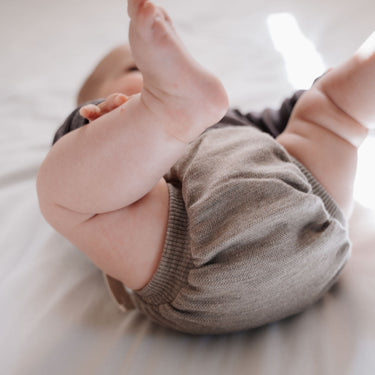
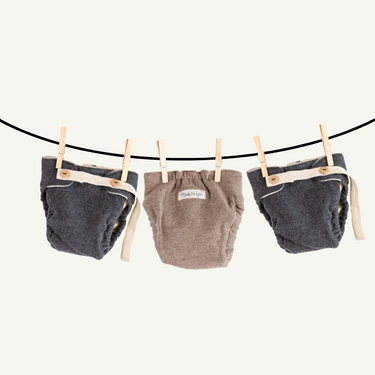
This is precisely where wool shows its particular strengths. It does not function like a classic disposable diaper, which is supposed to store as much liquid as possible for as long as possible. In combination with an absorbent insert, it serves more as a natural backup – especially for elimination communication and part-time EC.
At Mata Origin, we therefore do not use wool for nostalgic reasons. We choose it because its natural material properties are very well suited to a conscious, flexible and everyday approach to elimination.
Why the diaper area needs more than maximum absorbency
Disposable diapers are practical. Their absorbent core can absorb a lot of liquid and bind it in such a way that the surface feels comparatively dry. This can be a relief, especially when on the go or in situations where a quick change is not possible.
However, high absorbency alone does not determine how comfortable the diaper area is for a baby. Other factors play a role, including:
- how often the diaper is changed
- how long urine or stool remains in contact with the skin
- how warm and humid it gets under the clothes
- whether friction occurs
- which materials are directly on the skin
- whether the baby can be without a diaper or be held for elimination in between
A wool diaper therefore follows a different principle than a particularly absorbent disposable diaper. It is not intended to invisibly store excretions for as long as possible, but rather to protect as a reliable backup until changed or held for elimination.
What makes wool so special in the diaper area
Wool can absorb and release water vapor
Wool is hygroscopic. This means that its fibers can absorb moisture in the form of water vapor and then release it back into the environment. This can contribute to a more balanced microclimate between skin and textile.
This is not the same as absorbing larger amounts of liquid. Liquid urine is primarily absorbed by the inserted absorbent pad. The wool layer performs a different task: it encloses the insert, supports moisture management, and forms the outer protective layer.
Wool is breathable and temperature-regulating
The diaper area is often wrapped multiple times: diaper, onesie, pants, sleeping bag, blanket, or carrier come together. This can lead to heat buildup – not just in summer.
Wool can buffer moisture and react to changes in temperature and humidity. This makes it suitable for both cool and warmer days. Of course, the number of clothing layers a baby wears overall remains crucial.
So wool is not just a winter material. Depending on the fabric thickness and processing, it can be used all year round.
Lanolin supports the water-repellent function
Lanolin is natural wool grease. If a wool diaper or wool cover is treated with lanolin, it can repel liquids better and perform its function as an outer backup more reliably.
However, a lanolized wool layer does not replace an absorbent insert. The insert absorbs liquid, while the treated wool helps prevent it from immediately escaping to the outside.
How often a lanolin bath is required depends on the use, wool quality, and the specific product. If the wool becomes permeable more quickly or its water-repellent effect diminishes, re-lanolizing can be beneficial.
You can find detailed instructions in the article Lanolizing wool: How to do a lanolin bath.
Why wool is a good fit for elimination communication
With elimination communication (EC), your baby has the opportunity to excrete urine or stool outside the diaper. This can be done over a sink, a potty, a toilet, or a suitable container.
You don't have to completely forgo diapers for this. Many families continue to use a diaper as a backup and only practice EC in certain situations, for example:
- after waking up
- during or after breastfeeding
- before sleeping
- after longer car rides
- at a clear signal
A wool EC diaper fits well into this daily routine. It offers protection between EC moments and can be opened quickly without your baby having to be completely undressed.
The diaper thus remains a helpful backup – but it is no longer the only option.
Part-time EC: Wool as a relaxed middle ground
Elimination communication doesn't have to be an all-or-nothing concept. Part-time EC in particular is a realistic entry point for many families: the baby continues to wear a backup, but is offered EC in individual, well-suited situations.
Wool supports this middle ground because it is not designed for the longest possible wear times. It protects while parents and baby gradually develop their own rhythm.
You can read more about this in the article Part-time Elimination Communication: Why even individual moments count.
Is wool fundamentally better than any other diaper?
No – you can't say that in such general terms. The right system depends on the individual family, situation, and the baby's needs.
A disposable diaper can be practical when high absorbency is needed. A classic cloth diaper can be useful if it fits well into family life. A wool EC diaper is particularly interesting when natural materials, quick opening, and regular EC moments are the focus.
Wool is therefore an excellent choice, especially for families who:
- want to try elimination communication or part-time EC
- are looking for a natural outer diaper layer
- want to be more aware of the diaper area
- are willing to occasionally care for wool
- prefer a durable and reusable backup
Wool for sensitive or reddened baby skin
Redness in the diaper area can have many causes. These include moisture, stool, urine, friction, heat, care products, or individual skin sensitivity.
Wool is not a medical remedy. However, its breathable and moisture-regulating properties can be well suited to a daily routine where diapers are changed frequently, the skin is regularly aired, and the baby is occasionally offered elimination.
If the skin is severely reddened, weeping, open, or painful, or if the symptoms do not improve, the cause should be clarified by a pediatrician or midwife.
How to properly care for wool diapers and wool products?
Wool usually needs to be washed less often than many parents initially assume. With light moisture, depending on the product, it may be enough to let the wool dry completely and air it out well. Dry surface dirt can often be carefully brushed off.
In case of stool, heavy soiling, or persistent odor, cleaning is necessary. Always observe the care instructions for the respective product.
For regular cleaning and care, you will find three coordinated helpers in the Wool Care Set from Mata Origin:
- Wool wash concentrate for gentle washing
- SOS stain spray for targeted treatment of stubborn stains
- A wool brush for carefully removing dry dirt, dust, and pilling
Important: The set is for cleaning and care. If a wool diaper needs to be re-lanolized, you will also need suitable organic lanolin.
Basic rules for wool care
- Observe the product's care label
- First air out or carefully brush off dry dirt
- Treat stains as targeted as possible
- Use a mild wool detergent
- Choose hand wash or wool wash cycle
- Avoid strong rubbing and high temperatures
- Do not wring wool
- Do not tumble dry unless expressly permitted by the label
- After washing, gently reshape and dry flat or well-supported
What parents should consider when starting with wool diapers
Wool is not complicated, but it works differently than a disposable diaper. For a relaxed start, some basic expectations help:
- An absorbent insert is usually part of the system.
- The absorbency should match the situation.
- Wool products must be able to dry completely.
- If leakage decreases, a lanolin bath may be necessary.
- Stool should be removed promptly, and the product then cleaned.
- Even a wool diaper should not remain soiled on the baby unnecessarily long.
You don't have to change the entire diapering system immediately. A wool EC diaper, suitable inserts, and a regular EC offering after waking up can already be a good start.
Frequent questions about wool in the diaper area
Does a wool diaper replace a disposable diaper?
Not one to one. Disposable diapers are designed for high absorbency and long storage. A wool diaper is combined with an absorbent insert and is particularly suitable as a reusable backup for elimination communication or part-time EC.
Does a wool diaper need to be washed after every urine contact?
That depends on the product, the amount, and the smell. Often, thorough drying and airing out may be sufficient. In case of heavier soiling, persistent odor, or stool, cleaning is necessary. The product's care instructions remain decisive.
Why is a wool diaper treated with lanolin?
Lanolin supports the water-repellent function of the wool fibers. This allows the wool layer to better retain liquid within the diaper system. The actual absorbent function continues to be performed by the insert.
Is wool also suitable in summer?
Yes, provided the fabric thickness and other clothing match the temperature. Wool can absorb water vapor and contribute to temperature regulation. Very thick wool fabric can still be too warm in summer – the entire clothing system is always decisive.
Is wool also suitable for part-time elimination communication?
It is particularly well-suited for this. The wool diaper protects during the times between EC moments, while your baby regularly gets the opportunity to relieve itself outside the diaper.
Technical sources on the properties of wool
The following technical information refers to the general properties of wool textiles. They are not a specific medical efficacy statement for wool diapers:
- Woolmark: Thermoregulation of Merino Wool
- Woolmark: Moisture Management of Merino Wool
- Woolmark: Care for Wool Textiles
Conclusion: Wool accompanies rather than stores for as long as possible
Wool in the diaper area represents a different approach. The focus is not on maximum absorbency and the longest possible wear times, but on a natural backup, regular changes, and the ability to offer elimination communication to the baby.
For families who want to try elimination communication or part-time EC, wool can therefore be the better choice: breathable, reusable, durable, and easily combined with absorbent inserts.
It doesn't have to work perfectly right away. Even a single EC moment a day and a suitable backup can be a good start.