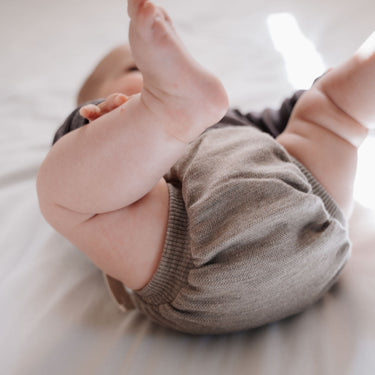
Baby skin is delicate. But in the diaper area, it is particularly challenged. Because there, sensitive skin encounters moisture, warmth, friction, excretions, and materials that often lie directly or indirectly on the skin for many hours.
This is where the question becomes exciting: What does baby skin in the diaper area really need? More absorbency? More care products? Or perhaps less contact with a full diaper, more air, and materials that handle moisture more naturally?
At Mata Origin, we don't just look at the diaper as a product, but at the entire daily routine:
- How long is a baby bundled up?
- What materials touch the skin?
- How often is there an alternative to the diaper?
- And what role can wool, elimination communication (EC), and part-time EC play?
Why the diaper area is different from other skin areas
A diaper is not normal clothing. It fits snugly, seals off the area more, and often stays on the body for a longer period. This creates a special diaper climate:
- more warmth
- more moisture
- less air
- more friction
- contact with urine and stool
- contact with diaper materials
This makes the diaper area more susceptible to redness, irritation, and sore skin. Therefore, it's not enough to just ask if a diaper "keeps dry." It's also crucial how long the skin remains bundled, how well air reaches the skin, and whether your baby always automatically has to excrete into the diaper.
Baby skin doesn't need more products, but less stress
A baby's skin is still developing. It often reacts more sensitively to moisture, friction, care products, fragrances, or certain materials. Especially in the diaper area, less can often be more.
Many parents quickly reach for more cream, more care, or even more absorbent diapers when redness appears.
Sometimes, however, a different question is more helpful: How can we relieve the diaper area as a whole?
This can mean: changing more frequently, using fewer additives, incorporating short diaper-free times, paying attention to softer materials, or offering your baby an alternative to the diaper at appropriate moments.
Moisture: The underestimated factor
Moisture is one of the most important factors in the diaper area. Urine, sweat, and a closed diaper climate can cause the skin to remain moist for longer. Moist skin is more sensitive and can be irritated more quickly by friction.
Disposable diapers with superabsorbers can bind liquid well and therefore feel dry for a long time.
This is practical, but it can also tempt parents to leave the diaper on the baby for longer. For the skin, it's not just whether the surface feels dry, but how warm, enclosed, and stressed the entire diaper area remains.
You can find out more here: Superabsorbers in diapers: Why disposable diapers absorb so much liquid
Urine and stool: Why EC becomes so exciting here
Urine and stool in the diaper area are not just "normal," but a real burden for the skin if they remain in contact for too long. Stool, in particular, can quickly irritate the skin, especially if your baby has frequent bowel movements or the stool is very soft.
This is where elimination communication (EC) comes into play. Because with EC, your baby gets the opportunity to relieve themselves outside the diaper. This doesn't mean you have to catch every single excretion.
But every bowel movement that doesn't end up in the diaper also means: less contact between sensitive skin and excretions.
This is not a miracle cure for diaper rash. But it's a very practical idea: If less ends up in the diaper, the skin has to deal with it for less time.
If you're new to EC, you can find an introduction here: What does Elimination Communication (EC) mean?
Why "dry" doesn't automatically mean skin-friendly
Many disposable diapers advertise being particularly dry. This is convenient for everyday life. But from the perspective of baby skin, dryness is only part of the truth.
A diaper can feel dry and still create a warm, closed microclimate. It can bind liquid and still cause friction. It can be leak-proof and still allow little air to reach the skin.
That's why at Mata Origin, we ask differently: Not just "How much does the diaper absorb?", but also: How does the diaper area feel overall? Is it warm? Moist? Enclosed? Irritated? Is there air intermittently? Are there alternatives to a full diaper?
Friction: When diaper, moisture, and movement come together
Babies are constantly moving. They kick, turn over, are carried, lie in a stroller, or sleep with their legs tucked up. The diaper also moves with them.
If the skin is moist, friction can lead to redness more quickly. The groin folds, bottom, thighs, the abdominal area under the diaper waistband, and skin areas at the cuffs are often particularly affected.
A good fit is therefore important. The diaper should sit securely but not cut in or constantly press. Clothing also plays a role: The tighter and warmer the diaper area is additionally wrapped, the less air reaches the skin.
Warmth and air exclusion: The typical diaper climate
Diapers not only retain moisture. They also trap heat. This is particularly relevant if your baby wears multiple layers of clothing, lies in a stroller, is carried, or sleeps.
A warm, moist, and enclosed area can stress the skin more than an area that can breathe.
That's why short diaper-free moments are so valuable. They don't have to last long. Sometimes a few minutes after changing, after bathing, or while kicking are enough.
Part-time EC can also help here. You don't have to live completely without diapers. Even individual EC moments or short times without a diaper can relieve the diaper area.
You can find out more here: Part-time Elimination Communication: Why even individual moments count
Additional substances: Baby skin doesn't need fragrances
Baby skin in the diaper area doesn't automatically need fragrances, lotions, or strongly perfumed care products. Such additives may sound appealing, but they mean additional substances in contact with the skin.
Especially if a baby reacts sensitively, simplicity is often the better way:
- fragrance-free diapers
- diapers without lotion
- mild cleaning
- few care products
- no unnecessary fragrances
This does not mean that every lotion or fragrance is automatically a problem. But baby skin does not need them to stay healthy. From Mata Origin's perspective, the principle here is: as little unnecessary contact as possible, as simple materials as possible, as much awareness as possible.
You can find out more here: Fragrances, lotions, and dyes in baby diapers: Does baby skin really need that?
Why wool works differently in the diaper area
Wool follows a different principle than many classic disposable diapers. It is not designed to store as much liquid as possible for many hours in a single-use product. Wool is breathable, temperature-regulating, and can regulate moisture.
When cared for with lanolin, wool becomes water-repellent and can be used as a natural backup in the diaper area. That's why at Mata Origin, we focus on EC diapers and wool products: not as a rigid system, but as a natural addition for families who want to try diaper-free, part-time diaper-free, or conscious diapering.
Wool does not automatically replace every diaper. But it can help to make the diaper area less enclosed. Especially in combination with EC, a different daily routine emerges: less pure "bundling up," more perception, offering, and reacting.
You can find out more here:
Why wool is ideal for Elimination Communication
Diaper rash: When several factors come together
Diaper rash often does not arise from a single trigger. Often, several factors come together: moisture, urine, stool, friction, warmth, tight diapers, frequent bowel movements, sensitive skin, or new care products.
Sometimes an infection or a fungus also plays a role. If the skin is severely reddened, weeping, shows open sores, the rash spreads, or your baby is in pain, medical advice should be sought.
This article does not replace a medical diagnosis. It helps you to better understand the typical stress factors in the diaper area and to make more conscious decisions in everyday life.
What parents can do in everyday life
You don't have to do everything perfectly. Especially with baby skin, it's not about perfection, but about relief. These small steps can help:
- Change diapers regularly
- Remove stool as soon as possible
- Gently clean the skin and do not rub vigorously
- Use fragrance-free products
- Incorporate short diaper-free times
- Try EC after waking up or breastfeeding
- Pay attention to fit and friction
- Test wool as a more breathable backup
- Take skin reactions seriously
The most important thought: It's not about changing everything immediately. You can start with a single moment. For example, after waking up. Many babies need to excrete then, and this moment is particularly well suited for starting EC.
You can find out more here: EC after waking up: The easiest entry
If your baby reacts sensitively
Some babies react particularly sensitively. In such cases, it's worth taking a closer look at the entire diaper routine: Which diaper do you use? Is it fragrance-free? Does it contain lotions? How often is it changed? How is it cleaned? Does the diaper rub in certain places? Are there diaper-free times? Are there EC moments?
At Mata Origin, we see time and again: For many families, it's not the big complete change that matters, but the first "aha" moment. For example, when a baby is held for EC after waking up and actually excretes. Or when parents realize that stool doesn't always have to end up in the diaper. Or when wool feels more comfortable in the diaper area than expected.
If redness recurs repeatedly or worsens, a midwife, pediatrician's office, or pharmacy should be consulted.
Public sources for further reading
If you would like to learn more about diaper dermatitis, baby skin in the diaper area, and absorbent hygiene products, you can find trustworthy public sources here:
- NHS: Nappy rash
- Mayo Clinic: Diaper rash – symptoms and causes
- German Environment Agency: Absorbent hygiene products
- German Environment Agency: Guideline for environmentally friendly procurement of diapers and hygiene products
Frequently asked questions about baby skin in the diaper area
Why is baby skin in the diaper area so sensitive?
In the diaper area, several stressors come together: warmth, moisture, friction, contact with urine or stool, and close material contact due to the diaper. The skin often gets less air there than on other parts of the body. Therefore, it can react more quickly to irritation.
What particularly irritates baby skin in the diaper area?
Common irritants include wet or soiled diapers, stool, friction, tight cuffs, warmth, fragrances, lotions, or overly intensive cleaning. Sensitive skin, diarrhea, or new care products can also play a role.
Can Elimination Communication (EC) relieve baby skin?
EC is not a medical remedy for sore skin. However, it can help ensure that your baby does not automatically excrete every time into the diaper. Especially with bowel movements, this can mean that the skin is in contact with excretions for less time.
Is being diaper-free only useful if you completely forego diapers?
No. Many families practice part-time EC. They only hold their baby for EC at certain moments and otherwise use diapers as a backup. Especially for sensitive baby skin, this middle ground can be interesting because it can allow more air, more attention, and less time in a full diaper.
Why can wool be comfortable in the diaper area?
Wool is breathable, temperature-regulating, and can regulate moisture. When cared for with lanolin, it becomes water-repellent and can be used as a natural backup. For families who are trying diaper-free or part-time EC, wool can therefore be a sensible alternative to strongly enclosed diaper systems.
Are disposable diapers bad for baby skin?
Disposable diapers are not automatically bad. They are practical and can absorb liquid well. Nevertheless, they create a warm, enclosed diaper climate and consist of various materials. Therefore, a conscious look at changing frequency, additives, fit, and possible alternatives is worthwhile.
Conclusion: Baby skin needs relief
Baby skin in the diaper area is particularly challenged. Not because parents are doing something wrong, but because the diaper area is a demanding environment: moisture, warmth, friction, urine, stool, and material contact all come together there.
Therefore, a conscious look at diapers, care, changing rhythm, and alternatives is worthwhile. Often, baby skin doesn't need more products, but less irritation, more air, and less time in a full diaper.
This is precisely where being diaper-free, Elimination Communication (EC), and wool come in. Not dogmatically. Not perfectly. But as practical ways to accompany the diaper area in everyday life more naturally and consciously.
Further Reading
What's in disposable diapers? Materials, layers, and substances explained simply
Superabsorbers in diapers: Why disposable diapers absorb so much liquid
Diaper climate: Why warmth, moisture, and friction can stress baby skin
Fragrances, lotions, and dyes in baby diapers: Does baby skin really need that?