
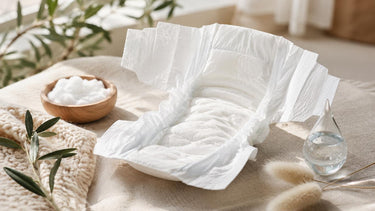
Disposable diapers can absorb an astonishing amount of liquid.
They remain comparatively thin, don't leak immediately, and often still feel dry on the surface, even though your baby has already peed in them.
For many families, this is practical. But precisely this enormous absorbency also raises questions:
- What actually binds the liquid?
- What is this material made of?
- What residues can be found in it?
- Can the diaper system contain hormonally active substances?
- And does the dry feeling possibly lead to diapers being changed later?
A central component of modern disposable diapers are so-called superabsorbents.
They make the diaper perform efficiently. At the same time, they are part of a technically complex disposable product that babies wear directly on their bodies for many hours a day for months or years.
Therefore, a careful and critical look is worthwhile.
Not out of fear.
But because parents deserve to know what their baby wears every day.
What are superabsorbents?
Superabsorbents are highly swellable, synthetic polymers.
In technical jargon, they are often abbreviated as SAP, which stands for "Super Absorbent Polymer".
When the superabsorbent comes into contact with liquid, it swells strongly, forming a gel-like mass that traps the liquid within its polymer structure.
This gel is precisely what allows modern disposable diapers to absorb large amounts of urine without immediately appearing completely soaked.
The superabsorbent pursues a clear technical goal:
To retain as much liquid as possible inside the diaper for as long as possible.
What are superabsorbents in diapers made of?
Cross-linked sodium polyacrylate is often used in classic disposable diapers.
This is not a natural fiber but an industrially manufactured acrylate-based polymer.
Simply put, the manufacturing process works as follows:
- Chemical raw materials are linked to form long polymer chains.
- These chains are cross-linked with each other.
- As a result, the material does not simply dissolve upon contact with liquid.
- Instead, it swells and forms a gel.
The cross-linking is crucial. Without it, the material would tend to disperse in the liquid. Cross-linking maintains a swelling structure that binds water and urine.
Superabsorbents are thus a highly developed functional material.
However, they are neither natural nor comparable to cotton, hemp, or wool.
Where is the superabsorbent located?
The superabsorbent is usually not directly exposed on your baby's skin.
It is located in the absorbent core between several other diaper layers.
Simply put, a disposable diaper is constructed as follows:
- A soft inner layer lies directly against the skin.
- A distribution layer directs urine into the diaper core.
- Cellulose absorbs liquid and distributes it.
- Superabsorbents swell and retain liquid.
- An outer plastic layer prevents leakage.
Additionally, there are adhesives, elastic cuffs, fasteners, dyes, and, depending on the product, lotions or fragrances.
A disposable diaper is therefore not a simple piece of cellulose.
It is a complex material system made of natural fibers, synthetic polymers, plastics, and various auxiliary materials.
You can find more about the complete structure here:
What's in disposable diapers? Materials, layers, and substances explained simply
Why does the diaper still feel dry?
When your baby urinates, the liquid is directed from the skin-contacting layer into the absorbent core.
There, it distributes between the cellulose and superabsorbent. The superabsorbent particles swell and retain a portion of the liquid as a gel.
As a result, comparatively little free liquid returns to the surface.
The diaper can therefore still feel dry or only slightly damp, even though it has already absorbed urine.
This is technically impressive and convenient in everyday life.
But the dry feeling also has another side:
The wetness becomes less noticeable.
For the baby. And possibly for the parents as well.
The theory: Are highly absorbent diapers changed later?
This question is important – and it should not be dismissed too quickly.
A diaper that feels noticeably wet after the first or second pee gives clear feedback:
Something has happened here. The diaper should be changed.
A highly absorbent disposable diaper can largely conceal this feedback.
It feels dry, doesn't leak, and may initially have little odor. This can create the impression that a change is not yet necessary.
The theory is therefore:
The less noticeable the excretion is, the longer a diaper may remain on the baby.
So far, there is no reliable study that unequivocally proves that parents change diapers later solely due to the superabsorbent.
However, the mechanism is plausible:
- The superabsorbent reduces the perceptible feeling of wetness.
- The diaper often shows few external changes.
- The baby receives less immediate feedback about its excretion.
- Parents may not notice a single pee.
- The technical absorption capacity is easily confused with a reasonable wearing time.
A study from 2025 provides an important clue regarding this.
In the small prospective study, children between 19 and 30 months showed significantly more recognizable excretion signals without a diaper than with a disposable diaper.
With a diaper, they less often indicated that they needed to urinate, less often sought contact with the caregiver, and less often touched or looked at their genital area.
The study did not specifically investigate superabsorbents or changing frequency. However, it shows:
A disposable diaper can attenuate the visible and perceptible feedback surrounding excretion.
From a Mata-Origin perspective, this is an important point. Because excretions do not have to be made invisible. They are part of the body and should be carefully accompanied.
Why long wearing times can be problematic
Superabsorbents can bind urine and reduce free wetness.
However, they do not remove all burdens from the diaper area.
Even a seemingly dry diaper:
- lies close to the body
- restricts ventilation
- creates friction during movement
- already contains excretions
- creates a warm, enclosed microclimate
The distinction between urine and stool is particularly important.
Superabsorbents can bind liquid. However, they cannot render stool harmless or completely keep it away from the skin.
Therefore, after a bowel movement, a diaper should be changed as soon as possible – regardless of how absorbent it is.
Even with urine, the maximum technical absorption capacity should not be equated with a recommendation to wear the diaper for as long as possible.
Just because a diaper could absorb more doesn't mean it has to stay on the baby longer.
Does the superabsorbent itself have a hormonal effect?
For the finished, high-molecular sodium polyacrylate inside an intact diaper, there is currently no reliable evidence that it directly affects a baby's hormonal system during normal use.
However, this does not mean that the hormonal question is settled.
Because a disposable diaper consists not only of the finished superabsorbent.
The entire product is crucial:
- What raw materials was it made from?
- What residues from polymer production are present?
- What adhesives and plastics are used?
- Does the diaper contain fragrances or lotions?
- What contaminants can come from cellulose or production processes?
- How long does the product remain in the warm and moist diaper area?
The hormonal concern therefore primarily relates to possible accompanying substances, residues, and contaminants – not solely the finished sodium polyacrylate.
What hormonally active substances are discussed?
During investigations and regulatory evaluations of absorbent hygiene products, the following substance groups, among others, are in focus:
- Phthalates
- Dioxins and furans
- Dioxin-like PCBs
- Certain alkylphenols
- Parabens
- Triclosan
- Certain organotin compounds
- Some fragrance components
Not all of these substances are present in every disposable diaper.
Some can be intentionally used as a component or auxiliary. Others can enter the final product as residues, contaminants, or by-products from raw materials and manufacturing processes.
Precisely for this reason, complete transparency is so important.
What did the French health authority ANSES find?
The French health authority ANSES examined disposable diapers for numerous chemical substances.
Among other things, the following substance groups were detected or quantified:
- Polycyclic aromatic hydrocarbons, or PAHs
- Dioxins and furans
- Dioxin-like PCBs
- Formaldehyde
ANSES concluded that, under the assumed exposure conditions, health risks for some substances could not be ruled out.
The authority therefore called for stricter limit values, better controls, and an EU-wide restriction of certain dangerous chemicals in baby diapers.
This is an important classification:
The discussion about problematic substances in diapers does not only originate from naturopathic blogs or cloth diaper manufacturers.
Even a state health authority saw sufficient reason to demand concrete regulatory measures.
What do the current EU Ecolabel criteria say?
The EU has since tightened its criteria for the Ecolabel for absorbent hygiene products.
For correspondingly certified products, among other things, the following are excluded or strictly limited:
- Phthalates
- Parabens
- Triclosan
- Certain alkylphenol compounds
- Certain organotin compounds
- Identified hormonally active substances
- Certain substances suspected of hormonal effects
- Fragrances and lotions in baby diapers
Requirements for residual monomers and water-soluble components also apply to superabsorbents themselves.
This does not prove that every diaper without an EU Ecolabel is dangerous.
However, it shows that possible hormonal effects, production residues, and unnecessary additives are taken seriously by regulators.
Phthalates in diapers: What does newer research show?
Phthalates are often used as plasticizers or technical aids in plastic and adhesive systems.
Several phthalates are known for their hormonally active or reproduction-toxic properties.
A study published in 2025 simultaneously analyzed disposable diapers and urine samples from infants.
The researchers found various phthalates in the examined diapers and corresponding breakdown products in the urine.
According to the study's model calculations, skin absorption from the diaper could account for a relevant proportion of the total exposure of the examined children to some phthalates.
Some phthalate metabolites were also associated with higher levels of a marker for oxidative DNA damage.
It is important to classify this carefully:
- The study does not prove a specific hormonal disease caused by diapers.
- It does not prove that every diaper product is equally contaminated.
- However, it shows that the diaper as a possible route of uptake cannot be generally ruled out.
Precisely for this reason, the statement "The superabsorbent does not touch the skin, so there is no problem" is too simplistic.
The skin touches the entire diaper system – in a warm, moist, and covered area for a long time.
Residual monomers: What remains from production?
During the production of a polymer, smaller chemical building blocks are linked to form long chains.
This conversion is not necessarily one hundred percent complete.
Therefore, small amounts of unconverted starting materials or smaller water-soluble components may remain in the superabsorbent.
In the case of sodium polyacrylate, this concerns, for example:
- Unconverted acrylic acid
- Components of cross-linking
- Short-chain acrylate compounds
- Water-soluble polymer fractions
This does not mean that every superabsorbent contains a dangerous amount of these substances.
However, it explains why independent limit values, laboratory tests, and transparent declarations are important.
The question should therefore not only be:
Is the finished polymer large enough not to penetrate the skin?
But also:
What smaller and possibly more mobile substances are still present in the finished material?
Do disposable diapers warm the genital area?
This question is particularly discussed for boys.
The testes are located outside the body because a lower temperature is important for their later function.
A study from 2000 found higher scrotal temperatures in boys wearing plastic-coated disposable diapers than in those wearing simple cotton diapers.
The researchers hypothesized that natural cooling could be impaired as a result.
However, a later study came to a different conclusion. It found no significant temperature difference between disposable diapers and reusable diapers when the cloth diaper was combined with a waterproof cover.
Only the simple cloth diaper without a waterproof cover was cooler.
The fair assessment is therefore:
- A covered and sealed diaper area can be warmer than a freely ventilated area.
- Whether disposable diapers are significantly warmer than other completely sealed systems is not conclusively clarified.
- A later hormonal disturbance or reduced fertility due to diaper wearing has not been proven.
- Nevertheless, the question is relevant enough to critically consider unnecessarily long wearing times and constant complete covering.
Time without a closed diaper and regular elimination communication can ventilate the genital area again and again – regardless of what backup a family otherwise uses.
What does this mean for body awareness?
A superabsorbent is intended to make liquid as unnoticeable as possible.
From a technical point of view, this is an achievement.
However, from the perspective of body perception, it can also mean:
- The baby feels the excretion less distinctly.
- Parents do not immediately see or feel the pee.
- Excretion signals are more easily overlooked.
- The diaper becomes the self-evident place for every excretion.
This does not mean that a baby automatically loses its body awareness through disposable diapers.
However, it shows why elimination communication and part-time diaper-free parenting offer a different approach.
With elimination communication, excretion is not made invisible.
Instead, you give your baby the opportunity to relieve itself outside the diaper. In doing so, you can learn signals, rhythms, and typical situations.
A diaper can still remain as a backup.
Part-time elimination communication: Why even individual moments matter
Superabsorbents and the environment
Superabsorbents make disposable diapers thin and efficient.
At the same time, they are part of a product that is disposed of after a single use.
The used diaper contains a difficult-to-separate material mix of:
- Cellulose
- Superabsorbents
- Plastic films and nonwovens
- Adhesives
- Elastic materials
- Urine and possibly stool
This material mix can hardly be meaningfully separated into its components under typical disposal conditions.
Superabsorbents are also not a rapidly rotting natural fiber. They are precisely developed to remain stable and retain large amounts of liquid.
The environmental question therefore does not only concern the toxicity of a single substance.
It concerns the entire system:
- Industrial raw materials
- Energy and material-intensive production
- Packaging and transport
- Single use
- large amounts of waste
- hardly any possibility of reuse
You can learn more about the resulting waste here:
How much diaper waste does one baby really produce?
Are there disposable diapers without superabsorbents?
Most modern disposable diapers contain superabsorbents.
This often applies even to diapers advertised as “eco,” “natural,” “plant-based,” or “organic.”
Such labels can refer, for example, to the pulp, the outer film, or individual components. They do not automatically mean that the entire product is plastic-free, biodegradable, or free of superabsorbents.
If you use disposable diapers, it’s worth taking a closer look:
- Which materials are fully listed?
- Is the diaper fragrance-free?
- Does it contain lotions?
- Are there independent test seals?
- Are limit values for problematic residues published?
- How transparently does the manufacturer answer inquiries?
What parents can look for in disposable diapers
You don't have to use disposable diapers with fear or a bad conscience.
But you can make their use more conscious.
- Don't wait until the diaper has reached its maximum absorption capacity.
- Change as soon as possible after a bowel movement.
- Check the diaper regularly, even if it feels dry.
- Prefer fragrance-free products without unnecessary lotions.
- Look for verifiable material specifications and independent seals.
- Observe redness, pressure marks, and skin changes.
- Give the diaper area regular air.
- Use individual elimination communication moments if they suit you.
The most important thought is:
High absorbency is a technical possibility – not an obligation for long wearing times.
What alternatives are there?
You don't have to give up every disposable diaper overnight.
Between complete disposable use and completely diaper-free, there are many options:
- more frequent elimination communication
- part-time elimination communication
- cloth diapers at home
- washable diaper liners
- wool covers
- wool elimination communication diapers
- disposable diapers only at night or when out and about
With elimination communication, some of the excretions don't even end up in the diaper.
Depending on the frequency, this can reduce:
- the time spent in a full diaper
- the consumption of disposable diapers
- the amount of diaper waste
- the need for diaper washing
At the same time, excretions remain perceptible and are not completely hidden by a highly absorbent product.
What does elimination communication mean?
Why wool follows a different principle
Wool does not replace a superabsorbent one-to-one.
It follows a different idea.
A superabsorbent diaper is designed to absorb as much liquid as possible and hold it inside for a long time.
Wool, on the other hand, is used as a reusable, breathable outer layer.
In combination with an absorbent insert, the system works like this:
- The insert absorbs liquid.
- The wool protects clothing.
- Lanolin makes the wool more water-repellent.
- Elimination communication can relieve the entire backup system.
Wool is not absolutely waterproof and is not intended to store large amounts of urine unnoticed for as long as possible.
This can be an advantage.
The system encourages earlier perception of excretions, changing inserts, and regularly offering the baby an alternative to the diaper.
Why wool is ideal for elimination communication
Discover wool elimination communication diapers
Frequently asked questions about superabsorbents
Are superabsorbents hormonally active?
For finished sodium polyacrylate in the absorbent core of an intact diaper, there is currently no reliable evidence of a direct hormonal effect during normal use. Hormonal concerns tend to relate to possible accompanying substances, additives, and contaminants in the entire diaper product, such as certain phthalates, dioxins, or dioxin-like PCBs.
Can diapers contain hormonally active substances?
Studies have detected substances or contaminants in individual diaper products that may be hormonally or reproductively relevant. This does not mean that every diaper is equally contaminated. However, it shows why transparent information and independent controls are necessary.
Does the superabsorbent touch the baby's skin?
Normally not directly. It is located in the absorbent core behind other material layers. However, gel particles can escape from a damaged or torn diaper.
Is the gel in a diaper dangerous?
The gel forms when the superabsorbent absorbs liquid. If it leaks from a damaged diaper, the diaper should be changed and the skin carefully cleaned. Gel particles should not get into the mouth, nose, or eyes.
Are highly absorbent diapers changed less frequently?
A direct causal study on this is lacking. However, the theory is plausible: the dry feeling and high absorption capacity can reduce visible and palpable signs of excretion. A recent study shows that children in disposable diapers show fewer excretion signals than without a diaper.
Do disposable diapers delay potty training?
Some studies suggest a link between prolonged diaper use and later acquisition of continence. However, current research is insufficient to name disposable diapers as the sole cause. Family culture, childcare structures, the start of potty training, and many other factors also play a role.
Are superabsorbents microplastics?
Superabsorbents are synthetic polymers. Whether they fall under a specific scientific or legal definition of microplastics depends, among other things, on particle size, shape, solubility, and degradability. Regardless of the designation, it is a synthetic material within a short-lived disposable product.
Are eco-diapers free of superabsorbents?
Mostly not. Many ecologically advertised disposable diapers also contain superabsorbents. Terms like "natural" or "plant-based" often refer only to individual material components.
Conclusion: Absorbency has its price
Superabsorbents are the main reason modern disposable diapers can absorb so much liquid.
They trap urine in the absorbent core, make the surface appear drier, and make diapers thin and comfortable.
But this technical achievement should not only be seen as an advantage.
High absorbency can make excretions less noticeable. It can contribute to the natural urge to change weakening. And it is part of a complex disposable product that, in addition to the superabsorbent, can contain other plastics, adhesives, additives, and possible contaminants.
There is no clear evidence for a direct hormonal effect of finished sodium polyacrylate.
However, there are legitimate questions about hormonally active accompanying substances, production residues, the warm and enclosed diaper climate, and the long-term daily use of the entire material system.
Therefore, prevention is sensible.
Not in the form of fear.
But through:
- more transparency
- independent tests
- more frequent changes
- fewer unnecessary additives
- regular time without a closed diaper
- and alternatives like cloth, wool, and elimination communication
The crucial question is not just:
How much liquid can this diaper absorb?
But also:
How long should my baby really wear this material system on their body?
Independent sources for further reading
- ANSES: Recommendations to improve the safety of baby diapers
- ANSES: Proposal for EU-wide restriction of hazardous chemicals in disposable diapers
- European Commission: Stricter EU Ecolabel criteria for absorbent hygiene products
- 2025 Study: Phthalate exposure from disposable diapers
- 2025 Study: Disposable diapers and excretion signals
- Study: Scrotal temperature under plastic-lined disposable diapers
- Counter-study: Scrotal temperature in disposable and reusable diapers
Further reading
- What's in disposable diapers? Materials and layers explained simply
- Pulp, fleece, and plastics: The layers of a disposable diaper
- Harmful substances in disposable diapers: What parents should know factually
- Part-time elimination communication: Why even individual moments count
Is elimination communication new to you?
You don't have to change your entire diapering system immediately.
Start with a moment that feels easy – for example, after waking up or at the next diaper change.
Discover the free starter guide for elimination communication