Sustainable living with a baby.
That sounds nice, actually.
Until it turns into a rather long list.
- Cloth diapers.
- Washable wet wipes.
- Secondhand clothes.
- Avoiding plastic.
- Diaper-free.
Only natural materials.
And suddenly, sustainability no longer feels easy.
But like just another thing parents are supposed to do perfectly.
We want to see that differently.
Sustainable diapering doesn't have to be perfect.
Perhaps it doesn't start with a completely new diapering system.
But with a single diaper that isn't needed today.
With a washable insert.
With a piece of clothing that the next child can also wear.
Or simply with the question:
What can be easily changed in our daily lives?
What does sustainable diapering actually mean?
Sustainable diapering can mean many things.
For example:
- using fewer disposable diapers
- using reusable products
- using high-quality items for a long time
- passing on used clothing
- avoiding unnecessary disposable products
- occasionally holding a baby over the toilet
There isn't one right way.
And you don't have to choose between disposable diapers, cloth diapers, and diaper-free living.
Many families use a mix.
And precisely therein lies a very practical form of sustainability.
1. One less diaper is not "too little"
Perhaps this is the most important thought in this article.
One less diaper seems small.
But small things become big when they are repeated often.
If, on average, one disposable diaper is not needed per day, that's approximately over two and a half years:
913 fewer diapers.
Almost 1,000 diapers.
Your baby doesn't have to be completely diaper-free for this.
Perhaps they are only held over the toilet in the morning after waking up.
Perhaps only for bowel movements.
Perhaps it works today – and not tomorrow.
That counts too.
What one less diaper per day can achieve
2. Elimination communication doesn't have to work all day long
At the word "diaper-free," many parents first think:
My baby shouldn't wear any diapers at all now?
No.
Diaper-free doesn't automatically mean diaper-less.
With elimination communication, you simply occasionally give your baby the opportunity to excrete outside of the diaper.
For example, over:
- a sink
- a small potty
- the toilet
If it works, great.
If not, the backup takes over.
Part-time elimination communication can already mean using just one familiar moment a day.
Part-time elimination communication: Why even individual moments count
3. Use the moments that are already there
Sustainability becomes particularly easy when it doesn't require an additional appointment in family life.
When it comes to elimination communication, situations that happen anyway are often suitable.
For example:
- after waking up
- before bathing
- during an already planned diaper change
- with a clearly recognizable bowel movement
So you don't have to observe elimination signals all day long.
Perhaps there's just that one moment in the morning.
Baby wakes up.
You briefly hold them over the toilet.
Then your day begins.
The more natural a sustainable step becomes, the more likely it is to last in the long term.
4. Reusing what can be easily reused
Not everything in the diapering routine has to end up in the trash after a single use.
Washable products can be used many times.
For example:
- diaper inserts
- muslin cloths
- washcloths
- changing pads
- cloth diapers or EC diapers
You don't have to completely give up disposables immediately.
Perhaps you use disposable diapers when out and about and washable solutions more often at home.
Perhaps vice versa.
A hybrid solution is not half a solution.
It is often exactly what works in real family life.
5. A backup can stay
A backup can take an incredible amount of pressure off.
Your baby doesn't have to lie on the carpet without protection just so you can call yourselves "diaper-free."
They are allowed to wear a diaper.
And still be held over the toilet.
A particularly practical backup is one that can be quickly opened and then closed again.
Our EC diapers from Mata Origin are designed precisely for this combination.
If something goes in, your baby is protected.
If you notice a suitable moment, you can quickly hold them over the toilet.
If the EC diaper stays clean, it's simply worn again.
Safety and less diaper consumption don't have to be opposites.
6. Clothing can make sustainable habits easier
Sometimes elimination communication fails not because parents don't want to do it.
It fails because of three snap fasteners.
A bodysuit.
A pair of pants.
Maybe a pair of tights too.
By the time everything is open, the moment is over.
That's why clothing plays such a big role for us.
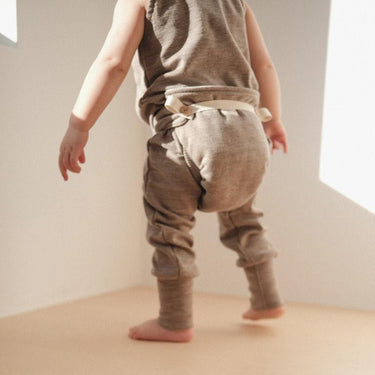
An EC pant can be opened quickly without having to undress your baby completely every time.
Our diaper-free clothing is also designed to make the diaper area easily accessible.
That sounds like a minor detail.
But it's precisely such minor details that often decide whether a good idea also works on a tired Tuesday morning.
7. Good things can accompany more than one child
Sustainability doesn't just mean buying less.
It can also mean using things for a long time.
A high-quality piece of clothing can:
be worn by the first child.
Then by the second.
Perhaps be passed on.
Or someday accompany another family.
The same applies to potties, changing pads, and other durable products.
The longer something is used, the less it feels like a consumable product.
8. Not every sustainable decision has to be the biggest
Perhaps you don't want to wash cloth diapers.
Then you don't have to.
Perhaps you like cloth diapers at home, but disposable diapers are more relaxing for you when traveling.
That's okay too.
Perhaps elimination communication works wonderfully for bowel movements, but hardly for pee.
Then just do elimination communication for bowel movements.
Sustainability is not worthless just because it is not complete.
A realistic small step that you take for two years can achieve more than a perfect solution that overwhelms you after two weeks.
9. Less disposable doesn't just mean diapers
Many small disposable products are also generated around diapering.
For example:
- disposable changing pads
- disposable washcloths
- plastic bags
- disposable inserts
Again, not everything has to be changed at once.
Perhaps you start with a reusable changing pad.
Or with a few small washcloths.
If it works, it stays.
If not, you look for another solution.
10. Less diaper waste can happen incidentally
Perhaps this is the most beautiful form of sustainability for us.
When you don't think in the morning:
Today we absolutely have to save waste.
But:
Our baby usually has to pee after waking up anyway.
So you hold them over the toilet.
The backup stays clean.
You get dressed.
And go to breakfast.
The fact that no new disposable diaper was needed is simply a nice side effect.
What matters more: cloth diapers or diaper-free?
We don't even have to decide this question.
Both can be combined.
A baby can wear a cloth diaper as a backup and still be held over the toilet.
They can wear a disposable diaper and still be held over the toilet.
They can be without a backup temporarily.
The environmental impact of cloth diapers also strongly depends on how they are washed, dried, and how long they are used.
Therefore, there is no one solution that is automatically the most sustainable for every family.
Environmental comparison of disposable diapers, cloth diapers, and diaper-free living
And what about eco or organic diapers?
They too can be part of a personal solution.
Some products, for example, use more renewable raw materials or certified pulp.
But an eco-diaper usually remains a disposable product.
After use, it is disposed of.
Therefore, two thoughts can be correct at the same time:
If disposable, it can be useful to pay attention to materials and manufacturing.
And:
A diaper that is not needed at all also causes no diaper waste.
Eco and organic diapers: What's really behind them?
What does sustainable diapering look like concretely without perfection?
Perhaps like this:
In the morning, you hold your baby over the toilet after waking up.
After that, they wear a backup.
At home, you partly use washable inserts.
For a long outing, you pack disposable diapers.
The changing pad is washable.
The EC pants can be opened quickly.
Some days work wonderfully.
On others, every pee goes into the diaper.
And both belong to the same sustainable family life.
The 5 easiest steps to start
- Hold your baby over the toilet once a day at an easy moment.
- Use a backup and take the pressure off.
- Replace a disposable product with a reusable alternative.
- Choose clothing that makes elimination communication easy.
- Use good things for a long time and pass them on.
You don't have to do all five at once.
Pick one.
That's enough for today.
Frequently Asked Questions about Sustainable Diapering
How can I diaper my baby more sustainably?
Even small changes can help: holding for individual eliminations, using reusable inserts or changing pads, choosing durable clothing, and reducing disposable products where it fits well into your daily life.
Do I have to use cloth diapers for sustainable diapering?
No. Cloth diapers are an option, but not a prerequisite. Families using disposable diapers can also reduce diaper waste by using elimination communication, reusable products, and more conscious use.
Does my baby have to be completely diaper-free?
No. Part-time elimination communication can mean holding your baby over the toilet only once a day or in individual familiar situations. A backup can be worn at any time.
How many diapers can a family save through elimination communication?
That depends on daily life. If, on average, one disposable diaper is not needed per day, that's approximately 913 diapers over two and a half years.
Does every instance of elimination communication automatically save a diaper?
No. A diaper is only actually avoided if a clean backup remains clean through elimination communication and therefore no new disposable diaper is needed.
Are cloth diapers always more sustainable than disposable diapers?
Not automatically. Their environmental footprint depends, among other things, on washing temperature, drying, energy consumption, and period of use. Reuse becomes particularly meaningful when products are used for a long time and, if applicable, for several children.
What clothing makes sustainable diapering and elimination communication easier?
Clothing that can be quickly opened at the diaper area makes elimination communication significantly less complicated. EC pants, EC diapers, and special diaper-free clothing save unnecessary undressing and dressing.
What if sustainable diapering stresses me out?
Then you can do less. Sustainability should support your family's daily life and not become an additional burden. A single small step is perfectly sufficient.
Conclusion: Sustainability can be quiet
Perhaps sustainable diapering doesn't look particularly spectacular for you.
No completely plastic-free bathroom.
No perfect cloth diaper routine.
No baby who never wears a diaper.
Perhaps it simply looks like this:
Your baby wakes up.
You open their EC pants.
Briefly hold them over the potty.
The backup stays dry.
Later in the day, a disposable diaper still goes into the trash.
And perhaps another one in the evening.
That's allowed.
Because sustainability doesn't start only when everything is perfect.
It begins where a small change fits so well into your life that it can stay.
Read more
- What one less diaper per day can achieve
- Part-time elimination communication: How much diaper waste you can save
- Environmental footprint of disposable diapers, cloth diapers, and elimination communication
- What is elimination communication? Diaper-free living simply explained
Make it easy for yourself
If elimination communication is to become your small sustainable step, it doesn't have to be complicated.
Our EC pants open quickly, EC diapers provide security as a backup, and washable diaper inserts can be reused again and again.
That's exactly why we develop Mata Origin's diaper-free clothing: so that a sustainable idea doesn't fail due to buttons, layers, and a hectic family life.
And if you first want to calmly understand how elimination communication works:
Our free starter guide shows you a loving and uncomplicated introduction.