
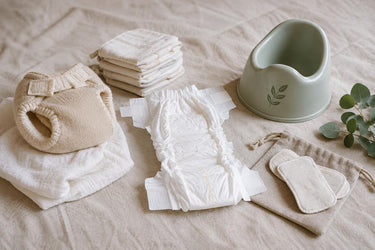
Many parents want to make more informed decisions when it comes to diapering.
They therefore choose diapers advertised with terms such as:
- Eco-diaper
- Organic diaper
- Natural
- Plant-based
- Chlorine-free
- Fragrance-free
- Skin-friendly
- Sustainable
Initially, this sounds reassuring.
Less plastic. Fewer problematic substances. More nature and a better feel on the baby's skin.
But what do these terms actually mean?
The honest answer is:
A well-certified eco-diaper can have several important advantages over a conventional disposable diaper. However, it is not automatically a natural product, plastic-free, or more skin-friendly for every baby.
Even an eco-diaper typically remains a technically constructed disposable product. It contains multiple layers, absorbs excrement, largely seals off the diaper area, and is disposed of after a single use.
At Mata Origin, we therefore don't just want to help parents find the seemingly better diaper.
We want to ask the bigger question:
How can we make diapering more natural overall – and does every excretion really need to end up in a diaper?
What does "eco-diaper" mean?
The term "eco-diaper" does not describe a uniform technical standard.
Depending on the manufacturer, it can mean something completely different.
A diaper described as such can, for example:
- Contain cellulose from certified sustainable forestry
- Be manufactured without fragrances
- Not have lotion on the inner layer
- Use individual plant-based plastic components
- Be produced with a gentler bleaching process
- Comply with certain pollutant limit values
- Use more environmentally friendly packaging
- Be certified by an independent environmental label
However, it can also merely have green packaging and advertise with general terms such as "natural" or "gentle on the environment."
Therefore:
The term "eco-diaper" alone does not indicate which specific environmental and health criteria the product meets.
What does "organic diaper" mean?
The term "organic diaper" can also easily promise more than it actually delivers.
For food, "organic" is clearly regulated by the European organic regulation. However, a diaper is not a food product and does not carry an EU organic seal for the entire product.
For a so-called organic diaper, the term may, for example, only refer to a single raw material:
- Organic cotton in the inner layer
- Plant-based components in a film
- Cellulose from certified sustainable forestry
- A material component from renewable resources
The rest of the diaper can still contain:
- Synthetic nonwovens
- Superabsorbents based on polyacrylate
- Plastic films
- Elastic plastics
- Adhesives
- Technical closures
An "organic diaper" is therefore not automatically a completely natural or biodegradable diaper.
The better question is:
Which specific component is organic, plant-based or more sustainable – and what is the rest made of?
Ecological and skin-friendly are two different questions
A diaper can perform better from an ecological perspective and yet not automatically be better suited to a particular baby's skin.
Conversely, a baby may tolerate a conventional diaper well, even if it is less advantageous from an environmental perspective.
For the ecological assessment, the following are particularly important:
- Origin of raw materials
- Energy consumption during manufacturing
- Emissions from pulp production
- Proportion of fossil and renewable raw materials
- Packaging and transport
- Waste quantity
- Disposal method
For the skin, other points are particularly relevant:
- Material directly on the skin
- Fragrances and lotions
- Fit and friction
- Frequency of changes
- Contact with urine and feces
- Heat and moisture
- Individual skin sensitivity
A green product promise must not conflate these two levels.
What certified eco-diapers can do better
An eco-diaper with a demanding, independent environmental label can have real advantages over a non-certified product.
These may include:
- Stricter limits for undesirable chemicals
- Exclusion of certain hormonally active substances
- Absence of fragrances
- Absence of lotions and odor inhibitors
- Controlled pulp origin
- Lower-emission pulp production
- Requirements for adhesives and dyes
- Limitation of certain residues in the superabsorbent
- Requirements for packaging and production
- Testing of usability
This is relevant.
Because a diaper doesn't just sit on the skin for a few minutes. Babies often wear them day and night – for months or years.
The clearer the requirements for raw materials, additives, and possible contaminants, the better parents can make an informed decision.
What even a good eco-diaper does not change
Even a certified and less harmful disposable diaper usually remains a disposable diaper.
This means:
- It is used only once.
- It sits close to the genital and gluteal area.
- It retains liquid within a multi-layer system.
- It usually still contains superabsorbents.
- It requires reliable leak protection.
- It usually contains plastics, adhesives, and elastic.
- It is disposed of after use.
An eco-diaper can improve the material mix.
But it does not automatically change the basic principle:
The baby excretes into a close-fitting product, and the excretion remains there until the diaper is changed.
Are eco-diapers plastic-free?
In most cases, no.
Many ecological disposable diapers advertised as plant-based also require materials that:
- Quickly wick away liquid
- Keep the absorbent core stable
- Prevent leaks
- Remain elastic
- Connect the individual layers
For this purpose, synthetic materials are often still used.
These may include:
- Polypropylene
- Polyethylene
- Polyester
- Polyurethane
- Synthetic elastic materials
- Superabsorbents based on polyacrylate
- Thermoplastic adhesives
A manufacturer can reduce the fossil plastic content or partially replace it with bio-based plastics.
However, this does not automatically make the diaper plastic-free.
"Plant-based" does not mean plastic-free
The term "plant-based" sounds like a natural material that simply reverts to nature after use.
It's not that simple.
A plant-based plastic can be chemically very similar or even identical to a petroleum-based plastic. The difference then lies primarily in the origin of the carbon – not necessarily in the properties of the finished material.
A plant-based plastic can:
- Still be a plastic
- Not be biodegradable
- Not be compostable
- Remain stable for a long time
- Be firmly bonded with other materials
The terms therefore do not mean the same thing:
- Bio-based describes the origin of the raw material.
- Biodegradable describes the possible decomposition under certain conditions.
- Compostable describes decomposition under precisely defined composting conditions.
A material can be bio-based but not biodegradable.
Another material can be biodegradable even if its raw material is not plant-based.
The statement "with plant-based materials" therefore does not yet indicate what happens to the diaper after disposal.
Are eco-diapers biodegradable?
Individual components can be biodegradable.
However, this does not mean that the entire diaper will be completely biodegraded under realistic conditions.
A modern disposable diaper is a composite product made of various materials.
Even an eco-diaper may contain:
- Cellulose
- Superabsorbents
- Synthetic nonwovens
- Films
- Adhesives
- Elastic
- Closures
After use, urine and possibly feces are added.
This means the diaper cannot simply be disassembled into its components or composted in the garden.
Statements such as "largely biodegradable" should therefore also be read carefully:
- Does the percentage refer to the weight or the number of components?
- Under what conditions does decomposition occur?
- How long does it take?
- Are plastic components left behind?
- Is there independent certification?
Can organic diapers be put in the organic waste bin?
In Germany, used disposable diapers generally belong in residual waste – even if they are advertised with terms such as "eco," "organic," "plant-based," or "biodegradable."
They do not belong in:
- The organic waste bin
- The yellow recycling bag
- The paper recycling bin
- Home compost
The material mix, hygienic contamination, and the disposal methods available in Germany generally make separate biological recycling impossible in normal family life.
A more ecological diaper is therefore not automatically a compostable diaper.
What does "chlorine-free bleached" mean?
Cellulose is not naturally as uniformly white as it appears in many diapers.
Various bleaching processes are used to clean and lighten it.
Diaper packaging often features terms such as:
- Chlorine-free
- Elemental chlorine-free
- ECF
- TCF
These terms are not synonymous.
ECF: elemental chlorine-free
ECF stands for "Elemental Chlorine Free."
No elemental chlorine is used in this process. However, chlorine-containing compounds such as chlorine dioxide can still be part of the bleaching process.
TCF: totally chlorine-free bleaching agents
TCF stands for "Totally Chlorine Free."
In this process, no chlorine-containing bleaching agents are used. Instead, oxygen, ozone, or hydrogen peroxide, for example, can be used.
TCF is therefore the more comprehensive statement.
This does not mean that an ECF diaper is automatically harmful to health.
However, the inscription "chlorine-free" should be explained precisely. Without further information, it remains unclear whether TCF or merely ECF is meant.
Are eco-diapers free of superabsorbents?
Mostly not.
Many ecological and plant-based disposable diapers advertised as such also contain superabsorbents.
These highly absorbent polymers ensure that a thin diaper can absorb large amounts of liquid and retain it inside.
Sodium polyacrylate is often used.
The superabsorbent is usually located in the absorbent core and not directly on the skin. However, it remains a synthetic component of the overall product.
Even demanding environmental labels do not fundamentally prohibit superabsorbents. However, they may impose requirements on residual monomers, water-soluble components, and problematic chemicals.
You can find more information here:
Superabsorbents in diapers: Effects, risks, and open questions
The high absorbency remains – even with eco-diapers
Eco-diapers are generally expected to function just as reliably as conventional diapers.
They should:
- Absorb a lot of liquid
- Keep the surface dry
- Preferably not leak
- Work even at night
This leaves a critical point:
A very absorbent diaper can make excretions almost completely invisible and barely perceptible.
This can weaken a natural cue for a change.
The possible chain is:
- The baby urinates.
- The liquid quickly disappears into the absorbent core.
- The surface still feels dry.
- The diaper does not leak.
- Parents may not notice a single pee.
- The diaper stays on the body longer.
It has not been definitively proven that eco-diapers or superabsorbent diapers fundamentally lead parents to change diapers later.
However, the mechanism is plausible.
A pilot study from 2025 also showed that children who were not yet toilet trained showed fewer recognizable excretion signals with a disposable diaper than without a diaper.
The study does not prove that the superabsorbent alone is responsible for this.
However, it supports the assumption that a modern disposable diaper can weaken the physical and visible feedback related to urination.
Therefore, even with an eco-diaper:
The maximum absorption capacity is not a recommendation for the maximum wearing time.
Are eco-diapers automatically free of hormonally active substances?
No – at least not solely due to the designation "eco" or "organic."
Only a verifiable standard or a specific manufacturer's statement can show which hormonally relevant substances are excluded or controlled.
Among others, the following are discussed in disposable diapers and their raw materials:
- Certain phthalates
- Dioxins and furans
- Dioxin-like PCBs
- Certain alkylphenols
- Parabens
- Triclosan
- Certain organotin compounds
- Individual fragrance components
Not all of these substances are found in every diaper.
Depending on the substance group, they can:
- Be used as a technical component
- Originate from adhesives, dyes, or plastic systems
- Remain as residues from manufacturing
- Enter the product as contaminants from raw materials
The French health authority ANSES detected, among other things, polycyclic aromatic hydrocarbons, dioxins, furans, dioxin-like PCBs, and formaldehyde in disposable diapers examined.
The authority subsequently called for stricter limit values and European restrictions for certain problematic substances.
This does not mean that every disposable diaper is dangerous to health.
But it shows:
The question of hormonally active and other problematic accompanying substances is real and should not be answered with a green packaging design.
What does the latest phthalate research show?
A study published in 2025 examined disposable diapers and urine samples from infants.
The researchers found various phthalates in the examined diapers and corresponding breakdown products in the children's urine.
Their model calculations suggested that absorption from the diaper through the skin could be a relevant exposure pathway for certain phthalates.
Some measured phthalate metabolites were also associated with elevated levels of a marker for oxidative DNA damage.
The study has clear limitations:
- It only examined a limited number of products and children.
- It cannot be generalized to every diaper brand.
- It does not prove hormonal disease caused by diapers.
- It cannot rule out all other sources of exposure.
However, it shows that diapers should not be generally ignored as a possible route of absorption.
A diaper with a demanding seal can offer more safety than a product that merely calls itself "natural."
What are the advantages of fragrance-free diapers?
Fragrances are not necessary for a diaper's function.
They do not improve:
- absorbency
- fit
- leak protection
- ventilation
They merely provide a certain scent or cover up other odors.
In the sensitive diaper area, they mean additional substances.
Especially for sensitive or already irritated skin, an explicitly fragrance-free diaper is therefore often the more cautious choice.
The exact wording is important:
"Free from known allergenic fragrances" does not necessarily mean the same as "completely fragrance-free."
What about lotions?
Some diapers contain a lotion on the skin-touching inner layer.
It is intended, for example, to:
- reduce friction
- protect the skin surface
- create a particularly soft feeling of care
A lotion is not automatically harmful.
However, it is also not necessary for every baby.
The more cosmetic additives a product contains, the more difficult it becomes to identify which component the baby might be reacting to, especially with sensitive skin.
The Blue Angel and the EU Ecolabel exclude lotions and fragrances from appropriately certified baby diapers.
This is a comprehensible precautionary principle:
What the diaper does not need for its actual function does not have to be permanently near sensitive baby skin.
What does the EU Ecolabel mean?
The EU Ecolabel is an official European eco-label.
For absorbent hygiene products, criteria apply, among other things, to:
- cellulose and other fiber raw materials
- manufacturing processes
- superabsorbents
- plastics
- adhesives
- paints and prints
- problematic chemicals
- fragrances and lotions
- packaging
- usability
The criteria exclude or limit certain substances that are harmful to health and the environment.
These include, among others, identified and certain suspected endocrine-disrupting substances.
However, an EU Ecolabel does not mean:
- that the diaper is plastic-free
- that it is completely biodegradable
- that no superabsorbent is contained
- that it is reusable
- that every baby is guaranteed to tolerate it
Rather, it means that the product meets stricter, publicly verifiable requirements within the category of disposable hygiene products.
What does the Blue Angel mean?
The Blue Angel is the German eco-label.
For certified diapers, requirements are made, among other things, for:
- cellulose from sustainable forestry
- energy-efficient and low-emission production
- certain pollutants and impurities
- cosmetic additives
- fragrances
- lotions
- odor inhibitors
- usability
Certified products must prove their criteria.
The Blue Angel also does not make a disposable diaper a plastic-free natural product.
However, it is significantly more meaningful than unprotected advertising claims such as:
- naturally inspired
- gentle to nature
- green technology
- with plant power
- consciously developed
What does the Nordic Swan mean?
The Nordic Swan is a state-supported eco-label of the Nordic countries.
Its criteria for absorbent hygiene products concern, among other things:
- raw material origin
- production processes
- problematic chemicals
- impurities
- fragrances
- lotions
- packaging
- product performance
Here too, it is important:
The label evaluates a disposable diaper within its product category.
It does not state that disposable diapers are generally more sustainable than any reusable or diaper-free system.
Is "dermatologically tested" a sufficient criterion?
No.
"Dermatologically tested" basically means that a product has been tested in some skin-related form.
However, the term alone does not say:
- how it was tested
- how many people participated
- whether babies were involved
- how long the test lasted
- which skin types were included
- whether fragrances are included
- whether hormonally relevant substances were controlled
- which residues were tested
Even a dermatologically tested product can contain plastics, superabsorbents, adhesives, lotions, or fragrances.
You can find more information here:
"Dermatologically tested" for diapers: What does it really mean?
Are eco-diapers really more skin-friendly?
The factual answer is:
A good eco-diaper can reduce unnecessary exposure. However, it is not automatically more skin-friendly for every baby.
Advantages can be:
- the absence of fragrances
- the absence of lotions
- stricter pollutant requirements
- clearer material specifications
- fewer unnecessary additional functions
However, for actual skin compatibility, the following also count:
- How often is it changed?
- How long does stool remain on the skin?
- How well does the diaper fit?
- Do cuffs or side panels rub?
- How warm and moist is the area?
- How sensitively does the skin react?
- Does the diaper area get regular air?
A baby can react sensitively to a high-quality eco-diaper and tolerate another diaper better.
Individual skin reaction therefore remains more important than any advertising promise.
Even an eco-diaper creates a diaper climate
An eco-diaper can improve certain materials.
However, it still fits snugly against the body and covers a large part of the genital and buttocks area.
Under the diaper, the following come together:
- body heat
- moisture
- movement
- friction
- urine
- possibly stool
A breathable outer film, advertised as such, can allow for limited exchange of water vapor.
However, it is still not comparable to freely ventilated skin.
Therefore, even with an eco-diaper, the following remain sensible:
- regular checking
- timely changing
- gentle cleaning
- an appropriate size
- air breaks without a closed diaper
Eco-diapers and sustainability
A certified eco-diaper can perform better in terms of raw materials and manufacturing than a conventional diaper.
Nevertheless, it remains a single-use product.
For each individual diaper, the following are needed:
- raw materials
- energy
- water
- production facilities
- packaging
- transport
After a few hours of use, the entire product becomes waste.
Used diapers consist of a soiled material composite that cannot be easily recycled under typical German disposal conditions.
Therefore, they belong in residual waste and are often thermally recovered.
The environmental question is therefore not only:
Which disposable diaper is slightly better?
But also:
How many disposable diapers do we need at all?
Detecting greenwashing
Some terms sound ecological without containing a concrete and verifiable statement.
Pay particular attention to formulations such as:
- inspired by nature
- with natural materials
- environmentally conscious development
- green diaper
- gentle to baby and planet
- more sustainable
- climate neutral
- biodegradable
Helpful follow-up questions are:
- Compared to which product?
- Which component is natural?
- What is its proportion?
- Under what conditions is the diaper degradable?
- Which independent body has verified the statement?
- Does the promise refer to the entire diaper or only to the packaging?
A concrete statement like "cellulose from FSC-certified forestry" is more meaningful than a general sentence like "with the power of nature."
What you can look for when buying
If you want to use an eco- or organic diaper, the following criteria can provide good guidance:
- a recognized eco-label
- explicitly fragrance-free
- without lotion
- without odor inhibitors
- transparent material specifications
- clearly named cellulose origin
- traceable bleaching process
- exclusion of certain phthalates
- exclusion of hormonally active substances
- independent pollutant testing
- good fit
- as few decorative additional functions as possible
Then observe your baby's skin.
Pay attention to:
- redness
- dry or weeping areas
- pressure marks
- chafing at cuffs
- changes after a brand change
In case of severe, open, weeping, or persistent skin changes, medical or midwifery advice should be sought.
Eco-diaper or wool?
An eco-disposable diaper and a wool diaper are not two variations of the same system.
They follow different principles.
The eco-disposable diaper is designed to:
- absorb excretions
- store a lot of liquid
- remain leak-proof for a long time
- then be disposed of
Wool, on the other hand, is used as a reusable outer protective layer.
It is:
- breathable
- temperature-regulating
- moisture-regulating
- reusable
- more water-repellent with lanolin
The liquid is absorbed by a washable insert. The wool protects the clothing.
The system is not designed to store large amounts of liquid unnoticed for as long as possible.
It encourages awareness of excretions, changing inserts, and regularly offering the baby an alternative to the diaper.
Why wool is the better choice in the diaper area
Discover elimination communication diapers made of wool
Why elimination communication poses the bigger question
When comparing diaper brands, the question is usually:
Which diaper is better?
Elimination communication goes a step further:
Does every excretion even have to end up in the diaper?
With elimination communication, you give your baby the opportunity to relieve themselves outside the diaper.
You can orient yourself by signals or typical situations:
- after waking up
- during diaper change
- around breastfeeding or feeding
- after carrying
- before bedtime
Your baby can still wear a diaper or elimination communication diaper as a backup.
Even individual elimination communication moments can mean:
- fewer excretions in the diaper
- less contact with a full diaper
- less disposable diaper consumption
- more air in the diaper area
- more awareness of bodily processes
It doesn't have to be a complete transition.
An eco-diaper on the go and elimination communication at home can be just as sensible a path as wool during the day and a disposable diaper at night.
What does elimination communication mean?
Discover the free starter guide to elimination communication
Frequently asked questions about eco-diapers and organic diapers
Are eco-diapers automatically free of harmful substances?
No. The term "eco-diaper" alone does not guarantee specified pollutant limits. A recognized eco-label, on the other hand, can exclude or limit specific substances and require corresponding evidence.
Are organic diapers completely natural?
Usually not. The term can refer to individual materials. Even so-called organic diapers often contain superabsorbents, synthetic nonwovens, moisture barrier films, elastic, and adhesives.
Are plant-based diapers plastic-free?
No. Raw materials made from plants can also be processed into plastics. Bio-based describes the origin of the raw material and does not automatically mean plastic-free, biodegradable, or compostable.
Can compostable diapers be put in the organic waste bin?
Used disposable diapers in Germany generally belong in residual waste. Even diapers advertised as biodegradable should not be placed in the organic waste bin without the express consent of the local waste disposal company.
Are eco-diapers free of superabsorbents?
Mostly not. Many certified or ecologically advertised diapers also contain superabsorbents. However, demanding eco-labels can set requirements for residual monomers and other components.
Are eco-diapers hormonally harmless?
The term "eco" alone does not allow this statement. Certifications can exclude certain hormonally active substances. Nevertheless, no general seal can guarantee that every baby tolerates every product equally well.
Are eco-diapers better for sensitive skin?
They can be advantageous if they are free of fragrances and lotions and meet stricter requirements for problematic substances. However, skin-friendliness also depends on fit, changing frequency, friction, diaper climate, and individual skin.
What is better: Blue Angel or EU Ecolabel?
Both labels set verifiable requirements for raw materials, manufacturing, and problematic chemicals. The criteria differ in individual details. Both are significantly more meaningful than an unverified self-statement such as "natural" or "environmentally friendly."
Are eco-diapers changed less frequently?
This is not clearly proven. However, since eco-diapers are also often very absorbent and feel dry for a long time, it is plausible that a single wetness is noticed less quickly. The maximum absorbency should therefore not determine the changing time.
Do I have to completely forgo disposable diapers?
No. You can choose a better certified disposable diaper while also integrating individual EC (elimination communication) moments, wool, or reusable inserts into your daily routine.
Conclusion: Eco-diapers can be better – but they are not the whole answer
A good eco-diaper can offer real advantages over a conventional disposable diaper.
Particularly beneficial are:
- the absence of fragrances
- the absence of lotions and odor inhibitors
- stricter pollutant requirements
- controlled cellulose
- lower-emission manufacturing
- more transparent material specifications
- independent certifications
However, an eco- or organic diaper usually remains:
- a complex material system
- a product with superabsorbent and plastics
- a largely closed barrier on the body
- a disposable product
- waste after a few hours of use
Therefore, the question of the better diaper is only part of the solution.
The bigger question is:
How can we ensure that our baby spends less time in a soiled diaper – and that not every elimination automatically ends up in a disposable product?
You don't have to live perfectly diaper-free for this.
Perhaps your journey begins with a fragrance-free and well-certified diaper.
Perhaps with an earlier change.
Perhaps with a wool EC diaper.
Or with a first EC moment after waking up.
Every step should suit you – without pressure and without a guilty conscience.
Independent sources for further reading
- German Environment Agency: Absorbent hygiene products
- Blue Angel: Requirements for baby diapers
- European Commission: EU Ecolabel criteria for absorbent hygiene products
- Nordic Swan Ecolabel: Criteria for sanitary products
- ANSES: Recommendations for improving baby diaper safety
- ANSES: Restriction of hazardous chemicals in disposable diapers
- 2025 study: Phthalate exposure from disposable diapers
- European Commission: Bio-based, biodegradable, and compostable plastics
- German Environment Agency: Correct waste separation and disposal of diapers
Further reading
- What's in disposable diapers? Materials and layers explained simply
- Cellulose, fleece, and plastics: The material layers of a disposable diaper
- Superabsorbents in diapers: Effects, risks, and open questions
- "Dermatologically tested" for diapers: What does it really mean?
- Disposable diapers, cloth diapers, or diaper-free: What is gentler for baby's skin?
- Why wool is the better choice for the diaper area
Is EC new to you?
You don't have to change your entire diapering system at once.
Start with a quiet moment – for example, after waking up or during the next diaper change.