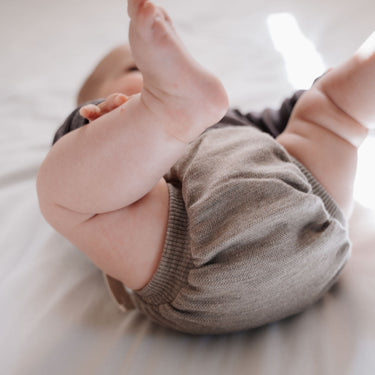
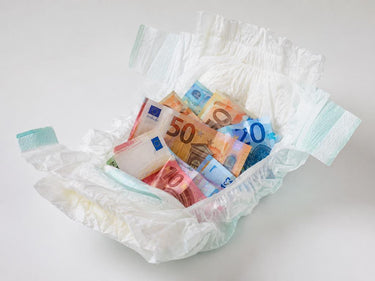
A baby is so small.
Tiny hands.
Tiny feet.
Tiny bodysuits that sometimes seem hardly bigger than a dishcloth.
And then suddenly, there's this surprisingly large diaper pail next to the changing table.
Full again.
Time to take it out again.
Time to make space for the next batch of diapers again.
Parents immediately notice that disposable diapers cost money at the store.
What is much less visible:
Even after a diaper has ended up in the trash, costs continue to accrue.
Someone has to pick it up.
Transport it.
Process it.
Incinérate it.
The necessary infrastructure for this has to be financed.
Ultimately, these costs are borne by municipalities, waste management companies, homeowners – and thus, in various ways, by all of us.
But how much does diaper waste actually cost?
The honest answer is:
There is no single price per diaper.
Whether a family pays an extra five, fifty, or one hundred euros in waste fees per year due to diapers largely depends on where they live and how residual waste is billed there.
Nevertheless, it can be shown quite well where the costs arise – and why even a little less diaper waste can make a difference.
What does diaper waste really cost?
Diaper waste incurs costs at several levels.
These include, among others:
- Residual waste containers or fee-based bags
- Emptying of waste bins
- Personnel and waste collection vehicles
- Transport of residual waste
- Treatment or incineration
- Maintenance of facilities
- Disposal of remaining incineration residues
- Administration and municipal waste infrastructure
Who immediately sees these costs depends on the respective fee system.
Sometimes a household pays for each additional emptying.
Sometimes for a larger container.
In many Swiss municipalities, for every single garbage bag.
And in apartment buildings, the costs may simply appear in the ancillary charges at some point.
Diaper waste is therefore not free just because we no longer pay when we throw it away.
Who pays for diaper disposal – the municipality or the family?
Actually, both.
And that's precisely why one should be cautious with statements like "diapers cost the municipality X euros."
Municipal waste management is often financed to a significant extent through fees.
This means:
The city or waste management company organizes vehicles, personnel, containers, and disposal.
However, the costs for this are then passed on to households and properties via waste fees, bag fees, or other charges.
Sometimes a municipality consciously covers part of the additional costs.
For example, through:
- free diaper bags
- free additional diaper bins
- discounted disposal for families
- subsidies for reusable diapers
Then the bill doesn't disappear.
It's just distributed differently.
How much diaper waste does a baby produce?
Before we talk about money, it helps to visualize the quantity.
For our previous calculations at Mata Origin, we assume a diapering period of two and a half years, resulting in approximately:
3,800 disposable diapers
on average.
Depending on the frequency of changes and the duration of diapering, it can, of course, be significantly more or less.
An unused diaper weighs, on average, only a few dozen grams.
After use, urine and stool are added.
Based on our model assumptions, this results in a volume of approximately:
410 to 550 kilograms of used diapers per child over two and a half years.
Almost half a ton.
A large part of this weight is, of course, the baby's excretions.
But along with them, pulp, plastics, superabsorbents, and other diaper materials are also disposed of each time.
How much diaper waste does a baby really produce?
Diapers are not a tiny marginal amount for waste management
One hardly thinks about it with a single diaper.
In total, it looks different.
Switzerland provides a good example.
In the nationwide study of waste composition in 2022, diapers were identified as a separate waste fraction.
They accounted for approximately:
10.8 kilograms per inhabitant per year or 7.3 percent of the investigated waste.
The interesting thing about this:
This value is calculated across the entire population.
Even including people who don't have a child in diapers at home.
A recent analysis from Lower Austria also shows that diapers make up a clearly visible part of residual waste.
Depending on the settlement structure examined, approximately 5.8 to 8.7 kilograms of diapers per inhabitant per year were found there in 2025.
This corresponds to approximately 4.9 to 6.5 percent of the residual waste weight in the groups examined.
The values from different countries cannot be easily compared due to different collection systems and investigation methods.
But they show one thing quite clearly:
Diapers are not a minor issue for municipal waste management.
What do diapers cost households in Germany?
In Germany, there is no uniform waste fee system.
Each municipality or responsible waste management company calculates differently.
Some primarily calculate based on container size.
Others additionally based on the number of emptyings.
Some offer special diaper bags or diaper bins.
A concrete example is Berlin.
There, for bi-weekly emptying in 2025/2026, the cost is:
- a 60-liter residual waste bin costs 33.19 euros per quarter
- a 120-liter residual waste bin costs 41.00 euros per quarter
If a household had to switch from 60 to 120 liters solely due to its higher residual waste volume, that would be:
around 31 euros in additional fees per year.
Over two and a half years, it would be around 78 euros.
This is expressly not a general "price for diapers."
In an apartment building, for example, the waste volume is shared, and the costs are distributed differently.
However, the example clearly shows:
More residual waste can explicitly cost more money.
Some German municipalities cover part of the diaper costs
It is interesting that numerous municipalities consciously relieve families in this regard.
The Main-Tauber district, for example, provides households with babies in diapers with free garbage bags.
Alternatively, a subsidy of up to 120 euros for reusable diapers can be applied for there.
Other districts provide families with additional diaper bags or subsidize their disposal.
This is thoughtfully intended and can practically help families.
However, it also shows:
The additional waste volume from diapers is large enough that municipalities develop their own solutions for it.
What does diaper waste cost in Austria?
In Austria, too, fees vary greatly from municipality to municipality.
In Vienna, the waste fee depends on the container size and frequency of emptying.
A 120-liter residual waste container with weekly emptying costs, according to the currently published tariff overview:
288.97 euros per year.
Of course, this does not mean that a family automatically has to pay 289 euros more because of a baby.
Often, sufficient residual waste volume is already available.
In an apartment building, the fees are also distributed among many apartments.
But if additional containers or more emptyings become necessary due to increased residual waste, additional costs arise precisely there.
And some Austrian municipalities react similarly to German municipalities:
They provide families with young children with free or discounted diaper bins.
Here too, the community then covers part of the disposal costs.
Diaper waste becomes particularly visible in Switzerland
In many Swiss municipalities, the waste fee operates on the polluter-pays principle.
The more refuse bags you need, the more you pay.
This makes diaper waste immediately visible to families.
In Bern, an official 35-liter fee-based bag currently costs approximately:
1.41 Swiss francs.
If a baby in diapers were to cause just one additional 35-liter bag per week, that would already be approximately:
73 Swiss francs per year.
Over two and a half years, it would be around 183 Swiss francs.
In Zurich, the selling price for ten 35-liter "Züri-Säcke" (Zurich bags), according to published price surveys, ranges between 15.45 and 19.95 Swiss francs, depending on the point of sale.
One additional bag per week would therefore correspond to approximately:
80 to 104 Swiss francs per year.
This is also just an example calculation.
Some families fit more diapers into one bag.
Others less.
And of course, there's other household waste in it too.
But the Swiss fee system makes it particularly clear:
Every bag avoided is not only less waste but eventually also a small financial saving.
Why can't a serious price per diaper be calculated?
It would be tempting to write:
A discarded diaper costs the municipality 7 cents.
But that's not how waste management works.
A waste collection vehicle doesn't drive fewer kilometers just because there's one less diaper in the bin today.
The waste incineration plant is still there.
The employees still have to be paid.
Many costs are fixed.
Others depend on quantity, weight, or the number of emptyings.
That's why the financial impact of waste avoidance often only materializes when many small savings add up.
For example, if:
- fewer residual waste containers are needed
- containers can be made smaller
- fewer fee-based bags are purchased
- fewer additional emptyings are required
- less residual waste needs to be treated in the long term
That's precisely why it's not just a single family that counts.
What matters is what happens when many families need a little less.
What would one less diaper a day change?
Here, an abstract calculation becomes something very small again.
Perhaps a morning pee.
Perhaps a bowel movement you now recognize well.
Perhaps a brief moment after a nap.
If this actually means a fresh disposable diaper is not needed, one less diaper a day over two and a half years results in approximately:
913 fewer diapers.
Almost 1,000 diapers.
They don't have to be bought.
But they also don't have to be:
- disposed of in the residual waste bin
- collected
- transported
- incinerated
Of course, a single family won't immediately change their municipal waste fee because of this.
But depending on the fee system, less waste can eventually become directly noticeable.
And at the municipal level, many small savings add up to a significant amount.
Almost 1,000 fewer diapers: What one elimination communication moment per day can achieve
And what if you only practice elimination communication sometimes?
Then it counts just the same.
Perhaps it's three diapers genuinely saved per week.
Over two and a half years, that's approximately:
390 fewer diapers.
At five per week:
around 650 fewer diapers.
Perhaps you'll never see a large number from this on your waste bill.
Perhaps no one will notice at first except your diaper pail.
But these diapers still didn't end up in the trash.
And we think that's pretty nice.
Part-time EC: How much diaper waste you can really save
Elimination communication does not automatically save a diaper with every pee
Here, too, we want to be honest.
Not every successful elimination communication moment automatically means a disposable diaper saved.
If the diaper was already full and needed changing anyway, no diaper has been saved by subsequent elimination communication.
The saving becomes particularly clear when:
- the backup is clean
- your baby eliminates outside the diaper
- the backup remains clean
- and can then simply be worn further
Then the elimination communication moment truly becomes a diaper that wasn't needed at all.
Perhaps the most beautiful saving is the one that doesn't feel like saving at all
No one has a baby and wants to manage waste from that moment on.
You want to get to know your baby.
Hold them.
Comfort them.
Breastfeed or bottle-feed them.
Laugh with them.
Perhaps, at night, eventually sleep for three hours straight again.
That's why we don't want to turn elimination communication into another sustainability project.
Perhaps you simply notice:
Our baby almost always pees after waking up.
And at some point, it becomes completely natural:
Pick up baby.
Practice elimination communication.
Continue with the day.
The fact that fewer diapers end up in the trash as a side effect is then almost just a nice bonus.
Why the right clothing changes so much
However, one thing surprisingly often determines whether this thought actually turns into an elimination communication moment in everyday life:
How quickly can you access the diaper area?
Because perhaps you already know:
Now my baby needs to go.
But before that are:
Bodysuit.
Pants.
Tights.
Snaps.
Diaper.
And while you're still opening, the moment is already over.
That's precisely why Mata Origin's clothing was developed around elimination communication.
Elimination communication should be easy. And clothing should help.
EC pants: quick opening, instead of complete undressing
An EC pant from Mata Origin can be opened in such a way that your baby doesn't have to be completely undressed every time.
This is particularly practical:
- after waking up
- with spontaneous signals
- on the go
- at night
- on cooler days
Sometimes it's precisely these few fewer steps that turn:
I could actually do elimination communication now.
into a completely relaxed:
Come on, let's try it quickly.
make.
EC diapers: a backup that goes with you
Our elimination communication diapers are also designed for this everyday use.
Your baby is protected.
If something goes into the diaper, that's perfectly fine.
But if you notice a suitable moment, you can quickly open the backup.
And if it stays clean, it's simply closed again.
No either-or.
No perfect diaper-free family.
Just a system that allows you to use diapers when you need them – and sometimes not.
Avoiding waste is the simplest solution, even for communities
Recycling is important.
Modern waste incineration is important.
Good collection systems are important.
But from a waste management perspective, there's a thought that comes before all of that:
Waste that isn't generated doesn't need to be collected or treated.
This doesn't mean that families are now responsible for their community's waste fees.
Absolutely not.
But it shows why waste avoidance makes sense for society.
If a hundred families each use one less diaper a day, that's approximately over two and a half years:
91,300 fewer disposable diapers.
For a thousand families:
913,000 fewer diapers.
And suddenly, a tiny morning moment has become a pretty large quantity.
Does elimination communication also save disposal costs?
Fundamentally, less residual waste can lead to lower disposal costs – but not always immediately on the personal bill.
In a system with fee-based bags, the effect is particularly directly visible.
Those who need fewer bags buy fewer bags.
For waste bins with fixed fees, a household only saves money directly if, for example:
- a smaller container is sufficient
- fewer emptying services are needed
- no additional diaper container is necessary
At the municipal level, waste avoidance primarily has an impact over larger quantities and longer periods.
It would therefore be wrong to promise:
With one less diaper, you will immediately save money on garbage collection every day.
But it would be equally wrong to say:
It makes no difference.
Frequently Asked Questions about Diaper Waste Costs
How much does diaper disposal cost?
There is no uniform price. Costs depend on the local fee system. Depending on the region, households pay based on container size, emptying frequency, weight, or through fee-based garbage bags.
Who pays for the disposal of baby diapers?
Collection and treatment are usually carried out by municipal or commissioned waste management companies. This is often financed through waste fees paid by households and properties. Some communities cover additional costs for free diaper bags or diaper bins.
Does a baby cause higher waste fees?
This can happen, but doesn't have to. If the existing residual waste container is still sufficient and there is a flat fee, nothing may change initially. However, if a larger container, an additional emptying, or an additional fee-based bag is required, immediate additional costs will arise.
How much diaper waste does a baby produce?
For an assumed diapering period of two and a half years, we calculate approximately 3,800 disposable diapers. Depending on assumptions about the weight of a used diaper, this results in an order of magnitude of approximately 410 to 550 kilograms of diaper waste, including excretions.
What is the proportion of diapers in residual waste?
This differs depending on the country, region, and investigation method. In the Swiss waste analysis 2022, diapers accounted for 7.3 percent of the investigated waste weight. In Lower Austria, the diaper share in 2025 ranged from approximately 4.9 to 6.5 percent of the residual waste weight, depending on the settlement structure.
Can a community save money by having fewer diapers?
In the long term, less residual waste can reduce the need for collection, transport, and treatment. However, costs do not decrease one-to-one with every avoided diaper, as a large part of municipal waste management consists of fixed costs.
Does elimination communication save on waste fees?
That depends on the fee system. With fee-based garbage bags or systems calculated by emptying, less residual waste can directly save money. With fixed fees, savings usually only become apparent when a smaller container or fewer emptying services are sufficient.
How many diapers can part-time elimination communication avoid?
Three diapers actually saved per week result in approximately 390 diapers over two and a half years. Five per week result in around 650, and one per day approximately 913 diapers.
Do I have to completely forego diapers?
No. Part-time elimination communication can mean only holding your baby in individual, well-suited situations and otherwise continuing to use a diaper or a reusable backup.
Conclusion: The calculation doesn't start with the garbage fee
A diaper costs money when you buy it.
And it costs resources again after you've thrown it away.
A garbage truck picks it up.
People take care of its disposal.
Facilities treat or incinerate it.
And all these systems are financed by us collectively.
This should not be a reason to think about garbage fees every time you change a diaper.
With a baby, there are already enough things to think about.
Perhaps the more beautiful idea is much smaller.
You notice tomorrow morning:
My baby needs to go.
You open their elimination communication pants.
Hold them over the potty for a moment.
The backup stays clean.
And a diaper simply isn't needed today.
No big sustainability project.
No bill.
No guilty conscience.
Just a small moment between you and your baby.
And maybe someday:
a slightly emptier diaper pail.
Independent Sources for Further Reading
- Federal Office for the Environment Switzerland: Waste Composition Survey 2022
- State of Lower Austria: Residual Waste Analysis 2025
- Berliner Stadtreinigung: Waste Fees 2025/2026
- City of Vienna: Household Waste Fees
- City of Zurich: Fees and Prices for Züri-Säcke
- City of Bern: Polluter Pays Principle for Household Waste
Read more
- How much diaper waste does a baby really produce?
- Part-time elimination communication: How much diaper waste can you really save?
- Almost 1,000 fewer diapers: What one elimination communication moment per day can achieve
- How are used diapers disposed of in Germany, Austria, and Switzerland?
Would you like to simply try out if a diaper can stay dry?
Then you don't have to change your entire daily routine.
Maybe you start tomorrow after waking up.
A brief moment.
A potty.
And a lot of calm.
Our free starter guide shows you how to begin elimination communication in a relaxed way.
And if elimination communication eventually becomes a more regular part of your daily life, elimination communication pants, elimination communication diapers, and our diaper-free clothing make that moment easier – so you don't have to undress your baby completely when they need to go.