
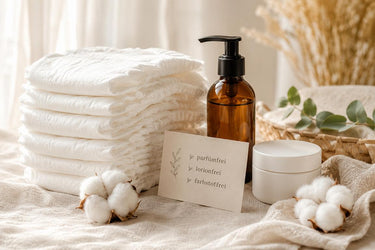
Baby diapers should absorb, protect, and function well in everyday life.
But some disposable diapers can contain more than just pulp, superabsorbers, and fleece: for example, fragrances, lotions, dyes, prints, or wetness indicators.
For many parents, this sounds harmless at first. A diaper that smells fresh. A lotion that sounds like skincare. A colorful print that looks friendly.
But from the perspective of baby skin, a simple question is worth asking: Does the diaper area really need that?
At Mata Origin, we don't view the diaper area as an advertising space or a place for additional care promises. We look at what touches baby skin for many hours every day. And precisely there, less is often better.
Why additives in diapers are even relevant
A diaper fits snugly on the body. It often stays on the skin for an extended period. The diaper area is warm, moist, and less well-ventilated than many other skin areas.
If additional substances are used in this area, they can be more relevant for sensitive baby skin than in a normal layer of clothing.
This doesn't mean that every additive is automatically problematic. But it does mean that parents should take a closer look.
The distinction between necessary functions and optional additives is particularly important. A diaper needs an absorbent core, an inner layer, moisture protection, and a suitable shape.
Fragrances or lotions, on the other hand, are not a prerequisite for a diaper to function.
Fragrances in diapers: Fresh for the nose, but not necessary for the skin
Fragrances are meant to mask unpleasant odors or give the diaper a fresh feel. For adults, this can seem pleasant. However, fragrances have no real benefit for baby skin.
This is especially important in the diaper area. Because there, fragrances are not just somewhere in the room; they can be part of a product worn closely on the body. And in an area that is already under greater stress due to warmth, moisture, and friction.
Therefore, "fragrance-free" is a meaningful selection criterion for baby diapers. Not out of panic. But because baby skin in the diaper area does not need perfuming.
Why fragrances are critically discussed
Fragrances are among the groups of substances that can trigger intolerances or contact allergies in sensitive individuals. The German Environment Agency points out that certain fragrances have been classified as particularly common allergens.
In the case of baby diapers, an additional factor is that the products are worn daily, close to the body, and often for a long period. Therefore, public bodies recommend being particularly cautious with fragrances in absorbent hygiene products.
For parents, the practical consequence is simple: If you use disposable diapers, choose fragrance-free varieties whenever possible. Especially if your baby reacts sensitively, tends to redness, or has already had a sore bottom.
Lotions in diapers: Care or additional skin contact?
Some diapers advertise with lotions. This sounds gentle and caring at first. But baby skin in the diaper area does not automatically need a lotion from the diaper.
A lotion always means that another substance or mixture comes into contact with the skin. Especially where the skin is warm, moist, and enclosed, one should question whether this is really necessary.
If baby skin needs care, it is often more sensible to care for it specifically and consciously: with a few well-tolerated products and only when they are really needed. A continuously active care component in the diaper is not automatically an advantage from our point of view.
Why "with care lotion" does not automatically mean more skin-friendly
"With lotion" quickly sounds extra gentle. But a diaper does not automatically become more skin-friendly just because it contains a caring component.
For the diaper area, other questions are at least as important:
- How long does the diaper stay on the body?
- How much air does the skin get?
- How often is it changed?
- Does stool remain on the skin for a long time?
- Does the diaper rub against the groin or cuffs?
- Which materials directly touch the skin?
A lotion cannot replace these fundamental questions. It does not automatically change the diaper climate and does not prevent urine or stool from irritating the skin if they remain in the diaper area for too long.
Dyes and prints: Visually appealing, but not crucial for babies
Many disposable diapers are printed. With patterns, figures, colors, size markings, or brand motifs. Most of these prints are on the outside and not directly on the baby's skin.
Nevertheless, they show something fundamental: baby diapers are not just hygiene products, but also consumer products. They are designed, advertised, and emotionally charged.
However, a colorful print is not important for your baby. For baby's skin, other things matter: a good fit, little friction, no unnecessary additives, regular changes, and as little time as possible in a full diaper.
Wetness indicators: Practical, but also an additive
Many disposable diapers have a wetness indicator. It shows by changing color whether the diaper is wet. This can be practical for parents, especially with newborns or during the first period.
At the same time, a wetness indicator is also an additional component of the product. It is not automatically problematic, but it is part of an honest consideration: disposable diapers consist of many different components, not just an absorbent material.
From a Elimination Communication perspective, it is interesting: the wetness indicator only shows what has already happened. Potty training starts earlier. It asks: Is there a moment when my baby might need to eliminate before the diaper gets wet?
The difference between control and perception
Disposable diapers make many things invisible. Urine is quickly absorbed, odor is partially reduced, the surface appears dry, and an indicator eventually shows what has happened.
This can be practical. But it can also distance parents further from their baby's rhythm. If every elimination immediately disappears into the product, it becomes harder to notice when a baby actually needs to go.
Elimination Communication reverses this perspective. It's not about control, but about perception. You observe typical moments, signals, and rhythms. You offer your baby an alternative to the diaper. And the diaper becomes a backup, not the only answer.
You can find the introduction here: What is Elimination Communication?
Why the diaper area should remain as simple as possible
The diaper area is already stressed: moisture, warmth, friction, urine, stool, and material contact all come together. Therefore, simplicity is a good principle.
From a Mata-Origin perspective, this means: fewer unnecessary additives, more attention to the skin, and more possibilities outside the diaper.
This can look very practical:
- Choose fragrance-free diapers
- Prefer diapers without lotion
- Do not use too many care products at once
- Remove stool as soon as possible
- Include short air breaks
- Try Elimination Communication in typical moments
- Get to know wool as a more breathable backup
You don't have to change everything at once. But each of these steps can help make the diaper area more conscious.
Why wool doesn't need fragrances
Wool works differently than a fragranced or lotion-equipped disposable diaper. It doesn't need to smell fresh, feel soft, or be loaded with care promises.
Wool is naturally breathable, temperature-regulating, and can regulate moisture. When cared for with lanolin, it becomes more water-repellent and can be used as a natural backup in the diaper area.
This is particularly exciting when practicing Elimination Communication. Because the diaper or EC-friendly diaper should not hide as much as possible for as long as possible, but rather accompany everyday life: protect when a backup is needed, and be quick to open when your baby wants to be held over a potty.
You can find out more here:
Why wool is ideal for Elimination Communication
Discover wool EC-friendly diapers
Fragrances, lotions, and diaper rash
Diaper rash usually does not arise from a single trigger. Often, moisture, stool, urine, friction, warmth, sensitive skin, and sometimes care products or additives come together.
If your baby frequently has redness, it's worth looking at everything that touches the diaper area: diapers, wet wipes, creams, detergents, clothing, and care products.
Especially then, a minimalist approach can be beneficial: less fragrance, less lotion, less friction, less time in a full diaper.
If redness is severe, weeping, open sores develop, or your baby is in pain, you should seek medical advice.
What parents can check when buying diapers
You don't have to be a chemist to shop more consciously. A few simple questions can help:
- Is the diaper fragrance-free?
- Does it contain lotion?
- Are there clear material specifications?
- Are there reputable test seals?
- Does the diaper primarily advertise with fragrance, design, or extreme dryness?
- How does my baby's skin react?
The last question, in particular, is important. The best diaper on paper is of little use if your baby reacts sensitively to it.
What public bodies say about this
The German Environment Agency recommends prohibiting the use of lotions and fragrances in absorbent hygiene products to reduce allergy risks. ANSES also recommends eliminating fragrances in baby diapers in its safety assessment of baby diapers.
This shows that the question of fragrances and lotions is not a minor issue. It is part of an objective consideration of products used daily and close to the body.
For parents, this doesn't mean fear of every diaper. But it does mean: perfuming and lotions are not necessary in the diaper area and should be consciously questioned.
What does this have to do with Elimination Communication?
Elimination Communication changes the fundamental question. It's not just about which diaper is the least problematic. It's also about whether every elimination really has to end up in the diaper.
If you hold your baby over a potty after waking up, after nursing, or when they show clear signals, a different kind of contact with elimination develops. You see: My baby has a rhythm. My baby might be showing something. And sometimes, they just need an opportunity outside the diaper.
This can relieve the diaper area, especially if stool doesn't always end up in the diaper. Not perfectly. Not always. But often enough to rethink everyday life.
You can find more about getting started gently here: Starting Elimination Communication: What you really need to know
Public sources for further reading
If you want to delve deeper into fragrances, lotions, and absorbent hygiene products, you can find trustworthy public sources here:
- German Environment Agency: Absorbent Hygiene Products
- German Environment Agency: Fragrances
- ANSES: Safety of baby diapers
- Joint Research Centre of the EU: EU Ecolabel criteria for absorbent hygiene products
Frequently asked questions about fragrances and lotions in baby diapers
Does a baby diaper need fragrances?
No. A baby diaper does not need fragrances to function. Fragrances can mask odors but have no benefit for baby's skin. Especially for sensitive skin, fragrance-free is often the better choice.
Are lotions in diapers good for baby skin?
Lotions sound nourishing, but they are not automatically an advantage. They mean additional substances in contact with the skin. If baby skin needs care, targeted, conscious care is often more sensible than a continuously present lotion in the diaper.
Are colorful prints on diapers problematic?
Prints are usually on the outside and do not directly touch the skin. Nevertheless, they show that disposable diapers consist of many components. For your baby, design and motifs are not important. For the skin, fit, material contact, changing frequency, and as few unnecessary additives as possible matter.
What does fragrance-free mean for diapers?
Fragrance-free means that no fragrances have been added to give the diaper a certain smell. This is particularly useful if your baby has sensitive skin or tends to redness.
Can Elimination Communication help reduce exposure to additives?
Elimination Communication does not automatically replace every diaper. But if your baby can eliminate outside the diaper for individual eliminations, the time spent in a full diaper is reduced. At the same time, the perspective changes: the diaper becomes more of a backup and less the sole place for eliminations.
Why does Mata Origin rely on wool instead of fragrances or lotions?
Wool does not need fragrances or care promises in the diaper. It is breathable, temperature-regulating, and can be used with lanolin as a natural backup. In combination with Elimination Communication, it fits a more conscious diaper routine.
Conclusion: Baby skin doesn't need fragrance promises
Fragrances, lotions, and colorful promises do not automatically make a diaper more skin-friendly. Especially in the diaper area, less is often more sensible: fewer unnecessary additives, less friction, less time in a full diaper, and more attention to what your baby really needs.
From Mata-Origin's perspective, the best question is therefore not: Which diaper smells freshest? But rather: How can we support the diaper area more naturally, airily, and consciously?
Elimination Communication, wool, and part-time EC are not radical solutions for this. They are practical ways to start with a single moment.
Further reading
What's in disposable diapers? Materials, layers, and substances explained simply
Superabsorbers in diapers: Why disposable diapers absorb so much liquid
Baby skin in the diaper area: Why it is particularly sensitive
Diaper climate: Why warmth, moisture, and friction can stress baby skin


