
Why is Elimination Communication (EC) useful?
In short: EC can be beneficial because you consciously support your baby in elimination. You learn their signals and rhythms, offer them an alternative to diapers, and can simultaneously reduce diaper consumption, waste, and ongoing costs.
It's not about "catching" every elimination or becoming diaper-free as quickly as possible. Many families only practice EC when it's convenient and continue to use a diaper as a backup. That, too, is EC.
The seven most important benefits at a glance:
- You get to know your baby's signals better.
- You offer your baby an alternative to diapers.
- The EC position can ease elimination.
- Less waste ends up directly on the skin.
- You can reduce diaper waste and resource consumption.
- Fewer used diapers can lower ongoing costs.
- EC can be practiced flexibly and without pressure for perfection.
What does Elimination Communication mean for a baby?
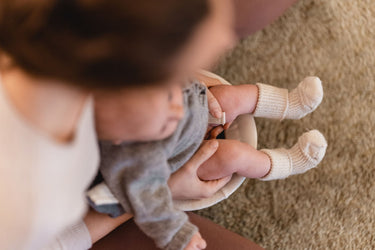
With EC, you give your baby the opportunity to relieve themselves outside the diaper – for example, over a sink, a toilet, a suitable bowl, or a small potty.
You can guide yourself by three things:
- Signals: Your baby may become restless, kick, push, pause briefly, or change their facial expression.
- Typical moments: Many babies eliminate after waking up, around breastfeeding or feeding, and during diaper changes.
- Your intuition: Sometimes, over time, you just get the feeling: Maybe my baby needs to go right now.
If something comes, that's great. If nothing comes, the offer was still fine. You can find a detailed introduction on our page What is Elimination Communication?
Is Elimination Communication the same as Diaper-Free?
The terms are often used interchangeably, but they don't mean exactly the same thing.
Elimination Communication describes the concrete action: You hold your baby in a secure position and offer them a place to eliminate.
Diaper-Free or Elimination Communication describes more the attitude and the daily routine behind it: You pay attention to signals, rhythms, and suitable moments and react to them when it's possible for you.
So, diaper-free doesn't automatically mean "without diapers." Many families practice part-time diaper-free and use diapers calmly as a backup.
1. You learn to understand your baby even better
With a baby, there are many moments of guesswork: Are they hungry? Tired? Do they need closeness? Do they have a tummy ache – or do they just need to eliminate?
With EC, you direct your attention to a need that is easily overlooked in everyday baby life. You observe body language, recurring times, and small changes. Gradually, a finer sense for your baby can develop.
Many parents experience this as:
- less guesswork,
- more certainty in everyday life,
- more trust in their own perception, and
- a beautiful feeling of closeness and togetherness.
It's important to be honest: There is no scientific evidence that EC automatically creates a "stronger bond." However, attention and responding to signals are central components of elimination communication. You can read about what signals might be typical at what age in our article Elimination Communication for Babies: Recognizing Signals by Age.
2. Your baby gets an alternative to diapers
A diaper is practical and an important safety net for many families. Nevertheless, it doesn't have to be the only place where your baby can eliminate.
With EC, you convey to your baby: I perceive that you need to go, and I offer you another place. They can relieve themselves while being held and accompanied.
Perhaps after some time, you notice that a certain restlessness always occurs shortly before peeing or pooping. Or you realize that your baby almost reliably needs to go after waking up. Such small "aha" moments make EC so valuable for many families.
This doesn't mean that every restless baby needs to eliminate. An offer should therefore always remain short, friendly, and without expectation.
3. The EC position can help with releasing
In classic EC, the baby is securely supported at the upper body and thighs. The legs are slightly bent. Some babies can release urine, stool, or gas more easily in this position and then visibly relax.
This is a possible support – not a promise of a cure. EC does not reliably prevent stomachaches or so-called "three-month colic." Severe or persistent crying can have many causes and should be checked by a pediatrician or midwife if you are unsure.
You can learn more about possible connections and clear limitations in our article Baby Tummy Ache and 3-Month Colic: Can Elimination Communication Help?
4. Less waste ends up directly on the skin
In the diaper area, warmth, moisture, friction, urine, and stool meet sensitive baby skin. Any waste that lands in the potty or sink is not in the diaper against the skin.
Regular EC can therefore mean:
- fewer full diapers,
- less contact with urine and stool, and
- more opportunities for air and dryness.
EC does not automatically protect against diaper rash. A full diaper should still be changed promptly, and irritated skin should be treated appropriately. However, it can be a gentle building block for a conscious approach to the diaper area.
The materials used also play a role. You can find more about this under Why natural materials are so important in the diaper area.
5. You can reduce diaper waste and resource consumption
Disposable diapers accompany many children for several years. Over the entire diapering period, large amounts of waste can accumulate. The Austrian environmental consulting service states that up to one ton of diaper waste per child is a typical order of magnitude.
How much you actually avoid through EC depends on how often a diaper remains dry and can be reused. Part-time diaper-free therefore doesn't automatically save a ton. But every diaper you genuinely use less reduces waste and the need for new materials.
You don't have to live perfectly diaper-free for this. Even one or two suitable EC moments a day can add up over many months.
You can find a detailed classification with figures in our article How much diaper waste does a baby really cause?
6. Fewer diapers can also mean lower costs
Disposable diapers are an ongoing expense in the family budget. The total cost depends, among other things, on the diaper brand, price per piece, daily consumption, and duration of the diapering period.
If a diaper remains dry through EC and can be reused later, your consumption decreases. Over weeks, months, and years, this can lead to significant savings.
How much you actually save is individual. Backup diapers, inserts, laundry, and possible EC equipment also belong in an honest calculation. Therefore, EC doesn't automatically promise a certain sum – but it gives you a practical way to reduce your ongoing diaper costs.
We show how many diapers babies typically use and what costs can arise in the article How many diapers does a baby really use?
7. EC also works on a small scale and with a safety net
One of the biggest advantages is its flexibility. EC doesn't have to become a new full-time project. You can practice it in a way that suits your baby and your family's everyday life.
This can mean:
- only practicing EC after waking up,
- only offering it at home or only during the day,
- reacting to particularly clear signals,
- taking breaks in between, or
- using diapers as a backup at any time.
The diaper is not a failure. It gives you security if you don't notice a signal, don't have the opportunity to practice EC, or simply need peace of mind.
Precisely this openness removes pressure: EC should adapt to your daily life – not your daily life to EC.
What does research say about the benefits of EC?
EC is studied internationally as Elimination Communication or Assisted Infant Toilet Training. A scientific review from 2025 describes signals, natural timing, and intuition as essential components. Observational studies also indicate possible benefits for bladder and bowel functions and reduced diaper consumption.
At the same time, the research is still limited. Many studies are not randomized, lack a control group, or can only be partially transferred to families in Germany. Therefore, possible health benefits should not be presented as definitively proven.
For your daily life, this means: You can try EC if it feels good. But it does not have to prevent complaints or work the same way for every family.
EC is not toilet training
In classic toilet training, an older child is supposed to increasingly use the potty or toilet independently. With EC, on the other hand, the responsibility lies with the adult caregiver: You observe, offer, and hold your baby safely.
Your baby doesn't have to perform. They are not judged, praised, or pressured to "do it right." The focus is on communication, support, and a relaxed approach to a perfectly normal bodily need.
When can you practice Elimination Communication with your baby?
You don't have to wait until you can reliably recognize every signal. Recurring everyday situations are suitable for getting started, for example:
- after waking up,
- during a diaper change,
- around breastfeeding or feeding,
- after carrying or a car ride,
- before sleeping, or
- if your baby tenses up or suddenly becomes restless.
At first, it's best to choose just one moment that already fits into your daily routine. This keeps experimenting easy. You can find more ideas under The best moments for EC.
What do you need to start with EC?
You don't need to buy anything for the first attempt. A sink, a toilet, a suitable bowl, or a small potty are sufficient.
Do you want simple step-by-step guidance? Our free EC starter guide shows you suitable everyday situations, a safe EC position, and the first relaxed attempt – even if you don't yet recognize clear signals.
If EC becomes a more frequent part of your daily routine, some things can make the process easier:
- clothing that can be opened quickly,
- an EC diaper as a backup,
- suitable diaper inserts,
- practical EC pants, and
- an EC potty for home or on the go.
These products are not a prerequisite. They are helpers if they bring you more ease.
Why EC doesn't have to be perfect
You will miss signals. Sometimes, something still ends up in the diaper immediately after EC. On other days, you might lack the time or desire.
All of that is part of it.
The purpose of EC is not to achieve the highest possible "hit rate." It is about repeatedly offering your baby an alternative and together figuring out what suits you.
A relaxed EC moment is more valuable than ten attempts under pressure.
Frequent Questions: Why EC?
From when is EC useful?
You can generally start from birth, but also weeks or months later. There is no perfect starting point. The crucial thing is that you feel safe and that EC remains relaxed for you and your baby.
Is EC also useful if I continue to use diapers?
Yes. Many families combine EC with diapers as a backup. Even individual offerings during the day can help you learn signals and rhythms and gradually reduce diaper consumption.
What if I don't recognize any signals?
Then you can orient yourself by typical moments, such as after waking up or during a diaper change. Some babies show clear signals, others hardly any. Both are normal and say nothing about your closeness or your attentiveness.
Can EC prevent tummy aches or colic?
This is not definitively proven. The EC position can help some babies with elimination or releasing gas. However, severe or persistent crying has many possible causes and should be medically clarified if you are unsure.
Does EC really save diapers and money?
Yes, if diapers remain dry through EC and fewer new diapers are actually used. How much you save depends on how often you practice EC, what backup you use, and what purchases you include in your calculation.
Can EC become stressful?
Yes, if you turn it into a task that always has to work. In that case, it helps to offer less frequently, take a break, or stick to just one relaxed standard moment. EC should make your everyday life easier and can be adjusted at any time.
Conclusion: Why EC is useful for many families
EC can help you to perceive your baby's signals and rhythms more consciously. It offers your baby an alternative to diapers, can relieve elimination, and reduce contact with urine and stool. If fewer diapers are used as a result, waste, resource consumption, and ongoing costs also decrease.
Perhaps the most important advantage is its openness: You don't have to live completely diaper-free. You can start small, use diapers as a backup, and find your own way.
Is EC new to you? Then start with a single, quiet moment. On our introductory page, we show you step-by-step how it works: Learn EC easily.


