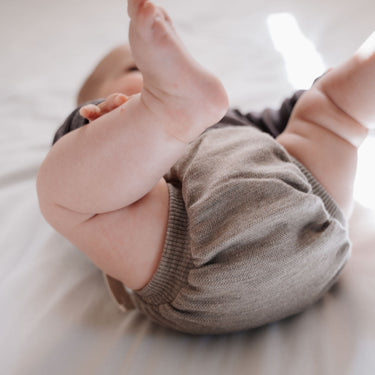
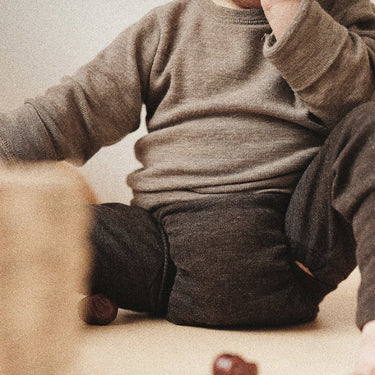
Merino wool is one of the most important materials at Mata Origin. It is soft, temperature-regulating, breathable, and comfortable on sensitive baby skin. At the same time, it can absorb moisture without feeling wet immediately and repel moisture outwards due to natural lanolin.
That is precisely why we use merino wool in many products for babies, for elimination communication (EC), holding, diapering, and outdoor clothing. It aligns with our philosophy: natural materials, thoughtful function, and clothing that makes everyday family life easier.
In this fabric guide, we explain why merino wool is so special for babies, what distinguishes it from other wool fabrics, and the role merino wool plays in elimination communication, EC diapers, wool pants, boiled wool, wool fleece, and changing mats.
What is Merino Wool?
Merino wool is a particularly fine wool from merino sheep. Compared to many classic types of wool, it feels significantly softer and more comfortable. This makes it especially interesting for baby clothing and products worn close to the skin.
It's important to note: Merino wool is primarily the fiber. How a finished fabric feels and what it's suitable for also depends on how the wool is processed. From merino wool, for example, light interlock fabrics, structured jacquard, fluffy wool fleece, or robust boiled wool can be made.
At Mata Origin, we therefore always consider merino wool from a practical perspective: What does baby skin need? What helps in everyday life? What works for elimination communication, diapering, being outdoors, and movement?
Merino Wool Explained Briefly
- Material: fine wool from merino sheep
- Feel: soft, comfortable, and wearable next to the skin Function: temperature-regulating, breathable, and moisture-regulating
- Special Feature: can absorb moisture without feeling wet immediately
- Moisture Protection: natural lanolin can help repel moisture
- Use at Mata Origin: baby clothing, EC diapers, wool pants, changing mats, blankets, and outdoor clothing
- Care: airing out is often sufficient; wash gently with wool detergent if needed
Why Merino Wool is Good for Baby Skin
Baby skin is delicate. It reacts more quickly to friction, moisture, heat, cold, and unsuitable materials. Therefore, it is important that fabrics are soft and support a comfortable body climate.
Merino wool is particularly exciting for babies because it can feel soft and simultaneously offers natural functions. It warms in the cold, but doesn't just feel thick or heavy. Instead, it helps to better balance temperature and moisture.
This is especially valuable for clothing worn close to the body. A fabric should not scratch, feel stiff, or quickly become sweaty. Merino wool can be a very good choice here – provided it is of high quality and properly cared for.
The Most Important Properties of Merino Wool
- Soft: particularly fine merino wool is comfortable on baby skin.
- Temperature-regulating: it supports a balanced body climate.
- Breathable: wool allows moisture to escape and does not quickly feel stuffy.
- Moisture-regulating: merino wool can absorb moisture without feeling wet immediately.
- Warming: it keeps you pleasantly warm, especially in cooler seasons.
- Also interesting for warm days: light wool qualities can be very comfortable in summer.
- Low odor in everyday use: wool often does not need to be washed after every wear.
- Natural: an animal natural fiber instead of synthetic standard material.
Why Merino Wool is Temperature-Regulating
Merino wool is often described as temperature-regulating. This means it can help to better balance warmth and moisture.
When it's cool, wool can provide pleasant warmth. When it gets warmer or your baby is being carried, wool can absorb moisture and help prevent the skin from feeling clammy immediately. This balance is precisely what makes merino wool so interesting for babies.
This is particularly important because babies cannot regulate their body temperature as reliably as adults. Of course, no material replaces observing the child. You should always check whether your baby is too warm or too cold. But as a material, merino wool supports a comfortable body climate very well.
Merino Wool and Moisture
A major advantage of merino wool is its handling of moisture. Wool can absorb moisture without feeling wet immediately. This distinguishes it from many materials that quickly feel clammy when wet.
In everyday baby life, this is very practical. During sleep, carrying, breastfeeding, diaper changes, or being outdoors, small temperature and humidity fluctuations can quickly occur. Merino wool can help to make these fluctuations more comfortable.
For elimination communication and diapering, there's another point: wool naturally contains lanolin. This wool grease can help repel moisture. That's why merino wool plays a special role in natural moisture protection solutions.
You can find more about this here: Why Wool Needs Lanolin
Merino Wool and Natural Moisture Protection
At Mata Origin, merino wool can be used not only as clothing material but also as natural moisture protection. This is particularly important for EC diapers, wool pants, wool liners, and products for elimination communication.
Natural moisture protection is not created by a plastic coating, but by the properties of the wool and by lanolin. Well-cared-for wool can repel moisture outwards while remaining breathable.
However, an honest assessment is important: wool is not the same as a completely waterproof plastic membrane. It can repel and regulate moisture, but with a lot of wetness or continuous pressure, even wool reaches its limits.
For many families, this is precisely the advantage: wool offers natural moisture protection without feeling like plastic.
Merino Wool for Elimination Communication and EC Diapers
In the everyday life of elimination communication and holding, materials have to perform exceptionally well. Clothing and backups should be soft, function quickly, absorb or repel moisture effectively, and not restrict the baby's movement.
Merino wool fits this approach very well. It can feel comfortable on the skin as clothing, repel moisture as a wool layer, and work together as part of a natural system with organic cotton and hemp.
A simple material system looks like this:
- Organic cotton: absorbs moisture quickly.
- Hemp: provides additional absorbency.
- Merino wool: can act as a natural moisture barrier to the outside.
This creates not a rigid diaper system, but a flexible interplay of natural materials for EC, part-time elimination communication, diapering, and on the go.
If you're not yet familiar with EC: What is EC?
Merino Wool in Summer
Many parents first think of winter when it comes to wool. This is understandable, but short-sighted. Especially fine merino wool can also be very comfortable in summer – especially if it is lightly processed.
Light merino wool or blends like wool-Tencel can feel soft, airy, and temperature-regulating. They are interesting for warm days, transitional seasons, carrying, sleeping, and close-fitting baby clothes.
The right fabric quality is always important. Thick boiled wool is certainly not a summer fabric. A light merino interlock or wool-Tencel, on the other hand, can work very well even in warmer temperatures.
You can find more about this here: Why Wool is Ideal for Babies in Summer
Merino Wool in Winter
In winter, merino wool shows its warming side. It can store heat while remaining breathable. This is particularly practical for babies who are in a stroller, being carried, or transitioning between indoors and outdoors.
For colder days, Mata Origin primarily offers wool fleece and boiled wool. Both are based on wool but fulfill different tasks: wool fleece is soft and cuddly, while boiled wool is denser, more robust, and more suitable for outdoors.
In a layering system, merino wool can be worn across a wide range of temperatures. Depending on the weather, thin wool layers, wool-silk, wool-Tencel, interlock, wool fleece, or boiled wool can be combined.
What Merino Fabric Qualities Does Mata Origin Offer?
Merino wool is not always the same. At Mata Origin, we use different wool qualities because they fulfill different tasks.
Merino Interlock
Merino interlock is soft, light, and temperature-regulating. It is particularly suitable for close-fitting baby clothes, EC pants, shorties, overalls, and harem pants. Interlock is smoother and thinner than boiled wool or wool fleece.
Learn more about Merino Interlock
Wool-Tencel
Wool-Tencel combines the natural properties of wool with the smooth, light feel of Tencel. The blend is particularly suitable for warm days, transitional seasons, rompers, shirts, and close-fitting clothing.
Merino Jacquard
Jacquard is not a fiber, but a fabric technique. The pattern is woven directly into the fabric structure. In combination with merino wool, a high-quality, structured wool fabric is created for EC diapers, EC pants, rompers, and wool pants.
Wool Fleece
Wool fleece is the cuddly wool quality. The fabric is soft, fluffy, warming, and temperature-regulating. It is particularly suitable for baby blankets, cuddly wool blankets, jackets, rompers, and warm comfort layers.
Boiled Wool
Boiled wool is felted, compacted wool. This makes the fabric denser, more robust, and more weather-appropriate. Boiled wool is ideal for outdoor clothing such as overalls, dungarees, jackets, and trousers.
Merino Wool or Organic Cotton?
Merino wool and organic cotton are both natural materials, but they serve different purposes.
Merino wool is particularly strong in temperature regulation, breathability, and natural moisture protection. It is suitable for clothing, wool pants, EC diapers, blankets, outdoor products, and changing mats.
Organic cotton is particularly strong as an absorbent material. It absorbs moisture quickly and is very suitable for diaper inserts and booster pads.
In the elimination communication everyday life, both materials work particularly well together: organic cotton absorbs, merino wool protects outwards.
Learn more about Organic Cotton
Merino Wool or Hemp?
Merino wool and hemp also have different purposes. Merino wool regulates temperature and can repel moisture. Hemp, on the other hand, is particularly interesting when additional absorbency is needed.
Hemp absorbs a lot, but rather slowly. Therefore, at Mata Origin, it is used as a booster – best under a fast-absorbing layer of organic cotton. Merino wool can help as a natural moisture barrier on the outside.
The combination of organic cotton, hemp, and merino wool is therefore particularly useful for EC diapers, cloth diapers, at night, and on the go.
Learn more about Hemp as an absorbent material
For Which Products is Merino Wool Particularly Suitable?
Merino wool is suitable for many products at Mata Origin, but not always for the same reason. Sometimes softness is the focus, sometimes temperature regulation, sometimes moisture protection, sometimes outdoor functionality.
- Baby clothing: soft, breathable, and temperature-regulating.
- EC pants: flexible, natural, and suitable for elimination communication.
- EC diapers: as part of a natural backup system.
- Wool pants: as natural moisture protection and warm clothing.
- Changing mats: as a natural alternative to plastic surfaces.
- Wool fleece products: soft, fluffy, and wonderfully warm.
- Boiled wool products: robust, warm, and ideal for outdoors.
- Blankets: cuddly, warming, and breathable.
Discover Merino Wool at Mata Origin
If you want to try out merino wool in everyday life with your baby, you will find many suitable products and categories at Mata Origin:
- Discover wool EC diapers
- Discover wool EC pants
- Discover wool outdoor clothing
- Changing mat for on the go
- Discover wool care products
- To the fabric guide overview
Is Merino Wool Itchy?
Many people associate wool with itchiness. With high-quality merino wool, this is often not the case. The fibers are particularly fine and can therefore feel significantly softer than classic coarse wool.
Whether a fabric is itchy, however, depends not only on the material name. Fiber quality, processing, fabric type, and individual skin sensation are decisive. That's why at Mata Origin, we make sure to use merino wool in a way that suits sensitive baby skin.
How to Care for Merino Wool?
Merino wool often needs to be washed significantly less frequently than many parents think. Good airing out is often sufficient. Small stains can be carefully removed or brushed off depending on the product.
If washing is necessary, merino wool should be cared for gently. Low temperatures, a suitable wool detergent, and minimal friction are important. Please do not rub vigorously, do not wash hot, and do not tumble dry.
For wool products that are intended to repel moisture, lanolin plays a special role. A lanolin bath can support the natural moisture protection of wool.
You can find more about care here:
- The right care for wool clothing
- Greasing wool: How the lanolin bath works
- Why wool needs lanolin
- Discover wool care products
Material Quality and Responsibility at Mata Origin
At Mata Origin, we don't just pay attention to whether a material looks nice or feels good. It is important to us where materials come from, how they are processed, and whether they align with our values.
Depending on the product, we use high-quality merino wool, mulesing-free wool, GOTS-certified materials, and as natural, low-plastic fibers as possible. We remain consciously transparent: when we speak of GOTS-certified materials, we mean the fabrics used, provided they are certified accordingly. This does not automatically mean that every finished product as a whole is GOTS-certified.
Our standard remains clear: materials should be comfortable for baby skin, functional in everyday life, and responsibly selected.
Frequently Asked Questions about Merino Wool
Is merino wool good for babies?
Yes, high-quality merino wool can be very suitable for babies. It is soft, temperature-regulating, breathable, and can absorb moisture without feeling wet immediately.
Why is merino wool temperature-regulating?
Merino wool can store warmth while absorbing moisture. This supports a comfortable body climate – especially with changing temperatures, when carrying, sleeping, or being outdoors.
Is merino wool also suitable for summer?
Yes, light merino wool can also be comfortable in summer. The right fabric quality is important. Merino interlock or wool-Tencel are more suitable for warm days than thick wool qualities like boiled wool.
Is merino wool waterproof?
Merino wool is not completely waterproof like a plastic membrane. However, due to the wool structure and lanolin, it can regulate moisture well and, depending on care, repel moisture.
What is the difference between merino wool and boiled wool?
Merino wool is the fiber. Boiled wool is a felted, compressed fabric quality made from wool. Boiled wool is denser, more robust, and particularly suitable for outdoor clothing.
What is the difference between merino wool and wool fleece?
Merino wool is the material. Wool fleece is a fluffy, brushed wool quality. Wool fleece is particularly soft, cuddly, and warming.
What is the difference between merino wool and organic cotton?
Merino wool regulates temperature and can repel moisture. Organic cotton absorbs moisture and is therefore particularly suitable for diaper inserts and absorbent pads.
How often do you need to wash merino wool?
Merino wool often does not need to be washed after every wear. Airing it out is often sufficient. If washing is necessary, it should be cared for with suitable wool detergent, at a low temperature, and with little friction.
Conclusion: Merino wool is a true functional material for babies
Merino wool is one of the most important materials at Mata Origin because it combines so many natural functions: softness, temperature regulation, breathability, moisture management, and natural moisture protection through lanolin.
It is suitable for baby clothing, diaper-free products, elimination communication diapers, wool pants, changing pads, blankets, and outdoor clothing. The right fabric quality is always crucial: interlock for light clothing, wool-Tencel for warm days, jacquard for texture, wool fleece for coziness, and boiled wool for outdoors.
For families looking for natural materials, functional clothing, and a conscious baby everyday life, merino wool is therefore a particularly strong choice.
Further Information
If you would like to learn more about merino wool, wool, and natural wool care, you can find further information here: