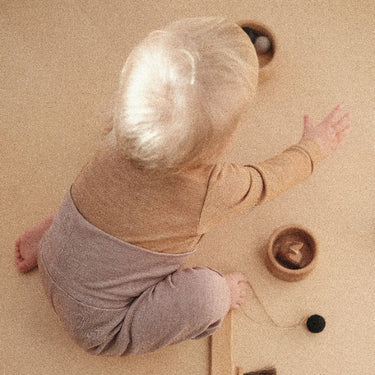
Merino wool baby clothes are one of the most natural and comfortable choices for many families in their daily baby life. It is soft, temperature-regulating, breathable, and can absorb moisture without feeling immediately wet.
This is especially important for babies. Young children cannot regulate their body temperature as well as adults. They lie, sleep, are carried, kick, sweat, cool down, and need clothes that adapt as well as possible to these changing situations.
Merino wool can help precisely with this. It warms when it's cool. It supports a comfortable body climate when it gets warmer. And it feels significantly softer on the skin than many classic wool qualities.
Therefore, merino wool plays a central role at Mata Origin: for baby clothes, elimination communication, holding off, wool pants, EC pants, rompers, dungarees, blankets, outdoor clothing, and natural backup systems in everyday life.
Our merino wool is GOTS-certified and mulesing-free – because baby clothes should not only be soft and functional but also responsibly chosen.
What are merino wool baby clothes?
Merino wool baby clothes are garments for babies and toddlers made from fine wool from Merino sheep. Unlike many coarse wool qualities, merino wool is particularly fine, soft, and comfortable on the skin.
Merino wool is used for a wide variety of garments:
- Baby pants
- Wool pants
- EC pants
- Rompers
- Dungarees
- Shirts
- Jackets
- Overalls
- Blankets
- Diapering and elimination communication products
Crucially, it's not just the material itself, but also the fabric quality. Merino wool can be processed as interlock, jacquard, wool fleece, boiled wool, or in blends such as wool-Tencel. Each type of fabric has a different role in daily baby life.
If you want to delve deeper into the various materials, you can find our overview here: Mata Origin Fabric Science.
Why merino wool is so special for babies
Babies need clothes that are soft, safe, comfortable, and functional. Clothes should not scratch, constrict, and should be able to handle temperature changes as well as possible.
Merino wool is particularly interesting for this because it combines several natural properties:
- It is soft and comfortable on baby skin.
- It is temperature-regulating.
- It can absorb moisture.
- It remains breathable.
- It doesn't absorb odors as quickly.
- It often only needs to be aired out.
- It is naturally elastic.
- It can repel moisture to the outside due to lanolin.
This means merino wool baby clothes are not only suitable for winter. Depending on the fabric quality, cut, and layering, merino wool can also be very comfortable in spring, during transitional periods, in warm indoor spaces, and on mild days.
Is merino wool good for baby skin?
Yes, high-quality merino wool can be very suitable for baby skin. The crucial difference lies in the fineness of the fibers. Fine merino fibers feel significantly softer than coarse wool.
Many parents first think of scratchy sweaters when they think of wool. Merino wool is different. It is finer, softer, and more pliable. That's why it is often used for close-fitting clothing – even for babies.
Nevertheless, for merino wool baby clothes, it is important:
- The wool should be of high quality.
- The fabric should lie softly on the skin.
- Seams and cuffs should not bother.
- The garment should match the temperature and situation.
- Every baby is individual and can react differently to materials.
If your baby has very sensitive skin, it's worth starting with a single garment and observing how the merino wool feels in everyday life.
You can find more about the base material here: Merino wool for babies.
The most important advantages of merino wool baby clothes
1. Merino wool is temperature-regulating
Babies constantly switch between different situations: sleeping, being carried, playing, breastfeeding, being outdoors, being indoors, stroller, car, baby carrier, or bed.
Merino wool can help keep the body climate more comfortable. It warms in the cold and simultaneously supports moisture balance when it gets warmer.
This does not mean that a merino garment is automatically perfect for every temperature. But merino wool is a very versatile natural material that often handles temperature changes better than many synthetic materials.
2. Merino wool can absorb moisture
Babies sweat, drool, are carried, lie warmly wrapped, or suddenly move a lot. Clothing must therefore be able to handle moisture.
Merino wool can absorb moisture without immediately feeling clammy. This is very pleasant in daily baby life, as the garment doesn't feel directly wet or cold.
Especially when carrying, sleeping, or during transitional periods, this property is particularly valuable.
3. Merino wool is breathable
Breathable baby clothes help to better balance warmth and moisture. Merino wool can regulate air and moisture, and thus often feels less stuffy than very dense, synthetic materials.
This is particularly important when babies wear several layers or spend longer periods in a stroller, car seat, or baby carrier.
4. Merino wool does not absorb odors as quickly
A great advantage of merino wool baby clothes: they often don't need to be washed after every wear. Often, thorough airing is sufficient.
This is practical, saves washing, and protects the material. Especially in daily baby life, where a lot is washed anyway, this is a real advantage.
5. Merino wool is naturally elastic
Baby clothes must allow for movement. Babies kick, crawl, roll, sit, are carried, and grow quickly.
Merino wool brings natural elasticity. This allows garments to move softly without feeling stiff. This is particularly comfortable for pants, rompers, dungarees, and close-fitting clothing.
GOTS-certified and mulesing-free: Why our merino wool is consciously chosen
When it comes to merino wool baby clothes, it's not just about how soft a fabric feels. It's also crucial where the wool comes from, how it was processed, and what standards are behind it.
Our merino wool is GOTS-certified and mulesing-free – because baby clothes should not only be soft and functional but also responsibly chosen.
Especially for clothing worn close to baby's skin, this material quality is particularly important. Parents should not only feel that a fabric is pleasantly soft. They should also know that the wool has been carefully selected.
What does mulesing-free mean?
Mulesing is a procedure on sheep that is internationally discussed and criticized, especially in merino wool production. Mulesing-free merino wool means that this practice was not applied during the wool harvesting.
For us, mulesing-free wool is important because baby clothes should not only be soft and functional but also associated with a more conscious treatment of animals.
You can find more about this here: What does mulesing-free mean?
What does GOTS-certified merino wool mean?
GOTS stands for the Global Organic Textile Standard. The standard considers ecological and social criteria along textile processing. For parents, this is particularly valuable because GOTS-certified materials can provide guidance when it comes to contaminant management, processing, and more responsible textiles.
At Mata Origin, GOTS-certified merino wool is an important part of our quality promise. Especially for baby clothes, EC pants, wool products, and clothing for sensitive baby skin, we want to use materials that parents can trust.
You can find more about this here: What does GOTS-certified mean?
Why this is so important for baby clothes
Babies wear clothes directly on their bodies for many hours. Therefore, with merino wool, it's not just about warmth, softness, and function. It's also about trust.
GOTS-certified and mulesing-free merino wool aligns with our standards at Mata Origin: natural materials, conscious processing, and products that truly support families in everyday life.
Merino wool baby clothes in summer and winter
Merino wool is often understood as a winter material. This is only partially true. Of course, merino wool can warm very well. But depending on the fabric quality, it can also be suitable for other seasons.
It is important which type of merino fabric is used:
- Merino Interlock: smooth, soft, and dimensionally stable – good for flexible baby clothes, EC pants, dungarees, and harem pants.
- Wool-Tencel: particularly soft, light, and flowing – comfortable for warm days and close-fitting clothing.
- Jacquard made of merino wool: high-quality, structured, and visually special.
- Wool fleece: soft, cuddly, and warmer – ideal for blankets, jackets, and cozy clothes.
- Boiled wool: robust, denser, and good for outdoors, autumn, winter, and cooler days.
This way, there is no rigid "merino wool is only for winter" image. Rather, it depends on which fabric quality you choose and how you combine it.
Which merino wool baby clothes are suitable when?
| Situation | Suitable Merino Quality | Why? |
|---|---|---|
| Spring and transitional season | Merino Interlock, Wool-Tencel, Jacquard | soft, flexible, and temperature-regulating |
| Warm indoor spaces | Wool-Tencel, light Merino clothing, short cuts | comfortable, soft, and not unnecessarily heavy |
| Mild summer days | Wool-Tencel, short Merino cuts | light, soft, and good for natural clothing |
| Cool days | Merino Interlock, Jacquard, Wool Fleece | more structure, warmth, and comfort |
| Autumn and winter outdoors | Boiled wool | robust, denser, and more weather-appropriate |
| Sleeping and cuddling | Wool Fleece, soft Merino fabrics | secure, soft, and temperature-regulating |
| Elimination Communication | Merino Interlock, Jacquard, Wool outside | flexible, natural, and practical for everyday use |
Merino wool baby clothes and elimination communication
At Mata Origin, we don't just see merino wool baby clothes as clothing. We see them from the perspective of daily life with babies – especially from the world of elimination communication, diaper-free, and natural backup systems.
Elimination communication involves perceiving babies' signals and regularly giving them the opportunity to relieve themselves outside the diaper. For this, clothing needs different properties than classic baby clothes.
It must:
- function quickly,
- fit comfortably,
- allow freedom of movement,
- not constantly slip,
- use natural materials,
- and remain uncomplicated in everyday life.
Merino wool fits this world very well. It is soft, flexible, temperature-regulating, and can also help as a natural protective layer in certain products.
Why Mata Origin uses merino wool for elimination communication clothing
Elimination communication clothing must be practical. It should not wrap babies in thick, stiff packages, but enable movement, closeness, and quick processes.
Merino wool supports precisely this approach. It feels natural, remains breathable, and is suitable for garments worn close to the body.
At Mata Origin, we use merino wool for, among other things:
- EC pants
- Cowboy pants
- Dungarees
- Shortys
- Harem pants
- EC diapers
- Changing pads
- Wool pants
- Boiled wool outdoor clothing
- Cuddle and baby blankets
This creates baby clothes that not only look beautiful but also have a clear function in everyday life.
The Mata Origin Trio: Merino wool as natural protection
In our world, elimination communication is central. But in real family life, almost every family needs a backup system. Babies fall asleep, signals are missed, things are not always plannable on the go, and different rules often apply at night.
Precisely for this reason, we work with the Mata Origin Trio at Mata Origin:
- Organic cotton on top: absorbs moisture quickly.
- Hemp underneath: stores additional moisture.
- Wool on the outside: can help as a natural moisture barrier.
Merino wool primarily takes on the outer protective function. It is not just a soft garment, but part of a natural system: quickly absorb, additionally store, naturally protect.
You can find more about this principle in the article: The Mata Origin Trio.
Merino wool baby clothes: Which products suit which needs?
For flexible everyday clothing: Merino Interlock
Merino interlock is a smooth, soft, and dimensionally stable wool quality. At Mata Origin, we use it where clothing should fit well and allow for a lot of movement.
Merino interlock is particularly suitable for EC pants, cowboy pants, dungarees, shortys, and harem pants. The fabric is comfortable on the skin, retains its shape well, and is suitable for active babies.
You can find more about this here: Merino Interlock for Babies.
For warm days: Wool-Tencel
Wool-Tencel combines wool with Tencel. This creates a particularly soft, smooth, and lightweight fabric quality. It is well suited for close-fitting clothing, warm indoor spaces, and mild summer days.
If you appreciate merino wool for baby skin but are looking for a particularly light and flowing quality, Wool-Tencel can be very suitable.
You can find more about this here: Wool-Tencel for Babies.
For special texture: Merino Jacquard
Jacquard is a weaving technique where patterns are directly incorporated into the structure. Merino jacquard thus appears high-quality, somewhat more structured, and visually special.
At Mata Origin, jacquard is used for baby and elimination communication products that should not only be functional but also particularly beautiful.
You can find more about this here: Jacquard for Babies.
For cuddling and warmth: Wool fleece
Wool fleece is soft, fluffy, and warmer. It is particularly suitable for baby blankets, jackets, cozy clothes, and situations where security and warmth are important.
Wool fleece is not the smooth everyday quality for everything, but rather the cuddly wool quality for warmth and well-being.
You can find more about this here: Wool Fleece for Babies.
For outdoors: Boiled wool
Boiled wool is denser, more robust, and particularly interesting for outdoor clothing. Felting makes wool more compact and resistant.
For autumn, winter, playgrounds, carrying, strollers, and cooler days, boiled wool is a very good choice.
You can find more about this here: Boiled Wool for Babies.
Correctly combining merino wool baby clothes
Merino wool works particularly well in layers. Instead of choosing a very thick garment, several suitable layers can be combined.
This is practical in daily baby life because you can react quickly:
- take off a layer indoors,
- add a layer outdoors,
- dress less thickly in a baby carrier,
- pay more attention to warmth in a stroller,
- consider temperature and sleeping environment at night.
Merino wool helps to regulate temperature and moisture more comfortably. Nevertheless, looking at the child remains crucial: neck, skin feeling, activity, and room temperature say more than a general rule.
Is merino wool baby clothes sustainable?
Merino wool can be a sustainable choice if its origin, animal welfare, processing, quality, and lifespan are right. A high-quality garment that is worn often, washed less frequently, well cared for, and passed on can be very sensible in everyday life.
However, it is important to note: natural material alone is not a complete promise of sustainability. The crucial factor is how the wool is obtained, processed, and used.
Our merino wool is GOTS-certified and mulesing-free. With this, we combine the natural properties of merino wool with a more conscious approach to animal welfare, material quality, and more responsible textile processing.
At Mata Origin, we also focus on long-lasting use, thoughtful designs, and clear material logic. We want to create products that are not superfluous after a few weeks but genuinely help in daily family life.
How to care for merino wool baby clothes?
Merino wool baby clothes require different care than cotton laundry. However, it is not as complicated as many parents initially think.
Often, airing out wool clothes is sufficient. Wool does not absorb odors quickly and therefore often does not need to be washed after every wear.
If washing is necessary, the following applies:
- Use wool detergent.
- Use the wool wash cycle or hand wash.
- Do not rub or wring vigorously.
- Allow to dry flat.
- Do not tumble dry.
- Observe the care instructions on the product.
For wool products with a moisture-protection function, a lanolin bath can be beneficial. Lanolin helps to support the natural protective function of the wool.
You can find more about care here:
- The right care for wool clothing
- Greasing wool: How the lanolin bath works
- Why wool needs lanolin
- Mata Origin wool care set
When are merino wool baby clothes not ideal?
Merino wool is versatile, but not every merino quality suits every situation.
For very hot days, very warm sleeping areas, or children who sweat easily, a particularly light fabric quality might be more suitable. Also, for very sensitive skin, it should be individually checked how the baby reacts to wool.
It is also important: wool clothing should not be washed too hot and requires more conscious care than normal cotton clothing.
So, merino wool is not a magic material that works equally well always and everywhere. It is a very good natural material when quality, cut, layering, temperature, and care all align.
Discover merino wool baby clothes at Mata Origin
At Mata Origin, you will find baby clothes made from merino wool and wool blends, specially designed for everyday life with babies, elimination communication, and diaper-free living.
Particularly interesting are:
- Baby clothing from Mata Origin
- Elimination communication pants
- Elimination communication diapers
- Outdoor wool clothing
- Elimination Communication Cowboy Pants in Fine Rib Merino Interlock
- Elimination Communication Summer Shorty in Fine Rib Merino Interlock
- Cowboy Dungarees in Merino Interlock
- Wool Harem Pants without Hole in Fine Rib Merino Interlock
- Boiled Wool Overall
- Boiled Wool EC Dungarees
- Wool Jacket
If you are still unsure which fabric quality suits you, it's best to start with the Fabric Guide or our article on Merino Wool for Babies.
Frequently asked questions about merino wool baby clothes
Are merino wool baby clothes useful?
Yes, merino wool baby clothes can be very useful. They are soft, temperature-regulating, breathable, and can absorb moisture without immediately feeling wet. This is particularly helpful in daily baby life with sleeping, carrying, being outdoors, and moving.
Is Mata Origin's merino wool GOTS-certified and mulesing-free?
Yes. Our merino wool is GOTS-certified and mulesing-free – because baby clothes should not only be soft and functional but also responsibly selected.
What does mulesing-free mean for merino wool?
Mulesing-free means that mulesing was not used in the production of the wool. For Mata Origin, this is important because baby clothes should not only be comfortable for babies but also reflect a more conscious treatment of animals.
What does GOTS-certified merino wool mean?
GOTS stands for the Global Organic Textile Standard. GOTS-certified merino wool provides parents with guidance on ecological and social criteria in textile processing.
Does merino wool scratch baby skin?
High-quality merino wool is significantly finer and softer than many classic wool qualities. Therefore, it generally scratches less. Nevertheless, every baby reacts individually. For very sensitive skin, it is worthwhile to start with a single item of clothing.
Can my baby wear merino wool directly on the skin?
Many babies can wear fine merino wool directly on the skin. Important factors are soft quality, good workmanship, and a suitable cut. If your baby is very sensitive, you can first test short wearing times.
Is merino wool only suitable for winter?
No. Depending on the fabric quality, merino wool can also be suitable for spring, transitional seasons, warm indoor spaces, and mild days. Boiled wool and wool fleece are more warming, while wool-Tencel or lighter merino qualities can be more comfortable for warmer situations.
Are merino wool baby clothes suitable for summer?
That depends on the fabric quality, cut, temperature, and child. Very light wool blends like wool-Tencel can be comfortable on warm days. For intense heat, clothing should be particularly light and always suitable for the situation.
Why is merino wool temperature-regulating?
Merino wool can naturally regulate heat and moisture. It warms in cold weather, can absorb moisture, and remains breathable. This supports a comfortable body climate.
How often do merino wool baby clothes need to be washed?
Merino wool often does not need to be washed after every wear. Airing it out is often sufficient. Washing is best done only when necessary, with wool detergent, low temperature, and minimal mechanical stress.
Can merino wool be machine washed?
Many wool products can be washed on the wool cycle if the care instructions allow it. Important factors are low temperature, suitable wool detergent, and low spin speed. Always observe the care label.
What is the difference between merino wool and regular wool?
Merino wool comes from the Merino sheep and is particularly fine. This makes it feel softer than many coarser wool qualities. Therefore, merino wool is often used for clothing worn close to the body and baby clothes.
Which merino baby clothes are suitable for elimination communication?
For elimination communication, particularly suitable items are those that are easily accessible, comfortable, and allow movement. These include elimination communication pants, cowboy pants, shortys, dungarees, wool pants, and elimination communication diapers made of merino wool.
What is better: cotton or merino wool for babies?
Both materials have different strengths. Organic cotton is very well suited as a quick absorbent layer. Merino wool is particularly suitable for temperature-regulating clothing and natural protective layers. At Mata Origin, we combine both materials depending on their function.
Why are merino wool baby clothes more expensive?
Merino wool is a high-quality natural fiber. The price is related to fiber quality, origin, processing, material usage, and manufacturing. In return, high-quality merino clothing can be used, cared for, and passed down for a long time.
Conclusion: Merino wool baby clothes are natural, functional, and suitable for everyday life
Merino wool baby clothes combine many properties that are valuable in everyday baby life: They are soft, temperature-regulating, breathable, moisture-regulating, and comfortable on the skin.
At Mata Origin, we don't just use merino wool because it sounds nice. We use it because it genuinely makes sense in daily life with babies – especially for elimination communication, diaper-free living, natural baby clothes, wool pants, EC pants, rompers, outdoor clothing, and backup systems.
A key component of our material quality is: Our merino wool is GOTS-certified and mulesing-free. This aligns with our commitment to developing baby clothes that are soft, functional, and responsibly selected.
The right selection is important: Merino Interlock for smooth, dimensionally stable activewear. Wool-Tencel for lighter, flowing clothing. Jacquard for special texture. Wool fleece for cuddling and warmth. Boiled wool for outdoors.
Thus, merino wool baby clothes become not a rigid material promise, but a thoughtful system: natural, soft, functional, and lovingly tailored to everyday life with a baby.
Further Information
If you would like to learn more about merino wool, fabric qualities, elimination communication, and wool care, you will find relevant articles and products here:
- Merino Wool for Babies
- Merino Interlock for Babies
- Wool-Tencel for Babies
- Jacquard for Babies
- Wool Fleece for Babies
- Boiled Wool for Babies
- The Merino Sheep: Where Merino Wool Comes From
- What Does Mulesing-Free Mean?
- What Does GOTS-Certified Mean?
- What Does Elimination Communication Mean?
- The Mata Origin Trio
- Mata Origin Fabric Guide
- Mata Origin Wool Care Set


