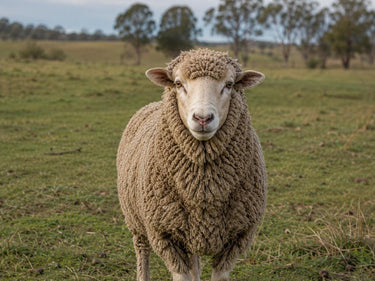
Before merino wool becomes a soft bodysuit, elimination communication pants, a boiled wool jacket, or a cozy baby blanket, it starts with an animal: the Merino sheep.
That sounds simple. And in a way, it is. A sheep grows. Its fleece grows with it. It protects the animal from cold, heat, wind, and weather. It is precisely this fleece that later becomes one of the finest and most popular natural fibers for baby clothing: merino wool.
At Mata Origin, we talk a lot about merino wool because it is a truly favorite material for us. It is soft, temperature-regulating, breathable, and can absorb moisture without immediately feeling wet. But behind these properties lies not just a fabric. Behind merino wool lies a living creature, a fiber, and a responsibility.
In this article, we explain what a Merino sheep is, why its wool is so exceptionally fine, why merino wool is well-suited for baby skin, and what we pay attention to at Mata Origin: mulesing-free wool, GOTS-certified materials, and a conscious approach to natural fibers.
What is a Merino sheep?
A Merino sheep is a special breed of sheep, primarily known for its very fine wool. While some sheep produce rather coarse, strong wool, Merino sheep grow particularly fine wool fibers.
This fineness is one of the most important reasons why merino wool is so popular. The finer a wool fiber is, the easier it can bend. This often makes it feel softer on the skin than coarser wool. This is especially important for babies, as their skin is more sensitive than adult skin.
Merino sheep have been bred for their fine wool over a long period. Today, merino wool comes from various regions of the world. Australia is particularly well-known, but Merino sheep are also kept in other countries. What is crucial for us is not only that the wool is fine, but also how it is obtained, processed, and certified.
Merino sheep briefly explained
- Animal: The Merino sheep is a breed of sheep.
- Special feature: It produces particularly fine wool.
- Material: Merino wool is made from its fleece.
- Skin feel: High-quality merino wool can feel soft and comfortable on the skin.
- Function: Merino wool is temperature-regulating, breathable, and moisture-regulating.
- Important for babies: The fine fiber is well-suited for close-fitting baby clothing when processed to a high standard.
- Important for Mata Origin: We prioritize mulesing-free wool and GOTS-certified materials.
Why does the Merino sheep, of all things, produce such soft wool?
Not all wool feels the same. Some wool appears strong, robust, or even scratchy. Merino wool is different because the fibers of the Merino sheep can be particularly fine.
You can imagine a wool fiber like a tiny hair. If this hair is very thick and stiff, it can prick the skin. If it is very fine and pliable, it lies more gently. This is precisely one of the reasons why merino wool is often perceived as particularly comfortable.
This is crucial for baby clothing. Babies often wear clothes directly on their skin. They are carried, sleep, kick, sweat, freeze, drink, cuddle, and move. A fabric that lies close to the body should therefore not only look good. It should be soft, flexible, and comfortable.
Merino wool can do just that – provided it is carefully selected and appropriately processed.
Fiber quality: Why micron is so important for merino wool
The quality of merino wool is largely judged by the fiber. The fineness of the wool fiber is particularly important. The finer the fiber, the softer the wool can feel on the skin.
The thickness of a wool fiber is measured in microns. One micron corresponds to one thousandth of a millimeter. The lower the micron value, the finer the fiber.
For merino wool, the following fineness ranges are often distinguished:
| Description | Fiber thickness | Classification |
|---|---|---|
| Ultrafine | less than 16.9 microns | particularly fine and soft |
| Superfine | 17 to 18.9 microns | very fine and comfortable close to the skin |
| Fine | 19 to 21.9 microns | fine and versatile |
| Medium | 22 to 23 microns | slightly stronger |
| Strong | 24 to 25 microns | more robust and noticeable |
This fiber fineness is particularly important for baby clothing. Because baby skin is sensitive and reacts more quickly to friction or scratchy materials. A very fine wool fiber is more pliable and can lie more gently against the skin. As a result, high-quality merino wool often feels significantly softer than coarser types of wool.
This also explains why merino wool is not simply "wool like any other." The special fineness of the fiber makes it so valuable for close-fitting clothing, rompers, elimination communication pants, blankets, and natural baby products.
What is merino wool?
Merino wool is the wool from the Merino sheep. It is an animal natural fiber and belongs to the finest virgin wools.
Important: Merino wool is primarily the fiber. How a finished fabric later feels depends additionally on the processing. At Mata Origin, merino wool is used to create completely different fabric qualities:
- Merino interlock for light, smooth baby clothing
- Merino jacquard for structured, high-quality elimination communication products
- Wool fleece for soft, fluffy blankets and jackets
- Boiled wool for warm, robust outdoor clothing
- Wool-Tencel for light, smooth clothing on warm days
You can find more about merino wool as a material in our fabric guide: Merino wool for babies.
From sheep to fabric: How is merino wool made?
Merino wool begins as the fleece of the Merino sheep. This fleece regrows continuously and is shorn at regular intervals. Shearing is necessary so that the sheep does not permanently carry an overly heavy wool fleece.
After shearing, the wool is sorted, cleaned, and further processed. Yarn is created from the fine wool fibers. This yarn can then be knitted, woven, felted, or processed into various fabric qualities.
Thus, from the same basic fiber, completely different things can emerge: a light fabric for warm days, a fluffy wool fleece for cuddly blankets, or a dense boiled wool for outdoors.
For us at Mata Origin, this is precisely what is fascinating: Nature provides a fiber. Humans decide how carefully a product is made from it.
Why merino wool is so special for babies
Babies need materials that are gentle, functional, and suitable for everyday use. Merino wool is so exciting for baby products because it combines many natural properties.
It can warm without being simply thick. It can absorb moisture without immediately feeling wet. It is breathable and supports a comfortable body climate. At the same time, it can repel moisture outwards through natural lanolin.
Especially for babies, this combination is valuable. Because babies cannot yet regulate their body temperature as reliably as adults. A material that can better balance heat and moisture is therefore particularly helpful in everyday life.
The special properties of merino wool
Merino wool is not only popular because it is soft. It comes with a whole range of natural properties that can be very helpful in everyday baby life.
- Temperature-regulating: Merino wool can provide warmth in winter and help maintain a comfortable body climate on warmer days.
- Breathable: The fiber structure can trap air while transporting moisture to the outside.
- Moisture-regulating: Wool can absorb moisture without immediately feeling wet, and release it to the outside.
- Low odor: Merino wool often absorbs odors less quickly than many other materials. Thorough airing out is often sufficient.
- Dirt-repellent: Due to the natural wool structure and the wool fat lanolin, dirt often penetrates less easily. Many wool products therefore do not need to be washed immediately.
- Natural UV protection: Depending on fabric density, color, and processing, wool can offer UV protection of up to 50.
- Dimensionally stable and elastic: Merino wool has a natural stretch. This allows clothing to remain flexible while still maintaining its shape well.
- No strong electrostatic charge: Wool usually charges significantly less statically in everyday life than many synthetic fibers.
This combination is particularly valuable for babies. A fabric should be soft, but not arbitrary. It should warm, but not overheat. It should regulate moisture, but not feel clammy immediately. And it should function in everyday life: when sleeping, carrying, breastfeeding, practicing elimination communication, changing diapers, and being outdoors.
Why merino wool is not simply "wool like any other"
Many people have a memory of scratchy wool. Perhaps a sweater from childhood. Perhaps a scarf that was uncomfortable on the neck. That's why many parents understandably ask: Is merino wool really soft enough for my baby?
The answer is: High-quality merino wool can be very, very soft. The reason lies in the fineness of the fiber. The finer and more pliable the wool fiber, the less stiff it stands on the skin. This can make merino wool feel much softer than coarse wool types.
Nevertheless, every child is different. Some babies are particularly sensitive. Some skin reacts more strongly to certain materials. Therefore, it remains important: Observe your baby. Does it feel comfortable? Is the skin calm? Is your baby appropriately warm? No material replaces the loving eye of the parents.
Why merino wool is so high quality
Merino wool is a high-quality natural material. This is not only because it comes from the Merino sheep. Fiber fineness, sorting, processing, origin, and material quality are decisive.
Fine merino wool is more complex to obtain and process than many simpler textile fibers. The fibers must be carefully sorted, cleaned, spun, and processed into suitable fabric qualities. From the same basic fiber, completely different fabrics can be created: light merino interlock, structured jacquard, fluffy wool fleece, or robust boiled wool.
The finer and higher quality the fiber, the more pleasant the finished material can feel on the skin. At the same time, the quality also increases the demands on processing, care, and origin.
Why products made from merino wool have their price
Products made from merino wool are often in a higher price segment. There are several reasons for this.
Merino wool is not a simple mass fiber. Particularly fine fibers are more valuable because they are rarer, more skin-friendly, and more complex to process. In addition, there is careful selection, yarn production, knitting or felting processes, cutting, processing, and quality control.
At Mata Origin, another point is added: we not only make sure that a fabric is soft. It is important to us that it suits baby skin, everyday life, and our values. That's why we pay attention to mulesing-free wool and offer GOTS-certified materials.
A higher price is therefore not just due to the word "merino." It arises from fiber quality, more responsible material selection, complex processing, and the long usability of the products.
Especially with baby products, this view is worthwhile. A good wool product can often be worn longer, washed less often, passed on, or repaired. Thus, a higher purchase price becomes a more conscious product for everyday use.
The Merino sheep and its natural protective layer
The Merino sheep's fleece protects the animal from temperature changes and weather. The wool fiber therefore contains a lot of natural function.
An important component is lanolin, also known as wool fat. Lanolin is a natural fat content in sheep's wool. It helps the wool repel moisture and keep the fiber supple.
For baby products, lanolin plays a role especially when wool is used as a natural moisture protection – for example, with elimination communication diapers, wool diaper covers, or wool mats.
You can find more about this here: Why wool needs lanolin.
Merino sheep, lanolin, and natural moisture protection
Wool is not waterproof like a plastic membrane. But it can regulate moisture in a special way. Merino wool can absorb moisture and at the same time repel moisture outwards through lanolin.
This is particularly interesting in the everyday life of elimination communication and diapering. It's not just about clothing, but also about small accidents, moisture, backups, and natural protective layers.
At Mata Origin, we therefore think in terms of material systems:
- Organic cotton absorbs moisture quickly.
- Hemp adds additional absorbency.
- Merino wool can repel moisture as a natural outer layer.
You can find more about this material logic here: To the Mata Origin fabric guide.
Why merino wool is so well suited for elimination communication and potty training
Elimination communication and potty training require materials that are thoughtful. Clothing and backups should be soft, function quickly, absorb or repel moisture effectively, and not restrict the baby's movement.
Merino wool fits this approach very well. It can lie comfortably on the skin as clothing, repel moisture as a wool layer, and work together with organic cotton and hemp as part of a natural system.
At Mata Origin, you will therefore find merino wool in many products related to elimination communication:
- Elimination communication diapers
- Elimination communication pants
- Outdoor clothing made of wool
- On-the-go changing mat
- Wool care products
If you are not yet familiar with elimination communication, you can find an introduction here: What is elimination communication?
Merino sheep and baby skin: Why origin matters
For baby products, it's not just about whether a fabric is soft. It's also about where it comes from, how it was processed, and what responsibility lies behind it.
Precisely because merino wool comes from an animal, origin is not a side issue. It's not just about material quality, but also about animal welfare, transparency, and a loving and conscious selection.
For us at Mata Origin, merino wool is not an anonymous raw material. It comes from a sheep. It is processed, dyed, sewn, and ultimately ends up on baby skin. This chain should not remain invisible. Families should know what they are buying – and why we choose certain materials.
What does mulesing-free mean?
When talking about Merino sheep, one cannot ignore an important topic: mulesing.
Mulesing is a procedure primarily used in certain Merino husbandry practices to protect sheep from flystrike. It involves removing skin from the hindquarters. For many people, this procedure is problematic from an animal welfare perspective.
The wool at Mata Origin is mulesing-free. Mulesing-free means: The wool used comes from sheep on which this procedure was not applied.
This is important for Mata Origin. Because when we use wool for babies, we don't just want to talk about softness. We also want to talk about responsibility.
We explain this in detail in our article: What does mulesing-free mean?
Why mulesing-free wool can be important for families
Many parents choose wool because they are looking for a natural material. But "natural" alone is not always enough. Especially with animal fibers, many families want to know more precisely: How was the wool obtained? What does that mean for the animal? Are there alternatives to problematic practices?
Mulesing-free wool provides important guidance here. It shows: The fiber was not only evaluated for its softness, but also for the treatment of the animal.
This aligns with our view of baby clothing. A fabric should not only be beautiful. It should feel good, function well, and align with our values.
What does GOTS-certified material mean?
In addition to mulesing-free wool, material certification is also important for Mata Origin. We offer GOTS-certified materials and ensure that natural fibers are used responsibly.
GOTS stands for Global Organic Textile Standard. The standard considers not only the fiber itself, but also ecological and social criteria in textile processing. This includes, among other things, requirements for organic fibers, processing, chemicals used, environmental criteria, and minimum social criteria along the supply chain.
It's important to be honest in our phrasing: When we talk about GOTS-certified materials, we mean the fabrics used, provided they are certified accordingly. This does not automatically mean that every finished product at Mata Origin as a whole is GOTS-certified.
We explain more about this here: What does GOTS-certified mean?
Mulesing-free, GOTS, and Fiber Quality: What goes together?
When we talk about merino wool at Mata Origin, it's not just about softness. It's about a complete picture of fiber quality, animal welfare, material processing, and transparency.
Fiber quality describes how fine, soft, and high-quality the wool is. The micron value helps to classify the fineness of the fiber.
Mulesing-free means that mulesing was not used on the sheep from which the wool originated. This is important to us because merino wool comes from an animal, and responsibility is therefore part of it.
GOTS-certified materials show that the fabrics used can be certified according to a recognized textile standard for organic fibers and textile processing. Honest phrasing is important here: When we talk about GOTS-certified materials, we mean the fabrics used, provided they are certified accordingly. This does not automatically mean that every finished product as a whole is GOTS-certified.
You can find more about this here:
Why we talk about these topics at Mata Origin
One might say: A baby just needs soft clothes.
Yes. But for us, it doesn't stop there.
A baby product touches skin. It is worn, washed, loved, passed on. It accompanies the first weeks, first nights, first outings, first elimination communication moments. That's why the question of material can be a bit bigger.
Where does the fiber come from? How does it feel? What function does it fulfill? How was it obtained? How long can the product be used? Can it be cared for, repaired, passed on?
That's exactly why we at Mata Origin explain our materials in detail. Not to seem complicated. But so that parents can make conscious decisions.
Merino sheep are not material suppliers – they are animals
This sentence is important to us: Merino sheep are not machines.
They are animals. Their fleece grows because it protects them. Only then does it become a material for us humans. This order should not be forgotten.
When we use merino wool at Mata Origin, we don't just see a beautiful fiber. We see a natural material with a history. And we see the responsibility not to use this material indiscriminately.
That's why we use wool where it really makes sense: for products that need temperature regulation, breathability, natural moisture protection, warmth, or softness.
Why merino wool is useful not only in winter
Many parents first think of wool in winter. This is understandable, but merino wool can do more. Especially fine, light wool qualities are also suitable for warmer days and transitional seasons.
A light merino interlock is not the same as a thick boiled wool. Wool-Tencel feels different from wool fleece. Jacquard serves different purposes than a baby blanket. Therefore, it is important not just to say "wool," but to choose the right fabric quality.
At Mata Origin, we use different wool qualities for different everyday situations:
- Merino Interlock: light, smooth, flexible, and dimensionally stable.
- Wool-Tencel: soft, smooth, and flowing for close-fitting clothing.
- Jacquard: structured, high-quality, and beautiful for visible elimination communication products.
- Wool fleece: fluffy, cuddly, and warm for blankets, jackets, and rompers.
- Boiled wool: robust, warm, and weather-resistant for outdoors.
What makes merino sheep so special for baby clothing?
The answer lies in the combination of animal, fiber, and processing.
The merino sheep provides particularly fine wool. This wool can be processed into soft, functional fabrics. And if these fabrics are responsibly selected and appropriately used, baby products are created that truly help in everyday life.
For us, this means:
- The material should feel good on baby's skin.
- It should regulate temperature and moisture.
- It should not need to be washed unnecessarily often.
- It should be suitable for elimination communication, assisted toileting, and natural diapering.
- It should be durable and maintainable.
- It should be as transparent and responsibly selected as possible.
Merino sheep or normal sheep: What's the difference?
The most important difference is in the wool. Many sheep breeds provide wool, but not all wool is equally fine. Merino sheep are particularly known for their fine wool.
Coarse wool can be robust and valuable, but it is not always suitable for close-fitting baby clothing. Due to its fineness, merino wool can lie much more comfortably on the skin and is therefore often used for clothing worn directly on the body.
This doesn't mean that other sheep are "worse." It just means: Different sheep breeds provide different wool qualities for different purposes. For baby skin, fine merino wool is particularly interesting.
Is merino wool animal-friendly?
Merino wool is an animal fiber. This means: It comes from an animal. This automatically involves responsibility. Animal-friendliness does not depend solely on the word "Merino," but on husbandry, origin, shearing, treatment of the animals, certifications, and the selection of the supply chain.
Therefore, it makes sense to pay attention to terms like mulesing-free, GOTS-certified materials, and transparent communication. They offer families better guidance than mere advertising promises.
At Mata Origin, we deliberately talk about this because we believe: Parents should know what's behind a material.
Why merino wool can be sustainable – but isn't automatically
Merino wool is a natural fiber. It is renewable, durable, functional, and often needs to be washed less frequently in everyday life than many other materials. These are strong advantages.
Nevertheless, no material is automatically sustainable just because it's natural. The origin, animal husbandry, processing, dyeing, transport, use, care, and lifespan of the finished product are crucial.
That's why our perspective at Mata Origin is always practical: A material shouldn't just sound good. It should function in everyday baby life, be usable for a long time, and be responsibly selected.
Wool is particularly suitable when its natural properties are truly needed: warmth, temperature regulation, breathability, moisture protection, and long usability.
How to care for merino wool correctly?
A nice advantage of merino wool: It often doesn't need to be washed after every wear. Often, thorough airing is sufficient. This protects the material, saves water, and makes family life easier.
If washing is necessary, merino wool should be cared for gently. Important are a suitable wool detergent, low temperatures, and little friction. Please do not rub vigorously, do not wash hot, and do not tumble dry.
For wool products that serve as moisture protection, lanolin plays a special role. A lanolin bath can help support the water-repellent function of the wool.
You can find more about care here:
Discover merino wool at Mata Origin
If you would like to try merino wool in everyday life with a baby, you will find many products at Mata Origin where the natural properties of wool are consciously used.
- Discover wool elimination communication diapers
- Discover wool elimination communication pants
- Discover wool outdoor clothing
- Changing pad for on the go
- To the fabric knowledge overview
Frequently asked questions about merino sheep and merino wool
Which sheep makes merino wool?
Merino wool comes from the merino sheep. This breed of sheep is particularly known for its fine wool.
Why is merino wool so soft?
Merino wool can be particularly soft because the wool fibers of the merino sheep are very fine. Fine fibers bend more easily and often feel less scratchy on the skin than coarse wool fibers.
What does micron mean for merino wool?
Micron is the unit of measurement for the thickness of a wool fiber. One micron corresponds to one thousandth of a millimeter. The lower the micron value, the finer the fiber and the softer merino wool can feel on the skin.
Why is fine merino wool particularly soft?
Fine wool fibers are more flexible than coarse fibers. When they touch the skin, they can bend more easily and therefore often feel softer and less scratchy.
Is merino wool good for babies?
Yes, high-quality merino wool can be very suitable for babies. It is soft, temperature-regulating, breathable, and can absorb moisture without feeling wet immediately.
Is merino wool always mulesing-free?
No. Merino wool is not automatically mulesing-free. Therefore, it is important to pay attention to corresponding information. At Mata Origin, we pay attention to mulesing-free wool.
What does mulesing-free mean?
Mulesing-free means that mulesing was not used on the sheep from which the wool originated. You can find more about this in our article What does mulesing-free mean?.
What does GOTS-certified material mean?
GOTS is a textile standard for organic fibers and textile processing. At Mata Origin, we speak of GOTS-certified materials when the fabrics used are certified accordingly. You can find more about this here: What does GOTS-certified mean?.
Is merino wool the same as virgin wool?
Merino wool is a form of virgin wool, as it is shorn from living sheep. The special difference is that it comes from merino sheep and can be particularly fine.
Does merino wool scratch?
High-quality merino wool often scratches significantly less than coarse wool types because its fibers are finer and more flexible. Nevertheless, each baby can react individually to materials.
Is merino wool only for winter?
No. Depending on the fabric quality, merino wool can also be suitable for warm days. Light merino interlock or wool-Tencel are different from thick boiled wool.
Why is merino wool more expensive than many other materials?
Merino wool is a high-quality natural material. Particularly fine fibers, careful processing, mulesing-free origin, GOTS-certified materials, and durable product quality can increase the price.
Does merino wool offer UV protection?
Wool can offer good natural UV protection depending on fabric density, color, and processing. Nevertheless, wool clothing does not replace careful sun protection for babies, especially not in direct sun in summer.
Why does Mata Origin use merino wool?
We use merino wool because it is soft, temperature-regulating, breathable, and functional. It is particularly suitable for baby clothing, elimination communication, assisted toileting, natural moisture protection, and outdoor products.
Conclusion: The merino sheep provides special wool – and we bear responsibility for it
Merino wool doesn't start on the fabric shelf. It starts with the merino sheep. This animal provides particularly fine wool, from which soft, functional, and durable baby products can be made.
For us at Mata Origin, this is a gift of nature – but also a responsibility. That's why we pay attention to mulesing-free wool, GOTS-certified materials, and only use merino wool where its properties truly make sense.
Merino wool is soft, temperature-regulating, breathable, and versatile. It can warm babies without unnecessarily burdening them. It can regulate moisture and support natural moisture protection through lanolin. And it can help families make more conscious material choices.
So the merino sheep doesn't just make "wool." It provides a fiber from which, with care, respect, and good processing, something very special can emerge: clothing and baby products that feel soft, function in everyday life, and are chosen with love.
Further information
If you want to learn more about merino wool, mulesing-free wool, and GOTS-certified materials, you will find relevant information here:


