
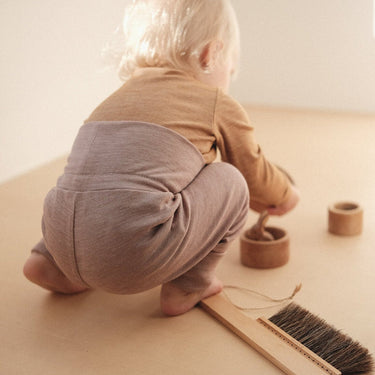
At home, elimination communication (EC) is now working quite well.
Especially in the mornings after waking up.
Sometimes after eating.
You might even recognize your child's expression right before a bowel movement.
And then daycare begins.
Suddenly, there are other people.
Different routines.
Different diaper changing times.
And you might ask yourself:
Is that it for EC?
No.
EC in daycare doesn't have to mean your child goes without a diaper all day or that caregivers constantly have to watch for signals.
Often much less is sufficient.
One or two familiar moments.
A backup for everything else.
And a solution that remains uncomplicated for the child, parents, and caregivers.
That's exactly what part-time EC is.
Can EC even work in daycare?
Yes – if the daycare is open to it and it can be well integrated into their daily routine.
It helps not to present EC as a grand concept.
But rather practically.
For example:
Our child almost always pees after their nap. If you're changing their diaper anyway, you could briefly put them on the potty or offer EC beforehand.
That's different from the expectation:
Please recognize every elimination signal from our child from now on.
A daycare center cares for many children simultaneously.
Therefore, a solution must be simple.
The better EC fits into existing routines, the more realistic it becomes.
EC in daycare does not mean diaper-free
This is probably the most important point.
Your child is, of course, allowed to wear a backup in daycare.
A disposable diaper.
A cloth diaper.
Or an easily opened EC diaper.
If no one notices a suitable moment, the backup takes over.
If there's time and the moment is right, EC is offered.
Part-time EC in daycare doesn't need to mean more than that.
EC with backup: Why a diaper isn't a step backward
How much diaper waste can part-time EC avoid in daycare?
This cannot be stated generally.
But we can make a simple model calculation.
Let's assume a child attends daycare for approximately 220 days a year.
And let's further assume that, on average, only one disposable diaper per daycare day is actually not needed due to EC.
Then that's:
220 fewer disposable diapers per child per year.
That might not sound huge at first.
But in a group, the perspective quickly changes.
| Children | One less diaper per daycare day |
|---|---|
| 1 Child | approx. 220 diapers per year |
| 5 Children | approx. 1,100 diapers per year |
| 10 Children | approx. 2,200 diapers per year |
| 20 Children | approx. 4,400 diapers per year |
This is not a prognosis for every daycare.
It's a model calculation.
But it shows something important:
A single small EC moment can suddenly make a big difference at the group level.
What do 2,200 fewer diapers mean for waste?
A dry disposable diaper weighs differently depending on the product and size.
For our previous calculations, we are using approximately 36 grams as an example.
2,200 avoided disposable diapers therefore correspond to approximately:
79 kilograms of pure diaper material.
For 20 children, that would be around:
158 kilograms of diaper material per year.
Depending on the diaper, this includes:
- cellulose
- superabsorbers
- plastic fleeces
- foils
- adhesives
- elastic materials
The actual weight of used diapers in residual waste would be even higher, as urine and faeces are added.
It is important to us to make this distinction:
During EC, excretions do not disappear, of course.
They just end up in the potty or toilet instead of in the residual waste along with a disposable diaper.
Not every EC moment automatically saves a diaper
Here too, we prefer to calculate honestly rather than spectacularly.
If a child is already wearing a full diaper and is offered EC during the diaper change, a diaper has not automatically been saved.
A disposable diaper is truly avoided primarily if:
- the backup is still clean
- the child eliminates outside the diaper
- the backup therefore remains clean
- and can subsequently be worn again
Therefore, it's not about counting as many successful EC moments as possible.
It's about some eliminations not ending up in the disposable product at all.
Which EC moments are particularly suitable for daycare?
The easiest situations are often those that are already part of the daily routine.
After naptime
Many children eliminate after sleeping.
And in daycare, there's always a transition to the next phase of the day after quiet time.
This can be a nice, calm moment.
During regular diaper changes
If the diaper is going to be opened anyway, a potty can be offered briefly before or after.
No completely new routine is created.
For a clearly recognizable bowel movement
Some children have very clear signals.
They become quiet.
They withdraw.
They push.
Or they already say a specific word.
If caregivers know this signal, offering a toilet or potty can be very straightforward.
Before going outside
Fixed transitions can also be suitable.
Before going into the garden.
Before naptime.
Or before a longer activity begins.
The important thing is not to find as many moments as possible.
One well-functioning moment is often more valuable than five complicated ones.
Daycare doesn't have to "do EC"
That takes a lot of pressure off the issue.
EC does not remain a program that a childcare facility must adopt.
Parents can rather say:
Our child is already familiar with the potty. If it fits into your routine, you are welcome to offer it in these two situations. If not, the backup is there.
This way, no additional demands are created.
Caregivers merely receive information about something the child is familiar with from home.
And, of course, each facility decides for itself what can be implemented given its staffing, spatial, and hygienic conditions.
What if the daycare doesn't want to participate in EC?
Then that's perfectly fine.
EC doesn't have to happen everywhere at once.
Perhaps EC is offered at home in the morning.
At daycare, the diaper takes over.
And in the afternoon or evening, a potty is offered again.
That too is part-time EC.
Your child doesn't have to live in two completely separate worlds.
They can learn:
Here, there's this option.
And there, there's the backup.
Part-time EC: Why even individual moments count
Perhaps the most important daycare factor: it has to be quick
A caregiver doesn't just have your child in front of them.
Perhaps three other children are waiting.
One needs help getting dressed.
One wants a drink.
And somewhere, a slipper is missing again.
If EC is to work in this everyday life, opening clothes should not take longer than the EC itself.
That's precisely why the right clothing makes such a big difference in daycare.
EC pants can make EC much easier in daycare
Normal baby pants often have to be pulled down quite a bit.
Then there might be a bodysuit with snaps.
And underneath, the diaper.
An EC pant from Mata Origin is designed precisely for this moment.
It opens quickly so that the child doesn't have to be completely undressed every time.
For caregivers, this means:
fewer manipulations.
And that's precisely what can determine whether EC remains practical in a daycare setting.
EC diapers: Backup and still quick to open
An EC diaper can also be practical for daycare.
The child remains protected.
If no EC moment is noticed, the backup works as normal.
When going to the potty, the diaper can be opened quickly and then closed again.
Especially for part-time EC, this combination is lovely:
Security for everyday daycare life – and still the option for EC.
Clothing should also be understandable for other caregivers
At home, you know exactly which button goes where.
In a daycare, however, several people may dress and undress your child.
Therefore, EC clothing should function as intuitively as possible.
No complicated diaper system.
No five additional steps.
The simpler an EC pant, EC diaper, or an EC garment from Mata Origin is to open, the greater the chance that it will be gladly used by various caregivers.
A small daycare kit is perfectly sufficient
You don't have to send half the wardrobe.
Practical items might include:
- an uncomplicated EC pant
- a quick-opening backup
- sufficient changing inserts or spare clothes
- a wet bag or the bag requested by the daycare for used items
It's best to discuss with the facility beforehand what they already have and what they actually need.
The simpler the equipment, the better.
Can EC also reduce cloth diaper laundry in daycare?
Yes, at least in principle.
If a child wears a reusable diaper or EC diaper and eliminates outside of it, the backup can remain clean.
Then it may be necessary to wash an insert or diaper less frequently.
The actual extent of this effect naturally depends on the child's daily routine.
Here, too, the following applies:
EC and cloth diapers are not opposites.
They can complement each other very well.
Why the topic is also ecologically interesting for daycares
The German Environment Agency estimates that around ten million disposable diapers are used and discarded daily in Germany.
The amount of waste doesn't just arise at home.
Part of it is created where young children spend many hours of their day.
In nurseries and daycares.
This doesn't mean that daycares suddenly have to become EC facilities.
But facilities that already practice sustainability could at least learn about EC as a possible form of waste prevention.
Because at the top of the waste hierarchy is a very simple idea:
Avoid waste before it needs to be recycled, recovered, or disposed of.
And a disposable diaper that is genuinely not needed does not have to be disposed of later.
What could a daycare group realistically achieve?
Let's take our cautious model calculation again.
Ten diapered children.
220 daycare days.
On average, one actually avoided disposable diaper per child per day.
This results in:
2,200 fewer diapers per year.
If it only works for half of the children:
still approximately 1,100 diapers.
And what if it only works three days a week?
Even then, over a daycare year, many hundreds of disposable diapers remain that never even end up in the diaper pail.
That's the beautiful idea behind part-time EC for us:
It doesn't have to work everywhere and always to make a difference.
EC in daycare should not create extra work for anyone
This is perhaps the most important sentence for parents and daycares.
A childcare facility already has an incredible number of tasks.
EC only works well there if it can be easily integrated.
If it causes stress, the backup works.
If there's too little staff today, the backup works.
If ten other things are happening, the backup works.
And when everything is calm and the child is being changed anyway after sleeping:
then perhaps the potty can be offered briefly.
This is how EC can be.
How do I approach the topic in daycare?
Ideally, in a very straightforward way.
You don't need to give a long explanation about EC.
For example:
Our child knows EC from home. Especially after sleeping, they often pee. If it fits into your routine, you are welcome to offer them the potty briefly then. But they will, of course, wear a backup if it doesn't fit.
This tells the daycare:
- There is no expectation of perfection.
- The child is already familiar with the situation.
- There is a specific time.
- A backup remains available.
This makes the idea much more tangible.
Frequently Asked Questions about EC in Daycare
Can an EC child go to daycare?
Of course. EC also doesn't necessarily mean a child has to be without a backup. Many families use a diaper in childcare and practice EC at home or during selected daycare times.
Does the daycare have to offer EC for my child?
Whether and how EC can be offered should be discussed with the respective facility. Staffing, spatial, and hygienic routines differ. Part-time EC also works if the daycare does not actively offer EC.
How much diaper waste can EC save in daycare?
This depends on the child and the daily routine. In a model calculation with 220 daycare days, one actually saved disposable diaper per daycare day would avoid about 220 diapers per child per year. For ten children, that would be around 2,200 diapers.
Does every successful pee on the potty save a diaper?
No. If a diaper had to be changed anyway, an additional diaper was not automatically saved. The key factor is whether a clean backup remains clean due to EC and can continue to be worn.
Which EC moments are suitable in daycare?
Fixed routines, such as after naps, during regular diaper changes, before going out, or when bowel movements are very clearly recognizable, are particularly practical.
What if the daycare doesn't want to support elimination communication?
Then your child can wear their backup normally at daycare and continue to be held at home. Part-time elimination communication doesn't have to look the same everywhere.
What clothing is suitable for elimination communication in daycare?
Clothing that can be opened quickly and intuitively in the diaper area is particularly practical. Split-crotch pants, quickly opening elimination communication diapers, and special elimination communication clothing can significantly simplify the process for various caregivers.
Is an elimination communication diaper useful for daycare?
It can be useful if the care facility is comfortable with the system. The elimination communication diaper still serves as a backup, but can be quickly opened and closed for potty or elimination moments.
Does my child need to be able to speak yet?
No. Some children show physical signals, others have recognizable rhythms. In daycare, fixed situations like after sleeping are often easier than waiting for individual signals.
Conclusion: Elimination communication can remain small-scale in daycare too
Perhaps your child is held five times a day at home.
And only once at daycare.
Perhaps not at all.
Perhaps it works surprisingly reliably after nap time.
All of that is allowed.
Elimination communication is not a system that has to function identically everywhere.
Especially in daycare, a single familiar moment can be entirely sufficient.
A potty after sleeping.
An elimination communication diaper that opens quickly.
Pants where no one has to search for ten buttons first.
And a backup for everything that can't be planned.
If this means an occasional disposable diaper stays dry, that's great.
If it eventually leads to hundreds or even thousands fewer diapers in a daycare group, even better.
But the most important thing remains:
It must work for the people who live this daily life together.
Read more
- Part-time Elimination Communication: Why even individual moments count
- Elimination Communication with Backup
- Part-time Elimination Communication: How much diaper waste you can really save
- Almost 1,000 Fewer Diapers: What one elimination moment a day can achieve
Elimination communication should remain simple in daycare too
That's exactly why we at Mata Origin have developed clothing that doesn't make elimination communication more complicated.
Our split-crotch pants open quickly, elimination communication diapers provide security as a backup, and our elimination communication clothing helps ensure that a quick potty moment doesn't start with completely undressing.
And if you're just discovering elimination communication:
Our free starter guide shows you a relaxed introduction to elimination communication.


