
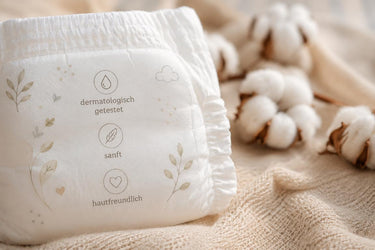
Many disposable diapers advertise with statements like "dermatologically tested," "skin-friendly," "gentle on baby's skin," or "suitable for sensitive skin."
For parents, this sounds reassuring. Especially if the baby is prone to redness or has had a diaper rash before, many prefer to use products that appear particularly skin-friendly.
But what does "dermatologically tested" really mean for diapers? And what does it not say?
At Mata Origin, we believe: Such information can be interesting. But it doesn't replace the more important questions: What materials are in contact with the skin? Does the diaper contain fragrances or lotions? How long does it stay on the body? And are there alternatives to a full diaper?
Why such statements are meant to reassure parents
Diapers are trust products. They touch the sensitive diaper area every day, often for many hours. Therefore, parents want to know that they are not exposing their baby to anything that unnecessarily burdens the skin.
Terms like "dermatologically tested" or "skin-friendly" work precisely at this point. They provide a sense of security. They sound like testing, expertise, and responsibility.
The problem is not that such statements are fundamentally false. The problem is that they often convey more security than they actually deliver in everyday life.
What "dermatologically tested" fundamentally means
"Dermatologically tested" essentially means: A product has been tested in some way related to the skin, usually under dermatological supervision or with dermatological reference.
But: The term does not automatically explain how exactly it was tested. It doesn't necessarily say how many people were involved, which skin types were tested, how long the testing lasted, or whether babies with sensitive skin were included.
Above all, the term does not automatically mean that a product is well tolerated by every baby. Baby skin is individual. What works without problems for one child can lead to redness in another.
What the indication does not answer
For disposable diapers, a skin-related test alone is not enough to truly assess the product. Because a diaper is not a simple care product, but a complex hygiene product with multiple layers and functions.
The indication "dermatologically tested" does not automatically answer, for example:
- what materials are directly against the skin
- whether fragrances are included
- whether lotions are used
- what adhesives, non-wovens, or plastics are used
- whether residues or impurities are tested
- how breathable the system is in everyday use
- how the diaper behaves after several hours of wear
However, precisely these questions are crucial for baby skin. Because skin compatibility is not only created by a test, but by the entire contact in everyday life.
Diaper skin is not a laboratory condition
The diaper area is special. There, warmth, moisture, friction, urine, stool, and material contact come together. This is not a neutral skin contact like with a fabric briefly placed over the arm.
A diaper is worn tightly. It moves with the baby. It absorbs liquid. It sometimes stays on the body for extended periods. And it is in an area that can be sensitive anyway.
Therefore, the question "Was the product dermatologically tested?" is not enough. From our perspective, the better question is: How does this product perform in real everyday diapering?
You can find more about the diaper climate here: Diaper climate: Why warmth, moisture, and friction can irritate baby skin
"Skin-friendly" is not the same as "natural"
Many disposable diapers feel soft, dry, and gentle. Nevertheless, they consist of a technical material mix: cellulose, superabsorbers, plastics, non-wovens, adhesives, elastic, and sometimes additional substances.
"Skin-friendly" therefore does not automatically mean "natural," "breathable," or "free from unnecessary additives."
A disposable diaper can be dermatologically tested and still contain fragrances. It can feel dry and still create a warm, enclosed diaper climate. It can appear soft and still cause friction from cuffs or extended wear.
Precisely for this reason, it's worth taking a closer look behind the claim.
Read "sensitive" and "for sensitive skin" critically
Terms like "sensitive" or "for sensitive skin" also sound reassuring. But they shouldn't blindly convince.
Such statements are often marketing terms. They can provide clues, but they don't replace complete material transparency.
If your baby reacts sensitively, it makes sense not only to look for the word "sensitive" but to specifically check:
- Is the diaper fragrance-free?
- Does it contain lotions?
- Are there clear material specifications?
- Which test marks are mentioned?
- How does my baby's skin react after several days?
Your baby's skin is often the most honest test in the end.
Why fragrances and lotions can still be present
A product can advertise skin compatibility and still contain optional additives. This is precisely why it's worth looking at fragrances and lotions.
From the perspective of baby skin, such additives are not necessary in the diaper area. They may seem fresh, nourishing, or high-quality, but they mean additional skin contact in a warm and moist area.
At Mata Origin, the principle is simpler: Baby skin in the diaper area doesn't need more promises, but fewer unnecessary burdens. Less fragrance. Less lotion. Less time in a full diaper. More air. More attention.
You can find more on this here: Fragrances, lotions, and dyes in baby diapers: Does baby skin really need that?
What parents can truly check
You don't have to be a material science expert to assess diapers more consciously. A few simple questions are enough:
- Is the diaper fragrance-free?
- Is it free of lotions?
- What materials are mentioned?
- Are there independent seals or verifiable standards?
- How often is the diaper changed?
- How does your baby's skin react?
- Are there more frequent rashes after certain diapers?
- How long does your baby stay in a full diaper?
The last point, in particular, is often underestimated. Because even the "skin-friendliest" diaper can irritate the skin if it is worn full for too long.
Why elimination communication changes the question
Elimination communication asks a different question. Not just: "Which diaper is best tested?" But: Does every excretion really have to end up in the diaper?
If you hold your baby out at appropriate moments, the diaper becomes more of a backup. It is no longer the only place for pee and poop.
This changes everyday diapering. Especially with bowel movements, holding out can mean that the skin is in contact with excretions for less time. And every moment out of the diaper is also a moment with less close material contact.
You don't have to live completely diaper-free for this. Part-time elimination communication is perfectly sufficient to start.
You can find the introduction here:
What is elimination communication?
Part-time elimination communication: Why individual moments also count
Wool doesn't need a "dermatologically tested" promise to be understood
Wool is not a technical disposable material mix. It is a natural material with properties that parents can understand: breathable, temperature-regulating, and moisture-regulating.
When cared for with lanolin, wool becomes more water-repellent and can be used as a natural backup in the diaper area. This is particularly interesting in combination with elimination communication.
Because with an elimination communication diaper made of wool, it's not about enclosing everything for as long as possible. It's about providing protection when needed and being able to open quickly when your baby wants to be held out.
You can find more on this here:
Why wool is ideal for elimination communication
Discover elimination communication diapers made of wool
What does this mean for sensitive baby skin?
If your baby reacts sensitively, you should not only pay attention to advertising claims. Look at the entire diapering routine.
Which diaper do you use? How long does it stay on the body? Are there fragrances or lotions? Does it rub at the cuffs? How often is it changed? Are there air breaks? Are there moments when your baby can excrete outside the diaper?
Sometimes it's not a single factor that is decisive, but the sum: material contact, warmth, moisture, friction, care products, and wearing time.
From Mata-Origin's perspective, the best strategy is therefore not more promises on the packaging, but more awareness in everyday life.
What public sources say about advertising claims
For cosmetic products, common criteria for advertising claims apply in the EU. Claims should, among other things, be truthful, verifiable, honest, fair, and understandable for consumers. Even if diapers are not classic cosmetics, this principle helps in classification: Statements on products should not promise more than they can actually prove.
The consumer protection agency also points out that terms like "sensitive" or "for sensitive skin" should be viewed critically. Even such products can contain ingredients that can irritate sensitive skin or trigger allergic reactions.
For parents, this means: Claims are a hint, but not a complete answer.
Public sources for further reading
If you want to delve deeper into advertising claims, skin compatibility, and absorbent hygiene products, you can find trustworthy public sources here:
- EU Regulation No. 655/2013: Common criteria for cosmetic claims
- European Commission: Technical document on cosmetic claims
- Consumer Protection Agency NRW: Identifying sensitive cosmetics
- German Environment Agency: Absorbent hygiene products
- ANSES: Safety of baby diapers
Frequently asked questions about "dermatologically tested" in diapers
What does "dermatologically tested" mean for diapers?
This indication means that a product has been tested in some way related to the skin. However, it does not automatically state how exactly it was tested, with how many people, over what period, or under what conditions. Therefore, one should also consider materials, additives, and skin reactions.
Is a dermatologically tested diaper automatically good for sensitive baby skin?
No, not automatically. A dermatologically tested diaper can work well for many babies, but every baby reacts individually. Fit, fragrances, lotions, frequency of changes, friction, and the overall diaper climate are also important.
Does "sensitive" say more than "dermatologically tested"?
Not necessarily. "Sensitive" sounds particularly skin-friendly, but it is also a term that should be carefully scrutinized. The deciding factor is not just the claim, but what is actually in the product and how your baby reacts to it.
What should I look for with sensitive baby skin?
Look for fragrance-free diapers, preferably no lotions, a good fit, regular changes, gentle cleaning, and short air breaks. If your baby reacts sensitively, it may also be beneficial to try elimination communication or wool as a backup.
Can elimination communication offer more than a "skin-friendly" diaper?
This cannot be said generally. But elimination communication changes everyday life: Not every excretion has to end up in the diaper. This means your baby can spend less time in a full diaper. This can be very valuable for the diaper area.
Why should I pay attention to my baby's skin despite seals and tests?
Because your baby reacts individually. Tests and seals can provide guidance, but they do not replace your observation. If redness, irritation, or diaper rash occur repeatedly, it is worth looking at the diaper, care, changing rhythm, and possible alternatives.
Conclusion: Claims are hints, not a complete answer
"Dermatologically tested" sounds reassuring. And it can be a useful indication. But the term does not answer all questions that are important for baby skin in the diaper area.
The entire daily routine is crucial: materials, additives, diaper climate, wearing time, friction, care, and the question of whether every excretion must end up in the diaper.
From Mata-Origin's perspective, true skin-friendliness does not begin with a single claim on the packaging. It begins with transparency, less unnecessary contact, more air, natural materials, and the possibility of accompanying your baby outside the diaper.
Further Reading
What's in disposable diapers? Materials, layers, and substances explained simply
Fragrances, lotions, and dyes in baby diapers: Does baby skin really need that?
Harmful substances in disposable diapers: What parents should factually know
Disposable diapers, cloth diapers, or elimination communication: What is gentler on baby's skin?