
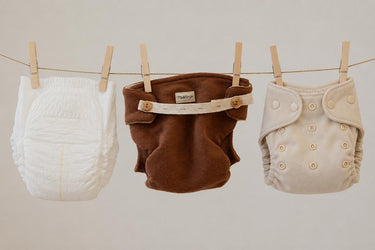
When you think about the early days with a baby, diapers probably come to mind as a given. Most parents ask themselves one main question before birth: Which diapers should we choose?
Often, it's about disposable diapers versus cloth diapers. Convenient or more sustainable. Simple or washable. Practical or more eco-friendly. But there's a third option that's talked about much less: elimination communication, or EC.
This doesn't mean your baby can never wear a diaper. It also doesn't mean you have to choose one method and follow it perfectly. It simply means this: You should know that babies can communicate about elimination right from the start.
In this article, we'll look at the three options: disposable diapers, cloth diapers, and elimination communication. And we'll do so without pressure, without ideology, and without claiming there's one right solution for all families.
The Three Options at a Glance
For daily life with a baby, there are essentially three ways to manage excretions. Many families don't just use one of them, but combine them depending on the situation.
- Disposable diapers: Single-use diapers that are discarded after use.
- Cloth diapers: Washable diaper systems that can be used multiple times.
- Elimination Communication (EC) or "potty training from birth": Parents offer the baby a chance to eliminate outside the diaper, for example, over a potty, sink, or toilet.
This overview alone shows: It doesn't have to be an either-or decision. You can use disposable diapers and still practice EC. You can use cloth diapers and try EC. You can act differently at home than when you're out or at night.
The best way is the one that suits your baby, your daily life, and your energy levels.
If you're currently planning your baby's entire initial equipment, you'll find a suitable overview here: Baby Essentials: What You Really Need.
Disposable Diapers: Practical and Widespread
Disposable diapers are the standard solution for many families. They are widely available, easy to use, and don't need to be washed. Especially in the first few weeks, many parents find them uncomplicated.
Their main advantage lies in their ease of use. Put on a diaper, change it, dispose of it. For outings, at night, or during very demanding periods, this can be a relief.
Advantages of Disposable Diapers
- easy to use
- available everywhere
- no washing necessary
- practical for travel and trips
- usually familiar to caregivers
- wide selection of sizes and varieties
Disadvantages of Disposable Diapers
- they continuously generate waste
- they need to be repurchased regularly
- they often sit directly on the baby's skin for many hours
- some babies react sensitively to certain materials or moisture
- parents sometimes notice excretions later because modern diapers feel very dry
So, disposable diapers can be practical. At the same time, it's worth remaining mindful. Not every diaper suits every baby. And even if you use disposable diapers, you can change your baby regularly, allow plenty of air to the skin, and, if interested, try individual EC moments.
Cloth Diapers: Washable and Reusable
Cloth diapers are a reusable alternative to disposable diapers. Many parents choose them because they want to reduce waste, prefer natural materials, or want to be more independent from single-use products in the long term.
Modern cloth diapers have little in common with the old terry nappies of past generations. There are various systems: covers, inserts, fitted diapers, all-in-one systems, and many combinations. This can seem a bit overwhelming at first, but it also offers flexibility.
Advantages of Cloth Diapers
- reusable
- less single-use waste
- materials can be chosen more consciously
- often good for passing on in the long term
- individually customizable depending on the system
- baby's excretions are often noticed earlier
Disadvantages of Cloth Diapers
- they need to be washed and dried
- the initial cost can be higher
- the right system needs to be found first
- you need space for used diapers when out and about
- depending on the clothing, a bulkier diaper can result
Cloth diapers can work wonderfully if the system suits you. But they can also be overwhelming if too much information, washing rules, and system questions hit you all at once.
Therefore, the same applies here: You don't have to do everything perfectly right away. Some families start with a few cloth diapers at home and use disposable diapers when out. Others switch later. Still others combine cloth diapers with EC.
Elimination Communication: The Third Option Many Parents Discover Late
Elimination Communication often sounds radical to many at first. However, the term is sometimes misleading. It's not about a baby having to live completely without a diaper. It's about perceiving the baby's elimination as part of their communication.
With EC, parents offer their baby a chance to eliminate outside the diaper. For example, after waking up, after breastfeeding or feeding, during diaper changes, or when the baby shows certain signals.
Many babies respond surprisingly well to such offerings. Not always. Not perfectly. But often enough for parents to realize: My baby isn't just passively in the diaper. They can also communicate something here.
Typical EC Situations
- after waking up
- during diaper changes
- after breastfeeding or feeding
- before sleeping
- when the baby becomes restless
- when parents recognize a specific pattern
EC can therefore start very small. Not as a program. But as an offering.
You can find a gentle introduction here: What Does Elimination Communication from Birth Actually Mean?.
Advantages of Elimination Communication
EC can be interesting for families for a variety of reasons. Some want to use fewer diapers. Others want to relieve their baby's skin. Many report, above all, that EC helps them perceive their baby more closely.
Possible Advantages
- you get to know your baby's signals better
- the baby spends less time in excretions
- diaper consumption can decrease
- EC can alleviate fussiness in some babies
- standard situations provide orientation
- parents experience more direct communication with their baby
- it can be combined well with disposable diapers or cloth diapers
Perhaps the most important advantage is not the diaper saved. It's the change in perspective. Your baby is not just being changed, but heard. Even in an area that is often entirely delegated to the diaper in our culture.
Challenges with Elimination Communication
EC can be very enriching. But it can also create pressure if parents believe they must recognize every signal or catch every pee. That's precisely not the point.
Accidents will happen. Sometimes a lot. Some days go well, others not at all. Your baby changes. Your daily life changes. And there are phases where EC is less suitable.
Possible Challenges
- signals are not always clear
- parents can put themselves under pressure
- it takes some practice when out and about
- other people don't always understand the approach
- clothing can be impractical if not designed for it
- phases with many missed moments are normal
Therefore, the Mata-Origin approach is particularly important here: EC can be undogmatic. It doesn't have to work all day. It can be part-time. It can take a break. It can remain light.
If you want to know exactly what you really need for this, you'll find a practical overview here: EC Essentials: What You Really Need.
The Most Important Difference: Diaper as a Toilet or Diaper as a Backup?
A helpful distinction is this: With traditional diapering, the diaper is usually where elimination happens. With EC, the diaper is understood more as a backup.
The baby can still wear a diaper. But parents also offer other options. If something goes into the diaper, that's not a failure. Then the backup has done exactly what it's there for.
This view takes a lot of pressure off. It makes EC more realistic for everyday life. Especially for families who are not looking for a radical path, but a natural complement.
Do You Have to Decide During Pregnancy?
No. You don't have to definitively decide during pregnancy whether you will use disposable diapers, cloth diapers, or EC.
However, it is useful to know the options. Because after birth, many things are new. If you hear about EC for the first time then, it can feel complicated or too late. If you've understood it beforehand, you can try it out more relaxed.
Before birth, for example, you can clarify:
- Do we want to use disposable diapers?
- Are we interested in cloth diapers?
- Do we want to at least learn about EC?
- What clothing makes diapering or EC easier?
- What solution is realistic at night and on the go?
These questions don't need definitive answers. They just open up the possibilities.
If you want to generally categorize EC, read more here: What Does Elimination Communication from Birth Actually Mean?.
How Can the Three Methods Be Combined?
Many families find their own mix. This is often more practical for everyday life than a pure solution.
Possible Combinations
- Disposable diapers at night, EC during the day in standard situations
- Cloth diapers at home, disposable diapers on the go
- Disposable diapers as a backup, regular EC after waking up
- Cloth diapers plus EC during diaper changes
- EC at home, traditional diapers in childcare
- EC only in the morning and evening, otherwise diapers
This creates not a dogma, but a vibrant family life. Your system can change as your baby gets older, if you travel, if siblings arrive, or if you simply need a break.
Which Is More Sustainable?
Sustainability depends on many factors: material, production, use, washing habits, disposal, quantity, and everyday practicality. Therefore, it's not always possible to say generally which solution is the most sustainable for every family.
Disposable diapers continuously generate waste and must be constantly repurchased. Over the entire diapering period, this can result in a very large number of diapers. We've explained in more detail how much diaper waste can be generated per baby here: How Much Waste Do Diapers Really Generate?
Cloth diapers are reused, but require water, energy, and detergent. EC can reduce diaper consumption, but does not replace every diaper in every family.
From Mata-Origin's perspective, the most important sustainability question is not: Which solution is theoretically perfect?
But rather: Which solution can you truly live with in everyday life without breaking down?
A family that practices part-time EC and thus consumes fewer diapers is already making a conscious decision. A family that uses cloth diapers but takes disposable diapers on the go is also. Sustainability can be practical.
If you want to plan your entire baby equipment more sustainably, you'll find a suitable in-depth discussion here: Sustainable Essentials: Buy Less, Choose Better.
Which is more skin-friendly?
Babies' skin is sensitive. Prolonged exposure to moisture or stool can irritate the skin. Therefore, regular changes are important, no matter which system you use.
Disposable diapers often feel dry, even after urine has been absorbed. This can be practical, but sometimes leads to excretions being perceived less consciously. Cloth diapers, depending on the material, feel wet more quickly. This can encourage more frequent changes. With EC, some excretions don't even end up in the diaper.
So, skin-friendliness is not just about the product. Skin-friendliness is also about how you use it: changing mindfully, allowing air to the skin, observing materials, and not leaving your baby in a full diaper for too long.
If your baby gets a sore bottom, you'll find calm guidance here: Sore Bottom in Baby: What Really Helps in the Postpartum Period.
Which Solution Is the Easiest?
At first glance, disposable diapers are the easiest. They require little knowledge and little preparation. Cloth diapers require more system understanding and a washing routine. EC requires attention, timing, and composure.
But simplicity is individual. For some parents, washing is not a problem, but waste is. Others find cloth diaper systems too complex, but enjoy offering EC in the morning and during diaper changes. Still others need the uncomplicated security of disposable diapers during certain phases.
The easiest solution is the one that actually makes your everyday life easier.
What Clothing Suits Disposable Diapers, Cloth Diapers, and Elimination Communication?
Clothing is often underestimated in this decision. Yet, it can significantly ease or complicate everyday life.
With disposable diapers, almost any baby clothing usually fits, as the diaper is relatively slim. With cloth diapers, you often need a little more room in the diaper area. For EC, it's particularly important that clothing can be opened quickly and that your baby doesn't have to be completely undressed.
Practical clothing is one that:
- is soft and comfortable
- allows enough room in the diaper area
- can be opened quickly
- doesn't cut into the stomach
- retains warmth, even when briefly opened
- suits your diapering or EC habits
This is precisely where Mata Origin comes in: with clothing that makes natural baby care easier in everyday life. EC pants, EC diapers, and diaper inserts can be particularly helpful.
More about newborn clothing can be found here: What Clothing Does a Newborn Really Need?.
Elimination Communication from Birth: Is That Realistic?
Yes, it can be realistic. But not in the sense of: catching everything from birth and no longer needing a diaper. A gentle introduction is realistic.
Many families start with very simple moments. For example:
- offering EC briefly during diaper changes
- offering it after waking up
- trying it after breastfeeding or feeding
- checking if elimination is an issue when the baby is clearly restless
If it works, great. If not, nothing is lost. Your baby is allowed to learn. You are allowed to learn. And the diaper remains as a backup.
You can find more on this here: What Does Elimination Communication from Birth Actually Mean?.
What Do You Need If You Want to Try Elimination Communication?
To start, you need less than many people think. Knowledge, calm, and suitable standard situations are more important than a lot of equipment.
Nevertheless, some things can make the start easier:
- a small EC potty
- soft cloths or washcloths
- a waterproof pad
- absorbent inserts
- EC diapers as a backup
- baby clothing with easy opening
- a wet bag for on the go
If you are planning your initial equipment anyway, you can consider such things directly. Not because you have to commit. But because you are keeping an option open for yourself.
You can find more information here: Elimination Communication Starter Kit: What You Really Need.
Prepare Changing Station or EC Area
Whether you use disposable diapers, cloth diapers, EC diapers, or a combination: an organized space makes everyday life easier.
You don't need a perfect changing table. It's important to have the essentials within reach: wipes, water, diapers or inserts, a change of clothes, a changing pad, and a place for used laundry.
If you want to try Elimination Communication (EC), having a small potty nearby can help. This keeps the moment calm and you don't have to search first.
You can find more information here: Setting Up Your Changing Station: What You Really Need.
What Questions Help with the Decision?
Instead of immediately trying to find the perfect solution, you can ask yourself a few calm questions.
- What is most important to us: simplicity, sustainability, skin feel, cost, or flexibility?
- How much laundry can and do we want to manage in everyday life?
- How open are we to observing our baby's elimination needs?
- What feels feasible to us, not just theoretically good?
- Which solution can other caregivers also support?
- Where do we need relief?
- Where do we consciously want to try new approaches?
These questions often lead to a more honest answer than any general recommendation.
An Undogmatic Suggestion for Getting Started
If you're unsure, you can start with an open system:
- a small supply of disposable diapers for the first few days
- if interested, some cloth diapers or inserts to try
- a small EC potty or a simple EC option
- clothing that makes diapering and EC easier
- the inner permission to adjust after birth
This way, you're prepared without feeling constrained. You can get to know your baby and then decide what works best for you.
If you want to plan your entire baby gear more consciously, you'll find the right article here: Baby Essentials: What You Really Need.
And if you want to start your baby's first year more naturally, without being dogmatic, read on here: Starting the Baby Year Naturally: What That Really Means.
Frequent Questions about Disposable Diapers, Cloth Diapers, and Elimination Communication
Can you combine disposable diapers and Elimination Communication?
Yes. Many families use disposable diapers as a backup and offer their baby the potty in certain situations. EC doesn't have to mean your baby never wears a diaper.
Are cloth diapers better than disposable diapers?
Cloth diapers have different advantages than disposable diapers. They are reusable and can reduce waste, but require a washing routine and initial investment. What works better depends on your daily life.
What exactly does Elimination Communication mean?
Elimination Communication means that parents offer their baby to eliminate outside of a diaper. This can happen over a potty, sink, or toilet. The diaper can still be used as a backup.
Can you start Elimination Communication with a newborn?
Yes, a gentle start is possible from birth. Many parents begin with standard situations such as after waking up, during diaper changes, or after feeding. It's not necessary to recognize every signal.
Which solution is the most sustainable?
That depends on usage, washing habits, diaper quantity, and daily life. EC can reduce diaper consumption, cloth diapers are reusable, disposable diapers are very practical. Often, a conscious combination is the most realistic.
What clothing helps with Elimination Communication?
Helpful clothing is that which can be quickly opened in the diaper area, fits softly, and keeps your baby warm. EC trousers, EC diapers, and suitable inserts can make getting started easier.
A Calm Thought to Conclude
You don't have to choose between right and wrong. Disposable diapers, cloth diapers, and Elimination Communication are not identities. They are possibilities.
Perhaps you'll use disposable diapers at first. Perhaps you'll try cloth diapers. Perhaps you'll offer your baby the potty in the mornings and skip it on other days. Perhaps you'll only find your way after a few weeks.
That's okay.
What's important isn't that you perfectly fulfill one method. What's important is that you perceive your baby, take your everyday life seriously, and allow yourselves to choose consciously.
Sometimes a more natural path doesn't begin with a big decision, but with a small question: Could my baby perhaps be showing me something here?
If you want to try Elimination Communication and offering the potty undogmatically, you'll find thoughtful companions for exactly this daily life at Mata Origin: soft, practical, and designed to make it easier for you to offer the potty, diaper, and accompany your baby.
Discover suitable products for your start: EC Diapers, EC Trousers, Diaper Inserts, and the On-the-Go Changing Pad.