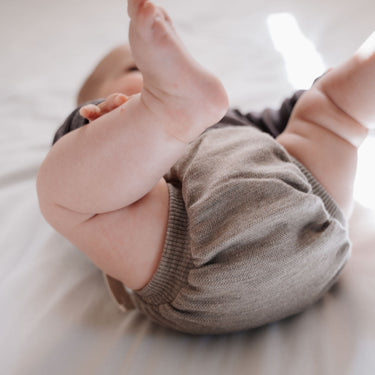
When you're choosing baby clothes for a newborn for the first time, it can feel surprisingly complicated. There are bodysuits, wrap bodysuits, rompers, trousers, pajamas, hats, cardigans, overalls, socks, swaddle sacks, and countless sizes. Plus, recommendations from friends, midwives, shops, lists, and family members.
And eventually, you're faced with the question: What does a newborn really need?
The good news is: In the beginning, your baby needs much less clothing than many layette lists suggest. What's crucial isn't the quantity, but whether the clothing is comfortable, soft, practical, and appropriate for the season. It should keep your baby warm without overheating. It should allow freedom of movement. And it should be easy to use in everyday life – when breastfeeding, sleeping, changing diapers, carrying, and perhaps even during elimination communication.
This article provides a calm, natural, and practical guide, so you don't buy too much, but consciously select what truly helps you in the first few weeks.
The short answer: This is the clothing a newborn needs initially
For the first few weeks, a manageable basic set is sufficient. If you wash regularly, you don't need huge quantities.
- 5 to 7 bodysuits, long- or short-sleeved depending on the season
- 4 to 6 soft trousers or leggings
- 3 to 5 tops, wrap shirts, or cardigans
- 2 to 4 pajamas or comfortable one-pieces
- 2 thin hats for the first few days or depending on the temperature
- 2 to 4 pairs of socks or soft wool socks
- 1 to 2 warming layers, for example, made of wool or wool/Tencel
- depending on the season, an outer layer like wool fleece, an overall, or a light blanket
This list is deliberately kept minimal. Some families need a bit more change of clothes because their baby spits up a lot or diapers frequently leak. Others get by with less. A basic set doesn't have to be perfect. It can grow with you.
If you want to plan the entire layette, you can find a suitable overview here: Baby Layette: What You Really Need.
Why less baby clothing is often better
Newborns grow very quickly. Many clothes in size 50 or 56 only fit for a few weeks. Some are even worn only once or twice before they become too small.
Therefore, it makes sense not to buy too many items in the smallest size at the beginning. A small selection of high-quality, easily combinable clothes is often more practical than a full drawer. You'll quickly see what's clean, what fits well, and which items you really like to use in everyday life.
Especially in the first few weeks, it's not about how varied your baby's outfits are. What's important is that the clothes fit comfortably, feel good, and don't create unnecessary hassle.
If you want to start with a conscious minimalist approach, read on here: Sustainable Layette: Buy Less, Choose Better.
What size does a newborn need?
Many babies start with size 50 or 56. Some newborns immediately need size 62, especially if they are born larger or heavier. Other babies initially wear smaller sizes, for example, if they are premature or have a very delicate build.
Before birth, this can never be planned with complete certainty. Even estimates can vary. Therefore, a mix is usually sensible.
A practical size distribution for the beginning
- a few items in size 50 if your baby is estimated to be rather small
- several basics in size 56
- a few items in size 62 so you don't have to buy more immediately
If you are unsure, it's better not to buy too much in size 50. Size 56/62 is more flexible for many families. Sleeves and trouser legs can often be rolled up a bit at first, as long as nothing is constricting or bothering the baby.
You can find a detailed size guide here: Which baby size for birth: 50, 56 or 62?.
Which bodysuits are practical for newborns?
Bodysuits are among the most important baby clothes. They lie directly on the skin, keep the tummy warm, and are less likely to ride up than a normal top. For newborns, soft, easy-to-put-on bodysuits are particularly comfortable.
Wrap bodysuit or pullover bodysuit?
Many parents find wrap bodysuits particularly practical in the first few weeks. They don't have to be pulled over the sensitive head but are opened at the side and wrapped around the body. This can be more relaxed, especially at the beginning, if you still feel unsure about dressing your baby.
Pullover bodysuits can be very practical later on when your baby is more stable and dressing becomes more routine. Some parents like to use them from the start, others wait a few weeks.
You can find more information here: Wrap bodysuit or pullover bodysuit: Which is better?.
Long-sleeved bodysuit or short-sleeved bodysuit?
For autumn, winter, and cool spring days, long-sleeved bodysuits are usually sensible. In summer, short-sleeved bodysuits or sleeveless bodysuits may be sufficient, depending on the temperature and material.
Not only the sleeve length but also the material is important. A thin bodysuit made of wool/Tencel can feel very comfortable in changing temperatures. Cotton is uncomplicated for everyday use when a lot of washing is done. Wool is particularly valuable if your baby needs extra warmth and temperature regulation.
You can find more on the quantity of bodysuits here: How many bodysuits does a newborn need?.
Which materials are suitable for newborns?
There isn't one perfect material for all babies and all families. Each material has advantages. What matters is what suits your baby's skin, the season, the care required, and your daily routine.
Wool
Wool is particularly valuable when it comes to warmth, temperature regulation, and a comfortable feel. It's breathable, can absorb moisture, and doesn't need to be washed after every wear. Often, thorough airing is sufficient.
For newborns, wool is particularly useful for warming layers, wool socks, cardigans, overalls, or clothing for cooler days.
Wool/Tencel
Wool/Tencel can be a wonderful material combination for baby clothes that should be soft, light, and suitable for everyday use. It combines natural temperature regulation with a very comfortable feel.
Especially for clothing worn directly or close to the body, wool/Tencel can be a great choice: soft enough for sensitive baby skin and practical enough for family life.
Cotton
Cotton is uncomplicated, familiar, and easy to care for. It's particularly practical when frequent washing is involved. Depending on the quality, it can be very comfortable, but it regulates temperature differently than wool.
Synthetic materials
Synthetic fibers can be found in certain functional products. For clothing directly on sensitive skin, many families prefer natural materials because they feel softer and more breathable.
You can find more about the differences here: Natural Baby Clothing: Wool, Wool/Tencel, and Cotton Compared.
What kind of trousers does a newborn need?
For newborns, soft trousers, leggings, or harem pants are ideal. They should not cut into the belly and should leave enough room for a diaper, cloth diaper, elimination communication diaper, or insert.
Wide, soft cuffs are particularly comfortable. They keep the trousers in place without putting pressure on the belly. This is especially important after feeding or during sleep.
What to look for in baby trousers
- soft waistband without strong pressure
- enough room in the diaper area
- comfortable freedom of movement
- material that doesn't scratch
- easy to put on and take off
- good combinability with bodysuits and tops
If you want to try elimination communication or diaper-free, clothing with an easy opening can be particularly helpful. Then you don't have to completely undress your baby every time you want to hold them for elimination or change them quickly.
Suitable product categories at Mata Origin are elimination communication trousers, elimination communication diapers, and diaper inserts.
Does a newborn need rompers?
Rompers can be practical, but they don't necessarily have to be part of the initial layette. Some parents love them because the torso and legs are well covered. Others prefer the combination of a bodysuit and trousers, because individual parts can be changed more flexibly.
A romper is particularly comfortable if it's easy to open and doesn't have to be completely removed. Look for snap fasteners, soft cuffs, and enough room in the diaper area.
If you want to start more minimalistic, you don't need a large collection of rompers. Two to three comfortable one-pieces or pajamas are enough for many families.
What sleepwear does a newborn need?
Sleepwear largely depends on room temperature, season, and sleeping bag. Many babies sleep in a bodysuit, pajamas, and a suitable sleeping bag. On very warm nights, less may be sufficient. On cool nights, an extra layer can be sensible.
It's important not to dress your baby too warmly. Many parents worry more about their baby being cold. However, overheating can also be stressful. As a guide, it's often recommended to feel the temperature at the nape of the neck: If the neck is comfortably warm, your baby is usually dressed appropriately. Cold hands alone do not automatically mean your baby is cold.
Sensible sleepwear for the beginning
- 2 to 4 soft pajamas or one-pieces
- bodysuits as the first layer
- a sleeping bag suitable for the season
- for cooler temperatures, an additional light wool layer
Avoid clothing with hard seams, thick hoods, large buttons on the back, or tight cuffs at night. Your baby lies down a lot. Anything that presses can be disturbing.
You can find a detailed guide here: Dressing baby at night: What does a newborn need for sleeping?.
Does a newborn need a hat?
Immediately after birth and in the first few days, a soft hat can be useful, especially if it's cool or your baby still needs help staying warm. Outside, a hat can also be important depending on the weather.
However, in warm indoor spaces, babies don't need to wear a hat constantly. As always: observe your baby, the room temperature, and the situation. A hat should protect, not overheat.
For starters, two thin hats are usually sufficient. In winter, an additional warmer hat for outdoors can be useful.
Socks, booties, and warm feet
Many newborns have cool hands and feet. This is not always a sign that they are cold overall. Nevertheless, soft socks or booties are practical, especially if the trousers don't have feet.
Wool socks can be very comfortable because they keep warm and regulate moisture well. Make sure that the cuff does not cut in and that the socks fit well without constantly slipping down.
A newborn does not need shoes. They look cute, but are usually superfluous for the first few weeks.
What clothes does a winter baby need?
A winter baby primarily needs good layers. Instead of choosing one very thick garment, the onion principle (layering) is often more practical. This way, you can more easily adjust whether you are indoors, outdoors, in the car, in the stroller, or in a carrier.
Suitable clothing for winter babies
- Long-sleeved bodysuits made of wool/Tencel, wool, or cotton
- soft trousers or leggings
- warming cardigans or wool layers
- wool socks
- warm hat for outdoors
- wool fleece overall or suitable outer layer
- warm blanket for stroller or carrier breaks
Especially in winter, it's important to differentiate between indoors and outdoors. In a heated room, your baby usually needs less than in a stroller. In a carrier, they also get your body heat.
You can find more information here: Winter Baby Layette: What You Really Need and here: Dressing Baby in Winter: Warm Without Overheating.
For cold days, a wool fleece overall can also be useful: Wool Fleece Overall from Mata Origin.
What clothes does a summer baby need?
A summer baby needs light, breathable clothing and protection from direct sun. Even in summer, a newborn is not automatically well-dressed in just a short-sleeved bodysuit. Temperature, drafts, shade, and material are crucial.
Suitable clothing for summer babies
- light short-sleeved or long-sleeved bodysuits
- thin trousers or airy leggings
- light hats or sun hats for outdoors
- thin socks if needed
- light blanket or cloth for shade and protection
- breathable materials like wool/Tencel or light cotton
In summer, not only heat is an issue, but also sun protection. Newborns should ideally not be exposed to direct sun. Clothing can help protect sensitive skin without burdening it with too much heat.
You can find more information here: Summer Baby Layette: What You Really Need and here: Dressing Baby in Summer: Light and Breathable.
What clothes does a baby need during transitional seasons?
Spring and autumn are often harder to plan for than summer or winter. It's cool in the morning, warm at midday, windy outside, and heated indoors. For babies, this is a situation where flexible layers are particularly helpful.
Useful for transitional seasons:
- Bodysuits made of wool/Tencel, wool, or cotton
- soft trousers
- light wool jacket or cardigan
- socks
- thin hat for outdoors
- light blanket
- an additional layer for stroller or carrier
You can find more information here: Dressing Baby in Transitional Seasons: Planning Spring and Autumn Correctly.
Dressing baby in the postpartum period
The postpartum period isn't about beautiful outfits. It's about settling in, closeness, and peace. Your baby will spend a lot of time on you, feeding, sleeping, being changed, perhaps doing elimination communication, and cuddling up again.
For this time, clothing that is soft, can be opened quickly, and doesn't interfere with skin-to-skin contact is ideal. Too many layers, stiff fabrics, or complicated fasteners can unnecessarily complicate daily life.
Practical for the postpartum period
- soft bodysuits
- comfortable trousers with a gentle waistband
- wrap shirts or easily opening tops
- small wool layers
- warm socks
- a light blanket for resting periods
Especially in the first few days, clothing can be simple. Your baby doesn't need a wardrobe for every occasion. It needs a comfortable covering for a lot of closeness.
You can find more on postpartum preparation here: Preparing for the Postpartum Period: What You Can Organize Before Birth.
Clothing and diapering: What really helps in everyday life
In the first few weeks, you will change or redress your baby frequently. Therefore, it makes sense to choose clothes not just for their appearance, but for their practicality.
Anything that opens easily saves time and reduces fuss. Especially at night or when your baby is tired, simple fasteners can make a big difference.
Good clothing for diaper changes
- can be easily opened in the diaper area
- doesn't need to be completely removed
- has no annoying buttons on the back
- fits comfortably over a diaper or cloth diaper
- retains its shape even after several washes
If you use cloth diapers, you often need a bit more room in the diaper area. If you use disposable diapers, the diaper package is usually slimmer. If you want to try elimination communication, easy accessibility becomes particularly important.
You can find more about changing stations here: Setting up a changing station: What you really need.
Clothing and Elimination Communication: Thinking ahead before birth
Many parents discover Elimination Communication (EC) later on. However, it can be helpful to know during the initial outfitting that EC is an option.
This doesn't mean you have to commit. You don't have to decide whether you're going "diaper-free." You just need to know: babies can show signals from the very beginning. And some standard situations are well-suited for relaxed EC attempts — for example, after waking up, during diaper changes, or after breastfeeding.
Clothing can make a big difference here. If you have to completely undress your baby for every EC attempt, it quickly becomes cumbersome. If clothing can be easily opened, the moment remains calmer.
Helpful for EC-friendly baby clothes
- quick opening in the diaper area
- soft fabrics that allow good movement
- enough space for inserts
- no complicated layers
- warmth, even when briefly opened
You can find a gentle introduction here: What does "diaper-free from birth" actually mean?.
If you want to plan concretely, you can find the suitable overview here: EC Starter Kit: What you really need.
Clothing for carriers, strollers, and car seats
Baby clothing largely depends on how your baby is traveling. In a carrier, they get body heat from you. In a stroller, they are more protected, but may need a different outer layer depending on the weather. In the car, safety is particularly important because thick jackets or overalls under the seatbelt can be problematic.
That's why it's worth considering these situations separately:
- In the carrier, the shared warm space matters.
- In the stroller, weather, wind, and lying position matter.
- In the car, safe belt adjustment takes precedence over maximum warmth.
You can find more about this here: Dressing baby in a carrier, Dressing baby in a stroller, and Dressing baby in a car seat.
How many clothes do you really need?
The quantity depends on how often you want to wash and what your baby is like. Some babies spit up a lot. Some diapers leak more often. Some parents don't want to do laundry every other day.
This amount can help as a calm starting point:
- 5 to 7 bodysuits
- 4 to 6 pairs of pants
- 3 to 5 tops or cardigans
- 2 to 4 sleepsuits
- 2 hats
- 2 to 4 pairs of socks
- 1 to 2 warming layers
If you find yourself constantly doing laundry, you can add more items specifically. If you find that some items remain unused, you haven't bought too much.
What you don't necessarily need
Some clothes look cute but are impractical for newborns. Especially at the beginning, it's worth being critical.
These things are often not necessary
- stiff shoes
- stiff jeans or uncomfortable pants
- clothing with many hard buttons
- hoodies for extended lying periods
- many outfits just for photos
- large quantities in size 50
- very tight clothing
- scratchy materials
Of course, there can also be beautiful clothes. Joy is part of it. But if you want to reduce, choose a few beautiful and practical items rather than many outfits that interfere with everyday life.
Washing baby clothes before birth
It makes sense to wash baby clothes before the first wear. This removes any potential residues from manufacturing, storage, or transport.
Use a mild detergent and, if possible, avoid fabric softener. Especially with natural materials like wool or wool/Tencel, proper care is important to keep the fibers soft and functional.
Before the first wear
- sort clothes by material
- follow care labels
- use mild detergent
- wash wool and wool/Tencel gently
- avoid strong fragrances
- dry clothes thoroughly
High-quality clothing often lasts longer if it's not unnecessarily hot, washed too frequently, or treated with aggressive detergents.
You can find more about this here: Washing baby clothes before birth: What's really useful.
A simple checklist for newborn clothing
If you want compact guidance, you can start with this list:
- 3 to 4 long-sleeve bodysuits
- 2 to 3 short-sleeve bodysuits or additional long-sleeve bodysuits depending on the season
- 4 to 6 soft pants or leggings
- 3 to 5 tops, wrap shirts, or cardigans
- 2 to 4 sleepsuits or one-pieces
- 2 hats
- 2 to 4 pairs of socks
- 1 warmer jacket or wool layer
- 1 seasonal outer layer for outdoors
- 1 light blanket or wool blanket
This list is not set in stone. It's a starting point. You can keep it smaller if you want to start minimalist, or expand it if it suits your everyday life.
How to recognize good baby clothes
Good baby clothes are not just recognized by their appearance. Their quality shows in everyday life.
- They feel soft and comfortable.
- They are easy to put on and take off.
- They don't restrict your baby.
- They are suitable for the season.
- They keep their shape even after washing.
- They provide enough space for a diaper, cloth diaper, EC diaper, or insert.
- They are made of materials you like to put on your baby's skin.
For Mata Origin, baby clothing is not just an accessory. It is part of natural parenting. It should protect and warm your baby and support you in everyday life — while cuddling, sleeping, breastfeeding, changing diapers, carrying, and elimination communication.
Frequent questions about newborn clothing
How many bodysuits does a newborn need?
For the beginning, 5 to 7 bodysuits are usually enough. If your baby spits up a lot or you wash less often, a few extra bodysuits can be useful.
What size should you buy before birth?
A mix of size 56 and 62 is practical for many families. Size 50 is especially worthwhile if your baby is estimated to be rather small. It's better to buy only a few items in this size.
Are wrap bodysuits better than regular bodysuits?
For newborns, wrap bodysuits are often very comfortable because they don't have to be pulled over the head. Regular bodysuits can become more practical later on when dressing is more routine.
Does a newborn need fresh clothes every day?
Not necessarily. If clothes are clean and feel comfortable, they don't need to be completely changed daily. Of course, changes are made if there's spit-up, a leaky diaper, or sweating.
What clothing is helpful for Elimination Communication?
For Elimination Communication (EC) or potting, clothing that can be opened quickly and doesn't require complete undressing is practical. Soft EC pants, EC diapers, suitable inserts, and uncomplicated layers can make everyday life easier.
Does a baby need clothes made of wool or wool/Tencel?
It's not a must, but it's very comfortable for many families. Wool is warming, temperature-regulating, and durable. Wool/Tencel can be particularly soft, lightweight, and suitable for everyday use. High-quality cotton can be a good addition for uncomplicated basics.
A loving thought in closing
Your baby doesn't need a perfect wardrobe. They need clothes that keep them warm, protected, and well-accompanied in their small, new world.
A few, soft, and well-thought-out items are often sufficient. You don't have to know everything in advance. You can start, observe, and gradually find out what suits you.
Good baby clothing doesn't make everyday life more complicated. It makes it easier. It allows for closeness. It supports small gestures. And it gives your baby what is so important at the beginning: warmth, security, and a good body feeling.
If you want to combine natural materials, practical cuts, and an undogmatic start with diapering, elimination communication, and closeness, you'll find thoughtful companions for exactly this first period at Mata Origin.
Discover suitable products for your baby's everyday life: Elimination Communication Pants, Elimination Communication Diapers, Diaper Inserts, and the Wool Fleece Overall.