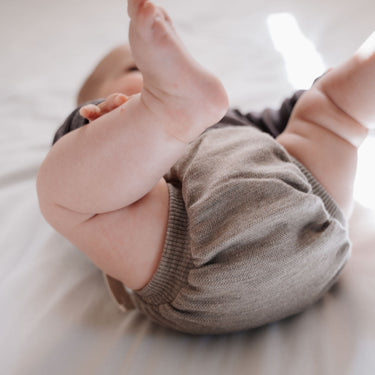
Putting together the initial baby gear can quickly feel overwhelming. As soon as the pregnancy progresses, lists appear everywhere: what you absolutely need, what is supposedly indispensable, and what you should buy weeks before the birth.
And suddenly, you're faced with the question: Does a newborn really need so much?
The honest answer is: No. What your baby needs most in the beginning is closeness, warmth, food, sleep, protection, and people who lovingly perceive their signals. Of course, there are things that make everyday life easier. But good initial gear doesn't mean buying as much as possible. It means choosing consciously.
Good initial gear isn't about covering every possible moment. It's about what supports you in the real first days: during diaper changes at three in the morning, when the first spit-up lands on a fresh onesie, when they arrive on your chest, when you carefully go outside, when you learn what your baby needs.
At Mata Origin, we believe: Starting the baby year naturally doesn't mean preparing everything perfectly. It means choosing consciously—less overwhelm, more trust, less disposable feeling, more connection.
In this article, you'll find a natural, sustainable, and practical guide to essential baby gear. Clearly organized by category. Without pressure for perfection. Without unnecessary must-haves. And with a focus on what truly supports you in the first few weeks.
The Most Important Things at a Glance
- You need less before birth than many initial gear lists suggest.
- Really important are clothing, a sleeping place, a changing or elimination communication area, basic care items, transportation, and postpartum supplies.
- Buy a few good quality items rather than many "maybe" products.
- You don't have to plan elimination communication perfectly—but it's helpful to know about this option before birth.
- A natural start doesn't mean deprivation, but conscious choice.
Baby's Initial Gear by Category
To get a better overview, it's helpful to view the initial gear not as an endless shopping list, but to categorize it by areas of life. What do you need on the go? What helps with sleep? What do you need for changing, elimination communication, and care? What clothing is sensible? And what will ease your postpartum period?
Thus, the big question "What do we need for everything?" becomes a much calmer question: "What will support us in our real everyday life with a baby?"
1. On the Go and Transportation
You'll need a safe way to transport your baby at the latest for the journey home from the hospital, birth center, or home birth. The first walks, pediatrician appointments, and short trips also feel easier if a few things are prepared.
Useful for on the go and transportation:
- Infant car seat for safe car rides
- Stroller with a suitable bassinet, if you intend to use one
- Baby wrap or baby carrier for closeness and free hands
- Changing mat for on the go
- Small diaper bag or well-organized pouch
- Change of clothes
- Muslin cloth
- Diaper, backup, insert, or elimination communication diaper
- Wet bag or laundry bag for damp clothes
You don't have to choose between a stroller and a carrier as if it were a matter of principle. Some families use both. Some carry almost exclusively. Others love the stroller. What's important is that the solution fits your body, your daily life, and your baby.
For short trips, you often need less than you think. A small, well-packed bag is usually more helpful in everyday life than a huge setup where you can't find anything.
A practical addition is a changing mat for on the go, which provides flexibility for diaper changes, elimination communication, or dressing.
You can find more information here: Packing Your Diaper Bag: What You Really Need on the Go and here: First Walk with Baby: When, How Long, and What to Bring?.
2. Sleeping
Babies sleep a lot in the first few weeks, but often not as adults expect. Some prefer to sleep very close to the body. Others need frequent nursing or feeding breaks. Many switch between short sleep phases, a need for closeness, and awake moments.
Therefore, for the sleeping area, you don't need many things, but above all a safe and quiet sleeping environment.
Useful for the sleeping area:
- Safe sleeping place, for example, a co-sleeper, crib, or another suitable solution
- Firm, fitted mattress
- 2 to 3 fitted sheets
- Appropriate baby sleeping bag for the season
- If needed, a waterproof, breathable underlay
- Small night light for quiet nights
- Baby monitor, if your baby also sleeps in another room
Pillows, loose blankets, large stuffed animals, and thick bumper pads are usually not necessary for baby sleep in the beginning. Many parents buy them out of anticipation, but then hardly use them in everyday life or only later.
A baby monitor can be helpful if your baby is sleeping and you are in another room. However, in the first few weeks, many babies sleep very close to their parents anyway. Therefore, a baby monitor is practical, but not immediately essential for every family.
If you are unsure how to dress your baby appropriately at night, you can find detailed guidance here: Dressing Baby at Night: What a Newborn Needs for Sleep?.
3. Diapering, Elimination Communication, and Care
When it comes to diapering, many automatically think of disposable diapers. Others explore cloth diapers during pregnancy. And then there's a third option that has been discussed far too little: elimination communication (EC).
It's not about perfectly implementing one method. It's about knowing that babies communicate from the start. Also about elimination. Many parents find it relieving to know about this option without putting pressure on themselves.
And especially when it comes to diapering, an open mind is worthwhile: Besides disposable diapers and cloth diapers, there is also the option of practicing elimination communication with your baby—fully or partially, with a diaper, insert, or EC diaper as a backup.
Useful for diapering, elimination communication, and care:
- Safe changing station or flexible changing option
- Wipeable changing mat
- Diapers, cloth diapers, backups, or elimination communication diapers
- Absorbent inserts
- Soft washcloths
- Small bowl for warm water
- Muslin cloths
- Wet bag or laundry bag
- Diaper rash cream for emergencies
- Fever thermometer
- Soft baby nail scissors or baby nail file
- Baby bathtub or bath bucket, if you want to use it
- Bath thermometer, if that gives you peace of mind
At home, you don't necessarily need wet wipes as a standard. Warm water and soft washcloths are often sufficient and particularly gentle. Wet wipes can be practical on the go, but they don't have to be the basis of your daily care.
The same applies to care products: less is often more. Your baby's skin first has to get used to the world outside the womb after birth. Too many products, fragrances, or care routines are usually not necessary.
You can find more about the changing station here: Setting Up a Changing Station: What You Really Need.
For specific care topics, these articles are also helpful: Baby Care in the Postpartum Period, Bathing Baby for the First Time, Diaper Rash in Baby, and Baby's Medicine Cabinet: What You Really Need Before Birth.
4. Clothing
Baby clothing is one of the most important areas of initial equipment. At the same time, a lot is bought, given away, and sometimes bought twice here.
For the beginning, a few easily combinable items of clothing are enough. Newborns grow quickly, and especially the smallest sizes are often only worn for a short time.
Useful clothing for the first few weeks:
- 5 to 7 bodysuits, ideally wrap bodysuits or easy-to-put-on styles
- 4 to 6 soft pants or leggings
- 3 to 5 tops or wrap shirts
- 2 to 4 sleepsuits or comfortable all-in-ones
- 2 light hats
- 2 to 4 pairs of socks or soft wool socks
- 1 to 2 cardigans or wool layers
- Depending on the season, a warm outer layer, overall, or jacket
You don't need ten of each item. Especially if you wash regularly, a smaller, high-quality selection is perfectly sufficient.
Good baby clothing isn't just cute. It makes the first few days easier: less tugging, less stress during changes, less pressure on the tummy, quicker access for diapering and elimination communication.
Which sizes are sensible at the beginning?
Many newborns start with size 50 or 56. Some babies need size 62 directly. If you are unsure before birth, a mix is often sensible: a few items in size 50/56 and a little more in size 56/62.
If your baby is estimated to be very small or premature birth is possible, smaller clothing can be helpful. If your baby is estimated to be rather large, you probably need less in size 50.
Here too, the rule applies: It's better not to buy too much in the smallest size. After birth, you will quickly notice what really fits.
You can find more detailed guidance here: What Clothes Does a Newborn Really Need?.
More on choosing sizes can be found here: Which Baby Size for Birth: 50, 56, or 62?.
Why natural materials are so valuable for baby clothes
A newborn's skin is sensitive. At the same time, a small baby cannot regulate its temperature as well as adults. Therefore, materials play a major role in initial equipment.
Natural materials such as wool, wool/Tencel, and high-quality cotton can make everyday life with a baby very pleasant. They feel soft, are breathable, and support a balanced body feeling.
Wool is particularly valuable when it comes to warmth and temperature regulation. Wool/Tencel can be a wonderfully soft, light, and practical material combination for everyday use. High-quality cotton is easy to care for and practical for many basic items.
For Mata Origin, baby clothing is not just clothing. It is a shell that protects, warms, and accompanies your baby. Especially at the beginning, when everything is new, clothing should be soft, functional, and natural.
You don't have to buy everything new. But for the items that lie directly on the baby's skin, good quality is particularly worthwhile.
You can find more about the materials here: Natural Baby Clothing: Wool, Wool/Tencel, and Cotton Compared.
5. Nutrition, Breastfeeding, and Bottles
Whether you want to breastfeed, bottle-feed, or combine both: here too, you don't have to prepare everything perfectly beforehand. Some things depend heavily on how your start goes.
An attitude without pressure is important. You are allowed to inform yourself without committing. You are allowed to accept help. And after the birth, you are allowed to see what you and your baby really need.
If you want to breastfeed:
- 2 to 3 well-fitting nursing bras
- Nursing pads
- Comfortable clothing that can be easily opened
- If needed, a nursing pillow
- Muslin cloths or burp cloths, about 8 to 10 pieces
- Large water bottle for yourself
- Small snacks for the postpartum period
If you want to bottle-feed or want to be prepared:
- Several baby bottles
- Suitable nipples for newborns
- A way to clean and sterilize
- Infant formula, if you are sure you will need it
- Muslin cloths or burp cloths
If you're unsure, talk to your midwife or a lactation consultant before birth. Especially when it comes to nutrition, individual support is often more valuable than a general list.
For postpartum preparation, a quiet nursing or feeding area is also helpful. You can find more about this here: Setting Up a Nursing Station: What You Really Need in the Postpartum Period.
If you want to bottle-feed or want to keep your options open, you'll find an undogmatic guide here: Bottle-feeding in the Postpartum Period.
6. Postpartum and Organization
Good initial baby gear doesn't just think about the baby. It also thinks about the first days and weeks as a family.
Because after birth, not only your baby needs care. You also need food, rest, water, support, protection from too many visitors, and people who can practically relieve you.
Helpful for the postpartum period:
- Pre-cooked meals or organized meals
- Water bottles in several locations
- Nursing or feeding station
- Clear visitor rules
- Help with household chores
- Partner or support person with specific tasks
- Document folder
- Contact details for midwife and pediatrician's office
- Emergency numbers
Many families prepare the baby's room more intensely than the postpartum period. However, the postpartum period is much more important in the beginning than a perfect room.
You can find more about this here: Preparing for the Postpartum Period: What You Can Organize Before Birth and here: The First Days at Home with Baby.
What is Missing from Many First-Time Parent Lists
Many lists think from the product outwards: bodysuit, diaper, bottle, bed, cream. This is practical, but not complete. Because your baby doesn't start life with product categories. It starts with needs.
It needs closeness. Warmth. Food. Sleep. Elimination. Protection. Care. And people who can learn to understand its signals.
Therefore, your initial equipment shouldn't just be a shopping list. It should be a preparation for your real everyday life.
A minimalist initial equipment therefore does not first ask: "What could one buy?" It asks: "What really helps us when our baby is here?"
The Most Important Idea: Less, but Better
Especially with the first child, the temptation is great to play it safe and buy too much rather than too little. That's understandable. After all, you want to be prepared. You want to give your baby a good start. And you want to avoid constantly having to organize something after the birth.
But many things are hardly used at first. Some babies don't like certain products. Some clothes only fit for a few weeks. And many things that seemed indispensable beforehand prove superfluous in everyday life.
Sustainable initial equipment therefore follows a simple principle:
- First buy what your baby definitely needs.
- Choose quality over quantity.
- Plan flexibly, instead of perfectly equipping everything beforehand.
- Supplement after birth, when you know your baby and your everyday life better.
This takes the pressure off. You don't have to own everything before birth. You can be prepared without letting lists and recommendations drive you crazy.
Considering Elimination Communication in Your Initial Gear
Many parents only learn months after birth that elimination communication is even an option. Yet, it can be helpful during pregnancy to already be familiar with this option.
Not because you have to commit. But because then you can decide more freely.
Elimination communication doesn't mean your baby never wears a diaper. It also doesn't mean you always have to pay attention to signals or do everything perfectly. Many families use elimination communication in a very undogmatic way: in the morning after waking up, after nursing, during diaper changes, or when they notice their baby is restless.
For the initial baby equipment, this means: From the beginning, you can choose clothes that offer you flexibility. Clothes that don't have to be completely taken off every time. Clothes that combine closeness, warmth, and easy handling.
That's exactly what Mata Origin develops elimination communication clothing for: to make natural baby care easier in everyday life.
A gentle introduction can be found here: What does "diaper-free from birth" actually mean?.
If you want to know exactly what you need for it, read on here: Elimination Communication Starter Kit: What you really need.
Our recommendation for a minimalist start
If you want to start with Mata Origin, you don't need everything at once. For many families, a small, well-thought-out basic set is enough to begin with: soft clothing, an EC diaper as a backup, absorbent inserts, muslin cloths, and a changing mat.
This way, you're prepared — without committing yourself and without filling your home with things you might never need.
You can find suitable basics here: EC Diapers, Diaper Inserts, EC Pants and the Portable Changing Mat.
What you don't necessarily have to buy before birth
Many things can wait. This is perhaps one of the most relaxing thoughts about baby equipment.
Not everything has to be ready before birth. Some purchases only make sense once you know your baby.
These things you can often decide later:
- too many bottles and nipples if you plan to breastfeed
- large quantities of diapers in one size
- many care products
- toys for the first few weeks
- baby bouncer or similar devices
- too many clothes in size 50
- shoes for newborns
- elaborate nursery decorations
- all clothing sizes for the first year
Your baby doesn't need a perfectly furnished nursery in the first few weeks. It needs you, closeness, nourishment, warmth, peace, and loving care.
Sustainable baby equipment: What you can pay attention to
Sustainability in baby equipment doesn't mean buying everything new and perfectly ecological. Sustainability can also mean buying less, acquiring used items, using high-quality clothing for a long time, and choosing products that are truly well-designed.
Practical sustainability questions before purchasing:
- Do we really need this product?
- Can it grow with the child or be used longer?
- Is the material natural, durable, and comfortable?
- Was it manufactured with high quality and responsibility?
- Is it easy to care for or pass on?
- Does it truly make our daily life easier?
Especially with baby clothes, it's worth choosing fewer items of better quality. High-quality natural materials can often be worn longer, passed on more easily, and feel more pleasant on the skin.
This fits with a baby equipment approach that focuses not on quantity, but on connection, function, and quality.
For a more in-depth guide, see here: Sustainable Baby Equipment: Buy less, choose better.
Considering U2, U3 and first appointments
Initial baby equipment isn't just about things. A little organization can also greatly relieve you after birth.
The first preventive examinations come faster than many parents expect. Therefore, it makes sense to know before birth which pediatrician's office is right for you and where U2 and U3 should take place.
Before birth, you can prepare:
- Find a pediatrician's office
- Clarify where the U2 will take place
- Inquire about the U3 appointment logic
- Prepare a document folder
- Note down emergency numbers
- Prepare a diaper bag for first appointments
You can find more about this here: Preparing for U2 and U3: What you should organize before birth.
A minimalist checklist for baby's first equipment
If you want a simple guide, you can start with this basic list.
On the go and transport
- Infant car seat
- Stroller, baby carrier, or both
- Diaper bag or small pouch
- Portable changing mat
- Change of clothes
- Wet bag or laundry bag
Sleeping
- safe sleeping place
- firm mattress
- 2 to 3 fitted sheets
- suitable sleeping bag
- small night light
Diapering, Elimination Communication, and Care
- Changing station or flexible changing option
- Changing mat
- Diapers, backups, or EC diapers
- absorbent inserts
- soft washcloths
- muslin cloths
- wet bag or laundry bag
- diaper rash cream for emergencies
- fever thermometer
Clothing
- 5 to 7 bodysuits
- 4 to 6 pants or leggings
- 3 to 5 tops
- 2 to 4 sleepsuits
- 2 hats
- 2 to 4 pairs of socks
- 1 to 2 warm layers
- depending on the season: overall, jacket, or light blanket
Breastfeeding and bottles
- Nursing bras, if you plan to breastfeed
- Breast pads
- Muslin cloths or burp cloths
- Nursing pillow, if it helps you
- Bottles and nipples, if you plan to bottle-feed or want to be prepared
- Water bottle and snacks for yourself
Postpartum and Organization
- Food prepared or organized
- Visiting rules clarified
- Help list created
- Pediatrician's office found
- Emergency numbers noted
- Document folder prepared
What's the best initial baby equipment for you?
The best initial equipment isn't the most extensive. It's the one that relieves you. It gives you security without overwhelming you. It leaves room for your own experience.
Perhaps after the birth, you'll realize that you don't need some things at all. Perhaps you'll buy other things later. Perhaps you'll only try elimination communication occasionally. Perhaps it will become a completely natural part of your daily life.
All of that is perfectly fine.
A natural start to the baby year doesn't mean preparing everything perfectly. It means consciously choosing, staying open, and meeting your baby with closeness, trust, and attention.
If you're preparing for the last weeks before birth, you can find a suitable overview here: The last weeks before birth: What you really still need to prepare.
Frequent questions about baby's first equipment
When should you buy baby's first equipment?
Many parents start buying initial baby equipment in the second or third trimester. However, it's sufficient to have the most important things ready a few weeks before the estimated due date. Not everything has to be complete months in advance.
What size does a newborn need at first?
Many babies initially wear size 50 or 56. Some start directly with size 62. It's sensible to have a small selection in 50/56 and a bit more in 56/62 to be flexible.
How much baby clothing do you really need?
For a start, usually 5 to 7 bodysuits, 4 to 6 pairs of pants, a few tops, sleepsuits, hats, and socks are enough. If you wash regularly, you won't need huge quantities.
What do you really need for diapering?
You'll need a comfortable changing area, diapers or a backup system, soft cloths, a changing mat, and some care products for emergencies. If you want to try elimination communication, a potty, suitable clothing, EC diapers, and absorbent inserts can be helpful.
Do you have to plan elimination communication before birth?
No, you don't have to commit. However, it can be very helpful to know during pregnancy that this option exists. Then, after the birth, you can calmly try out what suits you.
What can you buy used for initial baby equipment?
Many items of clothing, blankets, cloths, or furniture can be bought second-hand. For safety-critical products such as mattresses, car seats, or certain sleep products, you should carefully check that they are suitable and in good condition.
What doesn't belong in the initial baby equipment?
Not everything on classic lists needs to be bought before birth. Often, you can decide on toys, shoes for newborns, many care products, large diaper stashes, baby bouncers, or elaborate nursery decorations later.
What does a minimalist initial baby equipment look like according to the Mata-Origin approach?
It's small, soft, practical, and consciously chosen: a few good pieces of clothing, natural materials, a safe sleeping place, a simple changing or elimination communication area, gentle care basics, and enough room to see what else is needed after birth.
A loving thought at the end
You don't have to prepare everything perfectly. You don't have to fulfill every list. And you don't have to know before birth which path is exactly right for you in every detail.
Your baby doesn't come into the world with a shopping list. It comes with needs. For closeness. For warmth. For nourishment. For sleep. For connection.
Good initial equipment helps you to lovingly support these needs. No more. But no less either.
If you want to focus on natural materials, practical cuts, and an undogmatic start with diapering, elimination communication, and closeness, Mata Origin offers well-thought-out products for precisely this beginning.
Starting the baby year naturally doesn't mean owning everything. It means consciously choosing what truly supports you: during the postpartum period, when changing diapers, dressing, carrying, on the first walk, and in all the small moments where preparation turns into connection.
Discover suitable companions for your start: EC Diapers, EC Pants, Diaper Inserts and the Portable Changing Mat.
Note: This article does not replace medical advice. It is intended to provide guidance and support you in navigating your own path well-informed and with confidence. For medical questions, please consult your midwife, doctor, or physician.