
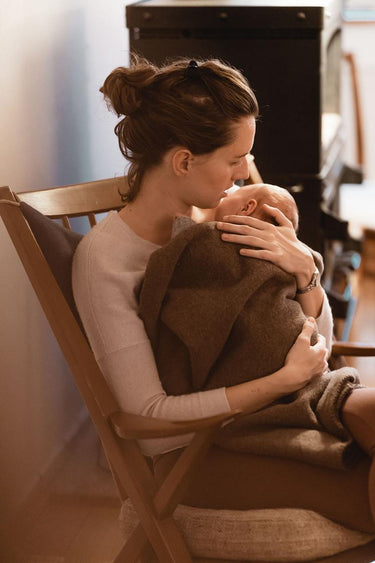
Starting the baby year naturally sounds wonderful at first. Like peace. Like closeness. Like a conscious beginning. Like less plastic, less stress, less external control.
At the same time, this desire can quickly create pressure. Suddenly there are new questions: Do I have to give birth naturally? Do I have to breastfeed? Do I have to use cloth diapers? Do I have to do elimination communication? Do I have to buy everything sustainably? Do I always have to be calm, connected, and intuitive?
No.
A natural start to the baby year is not a catalog of rules. It is not an exam and not an ideal you have to live up to. For Mata Origin, starting naturally primarily means: perceiving your baby as a feeling, communicating being. Taking yourself seriously. Working less against your needs. And consciously choosing what truly supports your family.
In this article, we'll look at what a natural start to the baby year can mean — and what it doesn't. And how you can prepare a path that suits you even during pregnancy.
Starting the baby year naturally: What does that actually mean?
Starting the baby year naturally does not mean doing everything without help, without technology, without diapers, or without compromise. It also does not mean that you have to make all decisions as ecologically or attachment-oriented as possible.
Naturally can mean:
- you take your baby's signals seriously
- you create space for closeness and physical contact
- you choose materials that feel good and genuine
- you buy less, but more consciously
- you prepare your postpartum period as a sanctuary
- you are interested in alternatives to classic routines
- you let go of perfection and seek your own rhythm
Naturally here is not an ideology. Naturally is a direction. An inner compass.
If you want to start planning practically, you'll find a good basis here: Baby Essentials: What you really need.
The most important beginning: Your baby is not passive
A baby does not come into the world as a small being that simply needs to be cared for. From the very beginning, it brings signals. It shows hunger, fatigue, a need for closeness, restlessness, overwhelm, well-being, and sometimes even elimination needs.
Starting the baby year naturally means not seeing these signals as a disturbance, but as a language.
You won't understand everything immediately. Nobody does. Some days are clearer, others confusing. But the attitude makes a difference: Your baby communicates. And you get to learn to listen.
This applies to breastfeeding or feeding. To sleeping. To carrying. To diapering. And also to elimination communication or holding out.
Naturally doesn't mean perfect
Especially expectant mothers often carry many expectations. Being a good mother. Living naturally. Shopping consciously. Staying calm. Being able to breastfeed. Feeling bonding. Understanding the baby. Accepting one's body. Managing the household somehow too.
That is a lot.
A natural start should therefore never become another performance requirement. It should not constrain you, but free you.
You are allowed to use disposable diapers and still live consciously. You are allowed to try elimination communication and pause again. You are allowed to hold out in the morning and diaper classically for the rest of the day. You are allowed to love natural baby clothes and still use gifted cotton bodysuits. You are allowed to want closeness and still sometimes need distance.
Naturalness loses its value when it shames you. It becomes valuable when it empowers you.
Buy less, choose more consciously
A natural start to the baby year often begins with the initial equipment. Not because things are the most important. But because the way we choose things reveals a lot about our attitude.
Many initial equipment lists are long. They convey the impression that a baby needs a lot of products. In reality, a newborn primarily needs closeness, warmth, food, sleep, protection, and loving guidance at the beginning.
Natural therefore often means: buying less, but choosing better.
This can mean:
- few good pieces of clothing instead of full drawers
- natural materials instead of a sole focus on design
- products that genuinely help in everyday life
- used items where it makes sense
- high-quality pieces that can be passed on
- conscious openness to what you will truly need later
You can find good guidance in the article Baby Essentials: What you really need.
If you want to pay even more attention to sustainability, read on here: Sustainable Initial Equipment: Buy less, choose better.
Natural baby clothes as the first layer
Baby clothing is not just decoration. Especially in the first few weeks, it is the layer that warms, protects, and accompanies your baby. It lies directly on the skin, is worn while sleeping, while breastfeeding or feeding, while cuddling, carrying, changing, and arriving.
That's why a conscious look at materials and cuts is worthwhile.
Wool, wool/Tencel, and high-quality cotton can fulfill different tasks. Wool warms and regulates temperature. Wool/Tencel feels soft, light, and supple. Cotton is familiar and easy to care for.
Naturally, not every material is automatically ideal for every situation. What matters is what suits your baby, the season, and your daily life.
You can find more about this here: Natural Baby Clothing: Wool, Wool/Tencel, and Cotton in comparison.
If you want to know exactly what clothes a newborn really needs, you'll find a practical overview here: What Clothes Does a Newborn Really Need?.
The postpartum period as a protected beginning
A natural start to the baby year doesn't just need things. It needs space.
The postpartum period is this space. Or it can be this space if you allow yourself to protect it. During this time, your body recovers, your baby arrives, bonding grows, breastfeeding or feeding establishes itself, and pregnancy transitions into family life.
Many cultures have long known that this time must be protected. Today, mothers often quickly fall back into functional mode. Answering messages, receiving visitors, doing housework, smiling gratefully, while everything internally is open.
Starting the baby year naturally also means: taking the postpartum period seriously.
This can practically mean:
- limiting visitors beforehand
- organizing food and support
- preparing resting places at home
- accepting help for housework and older children
- allowing for digital quiet time
- not having to function again immediately
If you want to prepare this time specifically, you can find the relevant article here: Preparing for Postpartum: What you can organize before birth.
For the first few days after birth, you'll also find guidance here: The first days at home with baby.
Closeness is not spoiling
A newborn doesn't need closeness as an extra. Closeness for a baby is orientation, security, and regulation. It knows your voice, your heartbeat, your movement, your warmth. After birth, this closeness is not a bad habit, but a transition.
Starting the baby year naturally can therefore mean not distrusting physical contact. Your baby can be carried. It can seek your closeness. It can feed often. It can be held without you having to fear spoiling it.
This doesn't mean you have to give yourself up completely. It just means: Babies are not designed to be as independent as possible from the start.
Closeness is not a step backward. It is a beginning.
Rethinking diapers, changing, and elimination communication
Hardly any topic seems as self-evident in everyday baby life as diapers. Many parents only ask before birth: Which diaper brand? Or: Disposable diaper or cloth diaper?
But there is also a third option: Elimination communication, or holding out.
This does not mean that your baby is not allowed to wear a diaper. It means that you can perceive elimination as part of your baby's communication. The diaper is then not necessarily abolished, but can be a backup.
This perspective fits very well with a natural baby year because it doesn't just focus on provision, but on relationship. Your baby isn't just changed. It is also seen in this area.
You can find an undogmatic comparison here: Disposable diapers, cloth diapers, or elimination communication: What are the options?.
Elimination Communication as an option, not an obligation
Elimination communication can sound unfamiliar to many pregnant women at first. Perhaps even overwhelming. That's why the most important message is: You don't have to commit.
You can learn about elimination communication without practicing it immediately. You can have a small potty ready and still use diapers. You can hold out in the morning and diaper classically for the rest of the day. You can start after a few days, after a few weeks, or not at all.
A natural start to the baby year does not mean that you have to do everything differently. It means that you even know what options there are.
You can find a gentle introduction in the article What does elimination communication from birth actually mean?.
Preparing for elimination communication without committing
If you find elimination communication interesting, you don't need to plan a perfect elimination communication routine before birth. It's enough to consider the possibility.
This can start small:
- you read a simple introduction
- you talk to your partner about it
- you consider whether a small potty makes sense
- you choose baby clothes that are easy to open
- you plan a backup so that no pressure arises
- you decide after birth what feels feasible
If you want to know what is really helpful for this, you will find the appropriate overview here: Elimination Communication Essentials: What you really need.
Sustainability in the baby year: practical rather than absolute
Sustainability is an important value for many expectant parents. At the same time, it can quickly become complicated in the baby year. Diapers, clothes, care products, transportation, washing, gifts, toys, packaging – everything suddenly seems to be a decision.
A natural start should relieve rather than burden here.
Sustainable can mean:
- buying fewer unnecessary products
- using high-quality clothing longer
- reducing diaper consumption where it fits
- consciously incorporating used items
- preferring natural materials
- repairing, caring for, or passing on products
- not having to make every decision perfectly
Sustainability in family life is not pure theory. It must withstand tired nights, full laundry baskets, growth spurts, and real limitations.
If you want to start consciously, this article is helpful: Sustainable Initial Equipment: Buy less, choose better.
Your baby's body deserves trust
Starting the baby year naturally also means not fundamentally distrusting your baby's body. Babies are immature, yes. They need protection, guidance, and care. But they are not incorrectly constructed.
They show rhythms. They seek closeness. They regulate themselves through contact. Their excretions are not random, but part of bodily processes. They react to warmth, cold, touch, voice, smell, and atmosphere.
When you look at your baby this way, everyday life changes. You ask less: How do I get my baby to function? And more: What is my baby showing me right now?
This question is not always comfortable. But it often leads closer to what is truly needed.
Your body counts too
Despite all the baby-centricity, one thing must not be forgotten: You are also there.
A natural start to the baby year must not mean that your needs disappear. You need food, sleep, healing, touch or distance, emotional security, support, and sometimes simply a break.
Your baby doesn't need a mother who completely neglects herself. It needs a relationship in which you are also supported.
Therefore, a natural start also includes the question:
- Who will care for me during postpartum?
- How do I get regular food and drinks?
- Who will protect my peace?
- With whom can I speak honestly?
- What do I need when I'm overwhelmed?
- Which expectations can I let go of?
Natural parenting is not a solo endeavor.
If you, as a family, would like to clarify roles and support in advance, this article can help: Partner in Postpartum: What really helps after birth.
The difference between preparation and control
Preparation is valuable. Control is often an illusion.
You can wash baby clothes, pack your hospital bag, plan your postpartum period, organize support, and research elimination communication. All of this can give you security.
But you cannot fully plan how birth, breastfeeding initiation, sleep, temperament, or family feeling will be. Some things only reveal themselves when your baby is here.
A natural start therefore requires both: good preparation and gentle openness.
You are allowed to inform yourself. And you are allowed to decide differently later.
If you want to continue planning practically, you will find the next step here: Packing your hospital bag: Natural, practical, and without too much ballast.
What you can consciously prepare before birth
If you want to start the baby year naturally, you can lay some foundations already during pregnancy.
1. A reduced initial equipment
Choose few things that are truly needed. Clothing, sleeping place, care, changing or elimination communication area, and good preparation for the postpartum period are sufficient as a focus.
2. Soft, natural clothing
Pay attention to materials that feel pleasant and cuts that are practical. Your baby will often be changed, carried, redressed, and held.
3. A protected postpartum period
Discuss visitors, food, support, and responsibilities. This preparation is often more important than a perfectly furnished nursery.
4. Knowledge about elimination communication
You don't have to decide anything. But it's valuable to know before birth that elimination communication is an option.
5. Fewer appointments and expectations
Don't plan too much after birth. The baby year doesn't start better if you are immediately available again.
What you don't need to prepare
You don't have to know everything before birth.
You don't have to know if your baby will sleep well. You don't have to decide how long you'll breastfeed. You don't have to know if elimination communication will be your path. You don't have to compare every product. You don't have to have read every guide.
Some clarity only arises in relationship.
This is not a lack of preparation. This is the essence of parenthood.
Starting the baby year naturally as a family decision
A natural start affects not only the mother. Partners, grandparents, or other caregivers also shape daily life.
Therefore, it is helpful to talk early about what is important to you.
- How do we want to deal with visitors?
- What role does sustainability play for us?
- How do we feel about elimination communication or holding out?
- Which clothes and materials do we want to use?
- How do we protect the postpartum period?
- How do we share responsibility?
- What do we do if things don't go as planned?
Such conversations don't have to clarify everything. But they create a common understanding.
The Mata-Origin Approach: Closeness, Strength, and Non-Dogmatism
Mata Origin does not stand for a rigid ideal of parenting. It's not about rejecting everything traditional or perfecting everything natural.
It's about closeness. About high-quality materials. About thoughtfully designed clothing. About less unnecessary consumption. About EC (Elimination Communication) as a real possibility. About the decision not to underestimate babies. And about the strength to forge your own path, even if it's not the loudest or most common one.
At the same time, this path remains non-dogmatic. Family life is at the center. Not a method. Not a product. Not proof of how conscious you are.
A natural start is successful when it brings you closer to your baby—and not further away from yourself.
Simple Guidance for Your Natural Baby Start
If you only take one practical piece of advice from this article, perhaps it's this:
- Buy less, but more consciously.
- Choose clothing that is soft, natural, and practical.
- Protect your postpartum period.
- Take closeness seriously.
- Learn about Elimination Communication without committing.
- Use diapers, cloth diapers, or EC in a way that suits you.
- Let your baby not just be cared for, but understood.
- Don't forget yourself.
This isn't a perfect plan. But it's a good start.
Frequently Asked Questions About a Natural Start to the Baby Year
Do I have to buy everything sustainably to start the baby year naturally?
No. Starting naturally and sustainably doesn't mean buying everything perfectly ecologically. Often, it makes more sense to buy less, use high-quality items for a long time, supplement with second-hand items, and avoid impulse purchases.
Is Elimination Communication essential for a natural baby year?
No. Elimination Communication is an option, not a must. It can fit very well with a natural start because it takes babies' communication seriously. But you can also try it partially or use conventional diapering.
What baby clothing suits a natural start?
Soft, comfortable clothing made from natural materials is a good basis. Wool, wool/Tencel, and high-quality cotton can be useful depending on the season and daily life. Practical cuts and enough freedom of movement are also important.
How do I prepare naturally for the postpartum period?
Organize food, support, rest, and clear boundaries for visitors. Set up practical spots for nursing, feeding, changing, and resting. The postpartum period needs less perfection and more protection.
What's more important: the right equipment or the right attitude?
The attitude is more important. Good equipment can help, but it doesn't replace attentiveness. A natural start is primarily created through closeness, perception, calmness, and conscious decisions.
Can I start naturally if the birth doesn't go as planned?
Yes. Starting the baby year naturally does not depend on whether the birth meets a certain ideal. Even after a C-section, hospital birth, interventions, or a difficult start, you can experience closeness, peace, connection, and conscious support.
A Loving Thought to Conclude
Starting the baby year naturally doesn't mean that everything will be gentle, calm, and perfect. A baby brings life. And life is not always orderly.
Perhaps your postpartum period will be wilder than expected. Perhaps you'll use more diapers than you planned. Perhaps you'll carry your baby all day. Perhaps you'll need help. Perhaps you'll slowly discover Elimination Communication. Perhaps after the birth, you'll buy things that weren't on any list.
All of that is allowed.
A natural start is not a finished picture. It's a decision to continually look: What does my baby need? What do I need? What strengthens us as a family?
If these questions guide you, you are already on a very good path.
If you want to walk this path with natural materials, practical clothing, and a non-dogmatic view of diapering, EC, and closeness, Mata Origin offers thoughtful companions for precisely this initial period.
Discover suitable products for your natural start: EC Diapers, EC Pants, Diaper Inserts, and the On-the-go Changing Mat.