
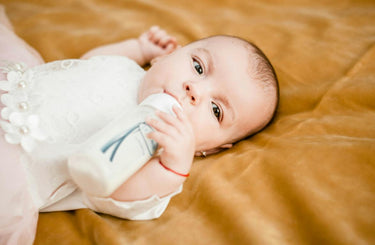
For some families, bottle-feeding in the postpartum period is a given from the start. For others, it's a decision fraught with many emotions: relief, uncertainty, sadness, pressure, shame, freedom, worry, or gratitude. Perhaps you wanted to breastfeed, and it's not working out. Perhaps you don't want to breastfeed. Perhaps you're pumping. Perhaps you're combining methods. Perhaps your baby needs supplementary nutrition for medical reasons.
What's important is this: Your baby needs nourishment, closeness, security, and loving guidance. And you need a feeding method that suits your reality.
The key takeaway is: Bottle-feeding is not less of a connection. It's a different form of feeding—and it too can be mindful, close, and secure.
In this article, you'll find calm, practical, and undogmatic guidance: What's important when bottle-feeding in the postpartum period? How can you feed with closeness? What should you know about safe preparation? What role do hunger cues, satiety, changing diapers, elimination communication, partners, visitors, and daily life play? And why you don't have to justify your baby's nutrition choices.
Bottle-feeding is not a breakdown of connection
Discussions around infant feeding often become very emotional. Breastfeeding is rightly described as valuable. At the same time, many mothers who do not breastfeed or do not exclusively breastfeed quickly feel judged.
However, connection is not tied to a single feeding method. Bonding develops through reliability, warmth, eye contact, physical proximity, responding to signals, gentle hands, voice, smell, and repetition.
Even when bottle-feeding, your baby receives:
- Nourishment
- Closeness
- Physical contact
- Eye contact
- Warmth
- Security
- Your voice
- Your attention
Bottle-feeding can be a moment of connection. Not just a technical act.
Why families bottle-feed in the postpartum period
There are many reasons why a baby might be bottle-fed in the postpartum period. Some are planned, others only arise after birth.
Possible reasons include:
- The mother does not want to breastfeed
- Breastfeeding is not suitable for physical or psychological reasons
- The baby needs supplementary nutrition
- The baby is not getting enough at the breast
- Breast milk is pumped and given via bottle
- Breastfeeding and bottle-feeding are combined
- Severe pain or sore nipples make breastfeeding difficult to start
- Illness, medication, or special circumstances play a role
- Adoption, co-parenting, or other family structures make bottle-feeding suitable
You don't have to justify the reason to others. What's important is that your baby is well-fed and that you receive professional support if there are medical or breastfeeding-related questions.
Breastfeeding, bottle-feeding, or combination: Thinking undogmatically
Sometimes it seems as if there are only two paths: either exclusive breastfeeding or no breastfeeding. In reality, there are many family realities.
For example, it's possible to:
- Exclusively breastfeed
- Exclusively bottle-feed
- Pump breast milk and give it via bottle
- Combine breastfeeding and formula
- Supplement temporarily
- Re-evaluate after breastfeeding problems
- Wean and bottle-feed
What's important is not that your path looks perfect to outsiders. What's important is that your baby is safely fed and that the mother doesn't break trying to chase an ideal.
If breastfeeding remains a topic for you, you can find further guidance here: Cluster feeding in the postpartum period, Milk coming in after birth, and Sore nipples in the postpartum period.
What infant formula is suitable at the beginning?
If your baby is not breastfed or not exclusively breastfed, industrially produced infant formula is usually used. It is designed to feed babies from birth when breast milk is not given or not given in full.
Please do not prepare bottle formula yourself from cow's milk, plant milk, grain drinks, or your own mixtures. Such homemade substitute foods are not suitable for infants.
kindergesundheit-info.de describes infant formula for bottles as an alternative when breastfeeding is not an option and advises against homemade bottle milk. Further information can be found at kindergesundheit-info.de: Infant formula for bottles.
It is important to:
- Use suitable infant formula
- Follow package instructions carefully
- Do not change the dosage on your own
- Consult a pediatrician or midwife for medical questions
- Do not use homemade substitute foods
If your baby was born prematurely, is very small, has special health conditions, or if you are unsure, please always clarify the suitable nutrition with a professional.
Safe preparation: Fresh, clean, precise
The safe preparation of bottle formula is important. Unlike direct breastfeeding, bottle-feeding always involves hygiene, water, powder, bottle, nipple, and temperature.
This is not meant to unsettle you. It just means that a few clear routines will help so you don't have to rethink every time.
Basic rules for preparation:
- Wash hands thoroughly before preparation
- Use a clean bottle and clean nipple
- Use fresh drinking water
- Do not take warm water directly from the tap
- Follow package instructions carefully
- Do not over or underdose the powder
- Prepare bottles fresh
- Check temperature before feeding
- Do not save and re-feed leftovers
The recommendations for hygienic preparation, the use of fresh drinking water, precise dosing, fresh preparation, and discarding leftovers are based on Gesund ins Leben: Preparation of infant formula and kindergesundheit-info.de: Preparation of infant milk.
Especially at night, it's helpful to have a clear routine. Tiredness is not a good time for complicated decisions.
Water for bottles: What's important?
In Germany, fresh tap water is generally suitable for preparing infant formula. It is important not to use standing water. Let the water run until it is cold from the tap, then warm it up appropriately.
Do not use warm water directly from the tap. If you are unsure, for example due to old pipes, house installations, or special circumstances, ask your pediatrician's office, midwife, or the responsible health department.
Practically, this means:
- Let cold water run first
- Use freshly drawn water
- Then warm the water
- Check temperature before feeding
- If unsure, use suitable bottled water
Gesund ins Leben recommends a lukewarm temperature of max 40 °C for mixing, also to avoid scalding. Always check the temperature before feeding, for example, with a few drops on the inside of your wrist.
Cleaning bottles and nipples
Bottles and nipples should be thoroughly cleaned after each meal. Milk residue is a good breeding ground for germs. Therefore, it makes sense not to leave bottles sitting around for a long time.
After feeding:
- Discard any leftovers
- Rinse bottle and nipple immediately
- Clean thoroughly with hot water and dish soap
- Rinse clean
- Allow to dry thoroughly
- Store dry and clean
Gesund ins Leben recommends rinsing bottles and nipples thoroughly immediately after each meal, cleaning them carefully, and storing them dry. Further information can be found at Gesund ins Leben: Cleaning bottles and nipples and at kindergesundheit-info.de: Hygiene in bottle-feeding.
A simple, repeatable cleaning routine is more important in the postpartum period than a complicated system.
How much should my baby drink?
Many parents want to know precise amounts when bottle-feeding. This is understandable because you can see how much has been drunk on the bottle. At the same time, this visibility can also create pressure.
Babies don't always drink the same amount. Some meals are larger, others smaller. It is important to pay attention to hunger and satiety cues and to have your baby's development professionally monitored.
Pay attention to:
- Hunger cues
- Satiety cues
- Regular wet diapers
- Weight development
- Alertness and general condition
- Feedback from midwife or pediatrician's office
Please do not pressure your baby to always finish the bottle. Even with bottle-feeding, your baby is allowed to show when they are full.
Recognizing hunger cues during bottle-feeding
Even with bottle-feeding, it's helpful to know early hunger cues. If your baby is already crying very hard, feeding is often more restless.
Hunger cues can include:
- Rooting
- Smacking
- Sucking on hand
- Restlessness
- Opening mouth
- Turning head from side to side
- Crying as a later signal
Satiety cues can include:
- Drinking slower
- Releasing the nipple
- Turning head away
- Relaxed body
- Falling asleep
- Not wanting to drink further
Feeding on demand, even with a bottle, means you observe your baby, not just the clock or the milliliter count.
If your baby cries a lot during feeding or if you are unsure, you will find a suitable addition here: Baby crying in the postpartum period: What really helps.
Bottle-feeding with closeness
A bottle can be given very intimately. Your baby doesn't have to lie alone while the bottle is in their mouth. They can be held, looked at, and accompanied.
For attachment-oriented bottle-feeding:
- Hold baby close to your body
- Offer eye contact
- Speak softly
- Allow for pauses
- Switch sides, similar to breastfeeding
- Do not pressure them to finish the bottle
- Pay attention to signals
- Do not hand over feeding to too many changing people
Your baby should not just be full. They should feel secure while being fed.
Who should give the bottle?
One advantage of bottle-feeding is that the second parent or a trusted caregiver can also feed. This can relieve stress and enable bonding.
At the same time, feeding should not be arbitrarily handed over to every visitor. For a newborn, feeding is an intimate moment. It requires familiar, calm people.
Suitable individuals are primarily:
- Mother
- Second parent
- Close caregivers
- People who are calm and attentive
- People who respect your feeding rules
You are allowed to tell visitors: "We feed our baby ourselves." This is not impolite. It is protection.
The feeding station in the postpartum period
Even with bottle feeding, a good feeding station is worthwhile. You might sit there often, especially at night or in the first few weeks. The spot should support you and your baby.
To the feeding station belong:
Even if you are not breastfeeding, you need care. Postpartum remains postpartum.
Many tips from the breastfeeding station article also apply to the feeding station: Setting up a breastfeeding station: What you really need in the postpartum period.
Bottle-feeding after a difficult start to breastfeeding
Some mothers bottle-feed because the start to breastfeeding was very difficult: sore nipples, pain, milk coming in, weak suck, cluster feeding, weight concerns, or emotional overwhelm.
Then bottle-feeding can be associated with relief—and at the same time with sadness.
You are allowed to feel both.
You are allowed to feel:
If the start to breastfeeding is bothering you, a conversation with a midwife, lactation consultant, or trusted professional can help—regardless of whether you want to continue breastfeeding, combine methods, or stop breastfeeding.
You can find relevant in-depth information here: Milk coming in after birth, Sore nipples in the postpartum period, and Cluster feeding in the postpartum period.
Combining: Breastfeeding and bottle-feeding
Some families combine breastfeeding and bottle-feeding. This can be temporary or permanent. It can happen for medical reasons, for relief, due to breastfeeding problems, or as a conscious decision.
A combination should be accompanied as well as possible, especially if you want to continue breastfeeding. This is because supplementing, pumping, feeding frequency, and milk production are all interconnected.
Questions for clarification might include:
Please don't make such decisions out of panic alone at three in the morning. If possible: sleep, drink, get support, then sort things out.
The partner during bottle-feeding
With bottle-feeding, the partner can be very directly involved. This is an opportunity—but also a responsibility. Feeding is not just "putting the bottle in." It's a moment of closeness and interaction.
The partner can:
- Prepare bottles according to instructions
- Feed the baby calmly
- Pay attention to hunger and satiety cues
- Take over a night feeding, if that suits you
- Clean bottles
- Change diapers after feeding
- Offer elimination communication
- Let the mother sleep
- Keep visitors away
If bottle-feeding is happening, the responsibility should not automatically fall on the mother. The second parent can contribute very concretely here.
You can find more on this here: Partner in the postpartum period: What really helps after birth.
Bottles, changing diapers, and elimination
After feeding, many babies eventually need to pee or poop. Some become restless, push, kick, or seem discontent shortly after a meal. Sometimes they need to burp, sometimes a fresh diaper, sometimes closeness — and sometimes they need to eliminate.
After the bottle, you can check:
- Does your baby need to burp?
- Is the diaper, insert, or elimination communication diaper wet?
- Is clothing or the waistband pressing on their tummy?
- Does your baby calm down when you hold them upright?
- Is an elimination communication offer appropriate?
A well-prepared changing station makes everyday life much easier. You can find more information here: Setting up a changing station: What you really need.
Bottle-feeding and Elimination Communication: Do they go together?
Yes. Elimination communication (EC) or "Windelfrei" is not tied to breastfeeding. A baby who is bottle-fed can also practice EC. Elimination communication does not depend on the feeding method.
After feeding, after waking up, and during diaper changes are often good standard situations. You don't have to read signals perfectly. You can simply offer.
Good EC moments can be:
- after waking up
- during diaper changes
- after the bottle
- when your baby is kicking restlessly
- when they are pushing or concentrating
- before sleeping, if it fits calmly
If nothing comes, that's not a problem. If something goes wrong, that's also not a problem. EC is not an additional chore. It's an opportunity to get to know your baby better.
Helpful items are:
- EC diaper as a backup
- absorbent inserts
- changing mat
- easy-to-open clothing
- wet bag or laundry bag
- calm standard situations
You can find suitable products here: EC diapers, diaper inserts, EC pants, and the changing mat for on the go.
If you want to learn more about elimination communication, you can start here: What does "Windelfrei from birth" actually mean?.
If you want to know what you really need to get started, read on here: EC Starter Kit: What you really need.
Bottle-feeding on the go
Being out and about with a baby requires some planning when bottle-feeding. It's especially important to prepare formula hygienically and fresh.
Helpful for on the go:
- clean bottle
- transport pre-measured powder separately
- take suitable water separately
- prepare bottle fresh
- check temperature
- discard leftovers
- pack a burp cloth
- take a changing mat, backup, and change of clothes
If you're unsure how to safely prepare bottles on the go, ask your midwife or pediatrician for a practical routine.
You can find more about packing your diaper bag here: Packing your diaper bag: What you really need on the go.
Bottle-feeding at night
Feeding at night is particularly challenging because tiredness, hunger, and hygiene come together. Good preparation helps reduce errors and stress.
Helpful at night:
- prepare clean bottles and have them ready
- prepare powder and water separately
- mix fresh
- use dimmed light
- check temperature
- discard leftovers
- place used bottle in a designated spot
- involve partner, if possible
Please do not prepare bottles hours in advance unless there is a professional recommendation to do so. Fresh preparation is the safe general rule.
You can find more about nighttime with a baby here: Dressing baby at night: What does a newborn need to sleep?.
Bottle-feeding and visitors
If your baby is bottle-fed, some visitors might want to feed them. This is understandable, but not automatically appropriate.
Feeding is a very intimate moment. You get to decide who feeds your baby. You can also say that only parents or close caregivers should give the bottle.
Helpful visitor rules:
- Baby is not fed by visitors if you don't want them to
- Visitors do not comment on your feeding decision
- Bottle-feeding is not seen as an opportunity to hold the baby
- Visitors should rather bring food for the parents
- no discussion about breastfeeding or bottle-feeding in the postpartum period
A possible phrase:
"We feed our baby ourselves. You can help us most by bringing food or offering a quick hand with household chores."
You can find more about visitor boundaries here: Visitors in the postpartum period: How much external closeness is truly good?.
Bottle-feeding with a sibling
If there's an older child, bottle-feeding can spark interest. Some siblings might want to help or even feed the baby themselves. This is understandable but should be well-supervised.
The sibling can help by:
- bringing a burp cloth
- singing a song
- sitting next to you
- choosing a onesie
- watching during diaper changes after feeding
Not suitable is:
- letting the baby feed alone
- letting them hold the bottle without direct supervision
- transferring responsibility for the feeding amount
- making the older child responsible for the baby's crying
The older child can be involved. But they are not responsible for the baby.
You can find more about this here: Postpartum with a sibling: What really helps you.
Bottle-feeding after a C-section
After a C-section, bottle-feeding can offer practical relief if other caregivers take over feedings. At the same time, you'll still need good positions to avoid straining your abdomen and incision.
Helpful after a C-section:
- have the baby handed to you
- use comfortable pillows
- have bottle and burp cloth within reach
- partner handles preparation and cleaning
- delegate diaper changes after feeding
- limit visitors
- avoid unnecessary standing up
You can find more information here: Postpartum after C-section: What really helps you.
Guilt feelings when bottle-feeding
Many mothers feel guilty when they bottle-feed. Even if it was medically sensible. Even if breastfeeding caused massive pain. Even if they knew from the beginning that they didn't want to breastfeed.
Guilt often arises not from one's own truth, but from external expectations.
You can tell yourself:
- My baby is being fed.
- I am more than just a feeding method.
- Bonding happens not only at the breast.
- I am allowed to make decisions that suit our family.
- My worth as a mother does not depend on breastfeeding.
- I can be sad and still act correctly.
If guilt, sadness, or pressure are heavily weighing on you, talk to a midwife, counseling center, doctor, or trusted person. Your feelings deserve space.
What you don't need when bottle-feeding
In the postpartum period, you don't need discussions about your baby's feeding. You need support.
Not helpful are:
- unsolicited breastfeeding advice
- comments like "You should have just tried harder"
- judgments about your decision
- visitors who want to feed the baby
- constant comparisons with other babies
- milliliter panic without professional context
- homemade substitute foods
- unclean or hurried preparation
Helpful is: calm, clear routine, professional guidance, and people who don't judge you.
When to seek professional help
When bottle-feeding, there are situations that should be professionally clarified. Don't wait too long if you're unsure.
Please seek advice if:
- your baby is not feeding well
- your baby seems very sleepy or noticeably unwell
- your baby has few wet diapers
- your baby is not gaining weight well
- they frequently spit up or vomit heavily
- diarrhea, fever, or signs of illness occur
- you don't know which formula is suitable
- you're unsure about preparation or quantity
- you are emotionally heavily burdened
A midwife, pediatrician, or doctor can help you assess feeding amount, preparation, weight development, and general condition.
If your baby frequently spits up or has tummy aches, you can find suitable complementary information here: Baby spitting up after feeding and Baby has tummy aches in the postpartum period.
A simple bottle-feeding checklist for the postpartum period
For preparation
- wash hands
- use a clean bottle
- use fresh drinking water
- follow package instructions exactly
- do not dose freely
- prepare fresh
- check temperature
- discard leftovers
For the feeding spot
- burp cloth
- comfortable pillows
- water for the feeding person
- small light
- changing mat within reach
- backup, diaper, or EC diaper
- inserts
For closeness during feeding
- hold baby close
- offer eye contact
- allow breaks
- don't pressure to finish the bottle
- pay attention to satiety cues
- speak softly
- don't pass to too many people
For diaper changes and EC
- check diaper or insert after feeding
- offer EC during diaper changes, if appropriate
- use standard situations after waking up
- use an EC diaper as a backup
- no pressure if nothing comes
Frequent questions: Bottle-feeding in the postpartum period
Is bottle-feeding less attachment-oriented than breastfeeding?
No. Breastfeeding has particular advantages, but attachment is not only created through breast milk. Closeness, eye contact, body warmth, calm, and sensitive responsiveness can also develop during bottle-feeding.
What milk does a newborn get if not breastfed?
Typically, suitable industrially produced infant formula. If you're unsure which formula is right for your baby, you should clarify with a midwife, pediatrician, or doctor.
Can you prepare bottles in advance and give them later?
The safe general rule is: prepare bottles fresh before the meal and discard leftovers. For special situations, please seek professional advice for an appropriate routine.
Can tap water be used for bottles?
Fresh tap water in Germany is generally suitable. Let it run until it's cold from the tap, then warm it up. If you're unsure about pipes or water quality, seek professional advice.
Does my baby have to finish the bottle?
No. Pay attention to satiety cues. Your baby should not be pressured to finish the bottle.
Can you bottle-feed and still practice elimination communication?
Yes. Elimination communication is not dependent on breastfeeding. Good standard situations are after waking up, during diaper changes, or after bottle-feeding.
Who is allowed to give my baby the bottle?
Ideally, trusted, calm caregivers. You don't have to let visitors feed the baby. Feeding is an intimate moment and can remain with the parents.
When should I seek help with bottle-feeding?
If your baby is not feeding well, has few wet diapers, is not gaining weight well, seems unusually sleepy, frequently vomits, has a fever, or if you are unsure about formula, quantity, or preparation, seek professional advice.
What if I feel guilty about bottle-feeding?
Then you are allowed to talk about it. Bottle-feeding can be associated with sadness, relief, or pressure. Your worth as a mother does not depend on a feeding method.
A calm thought to conclude
Bottle-feeding in the postpartum period can be many things: planned, necessary, relieving, sad, matter-of-fact, complicated, healing, or all at once.
What it doesn't have to be: a reason for shame.
Your baby needs nourishment. It needs closeness. It needs safe preparation. It needs people who see its signals. It doesn't need its mother to justify every decision.
If you bottle-feed, you are allowed to do it consciously. Close. Calm. Safe. With eye contact, body warmth, breaks, loving hands, and a clear routine.
And if others want to comment, your boundary can simply be:
Our baby is fed. And we are finding our way.
This also aligns with Mata Origin's philosophy: starting the baby year naturally doesn't mean every family has to follow the same path. It means combining closeness, safe care, practical routines, and natural materials in a way that suits your real situation.
If you want to accompany your baby with soft materials, practical cuts, and an undogmatic view on diapering, elimination communication, and closeness, Mata Origin offers thoughtful companions for this first period.
Discover suitable products for the postpartum period, diapering, and elimination communication: EC diapers, diaper inserts, EC pants, and the changing mat for on the go.
Note: This article does not replace medical, midwifery, or nutritional advice. It is intended to provide guidance. In case of premature birth, low birth weight, feeding difficulties, unusual sleepiness, few wet diapers, fever, vomiting, diarrhea, poor weight gain, uncertainty about infant formula, water quality, preparation, quantity, or special health questions, please contact your midwife, pediatrician, or doctor. In case of acute severe symptoms, seek immediate medical help.