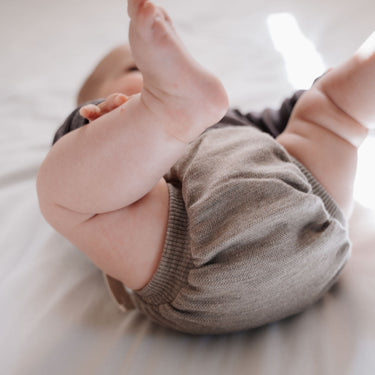
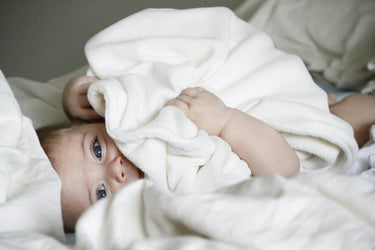
How do I dress my baby correctly at night? This question concerns almost all expectant parents. During the day, you can see, feel, and pick up your baby, and quickly take off a layer. At night, however, you want your baby to sleep safely, warmly, and peacefully — without getting cold or overheating.
Especially with newborns, this decision often feels uncertain. Is a onesie enough? Does your baby need pajamas? Which sleeping bag is suitable? What's different in summer than in winter? And how do you tell at night if your baby is too warm or too cold?
The most important guideline is: Your baby should be comfortably tempered at night, not wrapped up as warmly as possible. A suitable sleeping bag, breathable clothing, and regularly checking the neck help more than rigid rules.
In this article, you will find natural, practical, and calm guidance: how you can dress your baby at night, which materials are sensible, what to look out for in summer, winter, and transitional seasons, and how sleepwear also works with diapering or elimination communication.
First things first: Safe sleep takes precedence over beautiful sleepwear
Baby sleepwear should warm, soothe, and protect. But it should never be more important than a safe sleep environment.
For babies, less in bed is usually better. A suitable sleeping bag is generally safer than a loose blanket. Pillows, thick blankets, cot bumpers, furs, and many cuddly items do not belong in a newborn's sleeping area.
A hat is also usually not necessary at night in heated indoor rooms. Babies release excess heat, among other things, through their heads. If the head is covered, heat cannot escape as well.
Important for the night:
- Lay baby on their back to sleep
- Suitable sleeping bag instead of a loose blanket
- No pillows, cot bumpers, or furs in the crib
- No hat in warm indoor rooms
- Do not dress too warmly
- Check the neck instead of just judging hands or feet
- If in doubt, ask your midwife, pediatrician, or doctor
The safety-related information in this article is based on the recommendations of kindergesundheit-info.de for a safe sleep environment and on the information for the prevention of sudden infant death syndrome (SIDS).
Sleepwear is thus part of a larger whole. It should give your baby security without overheating or restricting them.
How do you tell at night if your baby is dressed correctly?
Many parents first check the hands or feet. These can be cool in babies, even though the body is comfortably warm. Therefore, the neck or upper back is usually a better indicator.
Here's how you can check:
- If the neck feels warm and dry, your baby is usually dressed appropriately.
- If the neck is damp, hot, or sweaty, your baby is probably too warm.
- If the neck feels cool and your baby seems restless, an additional layer might be useful.
Over time, you will get to know your baby better. Some babies sweat quickly. Others need a bit more warmth. It's important that you don't follow a rigid plan, but rather observe and adapt.
The simple night combination: Bodysuit, pajamas, sleeping bag
For many babies, a simple combination of bodysuit, pajamas, and a sleeping bag works at night. Depending on the temperature, season, and material, a lighter or warmer layer is chosen.
Classic nightwear can look like this:
- Diaper, elimination communication wrap, or other backup
- Bodysuit as the first layer
- Pajamas or soft all-in-one suit
- Suitable sleeping bag
In summer, pajamas can be omitted or be very light. In winter, a warmer sleeping bag or a warmer first layer may be appropriate. Flexibility is particularly important during transitional seasons.
If you are unsure, start with slightly lighter clothing and check the neck after some time. A sweaty baby is a sign that you should reduce a layer.
Which materials are comfortable at night?
At night, clothes lie on a baby's skin for many hours. Therefore, it's worth taking a conscious look at materials. They should be soft, not scratchy, remain breathable, and feel pleasant.
Wool
Fine wool can be very comfortable at night, especially in cooler months. It warms, absorbs moisture, and can regulate temperature. It is important that it is softly processed and that your baby tolerates it well.
Wool/Tencel
Wool/Tencel is soft, light, and supple. For close-fitting clothing such as bodysuits, it can be a very pleasant choice if you want to combine natural materials with a particularly gentle feel.
Cotton
Cotton is easy to care for, familiar, and washable. It works very well for many babies but can feel damp or cool more quickly if your baby sweats or clothing gets wet.
You can find more information about material selection here: Natural baby clothing: wool, wool/Tencel, and cotton compared.
Long-sleeve or short-sleeve bodysuit at night?
Whether your baby needs a long-sleeve or short-sleeve bodysuit at night depends primarily on room temperature, sleeping bag, and the season.
A long-sleeve bodysuit is useful:
- in cooler rooms
- in winter
- during transitional seasons
- if the sleeping bag is rather light
- if your baby quickly feels cool
A short-sleeve bodysuit is useful:
- in summer
- in warm indoor rooms
- under warmer pajamas
- if your baby sweats quickly
If you're just planning your initial layette, you can find more information on bodysuit quantity and selection here: How many bodysuits does a newborn need?.
Wrap bodysuit or pull-over bodysuit for the night?
For newborns, wrap bodysuits are often very practical at night. They don't have to be pulled over the head and can be put on more calmly. Especially in the first few weeks, when you're still uncertain about diapering at night or frequently changing your baby, this can be a relief.
Pull-over bodysuits can also work, especially if they are soft and very stretchy. Many parents like to use them later when dressing is more routine.
Practical for night-time:
- soft wrap bodysuits in the first few weeks
- few, simple fastenings
- no hard snaps in uncomfortable places
- enough room in the diaper area
- material that still feels comfortable after several hours
For detailed decision-making assistance, see here: Wrap bodysuit or pull-over bodysuit: Which is better?.
Pajamas or romper: What's better at night?
Soft pajamas, all-in-one suits, or rompers are suitable for nighttime. The name isn't important, but rather its practicality.
Good pajamas should fit comfortably, not constrict the stomach, and be easy to open for night-time diaper changes. Especially for newborns, simple snaps or zippers are helpful if they don't bother the baby and don't scratch the skin.
Helpful at night are:
- soft fabrics
- comfortable fit
- no tight cuffs
- easy access to the diaper area
- no bothersome seams on the back
- no thick hoods or hard details
Pajamas don't have to be particularly cute or elaborate. At night, the main thing is that your baby can lie calmly, comfortably, and safely.
The sleeping bag: Why it's so important at night
A baby sleeping bag is particularly practical for nighttime because it keeps your baby warm without lying loosely over their body. Unlike a blanket, it can't easily slip over their face.
A good sleeping bag should fit your baby's size. It should not be too wide at the neck so that your baby cannot slip inside. At the same time, it should allow enough freedom of movement for the legs and hips.
When choosing a sleeping bag, pay attention to:
- appropriate size
- not too large a neck opening
- enough freedom of movement
- breathable material
- appropriate warmth for the season
- easy handling at night
If a sleeping bag is too warm, dress your baby in fewer layers underneath. If it is very light, a warmer layer underneath may be appropriate.
What does TOG mean for baby sleeping bags?
Sleeping bags often have a TOG rating. This describes approximately how warm a sleeping bag is. A lower TOG value indicates lighter sleeping bags, while a higher value indicates warmer sleeping bags.
The TOG rating can be a good guide, but it doesn't replace your observation of your baby. Room temperature, material, bodysuit, pajamas, and your baby themselves always play a role.
Important for TOG ratings:
- Observe manufacturer's instructions
- Do not add too many layers of clothing
- Prioritize the neck check over pure tables
- Reduce clothing or sleeping bag if sweating occurs
- If in doubt, ask your midwife or pediatrician
TOG tables can help. But they are not a rigid rule for every night.
What do you dress your baby in at night in winter?
In winter, your baby usually needs a bit more warmth at night, but even here, the rule is: don't overheat. Heated rooms can be warmer than one might think, and a too-thick sleeping bag plus several layers can quickly become too much.
In winter, this might be suitable:
- Long-sleeve bodysuit
- Soft pajamas
- Warmer sleeping bag
- In cool rooms, natural materials like wool or wool/Tencel
- No hat in warm indoor rooms
Check your baby's neck. If it's damp or very warm, remove a layer. If your baby seems cool, you can choose a warmer layer.
You can find more information about winter clothing here: Dressing your baby in winter: warm without overheating.
If you're expecting a winter baby, you'll also find a complete guide here: Winter baby layette: What you really need.
What do you dress your baby in at night in summer?
In summer, your baby needs significantly less clothing at night. Depending on the room temperature, a light bodysuit and a thin summer sleeping bag may be sufficient. On very warm nights, even less might be appropriate.
In summer, this might be suitable:
- Short-sleeve bodysuit
- Light pajamas or just a bodysuit
- Thin summer sleeping bag, if appropriate
- No thick layers
- No hat
In hot weather, it is especially important to pay attention to sweating, drinking behavior, and your baby's general impression. If your baby is very warm, noticeably lethargic, unusually restless, or not drinking well, seek professional help.
You can find more information on summer clothing here: Dressing your baby in summer: light and breathable.
If you are expecting a summer baby, you will also find a suitable overview here: Summer baby layette: What you really need.
What do you dress your baby in during transitional seasons at night?
Spring and autumn nights are often particularly changeable. A room can still be warm in the evening and feel significantly cooler in the morning. Therefore, flexible layers are important.
During transitional seasons, this might be suitable:
- Long-sleeve bodysuit or short-sleeve bodysuit depending on the room
- Light to medium pajamas
- Suitable sleeping bag
- If necessary, wool/Tencel or fine wool as a balancing material
If you are unsure at night, check the neck. Transitional seasons do not mean that you have to constantly change clothes. But you can adjust the combination if you notice that your baby is sweating or feels cool.
You can find more information here: Dressing your baby in transitional seasons: Planning spring and autumn correctly.
Dressing baby at night at 18 to 20 degrees Celsius
Many bedrooms are approximately in this range. For many babies, a simple combination of a bodysuit, pajamas, and a sleeping bag works well.
Possible combination:
- Long-sleeve or short-sleeve bodysuit
- Light to medium pajamas
- Suitable sleeping bag
Whether long-sleeved or short-sleeved is more sensible depends on the sleeping bag, material, and your baby. A neck check after some time will give you better guidance than a fixed table.
Dressing baby at night in a very warm room
If the bedroom is very warm, your baby needs significantly less clothing. A bodysuit might be enough. Sometimes a very thin sleeping bag is useful, sometimes it's too much.
In a warm room:
- light short-sleeve bodysuit or sleeveless bodysuit
- possibly a thin summer sleeping bag
- no additional blanket
- no hat
- regularly check the neck
Make sure to keep the room as cool as possible during the day and to ventilate safely at night, without directing direct drafts at your baby.
Dressing baby at night in a cool room
If the room is cool, your baby may need a warmer layer. Nevertheless, they should not be overloaded with many thick layers.
In a cool room:
- Long-sleeve bodysuit
- Warmer pajamas
- Appropriate warm sleeping bag
- If necessary, natural materials like wool or wool/Tencel
- No loose blanket as an additional layer
If your baby seems cool despite warmer sleepwear or if you are unsure, talk to your midwife or pediatrician. Individual support is especially important for very small or premature babies.
What about socks at night?
Whether your baby needs socks at night depends on the pajamas, sleeping bag, and temperature. Many pajamas have feet. Then additional socks are often not necessary.
If your baby wears footless pajamas and quickly gets cold feet, soft socks can be useful. However, they should not constrict or slip.
When choosing socks for night-time, pay attention to:
- soft cuffs
- no constriction
- no slipping
- comfortable material
- do not use additionally if your baby is sweating
Cool feet alone do not automatically mean that your baby is cold overall. The neck remains the better indicator.
Why a hat is usually not necessary at night
Hats are sometimes useful immediately after birth, outdoors, or in cool situations. At night, in a heated indoor room, a healthy baby normally does not need a hat.
The head should remain uncovered so that your baby can release excess heat. If you feel that your baby needs a hat at night, please clarify this individually with your midwife or pediatrician.
Night diaper changes: Clothing that doesn't wake you up
In the first few weeks, diaper changes are frequent at night. Therefore, sleepwear should not only be warm and soft but also practical.
The more complicated the clothing, the more awake everyone involved often becomes. A bodysuit and pajamas that open easily in the diaper area make night changes calmer.
Helpful for night-time diaper changes:
- Wrap bodysuit or easily accessible bodysuit
- Pajamas with easy opening
- Few fastenings
- Dimmed light
- Change of clothes within reach
- Soft changing pad
Prepare everything as much as possible at night so you don't have to search for long. This helps your baby fall back asleep more quickly.
If you want to calmly prepare your changing area before birth, you'll find suitable guidance here: Setting up a changing area: What you really need.
Diaper-free at night: Is it possible?
Yes, nighttime elimination communication is possible. But it's not a must. Some babies become restless because they need to go, and after EC, they sleep more easily. Other families want as few additional routines as possible at night.
If you want to try diaper-free nights, clothing is particularly important. It should keep them warm and still allow quick access.
Helpful for nighttime EC:
- EC diaper as a backup
- absorbent inserts
- EC pants or easy-to-open clothing
- potty within reach
- dimmed light
- underlay/mat
- calm attitude without pressure to perform
If nighttime EC stresses you out, the diaper can simply remain a backup or main solution at night. Diaper-free can take place during the day and pause at night.
You can find suitable sections here: EC diapers, EC pants, diaper inserts, and the portable changing mat.
If you want to learn more about diaper-free, you can start here: What does "diaper-free from birth" actually mean?.
If you want to know what you really need to start with elimination communication, read on here: EC Starter Kit: What you really need.
What to do if your baby sweats at night?
If your baby sweats at night, they are probably too warm. Check their neck and remove a layer. Often, it's enough to replace a warmer sleepsuit with a lighter one or dress them in less clothing under the sleeping bag.
Possible adjustments:
- Replace long-sleeve bodysuit with short-sleeve bodysuit
- Choose lighter sleepwear
- Use a thinner sleeping bag
- Remove socks
- Better regulate room temperature
If your baby also has a fever, seems ill, drinks poorly, or is unusually sleepy, seek medical advice.
What to do if your baby seems cool at night?
If the neck is cool and your baby seems restless, an additional or warmer layer may be beneficial. Be careful not to simply add loose blankets, but rather adjust sleepwear or the sleeping bag appropriately.
Possible adjustments:
- Replace short-sleeve bodysuit with long-sleeve bodysuit
- Choose warmer sleepwear
- Use a warmer sleeping bag
- Add socks, if appropriate
- Avoid drafts
For very small babies, premature babies, or those with special health conditions, you should seek individual recommendations.
Dressing baby at night with a fever
If your baby has a fever, you should not bundle them up extra warmly. Many parents instinctively want to warm them, but with a fever, too much clothing can be a burden. Your baby then needs special attention and, if necessary, medical support.
In case of fever, unusual behavior, poor drinking, or uncertainty, please contact your pediatrician or the on-call medical service. For very small babies, it's better to seek professional advice early.
How many sleepsuits does a newborn need?
For the first few weeks, 2 to 4 sleepsuits or all-in-ones are usually sufficient. If your baby spits up frequently, often has leaks at night, or if you wash less often, 4 to 6 items can be more relaxing.
As a guide:
- 2 to 4 sleepsuits for regular washing
- 4 to 6 sleepsuits for more reserve
- not too many in size 50
- focus on size 56
- plan for some items in size 62
More information on size planning can be found here: Which baby size for birth: 50, 56, or 62?.
What belongs in the nighttime initial equipment?
For the night, you don't need a lot of specialized equipment. A few good, safe, and practical items are enough.
Useful items are:
- 5 to 7 bodysuits
- 2 to 4 sleepsuits or all-in-ones
- 1 to 2 suitable sleeping bags
- some soft socks as needed
- changing mat
- change of clothes within reach
- for diaper-free: EC diaper, inserts, and potty within reach
If you are planning your entire equipment, you can find the right starting point here: Baby's First Equipment: What you really need.
If you want to prepare your postpartum period more calmly overall, you can find more information here: Preparing for the postpartum period: What you can organize before birth.
Typical mistakes when dressing baby at night
Most mistakes arise from care. Parents want to protect their baby and sometimes dress them too warmly. Or they focus too much on cold hands and add extra layers.
Common mistakes include:
- too many layers under a warm sleeping bag
- hat indoors in a warm room
- loose blankets in addition to the sleeping bag
- only checking hands or feet
- choosing sleepwear that is complicated to open at night
- sleepsuits that are too tight in the diaper area
- bundling up extra warmly when the baby has a fever
At night, clothing should be comforting and protective. However, it should not lead to overheating or unnecessary stress during diaper changes.
A simple nighttime checklist
For normal nights
- Bodysuit
- Sleepsuit or all-in-one
- Suitable sleeping bag
- Neck check
- No hat
- No loose blanket
For warm nights
- Light bodysuit
- Possibly only a thin sleeping bag
- No socks if your baby is warm
- Keep room cool
- Watch for sweating
For cool nights
- Long-sleeve bodysuit
- Warmer sleepsuit
- Warmer sleeping bag
- Avoid drafts
- Seek professional advice if unsure
For nighttime diaper changes or elimination communication
- Easy-to-open clothing
- Dimmed light
- Change of clothes within reach
- Underlay/mat
- Backup or inserts
- Calm, short routines
Frequent questions: Dressing baby at night
What do you dress a newborn in at night?
Many newborns sleep well in a bodysuit, sleepsuit, and a suitable sleeping bag. Depending on the season and room temperature, you choose lighter or warmer materials.
How do I know if my baby is too warm at night?
Feel their neck or upper back. If this area is damp, hot, or sweaty, your baby is probably too warm. You should then reduce a layer.
How do I know if my baby is too cold at night?
A cool neck combined with restlessness can be an indication that your baby needs more warmth. Cold hands or feet alone are not always conclusive.
Does my baby need a hat at night?
Normally not in heated indoor spaces. The head should remain uncovered so that your baby can release excess heat. If there are special reasons, ask your midwife or pediatrician.
Should my baby wear socks at night?
That depends on the sleepsuit, sleeping bag, and temperature. If your baby has warm feet or is sweating, socks are not necessary. If they are wearing footless clothing and seem cool, soft socks can be useful.
What do you dress a baby in at night in summer?
On warm nights, a light bodysuit and a thin sleeping bag are often sufficient. Sometimes even less is appropriate. It is important to avoid sweating and to check the neck.
What do you dress a baby in at night in winter?
In winter, a long-sleeve bodysuit, sleepsuit, and warmer sleeping bag can be suitable. Nevertheless, you should avoid overheating and regularly check if your baby is sweating.
Can you go diaper-free at night?
Yes, but it's not a must. Some families do EC at night, others use a diaper or EC diaper as a backup at night. It's important that it doesn't stress you out and that your baby stays warm.
What clothing is practical at night with cloth diapers or EC diapers?
Enough space in the diaper area is important. Bodysuit and sleepsuit should not be too tight or compress the backup. Soft, easy-to-open clothing is usually the most relaxed at night.
A calm thought to conclude
Dressing your baby correctly at night is not an exact science. It's a combination of room temperature, season, sleeping bag, material, and your baby.
You don't have to plan every night perfectly. You are allowed to observe, feel, and adjust. Your baby's neck often gives you good guidance. Natural materials can help because they feel pleasant and regulate temperature.
Important: safe, simple, and not too warm. A suitable sleeping bag, soft clothing, and a reduced sleep environment are often the best foundation.
This way, nighttime clothing does not become another source of uncertainty, but a small building block for a secure start to your baby's first year.
If you want to accompany your baby with natural materials, practical cuts, and an undogmatic view of diapering, elimination communication, and closeness, you will find thoughtful companions for precisely this initial period at Mata Origin.
Discover suitable products for calm nights and your baby's everyday life: EC pants, EC diapers, diaper inserts, and the portable changing mat.
Further guidance on preventing Sudden Infant Death Syndrome can be found at kindergesundheit-info.de: Preventing Sudden Infant Death.
Note: This article does not replace medical advice. It is intended to provide guidance. In case of premature birth, illness, fever, unusual temperature, poor drinking, overheating, uncertainty, or specific health questions, please contact your midwife, pediatrician, or general practitioner. In case of acute severe symptoms, seek immediate medical help.