
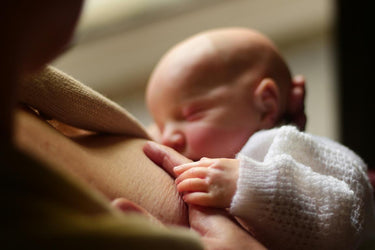
When your baby spits up after feeding, it can quickly be unsettling during the postpartum period. You've just breastfed or given a bottle, your baby seems content — and suddenly milk comes back out. On your shirt. On the burp cloth. On the fresh onesie. Maybe just a little. Maybe more than you expected.
Many parents then wonder: Is this normal? Did my baby drink too much? Is it not tolerating the milk? Is this already vomiting? Do I need to change something? And how do I know when spitting up is harmless and when I need medical advice?
The most important guidance is: Spitting up after feeding is common in babies. Nevertheless, you should always take severe, projectile, or repeated vomiting, signs of illness, and an unusually listless baby seriously.
In this article, you will find calm, practical, and non-dogmatic guidance: why babies spit up after breastfeeding or bottle-feeding, what you can do in everyday life, the role of burping, feeding position, clothing, diapering, elimination communication, and abdominal pressure — and when you should seek professional help.
Why Babies Spit Up After Feeding
Many babies spit up after breastfeeding or feeding during the first months of life. A common reason is that the transition between the esophagus and the stomach is still immature. Milk can therefore flow back up more easily, especially if the baby has swallowed air, drunk hastily, or is moved immediately after feeding.
This does not automatically mean that your baby is sick. Many babies spit up small amounts of milk and still develop well.
Spitting up can happen more often if:
- your baby drinks very hastily
- it swallows air while drinking
- it is laid down immediately after drinking
- it is moved a lot after drinking
- pressure is applied to the abdomen during diaper changes
- clothing or diaper press on the abdomen
- your baby drinks a lot or very frequently
- it brings up milk when burping
kindergesundheit-info.de describes that it is not unusual for babies to bring up milk when burping during the first months of life. Possible reasons include the still immature closure at the entrance to the stomach and hasty drinking with air swallowing. You can find more information at kindergesundheit-info.de: Common Breastfeeding Problems.
Spitting Up or Vomiting: What's the Difference?
In everyday life, spitting up and vomiting are often confused. However, for assessment, the difference is important.
When spitting up, milk usually flows or dribbles passively out of the mouth. It often happens when burping, after feeding, or when the baby is moved. The baby often does not appear severely ill.
Vomiting is usually more forceful. The milk comes out in a gush, with retching or visible effort. The baby may appear uncomfortable, sick, listless, or exhausted.
Spitting up often looks like this:
- Milk flows out of the mouth
- often when burping
- baby often remains content afterwards
- smaller amounts
- without great effort
Vomiting usually looks like this:
- Milk comes out forcefully or in a gush
- baby gags or appears strained
- abdominal muscles visibly contract
- baby appears sick, listless, or inconsolable
- it happens repeatedly or in larger quantities
gesund.bund.de describes vomiting in newborns as involuntary, forceful regurgitation of milk, in which the abdominal muscles also contract. You can find more information at gesund.bund.de: Vomiting in Newborns.
Is Spitting Up After Feeding Normal?
Yes, small amounts of spitting up after feeding can be normal in a baby's daily life. Many babies spit up and still gain weight well, feed well, have regularly wet diapers, and appear generally alert and strong.
The old saying "spitting children are thriving children" is very general and does not replace a medical assessment. But it shows: spitting up alone is not automatically a sign of a serious illness.
It is more reassuring if your baby:
- feeds well
- has regularly wet diapers
- gains weight
- appears alert and interested between meals
- does not cry painfully continuously
- does not appear sick after spitting up
- shows no other symptoms
If you are unsure whether the amount is still normal or if your baby is getting enough, please ask your midwife, pediatrician, or doctor. Especially during the postpartum period, it's better to ask too early.
Reflux in Babies: What Does That Mean?
When milk or stomach contents flow back up, it is called reflux. In babies, this often manifests as spitting up, regurgitation, or burping after breastfeeding or feeding.
In many babies, this reflux is not problematic in the first few months and resolves as they mature. However, if your baby is very restless, cries frequently, feeds poorly, gains weight poorly, or you have the impression that it is in pain, you should seek professional advice.
kindergesundheit-info.de describes that reflux in the first months of life usually manifests as increased spitting up, regurgitation, or burping after breastfeeding or feeding, and most children are not affected by it. You can find more information at kindergesundheit-info.de: Reflux in Babies.
What Can Help with Spitting Up After Feeding
You cannot always prevent spitting up. But you can often make the situation a little easier.
Helpful tips include:
- feed more calmly
- pay attention to early hunger cues before your baby gets very agitated
- take breaks in between
- offer burping
- hold your baby upright for a while after feeding
- do not move intensely immediately after feeding
- keep clothing and diaper loose around the abdomen
- diaper gently and with as little pressure on the abdomen as possible
Important: These tips are not a guarantee. Some babies spit up regardless. In such cases, the goal is not to prevent every instance of spitting up, but to observe your baby well and make everyday life manageable.
Burping: Does Every Baby Need to Burp?
Not every baby burps after every meal. Some need it often, others rarely. If your baby seems restless after feeding, squirms, spits up, or is difficult to put down, burping can help.
You can try:
- hold baby upright on your shoulder
- keep still
- gently stroke their back
- do not pat vigorously
- take a short break during breastfeeding or bottle-feeding
- don't force it indefinitely if nothing comes out
If milk comes up when burping, it is not automatically a bad thing. Keep a burp cloth handy and observe how your baby behaves afterwards.
Holding Upright After Feeding
Many babies spit up less or seem more content if they are held upright for a while after feeding. This can be in your arms, on your shoulder, or held calmly against your body.
Practical tips:
- place a burp cloth over your shoulder or chest
- hold the baby still
- do not move wildly immediately
- involve your partner
- do not create abdominal pressure immediately after feeding
Especially during the postpartum period, this is also a good task for the other parent: holding the baby after breastfeeding or bottle-feeding while the mother drinks, eats, goes to the toilet, or rests briefly.
Breastfeeding and Spitting Up
When breastfeeding, spitting up can have various reasons. Perhaps your baby drinks very hastily. Perhaps the milk flow is strong. Perhaps it swallows air, latches on and off frequently, or is very restless while breastfeeding.
When breastfeeding, you can check:
- Is your baby latched on well?
- Is your baby very agitated before coming to the breast?
- Does it swallow a lot of air?
- Is the milk flow very strong?
- Does your baby need a break in between?
- Does it need to burp?
- Does it calm down if it stays upright for a short time after drinking?
If breastfeeding also hurts, your baby feeds poorly, or you are unsure, seek support. Small changes in latching or positioning can make a big difference.
You can find more information here: Sore Nipples in the Postpartum Period: What Really Helps with Breastfeeding and here: Milk Engorgement After Birth: What Really Helps in the Postpartum Period.
Cluster Feeding and Spitting Up
During cluster feeding phases, your baby often feeds very frequently. Many small feeding sessions, need for closeness, fatigue, sucking, and digestion all come together. Spitting up can be more noticeable during this time.
This doesn't automatically mean you are over-breastfeeding. However, it can help to make feeding sessions calmer and plan some time for burping or holding upright after longer feeding periods.
Helpful with cluster feeding:
- Have burp cloths ready
- Allow short breaks between longer feeding sessions
- Hold baby upright after feeding
- Don't immediately change diaper after every small feed if not necessary
- Keep clothing loose around the abdomen
- Partner holds the baby in between
You can find more information here: Cluster Feeding in the Postpartum Period: When Your Baby Constantly Wants to Feed.
Bottle Feeding and Spitting Up
Babies who are bottle-fed can also spit up. Sometimes they drink too quickly, swallow air, or drink more than they currently need. Nipple size and feeding position can also play a role.
Helpful with bottle feeding:
- Hold baby close and slightly upright
- feed calmly
- allow breaks
- pay attention to satiety cues
- do not push to finish the bottle
- check nipple size if your baby drinks very hastily or chokes
- allow time for burping after feeding
Please do not change food, dosage, or preparation on your own. If you have the impression that your baby is not tolerating the food, is vomiting a lot, gaining weight poorly, or is restless, ask your midwife, pediatrician, or doctor.
You can find more information here: Bottle Feeding in the Postpartum Period.
Diapering After Feeding: Sometimes Better Before
If your baby frequently spits up after feeding, changing their diaper immediately afterwards can be unfavorable. During a diaper change, your baby is moved, their legs are lifted, and sometimes pressure is applied to their abdomen. This can cause milk to come back up more easily.
Some babies benefit from being changed before feeding — or from having a short upright break against your body after feeding.
You can try:
- change diaper before breastfeeding or bottle-feeding
- hold upright first after feeding
- do not press legs strongly towards the tummy when changing
- turn gently instead of moving hectically
- close diaper or elimination communication diaper loosely enough
- have a burp cloth ready
Of course, if the diaper or insert is very wet or full, it should be changed. It's not about rigid rules, but about getting to know your baby better.
You can find more information about setting up a changing station here: Setting up a Changing Station: What You Really Need.
For small diapering or elimination communication moments on the sofa, bed, or on the go, a compact changing mat can also help: Travel Changing Mat.
Spitting Up and Elimination Communication: Is Elimination Communication After Feeding Suitable?
Breastfeeding or bottle-feeding and elimination are often linked in a baby's daily life. Many babies need to pee or poop after feeding or waking up. However, if your baby tends to spit up a lot, direct elimination communication after feeding can sometimes involve too much movement.
Therefore: Elimination communication should adapt to your baby.
You can practice elimination communication:
- before feeding, if your baby is already restless
- during diaper changes
- after waking up
- after feeding, but only after a short break
- if your baby clearly signals that they need to go
You do not have to practice elimination communication:
- immediately after every meal
- if your baby seems very full right now
- if elimination communication increases spitting up
- if you yourself are tired or unsure
An elimination communication diaper as a backup is particularly helpful in such situations. It provides security when elimination communication is not suitable right now or you only offer it later.
Helpful items include:
- elimination communication diaper as backup
- absorbent inserts
- changing mat
- easy-to-open clothing
- burp cloths
- calm standard situations
You can find suitable items here: Elimination Communication Diapers, Diaper Inserts, Elimination Communication Pants, and the Travel Changing Mat.
If you want to learn about elimination communication, you can start here: What Does Diaper-Free from Birth Actually Mean?.
If you want to know what you really need to get started, read on here: Elimination Communication Starter Kit: What You Really Need.
Clothing for Spitting Babies
If your baby spits up a lot, clothing quickly becomes an everyday issue. You don't need to change them completely ten times a day, but you do need practical, soft clothes and plenty of burp cloths.
Practical items include:
- soft bodysuits
- wrap bodysuits for easy changing
- comfortable trousers without a tight waistband
- burp cloths within reach
- small change of clothes at the feeding or nursing station
- natural materials that feel comfortable on the skin
Make sure clothing doesn't press on the abdomen. Especially after feeding, tight waistbands or overly bulky diapers can be uncomfortable.
You can find more about first clothing here: What Clothes Does a Newborn Really Need? and here: Wrap Bodysuit or Regular Bodysuit.
You can find more about material selection here: Natural Baby Clothing: Wool, Wool/Tencel, and Cotton Compared.
Burp Cloths: Your Best Companions
When your baby spits up, burp cloths are often more important than many specialized products. They protect your clothes, baby's clothes, the nursing area, your shoulder, and the mattress when putting them down shortly after burping.
Have burp cloths ready:
- at the nursing station
- at the feeding station
- at the changing station
- in the diaper bag
- next to the bed
- in the stroller
- near the baby carrier
The goal is not to completely prevent spitting up. The goal is to ensure it disrupts your daily routine less.
Sleeping and Spitting Up: What is Safe?
When your baby spits up, many parents wonder if sleeping on their back is truly correct. The official recommendations for safe infant sleep remain important: babies sleep safely on their back, on a firm mattress, without pillows, bumpers, furs, or loose blankets.
Please do not put your baby to sleep on their stomach or use positioning devices to prevent spitting up without professional recommendation. Such measures can be dangerous.
For safe sleep:
- Back sleeping
- Sleep sack instead of loose blanket
- No pillows
- no cot bumpers
- no furs
- firm, flat mattress
- smoke-free environment
- don't dress too warmly
If you are concerned that your baby is spitting up a lot during sleep, talk to your pediatrician or midwife. Do not change the sleeping environment on your own.
You can find more information about a safe sleeping environment here: Dressing baby at night: What does a newborn need to sleep?.
Baby only sleeps in arms and spits up
Many babies who tend to spit up prefer to fall asleep upright in their parent's arms after feeding. This can be understandable: closeness, warmth, and a more upright position help some babies to remain calmer.
Safety is important. If your baby is sleeping in your arms, you must stay awake. If you get tired, your baby should be put down safely.
Helpful tips:
- Keep baby upright and awake after feeding
- Partner takes over holding the baby
- Do not fall asleep on the sofa with baby
- Put baby down safely if you get tired
- Have a muslin cloth ready
You can find more information here: Baby only sleeps in arms: What really helps in the postpartum period.
Spitting up and tummy ache
Spitting up, abdominal pressure, and restlessness can occur together. A baby who swallows a lot of air may spit up more often and appear to have a tummy ache. A baby who feeds very restlessly may swallow more air. A baby who is moved immediately after feeding may spit up more.
You can check:
- Does your baby feed very hastily?
- Does it swallow a lot of air?
- Does it become calmer after burping?
- Is clothing pressing on its tummy?
- Does it need to eliminate?
- Does it become calmer after diapering or elimination communication?
You can find more information here: Baby has tummy ache in the postpartum period: What really helps.
If your baby cries after feeding
Some babies spit up and then cry. Sometimes it's the shock. Sometimes there's still air pressure. Sometimes the baby is tired, overstimulated, wants to keep sucking, or needs to eliminate. Sometimes breastfeeding or bottle-feeding is generally restless.
You can calmly check:
- Does your baby still need closeness?
- Does it need to burp?
- Has its clothing become wet or cold?
- Is something pressing on its tummy?
- Does your baby need to pee or poop?
- Is it very tired?
- Does it seem ill or different than usual?
You can find more information here: Baby cries in the postpartum period: What really helps.
When spitting up should be medically evaluated
Spitting up can be harmless. However, there are situations in which you should not wait.
Please seek professional advice if:
- your baby repeatedly vomits forcefully or projectile-like
- the vomiting comes in a stream
- your baby appears sick, very floppy, or listless
- fever occurs
- diarrhea occurs
- your baby is not feeding well
- you cannot get it to feed
- it has hardly any wet diapers
- lips or tongue appear dry
- the abdomen is very tense
- there is blood in the vomit
- green or noticeably discolored vomit occurs
- your baby vomits after a fall or accident
- your gut feeling tells you: Something is not right
kindergesundheit-info.de recommends medical attention for vomiting with fever or diarrhea, repeated vomiting in very young infants, a sick-looking child, refusal to drink, vomiting after a fall or accident, and severe abdominal pain. Further warning signs such as dry lips and tongue, infrequent urination, and a tense abdominal wall are also cited as reasons for medical evaluation. You can find more information at kindergesundheit-info.de: Vomiting in babies and toddlers and kindergesundheit-info.de: When medical help is absolutely necessary.
For newborns and very young babies, it is always better to call too early than to wait too long.
Projectile vomiting: Please take seriously
If a young baby repeatedly projectile vomits or vomits in a stream after meals, this should be medically evaluated. Especially at a few weeks old, repeated projectile vomiting can indicate a treatable underlying cause.
kinderaerzte-im-netz.de points out that repeated projectile vomiting after meals in young infants should be medically evaluated and can be caused by pyloric stenosis. You can find more information at kinderaerzte-im-netz.de: Baby projectile vomits after meals.
This does not mean that every instance of spitting up is dangerous. But projectile, repeated vomiting is different from a little milk on a muslin cloth.
What you should not do when your baby spits up
When a baby spits up a lot, parents understandably look for quick solutions. Nevertheless, caution is important.
Please do not do without professional recommendation:
- Change formula on your own
- Change formula dosage
- Use thickeners
- Give medication
- Put baby to sleep on its stomach
- Place positioning aids in the bed
- Severely restrict breastfeeding or bottle-feeding
- Feed too little out of fear
If you feel something needs to be changed, discuss it with your midwife or pediatrician. Especially with newborns, you should not experiment on your own.
The partner when spitting up after feeding
Spitting up is not just a baby issue. It's an everyday issue. More laundry, more muslin cloths, more changing clothes, more uncertainty. The partner or the second caregiver can provide very specific relief here.
The partner can:
- Hold the baby upright after feeding
- Help with burping
- Change muslin cloths
- Take care of laundry
- Change the baby's clothes
- Handle diaper changes before feeding
- Offer elimination communication, if appropriate
- Contact the midwife or pediatrician if you are unsure
- Relieve the mother after breastfeeding
You can find more about the partner's role here: Partner in the postpartum period: What really helps after birth.
Spitting up after C-section: Relief for the mother
After a C-section, frequent spitting up can be particularly exhausting. Picking up the baby, holding it upright, changing its clothes, diapering, sorting laundry – all this happens while your own abdomen is healing.
This is especially helpful:
- Let someone hand you the baby
- Partner takes over holding the baby after feeding
- Keep muslin cloths and spare clothes within reach
- Plan diaper changes before feeding, if it fits
- Don't do every clothing change yourself
- Limit visitors
You can find more information here: Postpartum after C-section: What really helps you.
Spitting up on the go
If your baby tends to spit up, preparation is key when you're out and about. Not because you can prevent everything, but so you're not caught off guard every time.
Practical for on the go:
- several muslin cloths
- spare bodysuit
- spare pants
- small wet bag or laundry bag
- changing pad
- elimination communication diaper, backup, or fresh inserts
- quiet place to feed
- plan some time after feeding
You can find more information about packing your diaper bag here: Packing your diaper bag: What you really need on the go.
Visitors and spitting up
If your baby spits up frequently, visitors can cause additional unrest. People want to hold the baby, perhaps move it immediately after feeding, comment on the amount, or make you worry.
You are allowed to set clear rules.
Helpful tips:
- Do not pass the baby around after feeding
- Visitors should not take over immediately after feeding
- No comments about milk quantity or spitting up
- Visitors should rather bring food or help with housework
- Mother and baby are allowed to retreat
A possible sentence:
"Our baby spits up a little after feeding. We hold it ourselves calmly afterwards and are currently not passing it around."
You can find more information about visitor boundaries here: Visitors in the postpartum period: How much external closeness is truly good?.
With a sibling: calmly explain spitting up
If there's an older child, spitting up can raise questions. Maybe they find it funny, disgusting, or frightening. A simple explanation is sufficient.
You can say:
- "Sometimes some milk comes back out of the baby."
- "That's not your fault."
- "We'll get a cloth and clean it up."
- "You can bring me a muslin cloth if you want."
- "You don't have to help if you don't want to."
The older child can be involved but should not be responsible for the baby.
You can find more information here: Postpartum with a sibling: What really helps you.
Organizing help if spitting up dominates your everyday life
Frequent spitting up can be exhausting in the long run. Not necessarily because it's medically serious, but because there are constantly cloths, clothes, laundry, uncertainty, and interruptions.
Helpful things can be:
- Outsourcing laundry
- Having food delivered
- Storing muslin cloths in designated places
- Having spare clothes ready at the breastfeeding or feeding spot
- Partner takes over changing clothes and diapers
- Asking for professional advice when unsure, instead of pondering alone
You can find more information here: Organizing help in the postpartum period: What really relieves you after birth.
A simple spit-up baby checklist for the postpartum period
Around feeding
- observe early hunger cues
- feed or breastfeed calmly
- allow for breaks
- offer to burp
- hold upright after feeding
- do not move vigorously immediately after
Around diaper changing
- if appropriate, change diaper before feeding
- wait a short while after feeding
- do not press legs strongly towards the belly
- close diaper or elimination communication diaper comfortably
- check insert
- elimination communication only if it fits calmly
For clothing and everyday life
- muslin cloths within reach
- spare bodysuit handy
- soft clothing without pressure on the tummy
- wet bag for on the go
- burp cloths at the breastfeeding or feeding spot
- partner helps with laundry and changing clothes
When to seek help
- projectile or repeated vomiting
- baby appears sick, floppy, or listless
- fever or diarrhea
- poor feeding
- few wet diapers
- dry lips or dry tongue
- blood or green color in the vomit
- vomiting after a fall or accident
- severe abdominal pain or tense abdomen
- you have a bad feeling
Frequent questions: Baby spits up after feeding
Is it normal for my baby to spit up after breastfeeding?
Yes, small amounts of spitting up after breastfeeding or burping are common in the first few months of life. If your baby is feeding well, gaining weight, and seems alert, this is often less concerning. If you are unsure, ask your midwife or pediatrician.
What is the difference between spitting up and vomiting?
Spitting up usually involves milk passively flowing out of the mouth. Vomiting is more forceful, often with gagging, visible straining, or projectile expulsion. Repeated or projectile vomiting should be medically evaluated.
What helps if my baby spits up a lot?
Feed calmly, take breaks, offer to burp, hold baby upright after feeding, do not move vigorously immediately, and do not close clothing or diaper too tightly around the tummy.
Should I change my baby's diaper immediately after feeding?
If your baby frequently spits up after feeding, changing the diaper before feeding or after a short break might be better. When changing the diaper after feeding, move gently and avoid putting strong pressure on the tummy.
Can I do elimination communication despite spitting up?
Yes, but adapted. You can offer elimination communication before feeding, during diaper changes, or after a short break. If direct elimination communication after feeding increases spitting up, simply use the elimination communication diaper as a backup.
When is spitting up a reason to see a doctor?
If your baby repeatedly vomits forcefully or projectile-like, appears ill, has a fever or diarrhea, feeds poorly, has hardly any wet diapers, has blood or green color in the vomit, has a very tense abdomen, or vomits after a fall, you should seek professional advice.
Can I change the formula if my baby spits up a lot?
Please do not do so on your own. If you are bottle-feeding and suspect an intolerance or a problem, speak to your midwife or pediatrician before changing formula, dosage, or preparation.
Is spitting up in sleep dangerous?
The official recommendations for safe baby sleep remain important: back sleeping, sleep sack, firm mattress, and no pillows, cot bumpers, furs, or loose blankets. If you are concerned that your baby is spitting up a lot during sleep, please seek professional advice and do not change the sleeping environment on your own.
Can spitting up be related to tummy ache?
Yes, spitting up, air swallowing, burping, abdominal pressure, and restlessness can occur together. If your baby also cries a lot, feeds poorly, seems ill, or has a very tense abdomen, please seek professional advice.
A calm thought to conclude
When your baby spits up after feeding, it often looks like more than it is. A little milk on a muslin cloth can still raise big questions in the postpartum period.
You don't have to prevent every spit-up. You can observe: Is my baby feeding well? Does it seem alert? Does it have wet diapers? Is it gaining weight? Is it content after spitting up? Or does something really not seem right?
Sometimes small things help: feeding more calmly, burping, holding upright after feeding, not changing diapers immediately, loosening clothing around the tummy, having muslin cloths ready everywhere.
And sometimes professional assessment is needed. Especially with projectile vomiting, symptoms of illness, poor feeding, few wet diapers, or a bad gut feeling.
Spitting up is often part of everyday life with a baby. But you don't have to decide alone whether it's still normal.
You are allowed to look closely. You are allowed to ask questions. And you are allowed to organize your postpartum period so practically that a little milk on the cloth doesn't turn everything upside down every time.
This also aligns with Mata Origin's philosophy: starting the baby year naturally doesn't mean immediately dramatizing every small uncertainty. It means staying attentive, acting practically, and supporting your baby with closeness, soft materials, and well-thought-out routines.
If you want to accompany your baby with soft materials, practical cuts and a relaxed view on changing, elimination communication and closeness, you will find thoughtful companions for this first time at Mata Origin.
Discover suitable products for the postnatal period, changing and elimination communication: elimination communication diapers, diaper inserts, elimination communication pants and the changing mat for on the go.
Note: This article does not replace medical, midwifery or nutritional advice. It is intended to provide guidance. In case of repeated or projectile vomiting, fever, diarrhea, poor feeding, few wet diapers, dry lips or tongue, blood or green color in the vomit, noticeable drowsiness, poor general condition, severely tense abdomen, vomiting after a fall or accident, or if you have an uneasy feeling, please contact your midwife, pediatrician or emergency medical service. In case of acute severe symptoms, seek immediate medical help.