
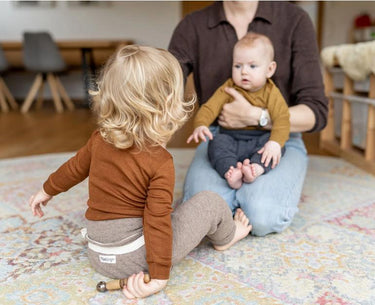
A postpartum period with a sibling is different from the first postpartum period. Not necessarily harder. But fuller. There isn't just a newborn who needs closeness, nourishment, warmth, diaper changes, and sleep. There's also an older child who suddenly has big feelings, seeks attention, wants to help, is jealous, is proud, wants to be little again, or doesn't understand why mom is lying down so much.
Many parents prepare mainly for the baby before the second or subsequent birth. Clothes, changing station, hospital bag, sleeping place, maybe elimination communication diapers and inserts. But the real challenge often lies elsewhere: How do we protect the postpartum period when there is already a child?
The most important guideline is: A postpartum period with a sibling needs more preparation, not more perfection.
In this article, you will find practical, loving, and undogmatic guidance: What really helps in the postpartum period with a sibling? How can you involve the older child without overwhelming them? What help should you organize? How do breastfeeding, diaper changing, elimination communication, sleep, and visitors work when everything no longer revolves only around one baby?
The second postpartum period is not the first postpartum period with more experience
Many parents think with the second child: "This time we already know how it goes." And yes, many things are more familiar. You might know how to hold, change, dress, or calm a baby. You know newborn sounds. You know that nights can be restless.
But a postpartum period with a sibling is not simply a repeat of the first postpartum period. It is a new family system.
This time, the following come together:
- a newborn with very immediate needs
- a mother who is physically healing
- an older child with their own feelings
- a partner or a second caregiver with more tasks
- household, food, laundry, and appointments
- visitor requests
- possible daycare, school, or childcare routes
- less complete rest than with the first baby
Therefore, you should not measure the second postpartum period by whether it will be as quiet as the first. It can be different. But it should still be protected.
You can find more about basic preparation here: Preparing for the postpartum period: What you can organize before birth.
If you have just arrived home with your baby, you will find a suitable addition here: The first days at home with baby.
The older child also gets a new life
For your older child, a lot changes with the birth of the baby. They don't just get a sibling. They get a new role. They have to share attention. They experience that mom is physically limited. They might hear "wait a moment" more often. They see a baby that is seemingly held, breastfed, changed, or carried all day long.
Even if your child was looking forward to the baby, the reality can be overwhelming.
Typical reactions can be:
- increased need for closeness
- jealousy
- anger or defiance
- regressions in sleep, toilet training, or independence
- sudden baby behavior
- strong desire to help
- disinterest in the baby
- insecurity towards the mother
This doesn't mean your child doesn't love the baby. It means they have to find their place anew.
Before birth: Preparing the sibling
You cannot fully prepare your older child for the change. But you can give them guidance.
It's important not to just talk romantically about the baby. A baby is not just cute. It cries, sleeps, drinks, needs its parents, and cannot play at the beginning. The more realistically your child is prepared, the less great the disappointment will be.
You can explain:
- The baby will sleep and drink a lot at first.
- The baby cannot play yet.
- The baby cries because it cannot speak yet.
- Mom will lie down a lot and recover after birth.
- You are still our child and just as important.
- You can help, but you don't have to help.
- You can like the baby and sometimes also find it annoying.
Children don't need a perfect explanation. They need repeatable, simple sentences.
No too big a role for the sibling
Many older children hear phrases like: "You're the big sister now" or "You're the big brother now." This can be well-intentioned. But it can also create pressure.
Your older child doesn't suddenly have to be sensible, helpful, and grown-up. They are still allowed to be little. They are allowed to have needs. They are allowed to want attention.
Better than "You're big now" are phrases like:
- "You are still our child."
- "You can help if you want to."
- "You don't have to think the baby is great all the time."
- "I see that this is hard for you right now."
- "I love you, even if I'm holding the baby right now."
A sibling doesn't just need a new role. They need the security that their old connection won't be lost.
The first moment with the baby
Many parents imagine the first meeting between sibling and baby to be very emotional. Maybe it will be. But maybe not.
Some children are excited. Others are cautious. Some want to touch the baby immediately. Others just look briefly and continue playing. Some react later.
All of this is normal.
Helpful for the first meeting:
- don't force a big moment
- don't pressure the older child to kiss or hold the baby
- don't immediately hand over the baby as "your baby"
- create a calm atmosphere
- allow for a brief encounter
- allow the older child's feelings
- then give attention back to the older child
When you come home from the clinic, it can be nice if the mother first greets the older child before everyone looks at the baby. The older child might have missed the mother.
A gift from the baby?
Some families give the sibling a small gift "from the baby." This can work, but it's not essential.
More important than a gift is that the older child feels seen. A small book, a cuddly toy, a special snack, or a prepared activity basket can be helpful – not as a bribe, but as a sign: You are important too.
Practical options include:
- a new picture book
- coloring supplies
- sticker book
- small puzzle
- special snack box
- cuddly toy
- a small "Mom is nursing" box with quiet items
The gift doesn't replace attention. It can only ease a small transition.
The most important preparation: help for the older child
In the postpartum period with a sibling, help is not optional. It is often the key.
Because the older child needs exercise, food, attention, routine, companionship, and sometimes someone to take them out while the baby and mother rest at home.
Helpful support:
- dropping off or picking up from daycare
- playground visit
- walk with the older child
- reading or playing
- preparing lunch
- taking over bedtime routine
- accompanying the sibling to appointments
- allowing for half a day of exclusive time
When people ask how they can help, you can be very specific: "Please take the older child out for two hours." That is real postpartum help.
You can find more information here: Organizing help in the postpartum period: What really relieves you after birth.
The partner as a bridge to the older child
The partner or second caregiver is particularly important in the postpartum period with a sibling. He or she doesn't just hold the baby or help with housework. He or she often becomes the bridge between the needs of the mother, the baby, and the older child.
The partner can:
- accompany the older child in the morning
- organize food
- change the baby's diaper
- take the older child out
- limit visitors
- protect the mother
- create exclusive time with the older child
- hold the baby so mother and older child can be alone for a short time
Especially in the first few days, not everything should depend on the mother. She is healing, perhaps feeding, sleeping little, and is emotionally open. The partner should actively take responsibility.
You can find more information here: Partner in the postpartum period: What really helps after birth.
Exclusive time: A few minutes can change a lot
Many parents believe that exclusive time must be long. An hour of playing, an outing, a big program. In the postpartum period, that is often unrealistic.
But a few undivided minutes can mean a lot.
Exclusive time can be:
- reading a book only with the older child
- eating breakfast together
- ten minutes of cuddling
- being alone briefly during bedtime
- drawing a picture together
- a small ritual before bedtime
- a short walk with one parent
The length is not important. The message is important: I see you. Not just as a big sibling, but as my child.
When the older child wants to be "a baby again"
Many children, after the birth of a sibling, suddenly show behaviors they had already outgrown. They want to be carried, want to drink from a bottle again, speak in a baby-like manner, want a diaper, sleep worse, or need more help.
This can be unsettling for parents. However, it is often an attempt to regain closeness and security.
Helpful actions include:
- not shaming
- not saying: "You're already big"
- briefly playing along if it's easy
- seeing the need behind the behavior
- offering more closeness
- not forcing small responsibilities
Your child doesn't really want to be a baby again. They want to know if they are still loved just as much.
Jealousy is not a problem, but a feeling
Jealousy in the postpartum period is normal. An older child experiences that the baby gets a lot of attention. Even if you try to be fair, it may not feel fair to the child.
The goal is not to prevent jealousy. The goal is to be able to guide it safely.
Helpful phrases:
- "You want to be in my arms too."
- "It's hard when I'm breastfeeding the baby right now."
- "You're angry. I understand that."
- "I love you, even if I can't immediately."
- "I'll be with you in a moment."
Feelings don't have to go away. They need words, boundaries, and closeness.
Safety: Never leave baby and sibling unsupervised
Even if the older child is loving, they should not be left alone with the baby. Small children cannot reliably assess their strength, movements, and impulses yet.
This is not a matter of trust. It is a matter of development.
It is important to:
- never leave baby unsupervised with a sibling
- never place baby on a sofa or bed next to a boisterous child
- never let the older child pick up the baby alone
- show gentle touch
- have clear rules for the baby's head, face, and hands
- place the baby in safe places
You can be loving and clear: "You can stroke the baby's foot. I'm holding it."
Involving the older child without making them responsible
Many children love to help. They want to fetch a diaper, bring a cloth, choose a bodysuit, or watch during bathing. That can be nice.
However, it is important that helping remains voluntary. Your older child is not responsible for the baby.
Good small tasks:
- choosing a fresh bodysuit
- bringing a muslin cloth
- handing over an insert
- singing a small song
- watching during diaper changes
- gently stroking the baby's foot
- fetching a diaper or backup
Not suitable are:
- carrying the baby alone
- holding the baby unsupervised
- taking responsibility for the baby's calm or sleep
- constantly having to help
- being made responsible for the baby's crying
Helping can create connection. But it should not become a burden.
Breastfeeding or feeding with a sibling
Breastfeeding or feeding is often the moment when the older child particularly wants attention. Precisely then, the mother is stuck. Precisely then, the baby cannot simply be put down.
You can prepare for this.
Helpful tips:
- a nursing or feeding box for the older child
- books that are only available during these moments
- a snack for the older child
- a small, quiet play idea
- partner takes over the older child, if possible
- briefly state what is happening before feeding
A nursing box doesn't have to be elaborate. A few books, stickers, a drawing pad, or small figures are often enough.
More about preparing a nursing station can be found here: Setting up a nursing station: What you really need in the postpartum period.
If your baby wants to feed very frequently in phases, you will find a suitable in-depth discussion here: Cluster feeding in the postpartum period: When your baby constantly wants to drink.
Diapering with a sibling
Diapering with an older child can either become easier or more chaotic. Some children want to help. Others use this exact moment to get attention.
A well-prepared changing station is therefore particularly important.
Helpful at the changing station:
- everything within reach
- never leave baby alone on a raised surface
- dangerous items out of reach of the older child
- a small task for the sibling
- change of clothes readily available
- wet bag or laundry bag directly next to it
If your older child wants to be present during diapering, you can involve them. If it stresses you out, diapering can also be a moment when your partner takes over the older child.
You can find more information here: Setting up a changing station: What you really need.
For small diapering situations on the sofa, in the bedroom, or on the go, a compact changing pad can also help: Portable changing pad.
Elimination Communication with Baby and Sibling
If you want to try elimination communication (EC) or assisted toileting with your baby, a sibling can add an extra dynamic. Perhaps they are curious. Perhaps they comment on everything. Perhaps they want to help. Perhaps you yourself find less peace than with your first child.
Therefore, an undogmatic start is particularly important.
EC with a sibling can start very simply: during diaper changes, after waking up, after feeding, or when your baby clearly becomes restless.
Helpful tips:
- EC diaper as a backup
- inserts readily available
- easy-to-open clothing
- EC pants if they make access easier for you
- changing mat
- involve partner
- don't make the sibling an audience if that stresses you out
If your older child asks questions, you can simply say: "We offer the baby a chance to pee or poop. The diaper is there for safety."
You can find suitable items here: Elimination Communication Diapers, Diaper Inserts, Elimination Communication Pants, and the Portable Changing Pad.
If you want to learn more about Elimination Communication, you can start here: What does Elimination Communication from birth actually mean?.
If you want to know what you really need to get started, read more here: Elimination Communication Starter Kit: What You Really Need.
Sleep in the postpartum period with a sibling
Sleep often becomes more complicated with multiple children. The baby sleeps irregularly. The older child might wake up more often. Bedtime routines take longer. The mother is tired. The partner is too.
There's no perfect solution here, just realistic planning.
Clarify before birth:
- Who will put the older child to bed in the evening?
- What happens if both children cry at the same time?
- Where does the baby sleep safely?
- Who takes care of the older child in the morning?
- How can the mother get rest during the day?
- Which routines should remain stable?
The older child, especially, benefits from a few stable routines. Not everything has to stay the same. But a familiar lullaby, a story, or a consistent phrase can provide security.
You can find more about nights with a baby here: Dressing baby at night: What does a newborn need for sleep?.
Visitors in the postpartum period with a sibling
Visitors can be particularly tricky with a sibling. Many people come for the baby and overlook the older child. That can be hurtful.
When visitors come, it's helpful to consciously involve the older child — but without putting them on display.
Good visitor rules:
- Visitors bring food or help practically
- Visitors also greet the older child
- Baby is not picked up without asking
- Older child is not pressured to interact
- Visitors stay briefly
- No one comes when sick
- Visitors prefer to take the older child to the playground rather than holding the baby
A particularly helpful visitor might ask: "Should I take the older child out for a bit?"
You can find more about visitor boundaries here: Visitors in the postpartum period: How much external closeness is really beneficial?.
Postpartum meals with a sibling
With a sibling, meals become even more important. Not only the mother needs to be nourished. The older child also needs meals, snacks, and reliable eating times.
Helpful tips:
- Pre-cooked family meals
- Snack box for the older child
- Breakfast that can be prepared quickly
- Visitors who bring food for everyone
- Simple favorite dishes
- No complicated new recipes right after birth
If the older child is hungry while the baby is nursing or being changed, the mood can quickly turn sour. Preparation helps more than good intentions here.
You can find more on this here: Preparing postpartum meals: What really helps after birth.
Daycare, childcare, and daily life in the first few weeks
If your older child goes to daycare or childcare, the question arises: Should they continue to go or stay home?
There's no general answer to this. For some children, familiar childcare is stabilizing. For others, more family time is important in the first few days. For the mother, childcare can be a relief. At the same time, drop-off and pick-up routines can become strenuous.
Questions for the decision:
- Does routine benefit the older child?
- Who can drop off and pick up?
- Is the child healthy?
- Does the mother need rest during the day?
- Are there waves of infection in childcare?
- How does the child feel about the situation?
You're allowed to be flexible. Perhaps the older child goes to childcare on some days and not on others. It's important not to cling to an ideal.
After a C-section with a sibling
After a C-section, the postpartum period with a sibling becomes even more demanding. You might not be able to lift, play roughly, jump up quickly, or react as usual.
The older child will only understand this to a limited extent, depending on their age. Therefore, they need clear, simple explanations and other people to take on physical tasks.
Helpful after a C-section:
- Prepare the older child beforehand: "Mommy has a tummy wound."
- Cuddling while sitting or lying down instead of lifting
- Partner takes over carrying, rough play, and errands
- Visitors bring food or occupy the older child
- Reduce stairs and walks
- Don't let the baby and older children climb on the scar unsupervised
You can find more on this here: Postpartum after C-section: What really helps you.
When the baby cries a lot
If the baby cries a lot in the postpartum period, it can be particularly stressful with a sibling. The older child might become restless, cover their ears, also want to be held, or react with anger.
Again, there is no perfect solution, but rather relief and a clear division of tasks.
Helpful tips:
- Partner takes care of the older child or the baby
- Short phrases for the sibling: "The baby is crying because it needs something."
- Create quiet retreats
- Get help when everyone is overstimulated
- Lay the baby down safely if you need a short break yourself
- Contact a midwife or pediatrician if unsure
You can find more information here: Baby crying in the postpartum period: What really helps.
What you don't have to achieve
A postpartum period with a sibling is often louder, messier, and less calm than a first postpartum period. This doesn't mean you're doing something wrong.
You don't have to:
- Meet the needs of both children at all times
- Constantly make the older child happy
- Always calm the baby immediately
- Implement Elimination Communication perfectly
- Receive visitors
- Maintain a normal household routine
- Always involve the older child
- Immediately resolve every setback
You are allowed to prioritize. Sometimes a child cries. Sometimes everyone waits briefly. Sometimes the day is chaotic. That's not automatically wrong. It's family reality.
What really matters
In a postpartum period with a sibling, it's not about giving everyone everything at all times. It's about protecting basic needs and re-establishing connection repeatedly.
What's really important:
- Mother heals and is cared for
- Baby receives closeness, nourishment, warmth, and safe care
- Older child continues to feel seen
- Partner or helpers actively contribute
- Visitors are limited
- Food and sleep are not forgotten
- No one expects perfection
Sibling love isn't born in a perfect first week. It grows through many small experiences: observing, waiting, helping, being jealous, being comforted, getting closeness again.
A simple checklist: Postpartum with a sibling
Before birth
- Realistically prepare the older child
- Clarify childcare for the first few days
- Organize help for the playground, daycare, or meals
- Formulate visiting rules
- Prepare a snack box or activity box
- Set up a safe and easily accessible changing area
- Pre-cook postpartum meals
- Discuss partner's tasks concretely
For the older child
- Small exclusive times
- Name feelings
- Don't expect too much "being grown-up"
- Offer voluntary small tasks
- Don't shame setbacks
- Maintain routines partially if possible
For the baby
- Soft clothing
- Diaper shirt or easily opening clothing
- Backup, diaper or elimination communication diaper
- Inserts
- Safe sleeping place
- Quiet care despite the larger family hustle and bustle
For Elimination Communication or Pottying
- Elimination communication diaper as a backup
- Inserts readily available
- Use standard situations
- Involve partner
- No pressure for perfection
- Let backup work when daily life is busy
For the mother
- Food and water within reach
- Protect rest periods
- Limit visitors
- Don't be solely responsible for both children
- Actively accept help
- Take feelings seriously
Frequently asked questions: Postpartum with a sibling
How do I prepare my child for a sibling?
Speak simply and realistically. Explain that the baby will sleep, drink, cry a lot, and can't play yet. Also tell your child that they are still just as important and don't suddenly have to be grown-up all the time.
What helps against jealousy in a sibling?
Jealousy doesn't have to be prevented. It can be accompanied. Exclusive time, clear words, understanding, small rituals, and the message: You are still my child and just as important, are all helpful.
Should the sibling help with diaper changes?
If they voluntarily want to, they can take on small tasks: hand a cloth, choose a onesie, or watch. However, they should not bear responsibility and should never be left alone with the baby.
Can you still start Elimination Communication with a sibling?
Yes, but in a particularly undogmatic way. Use standard situations like changing, waking up, or after nursing. EC diapers and inserts provide security when daily life with multiple children is busy.
How do I organize breastfeeding with an older child?
A small breastfeeding box with books, snacks, or quiet toys can help. The partner or visitors can also accompany the older child during these moments.
How many visitors are appropriate in the postpartum period with a sibling?
Less is often more. Visitors should stay briefly, come healthy, bring food, or constructively occupy the older child. Visitors who only want to see the baby can wait.
What to do if the older child wants to be a baby again?
Don't shame them. This behavior often shows a need for closeness. You can react lovingly, play along briefly, and at the same time create small stable routines for the older child.
What is particularly important after a C-section with a sibling?
More help. You should not lift, carry, or overexert yourself. Explain the abdominal wound simply to the older child and organize your partner, family, or friends for physical tasks.
How can I accompany both children simultaneously?
Not always perfectly at the same time. Prioritize safety and basic needs. State aloud what is happening: "I'm nursing the baby and will be with you in a moment." Help from your partner, family, or visitors is particularly valuable here.
A calm thought to conclude
A postpartum period with a sibling is not quiet like a protected cocoon. It is often lively, loud, messy, and full of simultaneous needs.
That doesn't mean it's less valuable. It just means it needs to be managed differently.
Your baby needs closeness. Your older child needs security. The mother needs healing. The partner needs clear tasks. The family needs help. And nobody needs perfection.
Perhaps the older child will be jealous. Perhaps it will want to help. Perhaps the baby will cry exactly when the older child also wants to be held. Perhaps one day feels chaotic and the next one feels lighter.
Siblings are not born in a perfect first moment. They grow into a relationship.
And you, as a family, grow with them.
This also aligns with Mata Origin's philosophy: Starting the baby year naturally doesn't mean creating a perfect family life. It means combining closeness, protection, practical routines, and natural companionship in a way that suits your real family.
If you want to accompany your baby with natural materials, practical cuts, and an undogmatic view of diapering, elimination communication, and closeness, Mata Origin offers well-thought-out companions for this first period.
Discover suitable products for the postpartum period, diapering, and elimination communication: Elimination Communication Diapers, Diaper Inserts, Elimination Communication Pants, and the Portable Changing Pad.
Note: This article does not replace medical, psychological, or educational advice. It is intended to provide guidance. In cases of severe exhaustion, psychological crisis, persistent overwhelm, severe pain, fever, noticeable bleeding, baby's poor feeding, aggressive behavior that makes you uneasy, or thoughts of self-harm or danger to mother, baby, or sibling, please seek professional help. In case of acute severe symptoms, contact emergency services.