
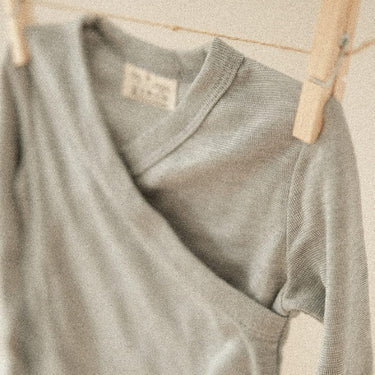
Baby clothes lie directly on the skin. They accompany your baby while sleeping, drinking, cuddling, being carried, having their diaper changed, and arriving in this new world. Especially in the first few weeks, clothing is therefore not just a question of size or color. It provides warmth, protection, and security.
When you plan your baby's initial layette, you will encounter many different materials: cotton, wool, wool/Tencel, fleece, boiled wool, jersey, muslin, and synthetic fibers. The question quickly arises: Which material is truly suitable for a newborn?
The honest answer is: There isn't one perfect material for all babies and all situations. But there are materials that are particularly well-suited to the needs of newborns. For Mata Origin, the focus is primarily on natural, high-quality, and practical fabrics: wool, wool/Tencel, and selected cotton.
In this article, we'll take a closer look at these materials. Not dogmatically. Not complicated. But with a focus on baby's skin, temperature, everyday life, care, and sustainability.
Why the material in baby clothes is so important
Newborns come from a warm, protected environment. After birth, they must adapt to air, light, touch, clothing, and changing temperatures. At the same time, their skin is sensitive, and their body is still developing its own temperature regulation.
That's why it makes a difference what clothing lies directly on the skin. A material can warm without causing overheating. It can absorb moisture. It can be soft or scratchy. It can be easy to care for or require special attention. It can make everyday life easier or more complicated.
Good baby clothes should therefore not only look good. They should feel good, function practically, and support your baby's body awareness.
If you are still fundamentally planning what clothes your baby really needs, you will find the right overview here: What clothes does a newborn really need?.
The most important requirements for baby clothes
Before we compare the materials, let's look at the basic requirements. For newborns and small babies, clothing is particularly useful if it fulfills several things at once.
- It feels soft and pleasant on the skin.
- It warms without quickly overheating.
- It allows freedom of movement.
- It does not press on the stomach or in the diaper area.
- It is easy to put on and take off.
- It is suitable for changing diapers, cloth diapers, or elimination communication.
- It is durable and easy to care for.
- It is made of natural or skin-friendly fibers as much as possible.
Especially in the beginning, it's worth buying fewer items, but paying more attention to material, cut, and practicality.
You can find more about conscious selection here: Sustainable layette: Buy less, choose better.
Wool: Naturally warm and temperature-regulating
Wool is one of the most valuable materials for babies. It warms without having to be stiff or heavy. It can absorb moisture and often still feels comfortable even when it is not completely dry. At the same time, wool does not need to be washed after every short wear. Often, thorough airing is sufficient.
For babies, particularly fine wool is interesting, for example, merino wool. It is significantly softer than the scratchy wool that many adults remember from their childhood. High-quality baby wool should be gentle on the skin and not chafe unpleasantly.
Advantages of wool for babies
- it warms naturally
- it can regulate temperature well
- it absorbs moisture
- it often only needs to be aired
- it is well suited for autumn, winter, and transitional seasons
- it is durable if well cared for
Wool is particularly well suited for warming layers: pants, jackets, overalls, blankets, or outdoor clothing. Wool can also be comfortable as a fine first layer if it is softly processed.
When is wool particularly useful?
Wool is not just for deep winter. It can be useful wherever your baby needs warmth without the clothing becoming thick and inflexible.
Wool is particularly helpful:
- in the first few weeks after birth
- in autumn and winter
- on cool spring days
- when carrying
- in the stroller
- as a warming layer over lighter clothing
- for babies who get cold quickly
Nevertheless, it is important: even with wool, you should not dress your baby too warmly. Feel their neck regularly. If their neck is pleasantly warm, your baby is usually dressed appropriately. If your baby is sweating, a layer can be removed.
For cold days, a boiled wool overall can be particularly practical: Boiled wool overall from Mata Origin.
Wool/Tencel: Soft, light, and practical for everyday use
Wool/Tencel combines the natural properties of wool with a particularly soft, smooth fiber. Tencel is made from cellulose and feels pleasantly light and supple. In combination with wool, a material is created that is very interesting for baby clothes: soft, balancing, and often somewhat lighter to wear than pure wool.
For many families, wool/Tencel is a wonderful middle ground. It brings the temperature advantages of wool, but feels particularly fine and snug. Especially when parents are concerned that pure wool might be too warm or too "woolly", wool/Tencel can be a very nice alternative.
Advantages of Wool/Tencel
- very soft feel
- light and comfortable on baby's skin
- temperature-regulating due to the wool content
- smooth feel due to Tencel
- well suited for first layers of clothing
- comfortable for transitional seasons and changing temperatures
Wool/Tencel is particularly well suited for baby clothes worn directly or close to the body: bodysuits, pants, light shirts, or soft everyday wear.
Why Wool/Tencel is so exciting for everyday baby life
Everyday life with a baby consists of many changes. Your baby sleeps, drinks, is carried, lies on you, has their diaper changed, perhaps has elimination communication, is cuddled again, and later put in the stroller or carrier. Clothing must keep up with these changes.
Wool/Tencel can be very comfortable here because the material does not feel heavy and yet can do more than a simple thin fabric. It is soft enough for closeness and flexible enough for many everyday situations.
Especially for families who like natural materials but are looking for a very light, snug quality, wool/Tencel is a strong option.
Cotton: Familiar, easy to care for, and versatile
Cotton is probably the most well-known material for baby clothes. It is widely available, uncomplicated, and comes in many qualities. Many parents instinctively reach for cotton because it is familiar and easy to wash.
Good cotton can be comfortable for babies. Especially for clothes that are washed frequently or are subject to more wear and tear, cotton is practical. However, cotton regulates temperature and moisture differently than wool. When cotton gets wet, it feels damp or cool more quickly.
Advantages of cotton
- easy to care for and uncomplicated
- readily available
- durable in everyday use
- often cheaper than wool or wool/Tencel
- comfortable if the quality is high
- good for clothes that are frequently washed
So cotton is not wrong. It just has different strengths. For many families, a combination of cotton, wool, and wool/Tencel makes the most sense for their wardrobe.
Wool, Wool/Tencel or Cotton: Which is better?
The question of the best material cannot be answered generally. It depends on what you need the clothes for.
Wool is particularly useful when:
- your baby needs warmth
- you are looking for temperature-regulating clothing
- you want to wash less often
- you prefer durable natural materials
- you are looking for clothing for cooler days, carrying, or strollers
Wool/Tencel is particularly useful when:
- you want a very soft, light material
- the clothing is worn close to the body
- you are looking for natural materials with a supple feel
- you need clothing for transitional periods
- you are looking for a good mix of warmth, lightness, and everyday practicality
Cotton is particularly useful when:
- you want very easy-care clothing
- you wash frequently
- you are looking for robust basics
- you need clothing for heavy soiling
- you are looking for an uncomplicated addition to wool clothing
Instead of having to choose one material, you can consciously combine them. This is often the best solution.
A sensible material combination for the initial layette
For the first few weeks, not every piece of clothing needs to be made of the same material. A small, well-coordinated selection is usually more practical.
A possible combination could look like this:
- soft bodysuits or first layers made of wool/Tencel or fine wool
- some robust cotton basics for frequent washing
- warming pants, jackets, or overalls made of wool
- a good wool blanket for home and on the go
- few but high-quality pieces instead of many unused outfits
This way you have suitable clothing for different situations without overfilling the drawer.
A reduced overall overview can be found here: Baby layette: What you really need.
Material and season: What fits when?
The season plays a big role in baby clothes. At the same time, the weather can be unpredictable. Therefore, it makes sense to think in layers.
In winter
In winter, wool and wool layers are particularly valuable. They keep warm without your baby having to be wrapped up inflexibly. A combination of bodysuit, pants, warming layer, and suitable outer layer is often more practical than a single very thick garment.
You can find more about this here: Winter baby layette: What you really need and here: Dressing baby in winter: warm without overheating.
In spring and autumn
During transitional seasons, temperatures often change. Wool/Tencel and light wool layers can be very comfortable here because they balance and can be flexibly combined.
You can find more about this here: Dressing baby in transitional seasons: Planning spring and autumn correctly.
In summer
In summer, your baby needs light, breathable clothing and protection from direct sun. Thin natural materials are useful here. Depending on the temperature, cotton, wool/Tencel, or very light wool qualities may be suitable. It is important not to dress your baby too warmly and to regularly check if they are sweating.
You can find more about this here: Summer baby layette: What you really need and here: Dressing baby in summer: light and breathable.
Material and skin feel: What lies directly on the skin?
For the first layer, the feel against the skin is particularly important. Everything that lies directly on baby's skin should be soft, free of irritating seams, and pleasantly flexible.
Many parents prefer fine wool or wool/Tencel for the first layer. Others use high-quality cotton because it is uncomplicated and familiar. The decisive factor is how your baby reacts and what proves to be effective in your everyday life.
A good test: Feel the garment on your own neck or on the inside of your forearm. If it feels rough, scratchy, or stiff there, it is probably not ideal for sensitive baby skin.
Material and elimination communication: Why function counts
If you want to try diaper-free or elimination communication, clothing becomes important in a different way. Then, not only the material counts, but also the question: How quickly and quietly can clothing be opened?
A soft, warming material helps your baby feel comfortable. A well-thought-out cut helps you not fumble for a long time at the right moment. Both together make natural baby care more practical for everyday life.
Particularly helpful are:
- soft fabrics that are not stiff
- clothing with good mobility
- enough space for a diaper, cloth diaper, or insert
- easy openings in the diaper area
- layers that provide warmth but remain quickly accessible
A gentle introduction to elimination communication can be found here: What does "diaper-free from birth" actually mean?.
If you want to plan specifically, read on here: Elimination Communication Layette: What you really need.
Suitable sections at Mata Origin are Elimination Communication Pants, Elimination Communication Diapers and Diaper Inserts.
Material for carriers, strollers, and cars
The right material also depends on where your baby is at the moment. In the carrier, your baby receives additional body heat from you. In the stroller, depending on the weather, it needs more protection from cold, wind, or sun. In the car, a safe harness adjustment is more important than a particularly thick layer.
- In the carrier: light, flexible layers are often useful because your body also provides warmth.
- In the stroller: wool, wool layers, or blankets can be good companions depending on the season.
- In the car: thick overalls or jackets under the harness are unfavorable; instead, add warmth with blankets after buckling up.
You can find more information here: Dressing baby in the carrier, Dressing baby in the stroller and Dressing baby in the car.
Care: What you should consider for wool, wool/Tencel, and cotton
A material is only practical for everyday use if you can care for it well. Wool, wool/Tencel, and cotton differ significantly in this regard.
Caring for wool
Wool does not need to be washed after every wear. Often, airing is sufficient. If you do wash it, use a suitable wool detergent and follow the care label. Avoid vigorous rubbing, hot water, and normal heavy-duty detergent.
Caring for Wool/Tencel
For wool/Tencel, you should also follow the care instructions. Depending on the composition, the material can be more sensitive than pure cotton. Gentle washing, suitable detergent, and avoiding fabric softener help protect the fibers.
Caring for cotton
Cotton is usually more straightforward. Many cotton items can be washed more frequently and more robustly. Nevertheless, a mild detergent is also worthwhile here, especially for newborn clothing.
You can find more about this here: Washing baby clothes before birth: What is really useful.
What does sustainable mean for baby materials?
Sustainability doesn't just depend on the raw material. A garment is more sustainable if it is actually worn, lasts a long time, can be well cared for, and perhaps passed on later.
A very inexpensive item that wears out after a few washes is not automatically more sustainable than a high-quality garment that is used for many months. At the same time, not everything has to be new or expensive. Used clothing, consciously selected basics, and durable favorite pieces can complement each other very well.
When it comes to sustainable baby clothing, you can ask yourself these questions:
- Is this item really needed?
- Is the material comfortable for my baby?
- Is it suitable for multiple situations?
- Is it well-made?
- Is it easy to care for?
- Can it be passed on?
- Does it make our daily life easier?
You can find more information in the article Sustainable First-Time Baby Gear: Buy Less, Choose Better.
What to look for when buying natural baby clothes
Good baby clothes reveal themselves in many small details. Especially with natural materials, it's worth looking not just at the name of the material, but at the craftsmanship and everyday usability.
- Is the fabric soft and comfortable?
- Are the cuffs elastic but not tight?
- Are there irritating seams or hard labels?
- Is the garment easy to put on?
- Is there enough space in the diaper area?
- Is the material suitable for the season?
- Is the care realistic for your daily routine?
Especially with newborns, small things are important. A scratchy label, a hard button on the back, or a tight waistband can quickly become bothersome because your baby lies down and is carried a lot.
What you don't necessarily need
Natural baby clothing doesn't mean you have to buy every material variant. You don't need a full drawer of specialty fabrics or perfect equipment for every temperature.
Often you can do without the following:
- too many items in the smallest size
- stiff or uncomfortable outfits
- clothes that are only practical for photos
- materials that already feel uncomfortable to you
- too many similar garments
- complicated care if it doesn't fit your daily routine
A good selection can be small. The crucial thing is that the pieces are worn frequently and truly support you.
A simple guide to getting started
When putting together a natural baby layette, you can start with this material logic:
- For warmth: wool, boiled wool, wool fleece, or wool layers
- For soft first layers: wool/Tencel or fine wool
- For robust everyday basics: high-quality cotton
- For changing temperatures: layers instead of a single thick item
- For elimination communication and diapering: soft materials plus practical openings
This creates an outfit that isn't overloaded but covers various everyday situations.
Frequently asked questions about natural baby clothing
Is wool suitable for newborns?
Yes, fine and high-quality wool can be very comfortable for newborns. It warms, balances temperature, and often doesn't need to be washed after every wear. It's important that the wool is soft and doesn't itch.
What is the advantage of wool/Tencel?
Wool/Tencel combines the balancing properties of wool with a particularly soft, smooth feel. The material is light, supple, and therefore very comfortable for many babies.
Is cotton inferior to wool?
No. Cotton is not worse, but different. It is easy to care for and robust, but regulates temperature and moisture differently than wool. Many families combine cotton with wool or wool/Tencel.
Which materials are best for winter?
For winter, wool layers are particularly useful. They provide natural warmth and can be easily combined in layers. Depending on the situation, a bodysuit, trousers, wool jacket, boiled wool overall, or wool blanket can work together.
Which materials are suitable for summer?
In summer, light, breathable materials are important. Depending on the temperature, thin cotton, wool/Tencel, or very light wool qualities can be comfortable. Direct sunlight should be avoided as much as possible for newborns.
Which clothes are practical for elimination communication?
For elimination communication, helpful clothing is soft, keeps warm, and can be opened quickly. Cuts with easy access in the diaper area and enough space for inserts are particularly practical.
A calm thought to conclude
Natural baby clothing doesn't have to be complicated. You don't have to know every material perfectly or follow every recommendation.
It's important that your baby feels comfortable. That clothes warm without being heavy. That they are soft, don't constrict, and work in everyday life. That you enjoy holding them because they feel good and truly accompany you.
Wool, wool/Tencel, and cotton can all have their place. Not as a rigid system, but as a conscious choice. A few good pieces are often enough to give your baby a warm, natural, and secure start.
If you want to combine natural materials, practical cuts, and an undogmatic start with diapering, elimination communication, and closeness, Mata Origin offers thoughtful companions for precisely this first period.
Discover suitable products for your baby's daily life: elimination communication pants, elimination communication diapers, diaper inserts, and the boiled wool overall.