
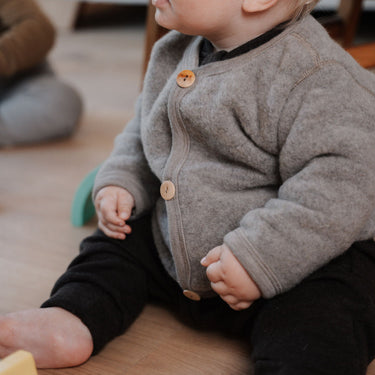
Wool fleece is one of those wool materials whose special quality you immediately feel: The surface is soft, fluffy, and pleasantly warm. This makes the material particularly suitable for baby blankets, jackets, rompers, and cozy layers of clothing.
But what exactly is wool fleece? How does it differ from synthetic fleece, boiled wool, or merino interlock? And how is it cared for so that its fluffy surface remains beautiful for a long time?
In this guide, you'll learn when wool fleece is suitable for babies, what limitations the material has, and what you should consider when washing and drying it.
What is wool fleece?
The term "fleece" initially describes a soft, napped or brushed textile surface. It doesn't yet specify what fiber the material is made of.
Many well-known fleece products are made from polyester. Wool fleece, however, consists predominantly or entirely of wool. For Mata Origin's wool fleece products, knitted merino wool is brushed in an additional processing step. This raises fine fibers on the surface, creating a soft, fluffy structure.
This structure traps many small air pockets. This makes wool fleece feel warm and voluminous, without being as firm and compact as boiled wool.
Is wool fleece the same as polyester fleece?
No. Both materials can look fluffy and provide warmth, but they differ fundamentally in their fiber composition.
Conventional fleece is often made of polyester and thus of synthetic fibers. Wool fleece is made of wool and brings with it the natural properties of the wool fiber.
These include in particular:
- the absorption and release of water vapor
- good moisture management
- a temperature-balancing effect
- natural elasticity
- a lower tendency to absorb odors quickly
This does not mean that synthetic fleece is generally unsuitable. It is often light, durable, and quick-drying. Wool fleece is particularly interesting when natural fibers, a pleasant feel against the skin, and a more balanced microclimate are paramount.
Why is wool fleece suitable for babies?
Soft and fluffy surface
The brushed surface makes wool fleece significantly fluffier than smooth wool fabrics. The material feels less cool and quickly conveys a warm, cozy feeling.
However, how pleasant a baby finds a fabric remains individual. Some babies like fluffy materials directly on their skin, while others feel more comfortable with a smoother layer of merino interlock or wool-silk.
Natural warmth through trapped air
Small air pockets are created between the raised fibers. This air layer slows down heat loss and ensures that wool fleece provides good warmth.
Wool fleece is therefore particularly suitable for:
- cool homes
- autumn and winter
- the transitional period
- the stroller
- carrying
- cozy resting and cuddling moments
- an additional layer in the onion look
Moisture and temperature
Wool fibers can absorb and release water vapor. This allows wool fleece to contribute to a more balanced climate between the body and the textile.
However, this does not mean that a baby in wool fleece never sweats. Wool clothing can also be too warm if too many layers are combined or the fabric is too thick for the respective temperature.
Therefore, regularly check your baby's neck to see if it is pleasantly warm. A warm, dry neck usually indicates suitable clothing. A noticeably hot or damp neck can indicate that an extra layer is being worn.
Wool fleece, boiled wool or merino interlock?
All three materials can be made of merino wool, but they serve different purposes.
| Material | Surface | Properties | Typical use |
|---|---|---|---|
| Wool fleece | soft, fluffy, brushed | warming, light, snug | Blankets, jackets, rompers, cozy layers |
| Boiled wool | dense, compact, firmer | robust, warming, better for heavier use | Overalls, outdoor trousers, jackets, coats |
| Merino Interlock | smooth, soft, dimensionally stable | thinner, flexible, wearable close to the body | Elimination communication pants, dungarees, shirts, light rompers |
Wool fleece or boiled wool?
Boiled wool is compacted by moisture, heat, and movement. This makes the fabric more compact, firmer, and more durable. It is particularly suitable for outdoor clothing that needs to withstand wind, ground, and movement.
Wool fleece is less dense and significantly fluffier. It is better suited for soft warmth, closeness to the body, and cozy clothing. For intensive play on rough surfaces, boiled wool is usually the more robust choice.
You can find out more about the differences and areas of application in the article Boiled wool for babies.
Wool fleece or Merino Interlock?
Merino Interlock is smooth, elastic, and less voluminous. It is particularly suitable for close-fitting clothing and items that need to allow for a lot of movement.
Wool fleece is fluffier and warmer. It is better suited as a cozy outer or mid-layer, as well as for blankets and warm rompers.
Simply put: Merino Interlock is the smooth wool quality for movement and close-fitting clothing. Wool fleece is the cozy wool quality for soft warmth.
What baby products is wool fleece suitable for?
Wool fleece is particularly useful when a product should provide soft warmth without requiring the firmness of boiled wool.
Wool fleece blankets
A wool fleece blanket can be used in the stroller, on the sofa, while breastfeeding, cuddling, or as an additional warm layer.
The Cuddly Wool Blanket for Babies made of Merino Wool from Mata Origin measures 100 × 150 centimeters and can therefore be used far beyond the first baby period.
For the sofa, family bed, and shared cuddling moments, there is also a larger Cuddly Wool Blanket for the Family.
Wool fleece rompers
A wool fleece romper keeps the tummy, back, and legs warm. In elimination communication daily life, it is particularly important that the garment can be opened quickly.
The Elimination Communication Romper made of wool fleece therefore has a two-way zipper. This allows the baby to be held or changed without the entire romper having to be taken off.
Wool fleece jackets
A light wool fleece jacket is suitable as a warming layer indoors, during the transitional season, or under a more robust outer layer.
The Wool Fleece Jacket made of Merino Wool can be worn as an outer layer or under boiled wool, depending on the temperature.
Wool fleece in the onion look
Babies often switch between different temperatures: outdoors, in the car, in the stroller, in heated rooms, or close to the body in a carrier.
Instead of a single very thick layer of clothing, several coordinated layers are often more practical. Wool fleece can serve as a warming mid-layer or outer layer.
Underneath, depending on the temperature, suitable options include:
- a thin merino wool shirt
- wool-silk blend
- merino interlock
- wool-Tencel blend
- light elimination communication clothing
If it gets warmer, the wool fleece layer can be quickly removed. This allows the clothing to be better adapted to indoor spaces, weather, and activity.
Is wool fleece suitable for outdoors?
Yes, but not for every situation equally.
Wool fleece is well suited for:
- in the stroller
- while carrying
- for short distances
- on dry, cool days
- as a layer under a boiled wool overall
When crawling on rough ground, in wet grass, or under heavy use, boiled wool is generally more robust. Wool fleece is designed more for softness and warmth than for mechanical resilience.
Wool fleece and elimination communication
In elimination communication daily life, clothing should keep warm without making holding unnecessarily complicated. Therefore, not only the material but also the cut is decisive.
A soft wool fleece romper can be very comfortable if it can be opened quickly and does not have to be completely removed every time. A wool fleece blanket can provide additional warmth during holding or – if intended for this purpose and properly cared for – serve as a base.
Are you new to the topic? In the guide What does Elimination Communication or Baby-Holding mean? you will find a simple and undogmatic introduction.
How to care for wool fleece correctly?
Wool fleece should be washed as rarely as necessary and as gently as possible. Often, airing the product thoroughly is sufficient. Superficial, dry dirt can be carefully brushed off, depending on the product.
For the various care steps, you will find a wool washing concentrate, an SOS stain spray, and a wool brush in the Mata Origin Wool Care Set.
Step 1: Air out
Hang or lay the wool product in a well-ventilated area. Avoid direct heat or prolonged strong sunlight.
Step 2: Carefully remove dry dirt
Allow mud or other superficial dirt to dry completely first. Then you can carefully brush it off.
For very fluffy wool fleece, you should first test a brush on an inconspicuous area and only work with light pressure in the direction of the fibers.
Step 3: Treat stains specifically
Whenever possible, treat only the affected area instead of washing the entire product immediately. Do not rub vigorously, as rubbing can felt the wool fibers. Always follow the application instructions for the stain remover used.
Step 4: Gentle washing
- Check care label
- Use hand wash or suitable wool wash program
- Use mild wool detergent
- Observe temperature guidelines, often a maximum of 30 °C
- Avoid strong rubbing and high spin speeds
- Do not use a normal full or universal wash cycle
Step 5: Proper drying
Wool fleece should not be put in the tumble dryer, unless the care label explicitly permits it. After washing, carefully reshape the product and dry it flat or so that the weight of the wet material is well supported.
Does wool fleece need to be greased with lanolin?
Normal wool fleece clothing does not necessarily need to be greased. A lanolin bath is particularly useful for products that are explicitly intended to become more water-repellent or to be used as moisture protection.
For blankets, rompers, and jackets, you should refer to the intended use and the respective care instructions. Too much lanolin can make the material feel greasy or heavy.
Is pilling normal for wool fleece?
Due to friction, small fiber knots can form on the surface. This is called pilling and is generally possible with wool textiles.
Pilling occurs particularly often in areas that rub strongly against other textiles, straps, or carriers. Individual knots are therefore not automatically a quality defect.
They can be carefully removed by hand or with a suitable tool for the material. With fluffy wool fleece, restraint is important so that not too many fibers are pulled from the surface.
How do I recognize high-quality wool fleece?
When buying, pay attention not only to the word "fleece" but to specific details:
- What is the wool content?
- What wool quality was used?
- Is the origin traceable?
- Is the wool mulesing-free?
- Is there a recognized certification?
- Where was the fabric knitted and the product sewn?
- Does the cut match the intended use?
- Are there clear care instructions?
For Mata Origin's wool fleece products, we use 100 percent merino wool. Depending on the product, the material comes from GOTS-certified and mulesing-free production. The wool fleece is knitted in Germany and then processed into the respective garments or blankets.
Frequently Asked Questions about Wool Fleece for Babies
Is wool fleece scratchy?
High-quality wool fleece made from fine merino wool usually feels soft. However, individual perception varies. For very sensitive skin, a thin, smooth layer under the wool fleece may be more comfortable.
Is wool fleece only suitable for winter?
No. It is also suitable for cool summer evenings and the transitional period. The crucial factors are fabric thickness, outside temperature, and the other layers of clothing.
Can wool fleece be worn directly on the skin?
This is possible if your baby finds the material comfortable. Some babies prefer a smooth layer of merino interlock, wool-silk, or another skin-tight material underneath.
Can wool fleece be put in the washing machine?
Many wool fleece products can be washed on a wool wash program. However, the care label of the respective product is always binding.
Which is warmer: wool fleece or boiled wool?
This cannot be answered solely based on the material designation. Fabric weight, thickness, cut, and other layers of clothing also play a role. Boiled wool is usually denser and more wind-resistant, while wool fleece is fluffier and softer.
Technical sources on wool and wool care
- Woolmark: Thermoregulation of Merino Wool
- Woolmark: Moisture Management of Merino Wool
- Woolmark: How to wash wool correctly
- Woolmark: Airing, brushing, and caring for wool
Conclusion: Wool fleece is the particularly cuddly side of wool
Wool fleece combines the natural properties of wool with a soft, brushed surface. The material warms without being as firm as boiled wool and is particularly suitable for blankets, rompers, jackets, and cozy layers of clothing.
For heavily used outdoor clothing, boiled wool is often more robust. For thin, close-fitting, and flexible clothing, merino interlock is usually more suitable. Wool fleece is the right choice when soft warmth, coziness, and a fluffy feel against the skin are paramount.
With regular airing, targeted stain treatment, and gentle washing, wool fleece remains soft and beautiful for a long time.