Dressing a baby in winter can feel uncertain at first. Is it warm enough? Is it too warm? Does it need another blanket? A hat? An overall? And how do you even tell if your baby is cold or sweating?
Newborns and young babies, in particular, cannot regulate their body temperature as reliably as adults. They need protection from the cold, but they should also not overheat. Therefore, winter clothing for babies is not simply a matter of "as thick as possible," but of good layering, suitable materials, and attentive observation.
The most important guideline is: your baby should be comfortably warm, not bundled to the point of immobility. Soft natural materials, the onion principle, and a quick check of the neck often help more than rigid temperature charts.
In this article, you will find calm, practical guidance: how to dress your baby in winter, which materials are useful, what to consider in a carrier, stroller, car, and at home, and how to provide warmth without creating pressure.
If you are currently planning the entire equipment for a winter baby, you will also find a suitable overview here: Winter Baby Essentials: What You Really Need.
The Basic Rule: Layers Instead of One Thick Item
In winter, the onion principle is particularly practical for babies. Instead of putting your baby in a single very thick piece of clothing, you put several thinner or medium layers on top of each other. This way, you can easily adjust when you come indoors from outside, when your baby is in a carrier, or when it is lying in a stroller.
Layers have several advantages:
- you can quickly take off a layer if it gets too warm
- warming air forms between the layers
- your baby remains more mobile
- you can react better depending on the situation
- natural materials can better show their strengths
So, a baby does not automatically need the thickest overall in winter. It needs a combination that suits the temperature, location, and activity level.
How Do You Know If Your Baby Is Dressed Warm Enough?
Cold hands or feet make many parents uneasy. However, they do not always mean that your baby is generally cold. Babies still have immature circulation, and hands or feet can be cool even if the body is well-tempered.
A better indicator is the neck or upper back.
How to check:
- If the neck feels pleasantly warm, your baby is usually dressed appropriately.
- If the neck is damp or sweaty, your baby is probably too warm.
- If the neck feels cool and your baby seems restless or pale, an additional layer may be useful.
Also, observe your baby itself. Does it seem relaxed? Is it sleeping peacefully? If it is unusually restless, very sleepy, sweaty, or noticeably cold, you should take a closer look and, if unsure, ask your midwife or doctor.
Which Materials Are Suitable for Babies in Winter?
In winter, it's not just about the thickness of the clothes. The material makes a big difference. Some fabrics warm well, others feel damp or cool quickly. Some materials balance temperature, others trap heat more intensely.
For Mata Origin, natural, high-quality materials are central because they can gently support a baby's body sensation. Wool, boiled wool, wool fleece, wool/Tencel, and high-quality cotton as a complementary material are particularly valuable in winter.
Wool
Wool is particularly suitable for winter. It warms, can absorb moisture, and balances temperature. Another advantage: wool does not need to be washed after every short wear. Good ventilation is often enough.
Wool/Tencel
Wool/Tencel is soft, light, and comfortable on the skin. It is well-suited for first or middle layers if you want to combine natural warmth with a particularly smooth feel.
Boiled Wool
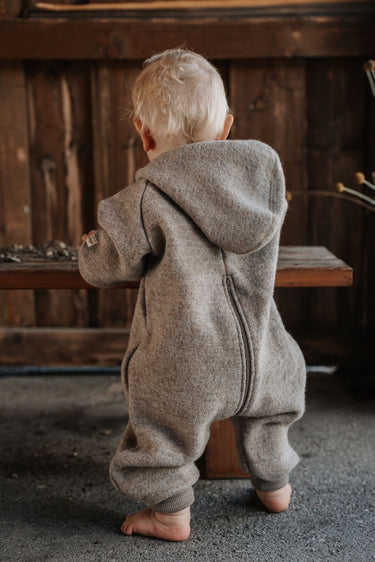
Boiled wool is very popular as an outer layer. It is warm, robust, breathable, and ideal for walks, strollers, or cool days. A boiled wool overall can be a very good winter solution if it suits the temperature and situation.
Cotton
Cotton is easy to care for and familiar. It can work well as a basic, but it warms and regulates moisture differently than wool. When cotton gets wet, it feels cooler more quickly. Therefore, it is often less ideal as a sole warming layer in winter.
More about material selection can be found here: Natural Baby Clothes: Wool, Wool/Tencel, and Cotton Compared.
Dressing Your Baby at Home in Winter
At home, your baby usually needs less clothing than outdoors. In heated rooms, an over-dressed baby can quickly sweat. Especially when your baby is lying on you, being breastfed, or carried, it receives additional body heat.
For home, a soft, breathable combination is often useful.
Possible clothing at home
- Bodysuit made of wool/Tencel, fine wool, or cotton
- Soft pants or leggings
- Socks or wool socks
- A light jacket if needed
- A blanket for quiet lying times, if used safely and appropriately
When your baby is lying on you or in a carrier close to your body, it often needs less additional clothing than you might initially think. Your body is an important source of warmth.
If you generally want to know what clothing a newborn needs, you can find a good basis here: What clothing does a newborn really need?.
Dressing Your Baby Outdoors in Winter
Outdoors, your baby needs protection from cold, wind, and moisture. How much clothing is needed depends on the temperature, wind, duration of the walk, stroller, carrier, and layering.
A classic winter setup might look like this:
- First layer: Bodysuit
- Second layer: Pants and top or one-piece
- Warming layer: Wool jacket, wool pants, or wool suit
- Outer layer: Boiled wool overall, footmuff, or suitable blanket
- Hat, warm socks or shoes without a firm sole
It is important that your baby is not stiffly bundled. It should be protected, but still be able to lie or be carried comfortably.
Dressing Your Baby in a Stroller in Winter
In a stroller, your baby moves very little. This means it cools down faster than an older child who is walking or playing. At the same time, a good footmuff or a warm blanket can retain a lot of heat.
If you use a warm footmuff, your baby often needs less thick clothing underneath than without a footmuff. Otherwise, it can get too warm.
A possible combination in the stroller
- Bodysuit
- Soft pants and top or one-piece
- Warming wool layer
- Hat
- Wool socks or warm booties
- Footmuff or wool blanket depending on the temperature
Check your baby's neck regularly while out and about. Especially after moving from outdoors to indoors, you should open or remove layers so that your baby doesn't overheat.
You can find more on this here: Dressing your baby in the stroller: What your baby needs outdoors.
Dressing Your Baby in a Carrier in Winter
In a carrier, the situation is different from a stroller. Your baby receives your body heat. At the same time, it is very close to you and is often additionally protected by your jacket or a carrier cover layer.
Many babies need less thick clothing in a carrier than parents initially assume. A very thick overall can be impractical because it can interfere with the M-position or create pressure. Additionally, your baby can quickly get too warm.
Practical for the carrier
- Soft base layer made of natural material
- Warming, but not too thick, wool layer
- Warm feet, for example with wool socks or leg warmers
- Hat, because the head usually remains outside your jacket
- Carrier jacket, carrier cover, or a shared jacket solution
With the carrier, the rule is: your upper body helps warm your baby. Pay particular attention to the head, feet, and exposed areas. The torso is often well-protected by proximity.
You can find more on this here: Dressing your baby in the carrier: What your baby really needs.
Dressing Your Baby in the Car in Winter
Different conditions apply when driving. In the car, it usually gets warm quickly. In addition, your baby should be able to be safely buckled into the infant car seat. Very thick, bulky clothing can be impractical, as the straps may not lie close enough to the body.
For short car journeys, it is often better to dress your baby in normal layers, buckle them in safely, and if necessary, place a blanket over the straps. The blanket can be removed if it gets warmer in the car.
Practical for the car
- No very thick, bulky overalls under the harness
- Preferably several thinner layers
- Blanket over the buckled baby, if necessary
- Hat for cold weather outside, remove if it gets warm in the car
- Regularly check the temperature in the car
If you are unsure how your baby is safely dressed in the infant car seat, ask your midwife, a child car seat expert, or check with the manufacturer of your infant car seat.
You can find more on this here: Dressing your baby in the car: safe and warm in the infant car seat.
Dressing Your Baby at Night in Winter
At night, a good balance is particularly important. Your baby should sleep warm enough, but not overheat. The right clothing depends on the room temperature, sleeping bag, and your baby.
Many families use a combination of a bodysuit, pajamas, and a sleeping bag. In cooler rooms, a warmer sleeping bag or an additional light layer may be useful. In warmer rooms, less is accordingly sufficient.
What to pay attention to at night
- Check the neck instead of just assessing hands or feet
- Choose a sleeping bag suitable for the room temperature
- Do not use unnecessarily thick layers
- Choose materials that are comfortable and breathable
- Reduce a layer if sweating occurs
There are many individual factors for baby sleep. If your baby was born prematurely, is ill, has a fever, or you are unsure, please seek professional support.
You can find more on this here: Dressing your baby at night: What does a newborn need to sleep?.
How Many Layers Does a Baby Need in Winter?
There is no fixed number that always applies. A common guideline is: babies often need one more layer than adults if they are not actively moving. But this rule is only a starting point, not a law.
More important is the specific situation:
- Is your baby lying quietly in the stroller?
- Is it being warmed by your body in the carrier?
- Are you only outside for a short time?
- Is it windy or damp?
- Are you immediately entering heated rooms?
- Does your baby sweat quickly?
Layers give you flexibility. You can open, take off, or add layers on the go without having to change the entire outfit.
Dressing Baby at 0 Degrees Celsius
At temperatures around freezing point, your baby needs good thermal layering outdoors. In a stroller, a warm footmuff or wool blanket can provide a lot of warmth. In a carrier, your body will help warm the baby.
In a stroller, this might fit:
- Bodysuit
- Warming one-piece or pants and top
- Wool layer
- Hat
- Warm feet
- Footmuff or warm blanket
In a carrier, this might fit:
- Bodysuit
- Light to medium wool layer
- Warm socks or leg warmers
- Hat
- Carrier jacket or cover
Check the baby's neck while out and about. Especially in a carrier, your baby can quickly get warm despite cold outdoor temperatures.
Dressing Baby at 5 to 10 Degrees Celsius
At 5 to 10 degrees Celsius, it's cool, but not deeply wintry. Here, the onion principle is particularly helpful because your baby needs more or less protection depending on wind, sun, and location.
A possible combination is:
- Bodysuit
- Soft pants and top
- Warming jacket or wool layer
- Hat
- Warm socks
- In the stroller, a blanket or light footmuff
If the sun is shining or you are in sheltered areas, less may suffice. In windy or humid conditions, the same temperature can feel significantly colder.
Dressing Baby in Sub-Zero Temperatures
In sub-zero temperatures, your baby should be well-protected outdoors. Head, feet, hands, and torso are particularly important. At the same time, you should make sure to open layers when moving into warm indoor spaces.
For longer walks in very cold temperatures, a good boiled wool overall, footmuff, or a warm carrier solution is helpful. Make sure your baby doesn't sweat, as moisture can later lead to chilling.
Important in sub-zero temperatures:
- Short checks of the neck
- Warm, dry feet
- Hat that fits well
- Wind protection depending on the weather
- No long stays if your baby seems restless or cold
- Open layers indoors
If your baby is very small, sick, or particularly sensitive, it's best to discuss longer stays in extreme cold with your midwife or pediatrician.
Head, Hands, and Feet: Don't Forget the Small Areas
Babies also lose heat through unprotected areas. In winter, hats, socks, and possibly hand protection are therefore important.
A hat should fit softly, protect the ears, and not slip over the face. Socks or wool booties should keep warm but not constrict. Gloves are helpful depending on age and temperature, but can quickly slip off very small babies.
If your baby is in a carrier, pay special attention to the feet. Pants often ride up a bit in the carrier, exposing ankles. Leg warmers or longer wool socks can compensate for this well.
Boiled Wool Overall: When Is It Useful?
A boiled wool overall is a very practical piece of clothing in winter. It is particularly suitable for outdoors, for walks, strollers, and many transitional situations. Boiled wool warms well, is breathable, and remains more flexible than some very bulky winter clothing.
A good overall should not be too tight. It should allow room for layers underneath, but not be so large that your baby gets lost in it. Sleeves and legs can grow with the baby or be rolled up, depending on the cut.
At Mata Origin, you can find high-quality wool clothing for cold days, for example here: Boiled Wool Overall.
Wool Blankets in Winter
A wool blanket can be very versatile in winter. It warms in the stroller, on the sofa, while breastfeeding, or as an additional layer over the legs. Unlike a fixed piece of clothing, it can be quickly removed if it gets too warm.
Especially during the postpartum period or for short trips, a good blanket is often more practical than many additional pieces of clothing. It should be soft, breathable, and comfortable on the baby's skin or clothing.
It is important to always use blankets appropriately for the situation. When sleeping and in the stroller, you should ensure safe use and not cover your baby loosely, heavily, or too warmly.
Winter Clothing and Elimination Communication
If you want to try elimination communication or going diaper-free, winter clothing poses a special question: How do you keep your baby warm and still be able to react quickly?
Many thick layers can make elimination communication cumbersome. Therefore, well-thought-out cuts and easily combinable layers are helpful. A warm base layer, practical elimination communication pants or a diaper, and an outer wool layer can simplify everyday life.
Helpful for winter and elimination communication:
- Soft clothing that does not need to be completely removed
- Split-crotch pants for quick changes
- Elimination Communication diapers as backup
- Absorbent inserts
- Warming wool layers over them
- A changing pad for relaxed moments at home or on the go
This way, Elimination Communication remains feasible even in the cold season. Not perfect. But easier.
If you want to understand Elimination Communication first, you'll find a gentle introduction here: What does Elimination Communication from birth actually mean?.
If you're concretely planning what you need, read on here: Elimination Communication Starter Kit: What you really need.
You can find suitable items here: Split-crotch pants, Elimination Communication diapers, Diaper inserts, and the changing pad for on the go.
Changing and dressing baby in winter
In winter, it's particularly pleasant when changing and dressing happen quickly and calmly. Babies often don't like to lie naked on the changing table for long, especially if the room is cool.
Helpful for changing diapers in winter:
- Protect changing area from drafts
- Lay out spare clothes beforehand
- Have warm hands
- Only uncover necessary areas
- Use a soft changing pad
- Bundle baby back up quickly after changing
If you want to practice Elimination Communication, it can help to have the potty right at the changing station. This keeps the process short and prevents your baby from getting unnecessarily cold.
You can find more information here: Setting up a changing station: What you really need.
Common mistakes when dressing baby in winter
Many uncertainties arise not because parents are inattentive, but because winter clothing often seems contradictory. It's easy to overdo it when trying to protect.
Common mistakes include:
- too many thick layers on top of each other
- not undressing baby indoors
- only using cold hands as a measure
- using overly thick clothing under the car seat harness
- not considering parents' body heat when babywearing
- using cotton as the only layer even when it's damp
- not having spare clothes with you
Good winter clothing is not maximally thick. It is appropriate, flexible, and comfortable.
A simple winter checklist for baby clothes
This reduced guide can help for the cold season:
- 5 to 7 bodysuits made of wool/Tencel, fine wool, or cotton
- 4 to 6 soft pants or leggings
- 2 to 3 warming tops or cardigans
- 2 to 4 sleepsuits or one-pieces
- 2 hats, one warmer for outdoors
- several pairs of wool socks or warm socks
- 1 boiled wool overall or warm outer layer
- 1 wool blanket
- if needed, leg warmers for carrier or stroller
- practical clothing for changing or Elimination Communication
If you're planning all the clothing for your baby, you'll find further guidance here: What clothes does a newborn really need?.
For more specific advice for winter babies, continue here: Winter Baby Essentials: What you really need.
Frequently Asked Questions: Dressing baby in winter
How do I dress my baby properly in winter?
Preferably in several layers. A soft base layer, a warming mid-layer, and depending on the situation, an outer layer like boiled wool, a footmuff, or a blanket are practical. Regularly check your baby's neck.
How do I know if my baby is cold?
Cold hands or feet alone are not a reliable indicator. It's better to feel the back of their neck or upper back. If this area is cool and your baby seems restless, an additional layer might be helpful.
How do I know if my baby is dressed too warmly?
If the back of your baby's neck is damp, very warm, or sweaty, your baby is probably too warm. You should then remove a layer or open clothing.
Is wool better than cotton in winter?
Wool has clear advantages in winter because it warms, absorbs moisture, and can regulate temperature. Cotton is easy to care for, but feels damp or cool more quickly when wet. A combination can be useful.
Does my baby always need a hat in winter?
Outdoors, a suitable hat is usually appropriate, especially in cold and windy conditions. In warm indoor spaces, your baby doesn't automatically need a hat. Pay attention to the temperature and situation.
What should a baby wear in a carrier in winter?
In a carrier, your baby benefits from your body heat. Therefore, a good base layer, a light to medium wool layer, warm feet, a hat, and a babywearing jacket or cover are often sufficient. Very thick overalls are often impractical.
What should my baby wear in the car in winter?
In the car, your baby should be able to be securely buckled. Very thick, bulky clothing under the harness is unfavorable. Thinner layers are better, and if needed, a blanket over the buckled baby.
Is a boiled wool overall sensible in winter?
Yes, a boiled wool overall can be very useful in winter, especially outdoors, in the stroller, or during walks. In a carrier or car, depending on its thickness and the situation, it's not always the best choice. Thinner layers are often more practical there.
A calm thought to conclude
Dressing your baby in winter is not a mathematical equation. There isn't one perfect combination for every temperature and every family.
You are allowed to observe, adapt, and learn. With time, you'll become more confident. You'll notice when your baby sweats easily, when they need extra warmth, and what clothing makes your daily life easier.
Natural materials, good layering, and an attentive eye will help you with this. Your baby needs warmth, but not over-packaging. Protection, but mobility. Clothing that not only looks good but proves itself in real life.
This way, winter clothing doesn't become another uncertainty, but rather a part of your secure start to the baby year.
If you want to accompany your baby with natural materials, practical cuts, and an undogmatic view on changing, Elimination Communication, and closeness, Mata Origin offers thoughtful companions for precisely this early period.
Discover suitable products for cold days and your baby's daily life: Boiled wool overall, Split-crotch pants, Elimination Communication diapers, diaper inserts, and the changing pad for on the go.
Note: This article is not a substitute for medical advice. It is intended to provide guidance. In cases of premature birth, illness, fever, unusual temperature, uncertainty, or specific health questions, please consult your midwife, pediatrician, or doctor.