Spring and autumn are seasons where planning baby clothes can be particularly challenging. Mornings are cold, midday is almost warm, it's cool in the shade, pleasant in the sun, and chilly again in the evening.
This can be particularly unsettling for a newborn. Is a bodysuit enough? Does your baby need a jacket? When is an all-in-one too much? Is a blanket in the stroller sufficient? And how do you prevent your baby from getting cold or overheating?
The most important answer is: during the transitional seasons, flexible layers are crucial. Not too thick. Not too thin. But such that you can react quickly in everyday life.
In this article, you will find natural, practical, and non-dogmatic guidance: how to dress your baby in spring and autumn, which materials are useful, what to consider when using a baby carrier, stroller, car, and at home, and which clothes remain practical for diaper changes or elimination communication.
Why transitional seasons are so challenging for babies
In winter, it's clear: it's cold. In summer, it's clear: it's warm. In spring and autumn, conditions often change within a few hours.
Typical for transitional seasons are:
- cold mornings
- mild middays
- cool evenings
- wind despite sunshine
- temperature differences between shade and sun
- warm interiors and fresh outdoor air
- sudden rain or humidity
For adults, this is usually just a matter of a jacket. For babies, it's a bit more complex because they can't regulate their temperature as well yet. They need clothes that protect but don't overheat.
If you are currently planning your baby's complete wardrobe, you will also find a good basis here: What clothes does a newborn really need?.
The basic rule: layer clothing instead of a fixed outfit
The layering principle is particularly valuable during transitional seasons. Instead of putting your baby in a fixed, very warm outfit in the morning, you combine several thinner layers.
This way, you can open, remove, or add a layer while out and about. Your baby remains mobile, and you are not prepared for just one temperature.
A simple layering structure can look like this:
- first layer: bodysuit made of wool, wool/Tencel, or cotton
- second layer: soft trousers and top or light all-in-one
- warming layer: wool jacket, wool trousers, or light wool suit
- outer layer: blanket, light all-in-one, boiled wool, or baby carrier cover depending on the weather
- extras: hat, socks, leg warmers, or light blanket
This structure helps you stay calm. You don't have to calculate every degree perfectly. You just need clothes that can be easily adjusted.
How do you know if your baby is dressed appropriately?
Many parents first check their baby's hands or feet. However, these can be cool in babies, even if the body is pleasantly warm. The neck or upper back is a better indicator.
Here's how you can orient yourself:
- If the neck feels pleasantly warm and dry, your baby is usually dressed appropriately.
- If the neck is damp, hot, or sweaty, your baby is probably too warm.
- If the neck feels cool and your baby seems restless, an additional layer might be useful.
Also, observe your baby: Does he or she seem relaxed, rosy, and calm? Or unusually sleepy, very restless, sweaty, or cool? Over time, you will become more confident in assessing your baby.
Which materials are suitable for spring and autumn?
During transitional seasons, materials that can regulate temperature are in demand. They should warm in the morning but not immediately become too warm at midday.
Therefore, natural materials are particularly valuable. They feel pleasant, can absorb moisture, and support a good body feeling.
Wool
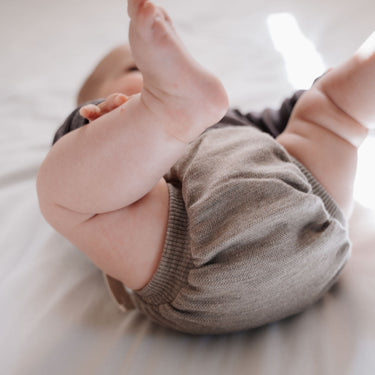
Wool is very practical in spring and autumn. It warms without immediately feeling stuffy and can regulate temperature well. Fine wool clothing is suitable as a close-fitting layer, and slightly thicker wool clothing as a warming intermediate layer.
Wool/Tencel
Wool/Tencel is soft, light, and pleasant on baby's skin. It is particularly well-suited for bodysuits or first layers if you want to combine natural temperature regulation with a particularly smooth feel.
Cotton
Cotton is easy to care for and familiar. It can work well during transitional seasons, especially indoors or on milder days. However, when wet, it feels cooler faster than wool.
Boiled wool
Boiled wool can be useful as an outer layer during transitional seasons, especially on cool, windy days. Depending on the temperature, however, a boiled wool overall can also be too warm. Therefore, it is important what your baby wears underneath and whether they are lying in the stroller or being carried.
You can find more about material selection here: Natural baby clothes: wool, wool/Tencel, and cotton compared.
Dressing baby in spring
In spring, temperatures often fluctuate greatly. Mornings can be frosty, midday mild, and almost warm in the sun. At the same time, the wind is often still fresh.
For a spring baby, light, easily combinable layers are therefore ideal. You don't immediately need summer clothes, but no longer the full winter gear either.
For spring days, this may be suitable:
- bodysuit made of wool/Tencel, fine wool, or cotton
- soft trousers or leggings
- light wool jacket or thin sweater
- socks or wool socks
- thin hat for wind or cooler temperatures
- light blanket in the stroller
- on cool days, a warmer outer layer
In spring, it's especially important not to underestimate the sun. Even if it's cool, direct sun on baby's skin or in the stroller can quickly feel intense. Shade, light head protection, and air circulation remain important.
If it's getting warmer, you'll find more in-depth information here: Dressing baby in summer: light and breathable.
Dressing baby in autumn
In autumn, the air becomes damper, the wind stronger, and the temperature often drops faster than expected. At the same time, there are mild days when winter clothes would still be too much.
For an autumn baby, you therefore need a slightly warmer transitional outfit than in spring. Wool, wool jackets, warm socks, hats, and a flexible outer layer are particularly helpful.
For autumn days, this may be suitable:
- long-sleeved bodysuit made of natural material
- soft trousers
- warming top or wool jacket
- wool socks or booties
- hat for outdoors
- blanket or footmuff depending on the stroller situation
- light boiled wool overall in cool weather
Especially in autumn, it's worth having a reserve layer with you. A small jacket, a blanket, or leg warmers can make a big difference when out and about.
If it's already significantly cooler, you can find more guidance here: Dressing baby in winter: warm without overheating.
Dressing baby at home during transitional seasons
At home, suitable clothing strongly depends on your room temperature. Some apartments are still cool in spring. Others are well heated in autumn. Old buildings, underfloor heating, drafts, and sun exposure also make a difference.
At home, a simple combination of bodysuit and trousers is often sufficient. If necessary, a light jacket or a second layer can be added.
At home, this can be useful:
- long-sleeved bodysuit
- soft trousers
- socks
- light jacket for cool rooms
- blanket for awake, supervised cuddle times
If your baby is often on you or in a carrier, they often need fewer additional clothes. Your body provides warmth.
Dressing baby outdoors during transitional seasons
Outdoors, you need flexibility in spring and autumn. The difference between wind-sheltered sun and a shady path can be significant.
A good basic outdoor outfit consists of comfortable base clothing, a warming layer, and an easily adjustable outer layer.
Practical for outdoors:
- bodysuit
- trousers and top or all-in-one
- warming jacket
- hat depending on temperature and wind
- warm feet
- blanket, footmuff, overall, or baby carrier cover depending on the situation
Always check the back of your baby's neck when you're out and about. Especially when going from outdoors to indoors, you should open or remove layers.
Baby in the stroller in spring and autumn
In the stroller, your baby hardly moves. Therefore, they usually need more outer protection there than in a baby carrier. At the same time, heat can build up under blankets or in a footmuff.
In spring, a light blanket is often sufficient. In autumn, depending on the temperature, a footmuff or a warmer blanket may be useful.
In the stroller, this may be suitable:
- bodysuit and soft clothes
- warming wool layer
- hat for wind or cold
- warm socks or booties
- light blanket in spring
- warmer blanket or footmuff in autumn
When you enter a café, shop, or warm apartment, you should open the outer layer. Many babies sweat in the stroller without parents immediately noticing.
You can find more about this here: Dressing baby in the stroller: What does your baby need outdoors?.
Baby in the baby carrier during transitional seasons
In the baby carrier, your baby is close to your body. They receive your warmth and are additionally surrounded by the baby wrap or carrier. Therefore, they usually need less clothing in the carrier than in the stroller.
A thick overall is often not necessary in a baby carrier and can even be impractical. Soft layers, warm feet, a hat, and depending on the weather, a babywearing jacket or cover are better.
Practical in the baby carrier:
- bodysuit made of natural material
- light to medium wool layer
- soft trousers
- warm socks or leg warmers
- hat if the head is exposed
- babywearing jacket or cover for wind and cold
Pay particular attention to feet and legs. In the carrier, trousers often ride up a bit, exposing ankles. Leg warmers or longer wool socks are very practical here.
You can find more about this here: Dressing baby in the baby carrier: What does your baby really need?.
Dressing baby in the car during transitional seasons
The car often gets warm quickly. At the same time, it can be chilly when getting in and out. Therefore, layers are also useful here.
Very thick clothing under the harness is unfavorable. Your baby should be able to be buckled in securely. A blanket can be placed over the straps and easily removed when it gets warm.
Practical for the car:
- normal clothing in thinner layers
- no very thick outer clothing under the harness
- blanket over the buckled baby, if necessary
- remove hat after getting in if it gets warm
- regularly check the temperature in the car
When driving, remember: your baby needs safety and temperature regulation. Not the thickest clothes.
You can find more about this here: Dressing baby in the car: safe and warm in the infant car seat.
Dressing baby at night during transitional seasons
At night, spring and autumn are often particularly changeable. Some nights are cool, others surprisingly mild. Therefore, sleepwear should also remain flexible.
A bodysuit, pajamas, and a suitable sleeping bag can be a good combination. Depending on the room temperature and material, one layer more or less may be appropriate.
At night, you can consider:
- check the back of the neck: warm and dry is usually appropriate
- reduce a layer if sweating
- check for an additional layer if the neck is cool
- choose a sleeping bag suitable for the room temperature
- do not use unnecessarily thick layers
- ensure a safe sleeping environment
If your baby is sick, has a fever, was born very small, or if you are unsure, seek professional advice.
You can find more about nightwear here: Dressing baby at night: What does a newborn need for sleep?.
What clothes does a baby need in spring?
For a spring baby or the spring months, you need clothes that can cover both cool and mild days.
A sensible spring outfit:
- 5 to 7 bodysuits, mixed long-sleeved and short-sleeved depending on the birth month
- 4 to 6 soft trousers
- 2 to 3 light jackets or tops
- 2 to 4 pajamas
- 1 to 2 hats
- socks or wool socks
- light blanket
- for cool months, a light wool layer or boiled wool
If your baby is born in March, you usually still need warmer clothes than for a baby born in May. Therefore, plan not only by season but by the actual month.
For very mild spring days, the summer baby starter kit can also help as a guide.
What clothes does a baby need in autumn?
For an autumn baby, the outfit can be planned to be slightly warmer. A baby born in September needs different clothes than a baby born in November.
A sensible autumn outfit:
- 5 to 7 long-sleeved bodysuits
- 4 to 6 soft trousers
- 2 to 3 warming tops or jackets
- 2 to 4 pajamas
- 2 hats, one of which is warmer
- warm socks or wool socks
- wool blanket
- light boiled wool overall or warm outer layer depending on the month
The closer the due date is to winter, the more it makes sense to already consider winter clothing.
For late autumn babies, you can find a suitable overview here: Winter baby starter kit: What you really need.
Transitional season and baby sizes
During transitional seasons, size planning is particularly important because your baby may grow into a new season. A baby born in March might wear size 62 as early as May. A baby born in September might need size 62 in the cooler autumn or early winter.
Therefore, you should not only plan for the first size but also for the next season.
Practical is:
- buy little in size 50
- plan size 56 as the starting range
- consider size 62 to match the upcoming season
- don't buy outer clothing too small
- wish for larger sizes when receiving gifts
You can find more about size planning here: Which baby size for birth: 50, 56, or 62?.
How many bodysuits does a baby need during transitional seasons?
For spring and autumn, 5 to 7 bodysuits are usually a good start. Depending on the birth month, these can be more long-sleeved bodysuits or a mix of long-sleeved and short-sleeved bodysuits.
If your baby is born in early spring or late autumn, long-sleeved bodysuits are usually more important. For a baby born in May or September, a mixed selection may be useful.
Practical for transitional seasons:
- 4 to 6 long-sleeved bodysuits
- 1 to 3 short-sleeved bodysuits depending on the temperature
- focus on size 56
- a few bodysuits in size 62 as a reserve
- soft materials directly on the skin
You can find more information here: How many bodysuits does a newborn need?.
Wrap bodysuit or slip bodysuit in spring and autumn?
For the first few weeks, wrap bodysuits are very practical even during transitional periods. They can be put on calmly without having to pull clothing over the baby's head.
Slip bodysuits can be a good addition when your baby is a little older or you have become more confident with dressing them. What matters less is the type of bodysuit alone, but rather that the bodysuit fits softly, doesn't pinch, and matches the layering.
You can find more about this decision here: Wrap Bodysuit or Slip Bodysuit: Which is better?.
Wool walk in the transitional period: useful or too warm?
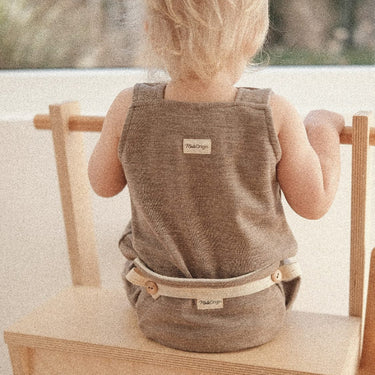
A wool walk overall can be very practical in spring and autumn, especially in windy conditions, cool mornings or late autumn days. At the same time, wool walk can be too warm on mild days if your baby is wearing many layers underneath.
Whether wool walk is suitable depends on three things: temperature, situation, and the layers underneath. In the stroller, a wool walk layer can be useful. In the carrier, less is often sufficient because your body provides warmth.
Wool walk can be useful:
- in cool wind
- in late autumn
- on fresh spring days
- in the stroller
- for short outdoor trips
You can find a suitable outer layer here: Wool walk overall.
Diaper-free and elimination communication during the transitional period
If you want to try diaper-free or elimination communication, the transitional period is often very pleasant. It's not as hot as in summer and not as cold as in winter. Nevertheless, your baby needs clothing that is warm enough and allows quick access.
Too many layers can make elimination communication cumbersome. Too little clothing can become uncomfortable in cool temperatures. The solution again lies in good, well-thought-out layers.
Helpful for elimination communication in spring and autumn:
- Elimination communication pants or quick-opening pants
- Elimination communication diaper as backup
- Absorbent inserts
- Soft base layer
- Warming wool layer over it
- Changing pad at home and on the go
- Small elimination communication potty within reach
You can find suitable sections here: Elimination communication pants, Elimination communication diapers, Diaper inserts and the changing pad for on the go.
If you want to learn more about elimination communication, you can start here: What does diaper-free from birth actually mean?.
If you want to know what you really need to start with elimination communication, read on here: Elimination communication initial equipment: What you really need.
Diapering during the transitional period
When changing diapers in spring and autumn, drafts are often more of an issue than intense cold or heat. A changing area by the window or in a cool room can quickly become uncomfortable.
Helpful when changing diapers:
- draft-free changing area
- soft pad
- change of clothes within reach
- warm hands
- only undress as much as necessary
- if needed, a light blanket over the upper body
Practical clothing makes diapering calmer. Wrap bodysuits, soft pants, and clothing with simple openings are particularly helpful in the first few weeks.
You can find more about preparing your changing area here: Setting up a changing station: What you really need.
Sustainable planning in spring and autumn
During the transitional period, it's particularly easy to buy too much because you feel like you want to be prepared for every type of weather. Often, however, a small, easily combinable selection is more sensible than many individual specialized items.
Sustainable and practical means:
- choosing a few high-quality basics
- considering size 62 to match the upcoming season
- planning with layers instead of individual outfits
- consciously using natural materials
- effectively supplementing with used clothing
- not buying outerwear too small
- buying specific items later, instead of owning everything before birth
You can find more information here: Sustainable first equipment: Buy less, choose better.
Typical mistakes when dressing a baby during the transitional period
Many mistakes occur because the transitional period is unpredictable. Parents start in the morning with the right clothes, but by midday, they no longer fit.
Common mistakes are:
- too thick clothing for mild midday hours
- no additional layer for cool evenings
- not undressing baby indoors
- only using cold hands as a benchmark
- dressing too warmly in the carrier
- underestimating warmth in the stroller
- not taking spare clothes
- buying outerwear too small
The solution is not to always take more. The solution is a small, easily combinable selection.
A compact checklist for spring and autumn
Clothing
- 5 to 7 bodysuits, long-sleeved or mixed depending on the month
- 4 to 6 soft pants
- 2 to 3 jackets or warming tops
- 2 to 4 sleepsuits or rompers
- 1 to 2 hats
- several pairs of socks or wool socks
- light to medium wool layer
On the go
- light blanket
- for autumn or cool days, a warmer blanket or footmuff
- carrier cover or carrier jacket if needed
- spare bodysuit
- spare pants
- hat
Diapering and Elimination Communication
- Changing pad
- Elimination communication diaper or backup
- Inserts
- Elimination communication pants or easy-opening clothing
- Washcloths or soft cloths
- Wet bag for on the go
Frequently asked questions: Dressing a baby during the transitional period
How do I dress my baby properly in spring?
In spring, flexible layers are ideal: bodysuit, soft pants, light jacket, socks, and a hat depending on wind or temperature. Outdoors, a blanket or light outer layer helps.
How do I dress my baby properly in autumn?
In autumn, clothing can be a bit warmer: long-sleeved bodysuit, pants, wool jacket, hat, warm socks, and depending on the temperature, a blanket, footmuff, or light wool walk overall.
Which materials are good for the transitional period?
Wool, wool/Tencel, and high-quality cotton can be useful. Wool and wool/Tencel are particularly valuable because they can balance temperature and provide pleasant warmth.
Does my baby need a hat during the transitional period?
Outdoors, a hat is often useful in windy or cool temperatures. Indoors in warm rooms, your baby usually doesn't need a hat. Temperature, age, and situation are decisive.
Is a wool walk overall useful in spring or autumn?
On cool, windy days, wool walk can be very practical. In mild temperatures, it can be too warm. What your baby wears underneath and whether it's in the stroller or being carried is important.
How do I dress my baby in the carrier during the transitional period?
In the carrier, your baby receives your body heat. Usually, a bodysuit, soft clothes, a light wool layer, warm feet, a hat, and a carrier cover or carrier jacket depending on the weather are sufficient.
Is it good to start elimination communication in spring and autumn?
Yes. The transitional period can be very pleasant for elimination communication. Helpful are elimination communication pants, elimination communication diapers, inserts, and clothing that can be opened quickly without your baby getting cold.
A calm thought to conclude
Spring and autumn don't demand a perfect baby wardrobe. They demand flexible clothing, good materials, and the willingness to constantly adapt.
You don't have to know in the morning how the whole day will feel. You are allowed to use layers, check the neck, open a blanket, take off a jacket, or add a hat.
With a few good basics, natural materials, and practical cuts, the transitional period becomes manageable. Your baby needs warmth, but not over-packaging. Protection, but air. Closeness, but freedom of movement.
Thus, clothing does not become a source of uncertainty, but a small, loving support in your daily life.
If you want to accompany your baby with natural materials, practical cuts, and an undogmatic approach to diapering, elimination communication, and closeness, you'll find well-thought-out companions for precisely this early period at Mata Origin.
Discover suitable products for changeable weather and your baby's daily life: Wool walk overall, Elimination communication pants, Elimination communication diapers, Diaper inserts and the changing pad for on the go.
Note: This article does not replace medical advice. It is intended to provide guidance. In case of premature birth, illness, fever, unusual temperature, uncertainty, or specific health concerns, please consult your midwife, pediatrician, or family doctor.