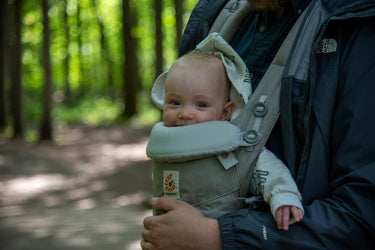
Dressing a baby in a carrier often feels uncertain at first. In a stroller, your baby lies freely in front of you. In a carrier, they are close to your body, receiving your warmth, surrounded by the baby wrap or carrier, and barely moving themselves.
That’s precisely why the rules for dressing in a carrier are somewhat different from those for a stroller. Your baby needs protection from cold, sun, and wind. At the same time, it can get warmer faster in the carrier because your body contributes to the heat.
The most important guideline is: The carrier counts as an additional layer of clothing. And your body is a source of heat.
In this article, you will find a natural, practical, and undogmatic guide: how to dress your baby in a carrier in summer, winter, and during transitional seasons, which materials are useful, what to consider for feet, head, and neck, and how clothing also works with diaper-free methods or elimination communication.
Why carrier clothing works differently than stroller clothing
When your baby is lying in a stroller, they are separated from your body heat. They move little and therefore often need an additional blanket, a footmuff, or a warmer outer layer.
In a carrier, it's different. Your baby lies close to you. Your upper body warms your baby's torso. Additionally, the baby wrap or carrier encloses part of their body. Depending on the carrying position, jacket, or cover, a lot of warmth can quickly build up.
Therefore, a baby in a carrier often needs less clothing than many parents initially think.
In the carrier, several layers of warmth work together:
- your baby's clothing
- your body heat
- the baby wrap or carrier
- your clothing
- possibly a babywearing jacket, carrier cover, or coat
If you keep all this in mind, it becomes clear: a thick overall is often not necessary in a carrier and sometimes even impractical.
If you want to dress your baby in a stroller, a slightly different logic applies. You can find more information here: Dressing Baby in a Stroller: What Your Baby Needs Outdoors?.
First things first: Safe carrying takes precedence over outfit
Before discussing materials, layers, or seasons, the safe position of your baby in the carrier is paramount. Clothing must not impede your baby's breathing, posture, or perception.
Important when carrying:
- Your baby's face should always be visible.
- Nose and mouth must not be covered by fabric or your body.
- The chin should not be pressed against the chest.
- Your baby should sit high and close to your body.
- The back should be well supported.
- The legs should be ergonomically well supported.
- Your baby should not overheat.
The safety-related information in this article is based, among other things, on information from RoSPA on baby sling safety, the HSE advice on baby carriers and slings, and information from Stiftung Warentest on baby carriers and slings.
Clothing should support these principles. It should not be so thick, stiff, or slippery that your baby cannot be properly positioned.
The basic rule: Your body counts as a layer of warmth
When you carry your baby, you actively warm them. This is one of the great advantages of carrying. Your baby feels you, hears you, smells you, and receives your warmth.
For clothing, this means: Your baby often needs fewer additional layers on the torso than in a stroller. However, the head, feet, and legs need special attention because they can be more exposed depending on the carrying method.
A simple rule of thumb:
- Dress the body less thickly.
- Protect exposed body parts well.
- Choose layers that you can easily adjust.
- Regularly check the back of the neck.
Especially with the first baby, it can be helpful to check after a short time: Is the back of the neck pleasantly warm and dry? Then the clothing is usually well-suited.
How do you know if your baby is dressed correctly in the carrier?
Even in a carrier, hands and feet are not always the most reliable temperature indicators. They can be cool even if your baby's body is pleasantly warm.
It's better to check the back of the neck or the upper back.
Here's how you can gauge it:
- If the back of the neck feels warm and dry, your baby is usually dressed appropriately.
- If the back of the neck is damp, hot, or sweaty, your baby is probably too warm.
- If the back of the neck feels cool and your baby seems restless, an additional layer might be useful.
In a carrier, a baby can sweat more quickly because closeness, fabric, and your own body heat combine. It's better to open a layer before your baby sweats excessively.
Which materials are suitable for a carrier?
In a carrier, clothing lies close to the body. It should be soft, breathable, and flexible. Stiff, thick, or hard materials can press, wrinkle, or disturb posture.
Wool
Wool is particularly valuable for carrying because it warms, can absorb moisture, and regulate temperature. Fine wool clothing is well-suited for cooler days or as a light warming layer.
Wool/Tencel
Wool/Tencel is soft, light, and supple. The material can be comfortable directly on the skin and is well-suited for bodysuits or close-fitting layers in the carrier.
Cotton
Cotton is easy to care for and familiar. It can work well in warm indoor spaces or in summer. However, if it gets very damp, it feels cooler more quickly.
Boiled wool
Boiled wool is very practical as an outer layer, but not always necessary in a carrier. A thick boiled wool overall can quickly become too warm or too stiff depending on the weather, babywearing jacket, and baby. Often, a softer wool layer plus a carrier cover or jacket is sufficient.
More on material selection can be found here: Natural Baby Clothing: Wool, Wool/Tencel, and Cotton Compared.
Dressing baby in the carrier in winter
In winter, many parents first think of a thick overall. However, this is not always the best solution in a carrier. Your baby receives your body heat and is additionally surrounded by the carrier and possibly a jacket or cover.
A very thick overall can also alter the posture because a lot of fabric lies between you and your baby. This may cause your baby to sit less close to your body, and the M-position (squat-spread) becomes more difficult.
In winter in the carrier, this can be suitable:
- Long-sleeved bodysuit made of wool, wool/Tencel, or cotton
- soft pants or leggings
- light to medium wool layer
- warm wool socks or booties
- leg warmers if pants ride up
- hat if the head is outside your jacket
- babywearing jacket or carrier cover as an outer protective layer
Important: your baby alone does not have to bear all the winter warmth. In the carrier, you form a common heating system.
More about winter clothing can be found here: Dressing baby in winter: warm without overheating.
If you are expecting a winter baby, you will find a complete guide here: Winter baby essentials: What you really need.
Dressing baby in the carrier in summer
In summer, it can quickly get warm in the carrier. Your baby is close to you, you might be sweating yourself, and the baby wrap or carrier also surrounds the body.
Therefore, your baby usually needs very little clothing in the carrier during summer. At the same time, the head, arms, and legs must be protected from direct sun.
In summer in the carrier, this can be suitable:
- light bodysuit
- possibly thin pants or leg warmers for sun protection
- sun hat with protection for face and neck
- no thick socks if your baby is warm enough
- no additional warming layers
- breaks in the shade
Babies should avoid direct sunlight as much as possible. Therefore, shade is more important than any summer outfit. Make sure your baby's head is not covered by fabric and that air can circulate well.
The heat-related tips are based on kindergesundheit-info.de on protecting children from heat.
More about summer clothing can be found here: Dressing baby in summer: light and breathable.
If you are expecting a summer baby, you will also find a suitable overview here: Summer baby essentials: What you really need.
Dressing baby in the carrier during transitional seasons
Spring and autumn are particularly changeable for babywearing clothes. In the morning it's cool, at midday mild, fresh in the wind and suddenly warm in the sun.
Therefore, the onion principle is ideal in a carrier. Better several thinner layers than one too thick item.
During transitional periods, this can be suitable:
- bodysuit made of natural material
- soft pants
- light wool jacket or thin wool layer
- socks or wool socks
- hat in wind or cool air
- carrier cover or jacket depending on the weather
The great advantage: You can open your own jacket, remove the cover, or take off a layer without completely redressing your baby.
More on transitional periods can be found here: Dressing baby in transitional seasons: Planning spring and autumn correctly.
Why thick overalls are often impractical in a carrier
Thick, bulky overalls seem obvious in winter. However, they can have several disadvantages in a carrier.
A thick overall can:
- store too much heat
- reduce the closeness between you and your baby
- make the posture in the carrier difficult
- create creases and pressure points
- distort the correct adjustment of the carrier
- be problematic under car seat belts
This doesn't mean an overall is never useful. It can be wonderful in a stroller. But in a carrier, a combination of soft layers, warm feet, hat, and carrier cover is often more comfortable.
For strollers, cold walks, or short trips outdoors, a boiled wool overall can still be very useful. A suitable outer layer can be found here: Boiled Wool Overall.
The feet: Particularly important in the carrier
Many parents quickly notice: In the carrier, the baby's pants ride up a bit. This exposes ankles or calves. Especially in winter or when it's windy, feet and legs can then get cold, even if the torso is warm.
Helpful for warm feet:
- long wool socks
- soft leg warmers
- booties
- pants with sufficient length
- no tight cuffs
- regular checking to see if skin is exposed
Make sure socks don't cut in. Warmth should not come at the expense of freedom of movement or circulation.
The head: Hat, sun hat, or bare?
The head is often outside your jacket or cover in the carrier. Therefore, it needs special protection depending on the weather.
In winter:
A soft hat protects the head and ears. It should fit well, not slide into the face, and not scratch.
In summer:
A light sun hat is useful if your baby is not completely in the shade. The hat should protect the face, ears, and, if possible, the neck, but not obstruct breathing.
Indoors:
Indoors, your baby usually doesn't need a hat in warm rooms. Especially in the carrier, it can quickly get too warm otherwise.
The head should always remain clearly visible. Do not pull fabrics, cloths, or jackets so high that the face, nose, or mouth are covered.
The legs: Why posture matters
In a good carrying position, a baby's legs are not simply allowed to hang down. An ergonomic posture is important, where the knees can be higher than the bottom and the thighs are well supported.
Clothing should not hinder this posture. Too tight pants, stiff fabrics, or rompers with too short feet can put tension on the legs.
Practical for the legs:
- soft, stretchy pants
- enough length in the leg
- no tight foot parts that pull
- leg warmers instead of too short socks
- no stiff jeans or firm fabrics
The information on ergonomic posture, where the knees are above the pelvis and the thighs are supported up to the knee pits, is based on Stiftung Warentest on baby carriers and slings.
Rompers in the carrier: Practical or difficult?
Rompers with feet can be problematic in a carrier if they are too short. Due to the squat-spread position, the legs ride up, and the fabric pulls on the feet. This can be uncomfortable.
If you use rompers in the carrier, they should fit generously enough. Footless pants plus socks or leg warmers are often more practical.
More suitable are often:
- footless pants
- leggings with a soft waistband
- elimination communication pants
- long socks
- leg warmers
This keeps your baby more mobile, and you can better adjust feet and legs to the temperature.
What clothing is suitable for at home in the carrier?
At home, it's often very warm in the carrier. Your baby receives your body heat and is additionally surrounded by the baby wrap or carrier. Therefore, they usually don't need thick clothing indoors.
At home, this can be sufficient:
- bodysuit
- soft pants
- socks as needed
- a light wool layer in cool rooms
If your baby falls asleep on you, check the back of their neck after a while. Especially in warm homes, it quickly gets too warm in the carrier.
If you are generally planning what clothing you need for the first few weeks, you will find a good overview here: What clothing does a newborn really need?.
What clothing is suitable for outdoors in the carrier?
Outdoors, clothing depends heavily on the weather, wind, temperature, and your carrying solution. If you carry your baby under your jacket, they need less outer clothing. If you carry them over your jacket, they need more personal protection.
Under your jacket:
- less thick clothing
- warm feet
- hat
- layers that are not bulky
Over your jacket:
- warmer clothing for your baby
- wind protection
- good outer layer
- special protection for legs and feet
For newborns, carrying close to the body and under a shared jacket solution is often particularly pleasant, as warmth and closeness combine well.
Babywearing jacket, carrier cover, or regular jacket?
You don't necessarily need a special babywearing jacket right away. However, it can be very practical if you plan to carry outdoors a lot.
A babywearing jacket is practical if:
- you regularly carry outdoors
- you want to keep your baby close to your body
- you want to easily open layers
- you don't want to use a thick overall every time
A carrier cover is practical if:
- you want to remain flexible
- you use different jackets
- you need additional wind or cold protection
- you don't want to buy a separate babywearing jacket
A normal jacket can work if it's wide enough and your baby can breathe safely and freely. The face and airways must never be covered.
Baby in the carrier and car: Adjust clothing in good time
Many journeys with a baby involve several situations: first the carrier, then the car, then outside again. The same clothing can suddenly be too warm, too thick or impractical.
Very thick clothing is unsuitable under straps in the infant car seat. When you move your baby from the carrier to the car, you should check whether a jacket, overall or thick layers need to be removed beforehand.
Helpful for switching to the car:
- thinner layers instead of bulky outerwear
- only place a blanket over the straps once your baby is buckled in
- remove hat in a warm car
- neck check after a short time
- do not stay in carrier mode when switching to the car
You can find more information here: Dressing your baby in the car: safe and warm in the infant car seat.
Baby in the carrier and sleep
Many babies fall asleep quickly in the carrier. This can be a great relief in everyday life. At the same time, you should regularly check that the face and airways remain clear and that your baby does not overheat.
If you put your baby down to sleep after carrying them, the situation is different again: Your body heat no longer counts, but rather room temperature, sleepwear and sleeping bag.
You can find more information about nightwear here: Dressing your baby at night: What does a newborn need to sleep?.
Baby in the carrier and diaper-free
Many babies become calm, warm and relaxed in the carrier. Some fall asleep quickly. Others show clear restlessness in the carrier when they need to go or when their diaper is full.
If you try diaper-free or elimination communication, the carrier can play an interesting role. You get to know your baby close to your body and sometimes feel very subtly when tension, movement or restlessness changes.
At the same time, elimination communication from the carrier requires some routine. You have to take your baby out of the carrier, open their clothing and offer them the potty. The simpler the clothing, the easier the process.
Helpful for carrier and diaper-free:
- elimination communication pants or easy-to-open pants
- elimination communication diaper as a backup
- absorbent inserts
- not too many layers in the diaper area
- wet bag for on the go
- changing mat for short breaks
You can find suitable items here: Elimination communication pants, Elimination communication diapers, Diaper inserts and the changing mat for on the go.
If you want to learn more about diaper-free, you can start here: What does diaper-free from birth actually mean?.
If you want to know what you really need to start with elimination communication, read on here: Elimination communication starter kit: What you really need.
Baby in the carrier and changing on the go
When you carry your baby on the go, changing can sometimes be a little different than with a stroller. You have less storage space and probably only want to take the essentials with you.
Practical for on the go:
- small changing mat
- 1 to 2 inserts or backup diapers
- soft cloths or wipes
- change of bodysuit
- light change of trousers
- wet bag
- small cloth for quick cleaning
If your baby's clothes are easily accessible, changing on the go becomes much more relaxed. Complicated outfits look nice, but are often impractical during carrier breaks.
You can find a suitable mat here: Changing mat for on the go.
What size is suitable for babywearing clothes?
Babywearing clothes should not be too tight. In the squat-spread position, trousers, bodysuits and rompers need enough length and freedom of movement. Bodysuits in particular can be tight in the crotch if they are a snug fit or if your baby wears cloth diapers, elimination communication diapers or inserts.
When choosing the size, pay attention to:
- enough torso length for bodysuits
- trousers that are not too short
- soft cuffs
- sufficient space in the diaper area
- no foot sections that pull in the carrier position
You can find more information about size planning here: Which baby size for birth: 50, 56 or 62?.
Wrap bodysuit or slip-on bodysuit in the carrier?
Both types of bodysuit can work in the carrier. For the first few weeks, wrap bodysuits are often particularly comfortable because they don't have to be pulled over the head and are easier to put on.
More important than the type of bodysuit, however, is the fit: the bodysuit should be soft, not tight in the diaper area and have no hard fasteners that press in the carrier.
You can find more information here: Wrap bodysuit or slip-on bodysuit: Which is better?.
How many layers does a baby need in the carrier?
There is no fixed number that always fits. A baby in the carrier needs a different number of layers depending on the temperature, carrying method and jacket.
As a guide:
- At home: usually a bodysuit and trousers, possibly a light additional layer.
- Summer outdoors: very light clothing plus sun protection.
- Transition period: bodysuit, trousers, light wool layer, hat as needed.
- Winter: warm, soft layers plus a babywearing jacket or cover.
The neck check remains more important than the number of layers.
Typical mistakes when dressing a baby in the carrier
Many mistakes arise from care. Parents want to protect their baby and then tend to dress them too warmly. Or they forget that exposed legs and feet need more protection than the warm torso.
Common mistakes are:
- too thick an overall in the carrier
- exposed ankles due to trousers riding up
- hat in warm indoor spaces
- too many layers under a babywearing jacket
- fabric over the face or nose
- too tight rompers with feet
- only checking hands and feet instead of the neck
- not undressing the baby after moving indoors
The solution is usually not more equipment, but better combinability.
A simple checklist for babywearing clothes
For at home
- Bodysuit
- soft trousers
- socks as needed
- light additional layer in cool rooms
For summer
- light bodysuit
- thin trousers or leg warmers as sun protection
- sun hat
- shade
- breaks and neck check
For the transition period
- bodysuit made of natural material
- soft trousers
- light wool jacket
- wool socks or leg warmers
- hat in windy conditions
- babywearing cover or jacket as needed
For winter
- long-sleeved bodysuit
- soft trousers
- wool layer
- warm feet
- hat
- babywearing jacket or cover
- no excessively bulky clothing between you and your baby
For diaper-free or changing on the go
- elimination communication diaper or backup
- inserts
- easy-to-open trousers
- changing mat
- wet bag
- change of clothes
Frequently asked questions: Dressing baby in the carrier
What do you dress a baby in the carrier in?
That depends on the season and carrying method. Basically, your baby needs less clothing in the carrier than in a stroller, because it receives your body heat and the carrier acts as an additional layer.
Does a baby in the carrier need an overall?
Not always. In the carrier, a thick overall is often too warm or too stiff. Soft layers, warm feet, a hat and a babywearing jacket or cover are often more practical.
How do I dress my baby in the carrier in winter?
In winter, a long-sleeved bodysuit, soft trousers, a wool layer, warm socks or leg warmers, a hat and a babywearing jacket or cover are suitable. Regularly check the neck so that your baby doesn't overheat.
How do I dress my baby in the carrier in summer?
In summer, a light bodysuit is often sufficient. In addition, sun protection for the head, arms and legs, shade and regular breaks are important. Your baby should not be carried in direct sunlight.
Why are feet often cold in the carrier?
In the carrier, trousers often ride up a little, exposing ankles or calves. Long socks, wool socks or leg warmers help to keep these areas warm.
Are rompers with feet suitable for the carrier?
Only if they are loose enough. In the squat-spread position, rompers with feet can pull at the toes. Footless trousers plus socks or leg warmers are often more practical.
What clothing is suitable for cloth diapers or elimination communication diapers in the carrier?
Important are enough space in the diaper area, soft cuffs and easy openings. Bodysuits, trousers or rompers should not pull on the backup or compress the insert.
Can I do diaper-free if I carry my baby a lot?
Yes. Many families combine carrying and diaper-free. Easily opening clothing, elimination communication diapers, inserts and a changing mat for on the go are helpful.
How do I know if my baby is too warm in the carrier?
Check the neck or upper back. If this area is damp, hot or sweaty, your baby is probably too warm. Then you should open or reduce a layer.
A calm thought to finish
Dressing a baby in the carrier becomes much easier over time. At the beginning, every layer feels like a decision. Later, you'll instinctively know what your baby needs.
The most important insight is: In the carrier, you are not separate systems. Your baby is close to you. You warm it. You protect it. You feel it. Clothing should support this closeness, not hinder it.
Soft natural materials, warm feet, a clear face, flexible layers and a regular neck check are a good foundation. Often, that's all it takes.
This way, carrying doesn't become complicated, but rather what it can be at its best: closeness, security and a practical companion through your daily life.
If you want to accompany your baby with natural materials, practical cuts and an undogmatic view of diapering, elimination communication and closeness, you'll find well-thought-out companions for precisely this early period at Mata Origin.
Discover suitable products for babywearing, diapering and elimination communication: elimination communication pants, elimination communication diapers, diaper inserts, the changing mat for on the go and the boiled wool overall.
Note: This article does not replace medical advice or individual babywearing consultations. It is intended to provide guidance. In case of premature birth, low birth weight, breathing problems, uncertainty, special health questions or difficulties with the carrying position, please consult your midwife, pediatrician or a qualified babywearing consultant.